

|
시장보고서
상품코드
1959316
바이오 가소제 시장 기회, 성장요인, 업계 동향 분석 및 예측(2026-2035년)Biobased Plasticizers Market Opportunity, Growth Drivers, Industry Trend Analysis, and Forecast 2026 - 2035 |
||||||

세계의 바이오 가소제 시장은 2025년에 19억 4,000만 달러로 평가되었고, 2035년까지 연평균 복합 성장률(CAGR) 6.5%로 성장하여 35억 8,000만 달러에 이를 것으로 예측되고 있습니다.

산업계가 재생 가능하고 지속 가능한 재료 솔루션으로 전환하는 움직임이 가속화되면서 시장은 꾸준히 발전하고 있습니다. 환경에 대한 인식이 높아지고 기존 석유 유래 가소제가 생태계에 미치는 영향에 대한 우려가 커지면서 재생 가능한 원료로 제조된 바이오 유래 대체품으로의 전환이 가속화되고 있습니다. 이러한 소재는 기업의 지속가능성 목표 및 순환 경제의 틀과 밀접하게 일치하기 때문에 제조업 및 소비재 산업에서 널리 주목받고 있습니다. 기업이 장기적인 재료 안전, 규제 준수, 환경적 책임을 우선시하는 가운데, 여러 가치사슬 전반에 걸쳐 수요가 증가하고 있습니다. 그린 케미스트리에 대한 지속적인 투자, 가공 효율 향상, 산업 응용 분야에서 재생 가능 첨가제의 광범위한 수용은 시장 전망을 더욱 뒷받침하고 있습니다. 선진국과 신흥국을 막론하고, 진화하는 재료 기준과 지속가능성 중심의 조달 전략에 힘입어 성장의 구조화 및 컴플라이언스 중심의 추세가 지속되고 있습니다.
| 시장 범위 | |
|---|---|
| 개시 연도 | 2025년 |
| 예측 연도 | 2026-2035년 |
| 개시 연도 가치 | 19억 4,000만 달러 |
| 예측 금액 | 35억 8,000만 달러 |
| CAGR | 6.5% |
규제 압력은 시장 확대에 있어 계속해서 중요한 역할을 하고 있습니다. 세계 각국의 정부 및 감독기관은 건강과 환경에 대한 우려로 인해 기존 가소제에 대한 규제를 강화하고 있습니다. 이러한 정책 변화로 인해 제조업체들은 무독성 바이오 대체품으로 제품을 재설계해야 하며, 규제 준수가 곧 채택률 향상과 안정적인 장기적 수요로 이어집니다.
에폭시화 식물성 오일 부문은 2025년 6억 7,000만 달러에 달할 것으로 예상되며, 2026년부터 2035년까지 연평균 6.2%의 성장률을 보일 것으로 예측됩니다. 제품 수준의 성장은 성능 요구 사항과 바이오 배합의 일관성이 증가함에 따라 제품 수준의 성장에 기인합니다. 제조업체들은 안정적인 공급과 신뢰할 수 있는 기능성을 갖춘 재생 가능한 원료로의 전환의 일환으로 식물성 오일계, 구연산계, 피마자유 유래, 숙신산 유래 가소제의 사용을 촉진하고 있으며, 산업 부문 전반 수요를 강화하고 있습니다.
유연성 PVC 부문은 2025년 7억 7,000만 달러의 매출을 창출하고 39.7%의 점유율을 차지하며 2035년까지 6.3%의 연평균 복합 성장률(CAGR)을 보일 것으로 예측됩니다. 이 부문은 점점 높아지는 지속가능성 기준과 진화하는 규제 요건에 힘입어 바이오 가소제의 가장 큰 소비 영역을 차지하고 있습니다. 제조업체들이 규제를 준수하고 환경 친화적인 가소제 솔루션을 유연성 소재 생산에 통합함에 따라, 용도 중심 수요는 계속 증가하고 있습니다.
북미 바이오 가소제 시장은 2025년 3억 5,000만 달러 규모에 달할 것으로 예상되며, 예측 기간 동안 꾸준한 성장세를 보일 것으로 예측됩니다. 지역 수요는 산업 분야 전반에 걸친 지속가능성 통합에 중점을 둔 점진적이지만 꾸준한 채택에 의해 뒷받침되고 있습니다. 미국은 규제에 대한 인식 증가와 적합성 있는 유연성 소재에 대한 수요를 통해 기여하고, 멕시코는 제조 능력의 확대와 수출 지향적 생산을 통해 성장을 뒷받침하고 있습니다. 이 지역 시장 개발은 혁신 주도형, 순환형 소재 전략에 따라 진행되어 신중하고 적합성 중심의 확장이 이루어지고 있습니다.
자주 묻는 질문
목차
제1장 조사 방법
제2장 주요 요약
제3장 업계 인사이트
제4장 경쟁 구도
제5장 시장 추산 및 예측 : 제품 유형별, 2022-2035
제6장 시장 추산 및 예측 : 등급별, 2022-2035
제7장 시장 추산 및 예측 : 바이오 함유율별, 2022-2035
제8장 시장 추산 및 예측 : 용도별, 2022-2035
제9장 시장 추산 및 예측 : 지역별, 2022-2035
제10장 기업 개요
LSH 26.03.18The Global Biobased Plasticizers Market was valued at USD 1.94 billion in 2025 and is estimated to grow at a CAGR of 6.5% to reach USD 3.58 billion by 2035.
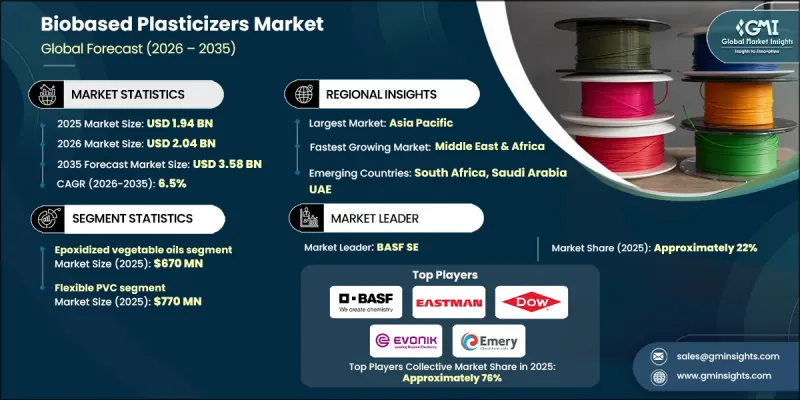
The market is progressing steadily as industries increasingly transition toward renewable and sustainable material solutions. Rising environmental awareness and growing concern over the ecological impact of conventional petroleum-based plasticizers are accelerating the shift toward bio-derived alternatives produced from renewable feedstocks. These materials align closely with corporate sustainability targets and circular economy frameworks, making them attractive across manufacturing and consumer-facing industries. Demand is strengthening throughout multiple value chains as companies prioritize long-term material safety, regulatory compliance, and environmental responsibility. The market outlook is further supported by consistent investments in green chemistry, improved processing efficiency, and broader acceptance of renewable additives across industrial applications. Growth remains structured and compliance-driven, supported by evolving material standards and sustainability-focused procurement strategies across developed and emerging economies.
| Market Scope | |
|---|---|
| Start Year | 2025 |
| Forecast Year | 2026-2035 |
| Start Value | $1.94 Billion |
| Forecast Value | $3.58 Billion |
| CAGR | 6.5% |
Regulatory pressure continues to play a significant role in market expansion. Governments and oversight bodies across global regions are tightening restrictions on conventional plasticizers due to health and environmental concerns. These policy shifts are compelling manufacturers to reformulate products using non-toxic biobased alternatives, directly translating regulatory compliance into higher adoption levels and stable long-term demand.
The epoxidized vegetable oils segment reached USD 0.67 billion in 2025 and is projected to grow at a CAGR of 6.2% from 2026 to 2035. Product-level growth is driven by increasing alignment between performance requirements and biobased formulations. Manufacturers are advancing the use of vegetable oil-based, citrate-based, castor oil-derived, and succinic acid-derived plasticizers as part of a broader move toward renewable inputs with consistent availability and reliable functionality, strengthening demand across industrial segments.
The flexible PVC segment generated USD 0.77 billion in 2025 and held a share of 39.7%, with an anticipated CAGR of 6.3% through 2035. This segment represents the largest area of consumption for biobased plasticizers, supported by rising sustainability standards and evolving regulatory expectations. Application-driven demand continues to expand as manufacturers integrate compliant and environmentally aligned plasticizer solutions into flexible material production.
North America Biobased Plasticizers Market generated USD 0.35 billion in 2025 and is expected to experience steady growth over the forecast timeline. Regional demand is supported by gradual but consistent adoption across industrial sectors, emphasizing sustainability integration. The United States contributes through higher regulatory awareness and demand for compliant flexible materials, while Mexico supports growth through expanding manufacturing capacity and export-oriented production. Market development in the region remains innovation-led and aligned with circular material strategies, resulting in measured and compliance-focused expansion.
Key participants in the Global Biobased Plasticizers Market include Dow Chemical, BASF SE, Emery Oleochemicals, Evonik Industries, Eastman Chemical, and other established manufacturers. Companies operating in the biobased plasticizers market are reinforcing their competitive position through product innovation, capacity expansion, and strategic sourcing of renewable raw materials. Many players are investing in advanced formulation technologies to improve performance consistency while maintaining sustainability credentials. Long-term supply agreements and backward integration into bio-based feedstocks are helping stabilize input costs and ensure supply reliability. Firms are also strengthening partnerships with downstream manufacturers to co-develop application-specific solutions.
Table of Contents
Chapter 1 Methodology
- 1.1 Market scope and definition
- 1.2 Research design
- 1.2.1 Research approach
- 1.2.2 Data collection methods
- 1.3 Data mining sources
- 1.3.1 Global
- 1.3.2 Regional/Country
- 1.4 Base estimates and calculations
- 1.4.1 Base year calculation
- 1.4.2 Key trends for market estimation
- 1.5 Primary research and validation
- 1.5.1 Primary sources
- 1.6 Forecast model
- 1.7 Research assumptions and limitations
Chapter 2 Executive Summary
- 2.1 Industry 360° synopsis
- 2.2 Key market trends
- 2.2.1 Regional
- 2.2.2 Product Type
- 2.2.3 Grade
- 2.2.4 Bio-Based Content
- 2.2.5 Application
- 2.3 TAM Analysis, 2026-2035
- 2.4 CXO perspectives: Strategic imperatives
- 2.4.1 Executive decision points
- 2.4.2 Critical success factors
- 2.5 Future Outlook and Strategic Recommendations
Chapter 3 Industry Insights
- 3.1 Industry ecosystem analysis
- 3.1.1 Supplier Landscape
- 3.1.2 Profit Margin
- 3.1.3 Value addition at each stage
- 3.1.4 Factor affecting the value chain
- 3.1.5 Disruptions
- 3.2 Industry impact forces
- 3.2.1 Growth drivers
- 3.2.2 Industry pitfalls and challenges
- 3.2.3 Market opportunities
- 3.3 Growth potential analysis
- 3.4 Regulatory landscape
- 3.4.1 North America
- 3.4.2 Europe
- 3.4.3 Asia Pacific
- 3.4.4 Latin America
- 3.4.5 Middle East & Africa
- 3.5 Porter's analysis
- 3.6 PESTEL analysis
- 3.7 Price trends
- 3.7.1 By region
- 3.7.2 By product
- 3.8 Future market trends
- 3.9 Technology and Innovation landscape
- 3.9.1 Current technological trends
- 3.9.2 Emerging technologies
- 3.10 Patent Landscape
- 3.11 Trade statistics (Note: the trade statistics will be provided for key countries only)
- 3.11.1 Major importing countries
- 3.11.2 Major exporting countries
- 3.12 Sustainability and Environmental Aspects
- 3.12.1 Sustainable Practices
- 3.12.2 Waste Reduction Strategies
- 3.12.3 Energy Efficiency in Production
- 3.12.4 Eco-friendly Initiatives
- 3.13 Carbon Footprint Considerations
Chapter 4 Competitive Landscape, 2025
- 4.1 Introduction
- 4.2 Company market share analysis
- 4.2.1 By region
- 4.2.1.1 North America
- 4.2.1.2 Europe
- 4.2.1.3 Asia Pacific
- 4.2.1.4 LATAM
- 4.2.1.5 MEA
- 4.2.1 By region
- 4.3 Company matrix analysis
- 4.4 Competitive analysis of major market players
- 4.5 Competitive positioning matrix
- 4.6 Key developments
- 4.6.1 Mergers & acquisitions
- 4.6.2 Partnerships & collaborations
- 4.6.3 New Product Launches
- 4.6.4 Expansion Plans
Chapter 5 Market Estimates and Forecast, By Product Type, 2022- 2035 (USD Billion, Kilo Tons)
- 5.1 Key trends
- 5.2 Epoxidized Vegetable Oils
- 5.2.1 Epoxidized Soybean Oil (ESBO/ESO)
- 5.2.2 Epoxidized Linseed Oil
- 5.2.3 Other Epoxidized Vegetable Oils
- 5.3 Citrate Esters
- 5.3.1 Tributyl Citrate (TBC)
- 5.3.2 Acetyl Tributyl Citrate (ATBC)
- 5.3.3 Other Citrate Esters
- 5.4 Castor Oil-Based Plasticizers
- 5.5 Succinic Acid-Based Plasticizers
- 5.6 Adipates & Sebacates
- 5.7 Glycerol-Based Plasticizers
- 5.7.1 Glycerin/Glycerol
- 5.7.2 Glycerin Acetate
- 5.8 Polymeric Bio-Based Plasticizers
- 5.9 Others
Chapter 6 Market Estimates and Forecast, By Grade, 2022 - 2035 (USD Billion, Kilo Tons)
- 6.1 Key trends
- 6.2 Food Grade
- 6.3 Medical Grade
- 6.4 Industrial Grade
- 6.5 Technical Grade
- 6.6 Others
Chapter 7 Market Estimates and Forecast, By Bio-Based Content, 2022 - 2035 (USD Billion, Kilo Tons)
- 7.1 Key trends
- 7.2 100% Bio-Based
- 7.3 Partially Bio-Based (>50% Bio-Based Content)
- 7.4 Partially Bio-Based (<50% Bio-Based Content)
Chapter 8 Market Estimates and Forecast, By Application, 2022 - 2035 (USD Billion, Kilo Tons)
- 8.1 Key trends
- 8.2 Flexible PVC
- 8.3 Packaging Materials
- 8.3.1 Food & Beverage Packaging
- 8.3.2 Consumer Goods Packaging
- 8.3.3 Compostable & Biodegradable Packaging
- 8.4 Wire & Cables
- 8.5 Flooring, Roofing & Wall Coverings
- 8.6 Automotive & Transportation
- 8.6.1 Interior Trim & Dashboard Films
- 8.6.2 Under-Hood Components
- 8.6.3 Seals & Gaskets
- 8.7 Coatings, Adhesives & Sealants
- 8.8 Others
Chapter 9 Market Estimates and Forecast, By Region, 2022 - 2035 (USD Billion, Kilo Tons)
- 9.1 Key trends
- 9.2 North America
- 9.2.1 U.S.
- 9.2.2 Canada
- 9.3 Europe
- 9.3.1 Germany
- 9.3.2 UK
- 9.3.3 France
- 9.3.4 Italy
- 9.3.5 Spain
- 9.3.6 Rest of Europe
- 9.4 Asia Pacific
- 9.4.1 China
- 9.4.2 India
- 9.4.3 Japan
- 9.4.4 Australia
- 9.4.5 South Korea
- 9.4.6 Rest of Asia Pacific
- 9.5 Latin America
- 9.5.1 Brazil
- 9.5.2 Mexico
- 9.5.3 Argentina
- 9.5.4 Rest of Latin America
- 9.6 Middle East & Africa
- 9.6.1 Saudi Arabia
- 9.6.2 South Africa
- 9.6.3 UAE
- 9.6.4 Rest of Middle East & Africa
Chapter 10 Company Profiles
- 10.1 Avient Corporation
- 10.2 BASF SE
- 10.3 Dow Chemical Company
- 10.4 Eastman Chemical Company
- 10.5 Emery Oleochemicals
- 10.6 Evonik Industries AG
- 10.7 Jungbunzlauer Suisse AG
- 10.8 LANXESS AG
- 10.9 Matrica S.p.A.
- 10.10 OXEA GmbH
- 10.11 Valtris Specialty Chemicals
- 10.12 Zhejiang Jiaao Enprotech


