
|
시장보고서
상품코드
1959599
산업용 이더넷 시장 기회, 성장요인, 업계 동향 분석 및 예측(2026-2035년)Industrial Ethernet Market Opportunity, Growth Drivers, Industry Trend Analysis, and Forecast 2026 - 2035 |
||||||

세계의 산업용 이더넷 시장은 2025년에 98억 달러로 평가되었고, 2035년까지 연평균 복합 성장률(CAGR) 7.9%로 성장하여 208억 달러에 이를 것으로 예측됩니다.
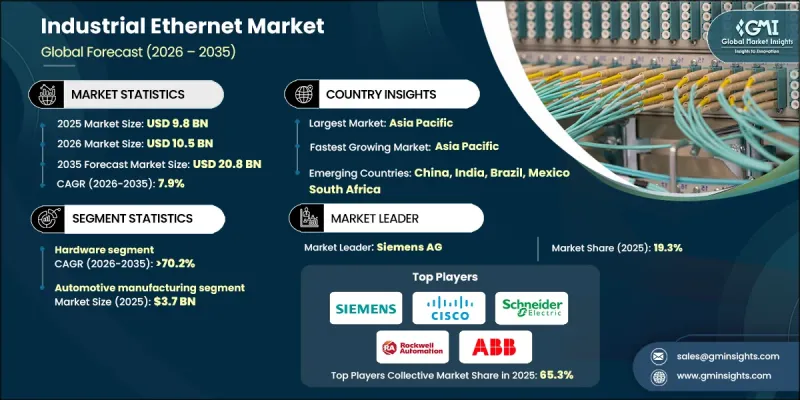
산업용 이더넷은 표준 이더넷 기술을 기반으로 하면서도 산업 환경의 까다로운 요구 사항에 적응하여 기계, 제어 장치, 센서 간의 고속, 안전하고 안정적인 통신을 실현합니다. 스마트 제조 및 산업 자동화의 확대는 생산 효율을 최적화하고 장비 성능을 모니터링하기 위해 제조업체들이 원활한 실시간 데이터 교환을 요구하면서 수요를 주도하고 있습니다. 산업용 사물인터넷(IIoT)의 보급도 도입을 더욱 촉진하고 있습니다. 센서, 장치, 기계는 예지보전, 자동화 프로세스, 프로세스 모니터링을 지원하기 위해 저지연, 고처리량 네트워크가 필요하기 때문입니다. 산업용 이더넷은 여러 장치 간 끊김 없는 통신을 가능하게 하여 운영 연속성을 보장하고, 다운타임을 줄이며, 데이터 무결성을 향상시킵니다. 이는 자동차, 항공우주, 제약, 에너지, 공정 제조 등 현대 산업 운영에서 매우 중요합니다. 디지털 전환 노력 증가, 스마트 팩토리에 대한 투자, 확장 가능하고 안전한 네트워크 인프라의 필요성, 이 모든 것이 지속적인 시장 성장에 기여하고 있습니다.
| 시장 범위 | |
|---|---|
| 개시 연도 | 2025년 |
| 예측 연도 | 2026-2035년 |
| 개시 연도 가치 | 98억 달러 |
| 예측 금액 | 208억 달러 |
| CAGR | 7.9% |
하드웨어 부문은 2025년 70.2%의 점유율을 차지했습니다. 이 부문은 산업용 스위치, 라우터, 네트워크 인터페이스 카드(NIC)와 같은 산업용 이더넷 장치에 대한 수요 증가의 혜택을 누리고 있습니다. 이 장치는 복잡한 산업 네트워크에서 안전하고 빠른 통신을 보장하고 제조, 에너지, 운송, 공정 자동화 용도에서 실시간 데이터 전송을 가능하게 합니다. 각 제조업체들은 고신뢰성, 완벽한 통합성, 강력한 보안 기능을 갖춘 하드웨어를 제공하는 데 주력하여 핵심 업무를 지원하고 있습니다. 처리량 향상, 지연 감소, 내구성 강화를 실현한 차세대 스위치, 라우터, NIC의 개발로 기업들은 시장 점유율을 확대하는 동시에 효율적이고 안정적인 네트워크 인프라를 원하는 산업 고객 증가하는 운영 요구에 대응할 수 있게 되었습니다.
제약 및 생명공학 분야는 2035년까지 연평균 복합 성장률(CAGR) 10.3%로 성장하여 19억 달러 규모에 달할 것으로 예측됩니다. 이 분야는 자동화, 스마트 제조, 엄격한 규제 준수를 지원하기 위해 산업용 이더넷의 도입이 빠르게 진행되고 있습니다. 산업용 이더넷은 전체 생산 수명주기 동안 정밀한 공정 제어, 데이터 무결성, 모니터링을 위한 안전한 실시간 통신을 실현합니다. 실험실 시스템과 생산 업무를 연결함으로써 기업은 업무 효율성 향상, 규제 준수 유지, 효율적인 품질 관리를 촉진할 수 있습니다. 생산의 모든 단계에서 중요한 데이터를 즉시 전송할 수 있는 능력과 실험실 시스템과 제조 시스템의 원활한 통합을 보장하는 것이 도입을 촉진하고 있으며, 제조업체는 고도로 통제된 산업 환경에서 업무의 신뢰성, 제품의 일관성, 규제 준수를 우선시하고 있습니다.
미국 산업용 이더넷 시장은 산업용 네트워크 인프라에 대한 투자 증가, 첨단 이더넷 솔루션의 급속한 보급, 스마트 제조 및 디지털 전환에 대한 수요 증가에 힘입어 2025년 24억 달러 규모에 이를 것으로 전망됩니다. 지속적인 기술 혁신과 시장 통합으로 경쟁력이 강화되고 산업용 이더넷 솔루션의 도입이 가속화되고 있습니다. 제조업체와 최종 사용자는 현대 산업 운영에 필수적인 대용량, 저지연 통신 및 예측 분석을 지원하기 위해 네트워크 인프라를 업그레이드하는 데 주력하고 있습니다. 북미의 성숙한 제조거점과 산업용 사물인터넷(IIoT) 및 자동화 기술의 강력한 산업 채택이 결합되어 이 지역은 산업용 이더넷 확장의 주요 원동력이 되고 있습니다.
자주 묻는 질문
목차
제1장 조사 방법과 범위
제2장 주요 요약
제3장 업계 인사이트
제4장 경쟁 구도
제5장 산업용 이더넷 시장 추산 및 예측 제공 형태별, 2022-2035
제6장 시장 추산 및 예측 : 최종 이용 산업별, 2022-2035
제7장 산업용 이더넷 시장 추산 및 예측 : 지역별, 2022-2035
제8장 기업 개요
LSH 26.03.16The Global Industrial Ethernet Market was valued at USD 9.8 billion in 2025 and is estimated to grow at a CAGR of 7.9% to reach USD 20.8 billion by 2035.
Industrial Ethernet leverages standard Ethernet technology while adapting it to the rigorous demands of industrial environments, providing high-speed, secure, and reliable communication between machines, controllers, and sensors. The expansion of smart manufacturing and industrial automation is fueling demand, as manufacturers seek seamless real-time data exchange to optimize production efficiency and monitor equipment performance. The proliferation of the Industrial Internet of Things (IIoT) further drives adoption, as sensors, devices, and machines require low-latency, high-throughput networks to support predictive maintenance, automated processes, and process monitoring. Industrial Ethernet enables uninterrupted communication across multiple devices, ensuring operational continuity, reduced downtime, and enhanced data integrity, which is critical for modern industrial operations spanning automotive, aerospace, pharmaceuticals, energy, and process manufacturing sectors. Increased digital transformation initiatives, investment in smart factories, and the need for scalable and secure network infrastructure are all contributing to sustained market growth.
| Market Scope | |
|---|---|
| Start Year | 2025 |
| Forecast Year | 2026-2035 |
| Start Value | $9.8 Billion |
| Forecast Value | $20.8 Billion |
| CAGR | 7.9% |
The hardware segment held 70.2% share in 2025. This segment benefits from the rising demand for industrial Ethernet devices such as industrial-grade switches, routers, and network interface cards (NICs). These devices ensure secure, high-speed communication across complex industrial networks, enabling real-time data transfer in manufacturing, energy, transportation, and process automation applications. Manufacturers are focusing on delivering hardware that combines high reliability, seamless integration, and robust security features to support critical operations. The development of next-generation switches, routers, and NICs with improved throughput, reduced latency, and enhanced durability allows companies to capture more market share while meeting the growing operational needs of industrial clients seeking efficient and reliable network infrastructure.
The pharmaceutical and biotechnology segment is projected to grow at a CAGR of 10.3%, reaching USD 1.9 billion by 2035. The sector is increasingly adopting Industrial Ethernet to support automation, smart manufacturing, and stringent regulatory compliance. Industrial Ethernet enables secure, real-time communication for precise process control, data integrity, and monitoring throughout the production lifecycle. By connecting laboratory systems with production operations, companies can enhance operational efficiency, maintain regulatory adherence, and facilitate streamlined quality management. The ability to transmit critical data instantaneously across all stages of production and ensure seamless integration of lab and manufacturing systems is driving adoption, as manufacturers prioritize operational reliability, product consistency, and regulatory compliance in highly controlled industrial environments.
U.S. Industrial Ethernet Market was valued at USD 2.4 billion in 2025, supported by increasing investment in industrial networking infrastructure, rapid adoption of advanced Ethernet solutions, and growing demand for smart manufacturing and digital transformation. Continuous technological innovation and market consolidation are enhancing competitiveness and accelerating the deployment of Industrial Ethernet solutions. Manufacturers and end users are increasingly focused on upgrading their network infrastructure to support high-volume, low-latency communication and predictive analytics, which are essential for modern industrial operations. North America's mature manufacturing base, coupled with strong industry adoption of IIoT and automation technologies, positions the region as a primary driver of industrial Ethernet expansion.
Prominent participants operating in the Global Industrial Ethernet Market include Belden Inc., ABB Ltd., Red Lion Controls, Inc., Advantech Co., Ltd., Phoenix Contact GmbH & Co. KG, Siemens AG, Rockwell Automation, Inc., OMRON Corporation, Moxa Technologies, Hirschmann Automation and Control, B&R Industrial Automation, Westermo Network Technologies, Weidmuller Interface GmbH & Co. KG, Kyland Technology Co., Ltd., Antaira Technologies, Perle Systems Inc., Bosch Rexroth AG, Schneider Electric SE, Cisco Systems, Inc., and others. Companies in the industrial Ethernet market are employing multiple strategies to strengthen their position and expand market share. Product innovation remains a primary focus, with firms developing high-speed, low-latency switches, routers, NICs, and integrated network solutions that are scalable, secure, and compatible with IIoT and Industry 4.0 frameworks. Strategic partnerships with industrial automation providers and system integrators enable broader adoption across manufacturing and process sectors. Firms are also prioritizing geographic expansion and localized support to meet regional demand efficiently.
Table of Contents
Chapter 1 Methodology and Scope
- 1.1 Market scope and definition
- 1.2 Research design
- 1.2.1 Research approach
- 1.2.2 Data collection methods
- 1.3 Data mining sources
- 1.3.1 Global
- 1.3.2 Regional/Country
- 1.4 Base estimates and calculations
- 1.4.1 Base year calculation
- 1.4.2 Key trends for market estimation
- 1.5 Primary research and validation
- 1.5.1 Primary sources
- 1.6 Forecast model
- 1.7 Research assumptions and limitations
Chapter 2 Executive Summary
- 2.1 Industry snapshot
- 2.2 Key market trends
- 2.2.1 Offering Type trends
- 2.2.2 End-User Industry trends
- 2.2.3 Regional trends
- 2.3 TAM Analysis, 2025-2034 (USD Billion)
- 2.4 CXO perspectives: Strategic imperatives
- 2.4.1 Executive decision points
- 2.4.2 critical success factors
- 2.5 Future outlook and strategic recommendations
Chapter 3 Industry Insights
- 3.1 Industry ecosystem analysis
- 3.1.1 Supplier Landscape
- 3.1.2 Profit Margin
- 3.1.3 Cost structure
- 3.1.4 Value addition at each stage
- 3.1.5 Factor affecting the value chain
- 3.1.6 Disruptions
- 3.2 Industry impact forces
- 3.2.1 Growth drivers
- 3.2.1.1 Rising adoption of industrial automation and smart manufacturing
- 3.2.1.2 Growth of Industrial Internet of Things deployments
- 3.2.1.3 Increasing demand for real-time and deterministic communication
- 3.2.1.4 Expansion of Industry 4.0 initiatives worldwide
- 3.2.1.5 Growing need for high-speed and reliable industrial networking
- 3.2.2 Industry pitfalls and challenges
- 3.2.2.1 High initial investment and installation costs
- 3.2.2.2 Complexity of network design and integration
- 3.2.3 Market opportunities
- 3.2.3.1 Increasing adoption of Time-Sensitive Networking technologies
- 3.2.3.2 Expansion of smart factories and digital twins
- 3.2.1 Growth drivers
- 3.3 Growth potential analysis
- 3.4 Regulatory landscape
- 3.4.1 North America
- 3.4.2 Europe
- 3.4.3 Asia Pacific
- 3.4.4 Latin America
- 3.4.5 Middle East & Africa
- 3.5 Porter’s analysis
- 3.6 PESTEL analysis
- 3.7 Technology and innovation landscape
- 3.7.1 Current technological trends
- 3.7.2 Emerging technologies
- 3.8 Price trends
- 3.8.1 Historical price analysis (2022-2024)
- 3.8.2 Price trend drivers
- 3.8.3 Regional price variations
- 3.8.4 Price forecast (2026-2035)
- 3.9 Pricing strategies
- 3.10 Emerging business models
- 3.11 Compliance requirements
- 3.12 Patent analysis
Chapter 4 Competitive Landscape, 2025
- 4.1 Introduction
- 4.2 Company market share analysis
- 4.2.1 By Region
- 4.2.1.1 North America
- 4.2.1.2 Europe
- 4.2.1.3 Asia Pacific
- 4.2.1.4 Latin America
- 4.2.1.5 Middle East & Africa
- 4.2.2 Market Concentration Analysis
- 4.2.1 By Region
- 4.3 Competitive benchmarking of key players
- 4.3.1 Financial performance comparison
- 4.3.1.1 Revenue
- 4.3.1.2 Profit margin
- 4.3.1.3 R&D
- 4.3.2 Product portfolio comparison
- 4.3.2.1 Product range breadth
- 4.3.2.2 Technology
- 4.3.2.3 Innovation
- 4.3.3 Geographic presence comparison
- 4.3.3.1 Global footprint analysis
- 4.3.3.2 Service network coverage
- 4.3.3.3 Market penetration by region
- 4.3.4 Competitive positioning matrix
- 4.3.4.1 Leaders
- 4.3.4.2 Challengers
- 4.3.4.3 Followers
- 4.3.4.4 Niche players
- 4.3.5 Strategic outlook matrix
- 4.3.1 Financial performance comparison
- 4.4 Key developments, 2022-2025
- 4.4.1 Mergers and acquisitions
- 4.4.2 Partnerships and collaborations
- 4.4.3 Technological advancements
- 4.4.4 Expansion and investment strategies
- 4.4.5 Sustainability initiatives
- 4.4.6 Digital transformation initiatives
- 4.5 Emerging/ startup competitors landscape
Chapter 5 Industrial Ethernet Market Estimates & Forecast, By Offering Type, 2022 - 2035 (USD Million)
- 5.1 Key trends,
- 5.2 Hardware
- 5.2.1 Network Infrastructure
- 5.2.2 Controllers & Edge Devices
- 5.2.2.1 Programmable Logic Controllers (PLCs)
- 5.2.2.2 Programmable Automation Controllers (PACs)
- 5.2.2.3 Industrial IoT Gateways
- 5.2.3 Connectivity Components
- 5.2.3.1 Cables
- 5.2.3.2 Connectors
- 5.2.3.3 Others
- 5.3 Software
- 5.3.1 Control & Monitoring Software
- 5.3.1.1 SCADA Systems
- 5.3.1.2 Human-Machine Interface (HMI)
- 5.3.1.3 Distributed Control Systems (DCS)
- 5.3.1.4 PLC Programming Software
- 5.3.2 Integration & Middleware
- 5.3.2.1 OPC UA Servers/Clients
- 5.3.2.2 Protocol Gateway Software
- 5.3.2.3 Configuration Tools
- 5.3.3 Network Management Software
- 5.3.3.1 Industrial Network Management Systems
- 5.3.3.2 SNMP Managers
- 5.3.3.3 Diagnostic & Troubleshooting Tools
- 5.3.1 Control & Monitoring Software
- 5.4 Services
Chapter 6 Market Estimates and Forecast, By End-Use Industry, 2022 - 2035 (USD Million)
- 6.1 Key trends
- 6.2 Automotive Manufacturing
- 6.3 Semiconductor & Electronics
- 6.4 Pharmaceutical & Biotechnology
- 6.5 Food & Beverage
- 6.6 Oil & Gas
- 6.7 Pulp & Paper
- 6.8 Mining & Metals
- 6.9 Others
Chapter 7 Industrial Ethernet Market Estimates & Forecast, By Region, 2022 - 2035 (USD Million)
- 7.1 Key trends, by region
- 7.2 North America
- 7.2.1 U.S.
- 7.2.2 Canada
- 7.3 Europe
- 7.3.1 UK
- 7.3.2 Germany
- 7.3.3 France
- 7.3.4 Italy
- 7.3.5 Spain
- 7.3.6 Netherlands
- 7.3.7 Rest of Europe
- 7.4 Asia-Pacific
- 7.4.1 China
- 7.4.2 India
- 7.4.3 Japan
- 7.4.4 South Korea
- 7.4.5 Australia
- 7.4.6 Rest of Asia-Pacific
- 7.5 Latin America
- 7.5.1 Brazil
- 7.5.2 Mexico
- 7.5.3 Argentina
- 7.5.4 Rest of Latin America
- 7.6 MEA
- 7.6.1 Saudi Arabia
- 7.6.2 South Africa
- 7.6.3 UAE
- 7.6.4 Rest of MEA
Chapter 8 Company Profiles
- 8.1 ABB Ltd.
- 8.2 Advantech Co., Ltd.
- 8.3 Antaira Technologies
- 8.4 B&R Industrial Automation
- 8.5 Belden Inc.
- 8.6 Bosch Rexroth AG
- 8.7 Cisco Systems, Inc.
- 8.8 Hirschmann Automation and Control
- 8.9 HMS Networks AB
- 8.10 Kyland Technology Co., Ltd.
- 8.11 Moxa Technologies
- 8.12 OMRON Corporation
- 8.13 Perle Systems, Inc.
- 8.14 Phoenix Contact GmbH & Co. KG
- 8.15 Red Lion Controls, Inc.
- 8.16 Rockwell Automation, Inc.
- 8.17 Schneider Electric SE
- 8.18 Siemens AG
- 8.19 Weidmuller Interface GmbH & Co. KG
- 8.20 Westermo Network Technologies