|
시장보고서
상품코드
1959660
특수 화학제품 시장 기회, 성장요인, 업계 동향 분석 및 예측(2026-2035년)Specialty Chemicals Market Opportunity, Growth Drivers, Industry Trend Analysis, and Forecast 2026 - 2035 |
||||||

세계의 특수 화학제품 시장은 2025년에 8,854억 달러로 평가되었고, 2035년까지 연평균 복합 성장률(CAGR) 2.9%로 성장하여 1조 2,000억 달러에 이를 것으로 예측됩니다.
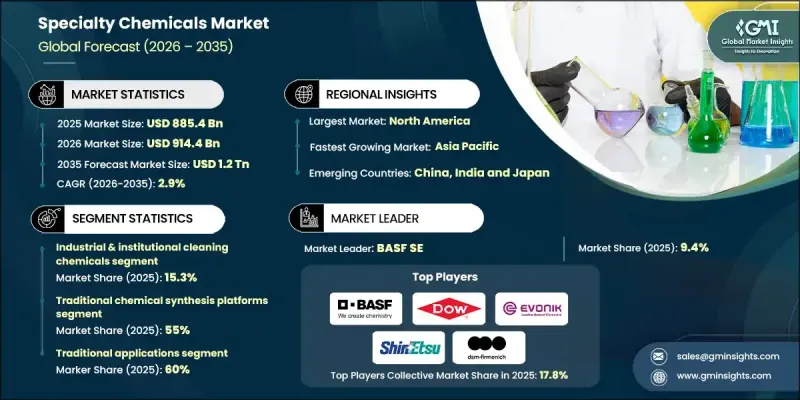
특수화학제품 산업은 다양한 산업분야의 기반산업으로서 경제적 불확실성 속에서도 회복탄력성을 보여주고 있습니다. 이러한 지속적인 성장은 기존 산업과 신기술 모두에 기여하는 고성능 제품과 필수적인 프로세스에 의해 뒷받침되고 있습니다. 시장은 단순한 양적 성장에서 혁신, 지속가능성, 청정에너지 및 디지털 인프라를 위한 특수 솔루션을 원동력으로 삼아 가치 지향적 확장으로 전환하고 있습니다. 고부가가치 용도가 확대되고, 규모보다 효율성, 영향력, 성능을 중시하는 성숙된 시장이 두드러집니다. 전통적인 특수 화학제품이 여전히 주류인 반면, 전기 모빌리티, 첨단 전자제품, 디지털 용도를 위해 설계된 차세대 제품이 빠르게 보급되고 있습니다. 선진 산업 생태계와 엄격한 품질 기준으로 선진 지역이 우위를 유지하는 반면, 아시아태평양을 중심으로 한 신흥 시장에서는 산업화, 기술 도입, 제조 능력의 확대로 빠른 성장을 보이고 있습니다.
| 시장 범위 | |
|---|---|
| 개시 연도 | 2025년 |
| 예측 연도 | 2026-2035년 |
| 개시 연도 가치 | 8,854억 달러 |
| 예측 금액 | 1조 2,000억 달러 |
| CAGR | 2.9% |
산업 및 시설용 세정제 부문은 2025년 15.3%의 점유율을 차지할 것으로 예상되며, 2035년까지 연평균 복합 성장률(CAGR) 3%를 나타낼 것으로 예측됩니다. 이 부문은 위생 관리가 매우 중요한 의료, 호텔, 식품 가공, 산업 시설 등에서 고성능 세척 솔루션에 대한 수요가 증가함에 따라 수혜를 받고 있습니다. 배합 기술의 혁신으로 세척 효율을 극대화하고 환경 부하를 최소화하는 데 중점을 두고 있습니다. 지속가능성이 전 세계 기업과 기관의 핵심 요구사항으로 떠오르면서 생분해성 및 친환경 솔루션의 도입이 확대되고 있습니다.
기존 용도 부문은 2025년 60%의 점유율을 차지할 것으로 예상되며, 2035년까지 연평균 2.4%의 성장률을 보일 것으로 전망됩니다. 건설, 자동차, 소비재, 산업 가공 등의 산업에서 이러한 용도는 안정적인 공급망과 안정적인 수익원으로서 기본적인 지위를 유지하고 있습니다. 한편, 전동화, 디지털화, 지속가능성 추세에 따라 고성장 분야에서는 수요 구조가 재편되고 있으며, 첨단 용도 및 혁신적 공정에 특화된 특수화학제품에 대한 기회가 창출되고 있습니다.
북미 특수화학제품 시장은 2025년 50%의 점유율을 차지했습니다. 이 지역의 성장은 잘 구축된 인프라, 높은 수준의 R&D 역량, 그리고 공급업체와 최종 사용자 간의 협력을 통한 고품질, 용도별 제품 생산으로 뒷받침되고 있습니다. 디지털화 및 지속 가능한 관행은 북미 제조업체의 중요한 차별화 요소이며, 고부가가치 특수 화학제품의 혁신을 가능하게 하는 요소입니다. 청정 기술에 대한 투자와 진화하는 소비자 니즈는 지역 전반에 걸쳐 고성능의 친환경 화학 솔루션에 대한 기회를 지속적으로 창출하고 있습니다.
자주 묻는 질문
목차
제1장 조사 방법과 범위
제2장 주요 요약
제3장 업계 인사이트
제4장 경쟁 구도
제5장 시장 추산 및 예측 : 제품별, 2022-2035
제6장 시장 추산 및 예측 : 기술별, 2022-2035
제7장 시장 추산 및 예측 : 용도별, 2022-2035
제8장 시장 추산 및 예측 : 지역별, 2022-2035
제9장 기업 개요
LSH 26.03.16The Global Specialty Chemicals Market was valued at USD 885.4 billion in 2025 and is estimated to grow at a CAGR of 2.9% to reach USD 1.2 trillion by 2035.
The specialty chemicals industry remains a cornerstone for a vast range of industrial applications, demonstrating resilience even amid economic uncertainties. Its sustained performance is driven by high-performance products and indispensable processes that serve traditional industries and emerging technologies alike. The market is transitioning from growth based solely on volume to value-oriented expansion, fueled by innovations in technology, sustainability, and specialty solutions for clean energy and digital infrastructure. High-value applications are expanding, highlighting a maturing market that emphasizes efficiency, impact, and performance over scale. Conventional specialty chemicals still dominate, yet next-generation products designed for electric mobility, advanced electronics, and digital applications are rapidly gaining traction. Developed regions retain dominance due to advanced industrial ecosystems and rigorous quality standards, while emerging markets, particularly in Asia Pacific, are growing rapidly due to industrialization, technology adoption, and expanding manufacturing capabilities.
| Market Scope | |
|---|---|
| Start Year | 2025 |
| Forecast Year | 2026-2035 |
| Start Value | $885.4 Billion |
| Forecast Value | $1.2 Trillion |
| CAGR | 2.9% |
The industrial and institutional cleaning chemicals segment held 15.3% in 2025 and is projected to grow at a CAGR of 3% by 2035. This segment benefits from rising demand for high-performance cleaning solutions across healthcare, hospitality, food processing, and industrial facilities, where hygiene and sanitation are critical. Innovation in formulations emphasizes maximizing cleaning efficiency while minimizing environmental impact. Biodegradable and eco-friendly solutions are increasingly adopted as sustainability becomes a core requirement for enterprises and institutions globally.
The traditional applications segment accounted for 60% share in 2025 and is expected to grow at a CAGR of 2.4% by 2035. These applications remain fundamental across industries such as construction, automotive, consumer goods, and industrial processing, offering stable supply chains and reliable revenues. At the same time, high-growth sectors driven by electrification, digitalization, and sustainability trends are reshaping demand patterns, creating opportunities for specialty chemicals tailored to advanced applications and innovative processes.
North America Specialty Chemicals Market held a 50% share in 2025. Growth in this region is fueled by well-developed infrastructure, advanced R&D capabilities, and collaboration between suppliers and end-users to create premium, application-specific products. Digitalization and sustainable practices are key differentiators for North American manufacturers, enabling innovation in high-value specialty chemicals. Investments in clean technologies and evolving consumer demands continue to unlock opportunities for high-performance, environmentally responsible chemical solutions across the region.
Major players in the Global Specialty Chemicals Market include Arkema S.A., BASF SE, Clariant AG, Covestro AG, Croda International, Dow Inc., DSM Firmenich, Eastman Chemical Company, Evonik Industries, Huntsman Corporation, Indovinya, Lanxess AG, LG Chem, Mitsubishi Chemical Group, Mitsui Chemicals, Nouryon, Shin Etsu Chemical, Solstice Advanced Materials, Solvay S.A., Sumitomo Chemical, and Wacker Chemie AG. Companies in the specialty chemicals market strengthen their foothold through technological innovation, strategic collaborations, and geographic expansion. They invest in advanced R&D to develop high-performance, application-specific solutions while prioritizing sustainability and regulatory compliance. Partnerships with industrial and technology leaders accelerate product adoption across emerging applications such as digital infrastructure, clean energy, and electrified mobility. Expanding production and distribution networks globally ensures faster delivery and competitive pricing. Differentiation through specialized products, eco-friendly formulations, and digital-enabled solutions enhances brand value.
Table of Contents
Chapter 1 Methodology & Scope
- 1.1 Market scope and definition
- 1.2 Research design
- 1.2.1 Research approach
- 1.2.2 Data collection methods
- 1.3 Data mining sources
- 1.3.1 Global
- 1.3.2 Regional/Country
- 1.4 Base estimates and calculations
- 1.4.1 Base year calculation
- 1.4.2 Key trends for market estimation
- 1.5 Primary research and validation
- 1.5.1 Primary sources
- 1.6 Forecast model
- 1.7 Research assumptions and limitations
Chapter 2 Executive Summary
- 2.1 Industry 360° synopsis
- 2.2 Key market trends
- 2.2.1 Regional
- 2.2.2 Product type
- 2.2.3 Technology
- 2.2.4 Application
- 2.3 TAM Analysis, 2026-2035
- 2.4 CXO perspectives: Strategic imperatives
- 2.4.1 Executive decision points
- 2.4.2 Critical success factors
- 2.5 Future Outlook and Strategic Recommendations
Chapter 3 Industry Insights
- 3.1 Industry ecosystem analysis
- 3.1.1 Supplier landscape
- 3.1.2 Profit margin
- 3.1.3 Value addition at each stage
- 3.1.4 Factor affecting the value chain
- 3.1.5 Disruptions
- 3.2 Industry impact forces
- 3.2.1 Growth drivers
- 3.2.1.1 Electric vehicle revolution driving battery chemistry demand
- 3.2.1.2 Renewable energy expansion requiring advanced materials
- 3.2.1.3 Digital infrastructure growth demanding electronic chemicals
- 3.2.2 Industry pitfalls and challenges
- 3.2.2.1 Raw material price volatility & feedstock dependencies
- 3.2.2.2 Stringent environmental regulations increasing compliance costs
- 3.2.3 Market opportunities
- 3.2.3.1 Ai-driven chemical discovery reducing development time by 50%
- 3.2.3.2 Energy transition creating demand for specialized electrolyzer components
- 3.2.1 Growth drivers
- 3.3 Growth potential analysis
- 3.4 Regulatory landscape
- 3.4.1 North America
- 3.4.2 Europe
- 3.4.3 Asia Pacific
- 3.4.4 Latin America
- 3.4.5 Middle East & Africa
- 3.5 Porter’s analysis
- 3.6 PESTEL analysis
- 3.7 Price trends
- 3.7.1 By region
- 3.7.2 By product
- 3.8 Future market trends
- 3.9 Technology and Innovation landscape
- 3.9.1 Current technological trends
- 3.9.2 Emerging technologies
- 3.10 Patent Landscape
- 3.11 Trade statistics (HS code)( Note: the trade statistics will be provided for key countries only)
- 3.11.1 Major importing countries
- 3.11.2 Major exporting countries
- 3.12 Sustainability and environmental aspects
- 3.12.1 Sustainable practices
- 3.12.2 Waste reduction strategies
- 3.12.3 Energy efficiency in production
- 3.12.4 Eco-friendly initiatives
- 3.13 Carbon footprint consideration
Chapter 4 Competitive Landscape, 2025
- 4.1 Introduction
- 4.2 Company market share analysis
- 4.2.1 By region
- 4.2.1.1 North America
- 4.2.1.2 Europe
- 4.2.1.3 Asia Pacific
- 4.2.1.4 LATAM
- 4.2.1.5 MEA
- 4.2.1 By region
- 4.3 Company matrix analysis
- 4.4 Competitive analysis of major market players
- 4.5 Competitive positioning matrix
- 4.6 Key developments
- 4.6.1 Mergers & acquisitions
- 4.6.2 Partnerships & collaborations
- 4.6.3 New product launches
- 4.6.4 Expansion plans
Chapter 5 Market Estimates and Forecast, By Product, 2022-2035 (USD Billion) (Kilo Tons)
- 5.1 Key trends
- 5.2 Agrochemicals
- 5.2.1 Herbicides
- 5.2.2 Pesticides
- 5.2.3 Fungicides
- 5.2.4 Growth regulators
- 5.2.5 Others
- 5.3 Water treatment chemicals
- 5.3.1 Corrosion inhibitors
- 5.3.2 Scale inhibitors
- 5.3.3 Biocides
- 5.3.4 Others
- 5.4 Oil-field chemicals
- 5.4.1 Lubricants & friction reducers
- 5.4.2 Rheology modifiers
- 5.4.3 Biocides
- 5.4.4 Surfactants
- 5.4.5 Inhibitors & scavengers
- 5.4.6 Demulsifiers
- 5.4.7 Gellants & Viscosifiers
- 5.4.8 Pour-point Depressants
- 5.4.9 Viscosity modifiers
- 5.4.10 Others
- 5.5 Construction chemicals
- 5.5.1 Asphalt modifiers
- 5.5.2 Concrete admixtures
- 5.5.3 Adhesives
- 5.5.4 Sealants
- 5.5.5 Protective coatings
- 5.5.6 Others
- 5.6 Paper additives
- 5.6.1 Bleaching chemicals
- 5.6.2 Process chemicals
- 5.6.3 Functional chemicals
- 5.6.4 Basic chemicals
- 5.6.5 Rubber processing chemicals
- 5.6.6 Accelerators
- 5.6.7 Antioxidants
- 5.6.8 Antiozonants
- 5.6.9 Retarders
- 5.6.10 Anti-tack agents
- 5.6.11 Flame retardants
- 5.6.12 Others
- 5.7 Industrial & Institutional Cleaning Chemicals
- 5.7.1 Chlor-alkali based chemicals
- 5.7.2 Surfactants
- 5.7.3 Solvents
- 5.7.4 Others
- 5.8 Refinery and pipeline chemicals
- 5.8.1 Corrosion inhibitors
- 5.8.2 Antioxidants
- 5.8.3 Pour point depressants
- 5.8.4 Lubricants
- 5.8.5 Emulsifiers
- 5.8.6 Antifouling agents
- 5.8.7 Others
- 5.9 Plastic additives
- 5.9.1 Plasticizers
- 5.9.2 Stabilizers
- 5.9.3 Flame retardants
- 5.9.4 Impact modifiers
- 5.9.5 Lubricants
- 5.9.6 Others
- 5.10 Paints & coatings additives
- 5.10.1 Wetting and dispersing
- 5.10.2 Flow additives
- 5.10.3 Defoaming
- 5.10.4 Rheology modifier
- 5.10.5 Coalescents
- 5.10.6 Biocide
- 5.10.7 Rust Inhibitor
- 5.10.8 Others
- 5.11 Others
Chapter 6 Market Estimates and Forecast, By Technology, 2022-2035 (USD Billion) (Kilo Tons)
- 6.1 Key trends
- 6.2 Traditional chemical synthesis platforms
- 6.3 Bio-based production technologies
- 6.4 Advanced manufacturing platforms
- 6.5 Circular chemistry technologies
Chapter 7 Market Estimates and Forecast, By Application, 2022-2035 (USD Billion) (Kilo Tons)
- 7.1 Key trends
- 7.2 Traditional applications
- 7.2.1 Agriculture & crop protection
- 7.2.2 Construction & infrastructure
- 7.2.3 Automotive manufacturing & aftermarket
- 7.2.4 Electronics & consumer devices
- 7.2.5 Personal care & cosmetics
- 7.3 High-growth applications
- 7.3.1 Electric vehicles & battery systems
- 7.3.2 Renewable energy infrastructure
- 7.3.3 Water treatment & management systems
- 7.3.4 Healthcare & medical device applications
- 7.3.5 Food & beverage processing
- 7.3.6 Aerospace & defense technologies
- 7.3.7 Digital infrastructure & data centers
Chapter 8 Market Estimates and Forecast, By Region, 2022-2035 (USD Billion) (Kilo Tons)
- 8.1 Key trends
- 8.2 North America
- 8.2.1 U.S.
- 8.2.2 Canada
- 8.3 Europe
- 8.3.1 Germany
- 8.3.2 UK
- 8.3.3 France
- 8.3.4 Spain
- 8.3.5 Italy
- 8.3.6 Rest of Europe
- 8.4 Asia Pacific
- 8.4.1 China
- 8.4.2 India
- 8.4.3 Japan
- 8.4.4 Australia
- 8.4.5 South Korea
- 8.4.6 Rest of Asia Pacific
- 8.5 Latin America
- 8.5.1 Brazil
- 8.5.2 Mexico
- 8.5.3 Argentina
- 8.5.4 Rest of Latin America
- 8.6 Middle East and Africa
- 8.6.1 Saudi Arabia
- 8.6.2 South Africa
- 8.6.3 UAE
- 8.6.4 Rest of Middle East and Africa
Chapter 9 Company Profiles
- 9.1 BASF SE
- 9.2 Arkema S.A.
- 9.3 Asahi Kasei Corporation
- 9.4 Clariant AG
- 9.5 Covestro AG
- 9.6 Croda International
- 9.7 Dow Inc.
- 9.8 DSM-Firmenich
- 9.9 Eastman Chemical Company
- 9.10 Evonik Industries
- 9.11 Huntsman Corporation
- 9.12 Indovinya
- 9.13 Lanxess AG
- 9.14 LG Chem
- 9.15 Mitsubishi Chemical Group
- 9.16 Mitsui Chemicals
- 9.17 Nouryon
- 9.18 Shin-Etsu Chemical
- 9.19 Solstice Advanced Materials
- 9.20 Solvay S.A.
- 9.21 Sumitomo Chemical
- 9.22 Wacker Chemie AG