

|
시장보고서
상품코드
1982321
여성형 유방 수술 시장 기회, 성장 촉진요인, 업계 동향 분석 및 예측(2026-2035년)Gynecomastia Procedures Market Opportunity, Growth Drivers, Industry Trend Analysis, and Forecast 2026 - 2035 |
||||||

세계의 여성형 유방 수술 시장은 2025년에 10억 달러로 평가되었으며, CAGR 8.6%로 성장하여 2035년까지 23억 달러에 달할 것으로 추정됩니다.
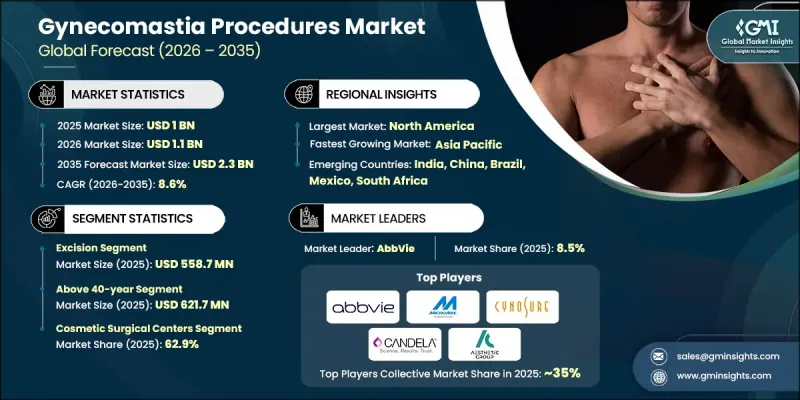
시장 모멘텀은 비만의 증가, 호르몬 이상을 경험하는 남성 인구의 증가, 수술 기술의 지속적인 기술 혁신에 의해 뒷받침되고 있습니다. 체지방률의 증가는 내분비 교란과 밀접한 관련이 있으며, 특히 지방조직의 대사에 의한 에스트로겐 활성의 증가는 여성형 유방의 발생 확률을 현저하게 증가시킵니다. 또한, 가슴 부위의 과도한 지방 축적은 종종 환자들이 의학적, 미용적 개선을 위해 교정 수술을 찾는 요인이 되기도 합니다. 비만 부담의 확대, 인식의 증가, 진단율의 향상, 그리고 남성 미용 수술에 대한 사회적 수용의 확대가 결합되어 전 세계적으로 지속적인 수술 수요를 창출하고 있습니다. 최소침습적 기술의 발전과 수술 정확도의 향상으로 주요 시장 전반에 걸쳐 환자들의 신뢰와 장기적인 치료의 정착이 더욱 강화되고 있습니다.
| 시장 범위 | |
|---|---|
| 시작 연도 | 2025년 |
| 예측 기간 | 2026-2035년 |
| 개시시 시장 규모 | 10억 달러 |
| 예측 금액 | 23억 달러 |
| CAGR | 8.6% |
시술 유형별로 보면 시장은 지방흡입과 절제술로 분류되며, 절제술 부문은 2025년 5억 5,870만 달러로 큰 비중을 차지했습니다. 절제술은 신중하게 배치된 절개 부위를 통해 유선조직을 정확하게 절제하는 것으로, 지방제거술만으로는 대처할 수 없는 고밀도 조직의 경우 효과적인 교정이 가능합니다. 이 방법은 신뢰할 수 있는 윤곽 성형 결과를 제공하며, 특히 중등도에서 중증의 경우에 적합합니다. 임상적 효과와 영구적인 조직 제거 능력으로 인해 외과 진료 현장에서의 채택이 지속적으로 확대되고 있습니다.
최종 용도별로는 미용 수술 센터 부문이 2025년 62.9%의 점유율을 차지했습니다. 이들 시설은 선택적 미용 수술을 제공하기 위해 특별히 구성되었으며, 남성 유방 축소술에 특화된 전문 지식, 첨단 장비, 숙련된 수술 팀을 갖추고 있습니다. 높은 운영 효율성이 더 많은 환자 수용과 일관된 치료 결과를 뒷받침하고 있습니다. 병원 환경과 비교했을 때, 성형외과 센터는 일반적으로 더 짧은 예약 대기 시간, 경쟁력 있는 가격 체계, 그리고 효율적인 진료 제공 모델을 제공합니다. 이러한 장점은 여성형 유방 교정을 원하는 사람들 중 대다수를 차지하는 자비 부담 환자들에게 매우 매력적입니다.
지역별로는 2025년 북미가 세계 여성형 유방 수술 시장 점유율의 40.5% 이상을 차지했습니다. 미국 시장에서의 성장은 주로 높은 비만 유병률과 여성형 유방이 치료 가능한 의학적, 미용적 문제로 인식되고 있는 것에 힘입은 바 큽니다. 교육 활동 확대, 상담 기회 확대, 디지털 헬스 참여로 인해 더 많은 남성들이 전문적인 치료를 받고 있습니다. 남성의 건강과 외모에 대한 인식의 변화가 이 지역 전체에서 시술 건수 증가를 뒷받침하고 있습니다.
자주 묻는 질문
목차
제1장 조사 방법과 범위
제2장 주요 요약
제3장 업계 인사이트
제4장 경쟁 구도
제5장 시장 추정 및 예측 : 시술 종별, 2022-2035
제6장 시장 추정 및 예측 : 연령층별, 2022-2035
제7장 시장 추정 및 예측 : 최종 용도별, 2022-2035
제8장 시장 추정 및 예측 : 지역별, 2022-2035
제9장 기업 개요
KSM 26.04.10The Global Gynecomastia Procedures Market was valued at USD 1 billion in 2025 and is estimated to grow at a CAGR of 8.6% to reach USD 2.3 billion by 2035.
Market momentum is supported by the growing incidence of obesity, a rising population of men experiencing hormonal irregularities, and continuous technological innovation in surgical techniques. Higher body fat levels are closely linked to endocrine disruption, particularly elevated estrogen activity resulting from adipose tissue metabolism, which significantly increases the likelihood of gynecomastia. In addition, excess fat accumulation in the chest region often leads patients to pursue corrective procedures for both medical and aesthetic improvement. The expanding burden of obesity, combined with greater awareness, improved diagnosis rates, and broader social acceptance of male aesthetic procedures, is translating into sustained procedural demand worldwide. Advancements in minimally invasive technologies and enhanced surgical precision are further strengthening patient confidence and long-term treatment adoption across key markets.
| Market Scope | |
|---|---|
| Start Year | 2025 |
| Forecast Year | 2026-2035 |
| Start Value | $1 Billion |
| Forecast Value | $2.3 Billion |
| CAGR | 8.6% |
By procedure type, the market is categorized into liposuction and excision, with the excision segment generating USD 558.7 million in 2025 and accounting for a substantial share. Excision procedures involve the precise removal of glandular breast tissue through carefully placed incisions, enabling effective correction in cases where dense tissue cannot be addressed through fat removal techniques alone. This method provides reliable contouring outcomes and is particularly suited for moderate to advanced presentations. Its clinical effectiveness and ability to deliver permanent tissue removal continue to drive adoption across surgical practices.
In terms of end use, the cosmetic surgical centers segment captured 62.9% share in 2025. These facilities are specifically structured to deliver elective aesthetic procedures, offering specialized expertise, advanced equipment, and experienced surgical teams focused on male breast reduction treatments. Their operational efficiency supports higher patient throughput and consistent results. Compared to hospital settings, cosmetic surgical centers generally provide shorter scheduling timelines, competitive pricing structures, and streamlined care delivery models. These advantages strongly appeal to self-funded patients, who represent a significant portion of individuals seeking gynecomastia correction.
Regionally, North America accounted for more than 40.5% of the global gynecomastia procedures industry share in 2025. Growth across the U.S. market is largely fueled by the high prevalence of obesity and increasing recognition of gynecomastia as a manageable medical and cosmetic concern. Broader education initiatives, expanded consultation access, and digital health engagement have encouraged more men to pursue professional treatment. Evolving perceptions surrounding male wellness and physical appearance continue to support procedural uptake throughout the region.
Key companies active in the Global Gynecomastia Procedures Market include Johnson & Johnson, AbbVie Inc., Candela Corporation, Cutera, Lumenis, Cynosure, Solta Medical, Sientra, MicroAire Surgical Instruments, and Aesthetic Group. Companies operating in the Gynecomastia Procedures Market are strengthening their competitive position through innovation, portfolio expansion, and strategic collaborations. Leading players are investing heavily in advanced surgical technologies that improve precision, reduce recovery time, and enhance patient outcomes. Many firms are broadening their aesthetic device portfolios to address evolving clinical preferences and surgeon demand. Partnerships with cosmetic surgical centers and specialty clinics are helping manufacturers expand distribution networks and increase product visibility. Organizations are also prioritizing physician training programs and hands-on workshops to build brand loyalty and encourage product adoption. In addition, mergers, acquisitions, and geographic expansion strategies are being implemented to reinforce global presence and capture emerging growth opportunities.
Table of Contents
Chapter 1 Methodology and Scope
- 1.1 Market scope and definitions
- 1.2 Research design
- 1.2.1 Research approach
- 1.2.2 Data collection methods
- 1.3 Data mining sources
- 1.3.1 Global
- 1.3.2 Regional/Country
- 1.4 Base estimates and calculations
- 1.4.1 Base year calculation
- 1.4.2 Key trends for market estimation
- 1.5 Primary research and validation
- 1.5.1 Primary sources
- 1.6 Forecast model
- 1.7 Research assumptions and limitations
Chapter 2 Executive Summary
- 2.1 Industry 3600 synopsis
- 2.2 Key market trends
- 2.2.1 Procedure type trends
- 2.2.2 Age group trends
- 2.2.3 End use trends
- 2.2.4 Regional trends
- 2.3 CXO perspectives: Strategic imperatives
Chapter 3 Industry Insights
- 3.1 Industry ecosystem analysis
- 3.2 Industry impact forces
- 3.2.1 Growth drivers
- 3.2.1.1 Increasing prevalence of obesity
- 3.2.1.2 Rising number of men affected by hormonal imbalances
- 3.2.1.3 Upsurge in technological advancements
- 3.2.1.4 Increasing awareness regarding gynecomastia
- 3.2.2 Industry pitfalls and challenges
- 3.2.2.1 High cost of procedures
- 3.2.2.2 Lack of reimbursement scenario
- 3.2.3 Market opportunities
- 3.2.3.1 Rising demand for minimally invasive procedures
- 3.2.1 Growth drivers
- 3.3 Growth potential analysis
- 3.4 Regulatory landscape
- 3.4.1 North America
- 3.4.2 Europe
- 3.5 Technology landscape
- 3.5.1 Current technological trends
- 3.5.2 Emerging technologies
- 3.6 Future market trends
- 3.7 Gap analysis
- 3.8 Porter’s analysis
- 3.9 PESTEL analysis
Chapter 4 Competitive Landscape, 2025
- 4.1 Introduction
- 4.2 Company market share analysis
- 4.3 Company matrix analysis
- 4.4 Competitive analysis of major market players
- 4.5 Competitive positioning matrix
- 4.6 Strategy dashboard
- 4.7 Key developments
- 4.7.1 Mergers and acquisitions
- 4.7.2 Partnerships and collaborations
- 4.7.3 New product launches
- 4.7.4 Expansion plans
Chapter 5 Market Estimates and Forecast, By Procedure Type, 2022 - 2035 ($ Mn)
- 5.1 Key trends
- 5.2 Liposuction
- 5.3 Excision
Chapter 6 Market Estimates and Forecast, By Age Group, 2022 - 2035 ($ Mn)
- 6.1 Key trends
- 6.2 18-40 years
- 6.3 Above 40 years
Chapter 7 Market Estimates and Forecast, By End Use, 2022 - 2035 ($ Mn)
- 7.1 Key trends
- 7.2 Hospitals
- 7.3 Cosmetic surgical centers
- 7.4 Other end users
Chapter 8 Market Estimates and Forecast, By Region, 2022 - 2035 ($ Mn)
- 8.1 Key trends
- 8.2 North America
- 8.2.1 U.S.
- 8.2.2 Canada
- 8.3 Europe
- 8.3.1 Germany
- 8.3.2 UK
- 8.3.3 France
- 8.3.4 Spain
- 8.3.4 Italy
- 8.3.5 Netherlands
- 8.4 Asia Pacific
- 8.4.1 China
- 8.4.2 Japan
- 8.4.3 India
- 8.4.4 Australia
- 8.4.5 South Korea
- 8.5 Latin America
- 8.5.1 Brazil
- 8.5.2 Mexico
- 8.5.3 Argentina
- 8.6 Middle East and Africa
- 8.6.1 South Africa
- 8.6.2 Saudi Arabia
- 8.6.3 UAE
Chapter 9 Company Profiles
- 9.1 MicroAire Surgical Instruments
- 9.2 Lumenis
- 9.3 Aesthetic Group
- 9.4 Candela Corporation
- 9.5 Johnson & Johnson
- 9.6 Cutera
- 9.7 Cynosure (Hologic, Inc.)
- 9.8 AbbVie Inc.
- 9.9 Solta Medical
- 9.10 Sientra


