

|
시장보고서
상품코드
1982339
항공기 파생형 가스 터빈 시장 기회, 성장 촉진요인, 업계 동향 분석 및 예측(2026-2035년)Aeroderivative Gas Turbine Market Opportunity, Growth Drivers, Industry Trend Analysis, and Forecast 2026 - 2035 |
||||||

세계의 항공기 파생형 가스 터빈 시장은 2025년에 73억 달러로 평가되었으며, 2035년까지 CAGR 11.3%로 성장하여 215억 달러에 달할 것으로 추정됩니다.
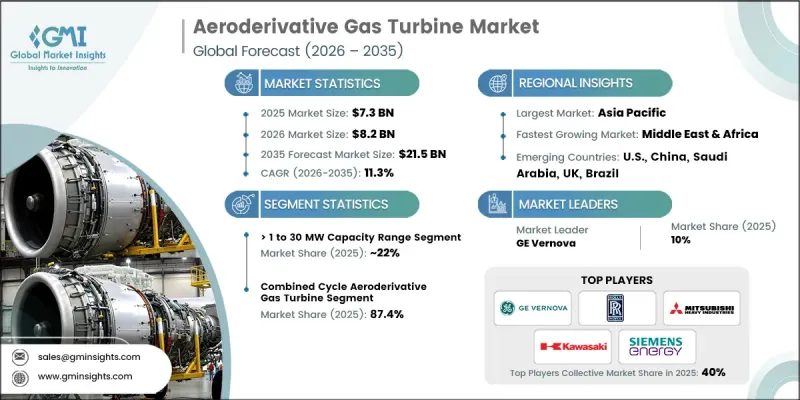
이 산업은 세계 에너지 수요 증가에 대응하기 위해 천연가스 채굴 및 유통에 대한 투자 확대에 힘입어 성장하고 있습니다. 마이크로그리드 확대와 대규모 화력발전소 설비투자 축소 노력도 마이크로그리드 도입을 더욱 촉진하고 있습니다. 항공기 제트엔진을 응용한 항공기 파생형 가스 터빈은 경량 설계와 고효율, 모듈식 구조, 높은 압축비, 그리고 빠른 기동 능력을 겸비하고 있습니다. 이 터빈은 광범위한 연료 호환성, 짧은 시동 시간, 견고한 성능으로 계통연계형 및 독립형 전력 시스템 모두에 적합한 터빈입니다. 재생 가능 연료로의 전환과 피크 부하 및 백업 운영의 배출 규제 강화는 시장의 잠재력을 높이고 있습니다. AI를 활용한 예지보전, 디지털 트윈의 통합, 재생에너지 시스템과의 원활한 연결 등의 기술 발전이 산업의 변화를 주도하고 있습니다. 에너지 안보, 비용 효율성, 장기적인 지속가능성에 대한 관심도 시장 성장에 영향을 미치고 있습니다.
| 시장 범위 | |
|---|---|
| 시작 연도 | 2025년 |
| 예측 기간 | 2026-2035 |
| 개시시 시장 규모 | 73억 달러 |
| 예측액 | 215억 달러 |
| CAGR | 11.3% |
2025년에는 1-30MW 용량 부문이 22%의 점유율을 차지했으며, 2035년까지 연평균 11.5%의 성장률을 기록할 것으로 전망됩니다. 이 터빈은 석유 및 가스, 산업 제조 및 전력망 확장이 비용이 많이 들거나 비현실적인 원격지 운영과 같이 높은 연속 출력이 필요한 분야에 적합합니다.
복합 사이클 및 항공기 파생 가스 터빈 부문은 2025년 87.4%의 점유율을 차지하며 2035년까지 150억 달러에 달할 것으로 예상됩니다. 복합 사이클 시스템은 산업단지, 캠퍼스 및 유틸리티 규모의 프로젝트에서 고효율 및 장시간 작동에 적합하며, 낮은 열효율과 연속 출력을 제공합니다. 석탄 화력 발전에서 청정 대체 에너지로의 전환은 시장 성장을 더욱 촉진하고 있습니다.
미국의 항공기 파생형 가스 터빈 시장은 2025년 72%의 점유율을 차지했습니다. 도입 배경에는 첨단 가스 터빈 기술로의 전환, 탄소 배출 감소 노력, 엄격한 환경 규제 준수 등이 있습니다.
자주 묻는 질문
목차
제1장 조사 방법과 범위
제2장 주요 요약
제3장 업계 인사이트
제4장 경쟁 구도
제5장 시장 규모 및 예측 : 용량별, 2022-2035
제6장 시장 규모 및 예측 : 기술별, 2022-2035
제7장 시장 규모 및 예측 : 용도별, 2022-2035
제8장 시장 규모 및 예측 : 지역별, 2022-2035
제9장 기업 개요
KSM 26.04.10The Global Aeroderivative Gas Turbine Market was valued at USD 7.3 billion in 2025 and is estimated to grow at a CAGR of 11.3% to reach USD 21.5 billion by 2035.
The industry is driven by increasing investments in natural gas extraction and distribution to meet growing global energy demand. Expansion of microgrids and the effort to reduce capital expenditures for large-scale thermal plants are further boosting adoption. Aeroderivative gas turbines, adapted from aircraft jet engines, combine lightweight design with high efficiency, modular construction, high compression ratios, and rapid start-up capabilities. These turbines offer broad fuel flexibility, low start-up times, and robust performance, making them suitable for both grid-connected and standalone power systems. The transition to renewable fuels and stricter emission regulations for peak load and backup operations are enhancing market potential. Advancements such as AI-powered predictive maintenance, digital twin integration, and seamless connection with renewable systems are reshaping the industry. A focus on energy security, cost efficiency, and long-term sustainability is also influencing market growth.
| Market Scope | |
|---|---|
| Start Year | 2025 |
| Forecast Year | 2026-2035 |
| Start Value | $7.3 Billion |
| Forecast Value | $21.5 Billion |
| CAGR | 11.3% |
The >1 to 30 MW capacity segment accounted for 22% share in 2025 and is projected to grow at a CAGR of 11.5% through 2035. These turbines are ideal for sectors requiring high continuous power output, including oil and gas, industrial manufacturing, and remote operations where extending the grid is costly or impractical.
The combined cycle aeroderivative gas turbine segment held an 87.4% share in 2025 and is expected to reach USD 15 billion by 2035. Combined cycle systems are favored for high-efficiency, long-duration operations in industrial parks, campuses, and utility-scale projects, offering lower heat rates and continuous output. The shift from coal-based generation to cleaner alternatives is further supporting market growth.
U.S. Aeroderivative Gas Turbine Market held a 72% share in 2025. Adoption is driven by the move toward advanced gas turbine technology, carbon reduction commitments, and compliance with stringent environmental regulations.
Key players operating in the Global Aeroderivative Gas Turbine Market include Ansaldo Energia, Destinus Energy, Capstone Green Energy, Doosan Enerbility, Everllence, GE Vernova, Harbin Electric, Honeywell International, IHI Corporation, Kawasaki Heavy Industries, Mitsubishi Heavy Industries, Nanjing Turbine & Electric Machinery, Pratt & Whitney, Rolls-Royce, Safran, Siemens Energy, Vericor, Baker Hughes, and Collins Aerospace. Companies in the Aeroderivative Gas Turbine Market are implementing multiple strategies to strengthen their foothold. They are investing in research and development to enhance turbine efficiency, fuel flexibility, and start-up speed while integrating AI and predictive maintenance solutions. Strategic partnerships and joint ventures are being formed to expand geographic reach and share development risks. Firms are diversifying portfolios by combining turbines with renewable energy systems and offering turnkey solutions for microgrid and industrial applications. Market leaders are also focusing on servicing, retrofitting, and upgrading existing installations to retain clients while acquiring new ones. Additionally, leveraging government incentives and financing programs helps reduce project costs, increasing market penetration and competitiveness.
Table of Contents
Chapter 1 Methodology & Scope
- 1.1 Research design
- 1.2 Quality commitments
- 1.2.1 GMI AI policy & data integrity commitment
- 1.2.1.1 Source consistency protocol
- 1.2.1 GMI AI policy & data integrity commitment
- 1.3 Research trail & confidence scoring
- 1.3.1 Research trail components
- 1.3.2 Scoring components
- 1.4 Data collection
- 1.4.1 Partial list of primary sources
- 1.5 Data mining sources
- 1.5.1 Paid sources
- 1.5.1.1 Sources, by region
- 1.5.1 Paid sources
- 1.6 Base estimates and calculations
- 1.6.1 Base year calculation for any one approach
- 1.7 Forecast model
- 1.7.1 Quantified market impact analysis
- 1.7.1.1 Mathematical impact of growth parameters on forecast
- 1.7.1 Quantified market impact analysis
- 1.8 Research transparency addendum
- 1.8.1 Source attribution framework
- 1.8.2 Quality assurance metrics
- 1.8.3 Our commitment to trust
- 1.9 Market definitions
Chapter 2 Executive Summary
- 2.1 Industry synopsis, 2022 - 2035
- 2.1.1 Business trends
- 2.1.2 Capacity trends
- 2.1.3 Technology trends
- 2.1.4 Application trends
- 2.1.5 Regional trends
Chapter 3 Industry Insights
- 3.1 Industry ecosystem analysis
- 3.1.1 Raw material availability & sourcing analysis
- 3.1.2 Manufacturing capacity assessment
- 3.1.3 Supply chain resilience & risk factors
- 3.1.4 Distribution network analysis
- 3.2 Industry impact forces
- 3.2.1 Growth drivers
- 3.2.2 Industry pitfalls & challenges
- 3.3 Regulatory landscape
- 3.4 Growth potential analysis
- 3.5 Price trend analysis (USD/MW)
- 3.5.1 By region
- 3.5.2 By capacity
- 3.6 Porter's analysis
- 3.6.1 Bargaining power of suppliers
- 3.6.2 Bargaining power of buyers
- 3.6.3 Threat of new entrants
- 3.6.4 Threat of substitutes
- 3.7 PESTEL analysis
- 3.7.1 Political factors
- 3.7.2 Economic factors
- 3.7.3 Social factors
- 3.7.4 Technological factors
- 3.7.5 Legal factors
- 3.7.6 Environmental factors
- 3.8 Cost structure analysis of aeroderivative gas turbines
- 3.9 Emerging opportunities & trends
- 3.9.1 Digitalization & IoT integration
- 3.9.2 Emerging market penetration
- 3.10 Investment analysis & future prospects
Chapter 4 Competitive Landscape, 2026
- 4.1 Introduction
- 4.2 Company market share analysis, by region, 2025
- 4.2.1 North America
- 4.2.2 Europe
- 4.2.3 Asia Pacific
- 4.2.4 Middle East & Africa
- 4.2.5 Latin America
- 4.3 Competitive positioning matrix
- 4.4 Key developments
- 4.4.1 Mergers & acquisitions
- 4.4.2 Partnerships & collaborations
- 4.4.3 New product launches
- 4.4.4 Expansion plans & funding
Chapter 5 Market Size and Forecast, By Capacity, 2022 - 2035 (USD Million & MW)
- 5.1 Key trends
- 5.2 50 kW
- 5.3 > 50 to 500 kW
- 5.4 > 500 kW to 1 MW
- 5.5 > 1 to 30 MW
- 5.6 > 30 to 70 MW
- 5.7 > 70 MW
Chapter 6 Market Size and Forecast, By Technology, 2022 - 2035 (USD Million & MW)
- 6.1 Key trends
- 6.2 Open cycle
- 6.3 Combined cycle
Chapter 7 Market Size and Forecast, By Application, 2022 - 2035 (USD Million & MW)
- 7.1 Key trends
- 7.2 Power plants
- 7.3 Oil & gas
- 7.4 Process plants
- 7.5 Aviation
- 7.6 Marine
- 7.7 Others
Chapter 8 Market Size and Forecast, By Region, 2022 - 2035 (USD Million & MW)
- 8.1 Key trends
- 8.2 North America
- 8.2.1 U.S.
- 8.2.2 Canada
- 8.2.3 Mexico
- 8.3 Europe
- 8.3.1 UK
- 8.3.2 France
- 8.3.3 Germany
- 8.3.4 Russia
- 8.3.5 Italy
- 8.3.6 Netherlands
- 8.3.7 Denmark
- 8.3.8 Poland
- 8.3.9 Sweden
- 8.4 Asia Pacific
- 8.4.1 China
- 8.4.2 Australia
- 8.4.3 Japan
- 8.4.4 India
- 8.4.5 South Korea
- 8.4.6 Indonesia
- 8.4.7 Thailand
- 8.4.8 Malaysia
- 8.5 Middle East & Africa
- 8.5.1 Saudi Arabia
- 8.5.2 UAE
- 8.5.3 Qatar
- 8.5.4 Kuwait
- 8.5.5 Oman
- 8.5.6 Egypt
- 8.5.7 Turkey
- 8.5.8 Iraq
- 8.5.9 South Africa
- 8.5.10 Nigeria
- 8.5.11 Algeria
- 8.6 Latin America
- 8.6.1 Brazil
- 8.6.2 Argentina
- 8.6.3 Chile
Chapter 9 Company Profiles
- 9.1 Ansaldo Energia
- 9.2 Baker Hughes
- 9.3 Capstone Green Energy
- 9.4 Collins Aerospace
- 9.5 Destinus Energy
- 9.6 Doosan Enerbility
- 9.7 Everllence
- 9.8 GE Vernova
- 9.9 Harbin Electric
- 9.10 Honeywell International
- 9.11 IHI Corporation
- 9.12 Kawasaki Heavy Industries
- 9.13 Mitsubishi Heavy Industries
- 9.14 Nanjing Turbine & Electric Machinery
- 9.15 Pratt & Whitney
- 9.16 Rolls-Royce
- 9.17 Safran
- 9.18 Siemens Energy
- 9.19 Vericor
- 9.20 Wartsila


