
|
시장보고서
상품코드
1998805
고급 전기차 시장 기회, 성장요인, 업계 동향 분석 및 예측(2026-2035년)Luxury Electric Vehicle Market Opportunity, Growth Drivers, Industry Trend Analysis, and Forecast 2026 - 2035 |
||||||

세계의 럭셔리 전기자동차 시장은 2025년에 1,912억 달러로 평가되었고, 2035년까지 연평균 복합 성장률(CAGR) 11.3%로 성장하여 5,624억 달러에 달할 것으로 예측됩니다.
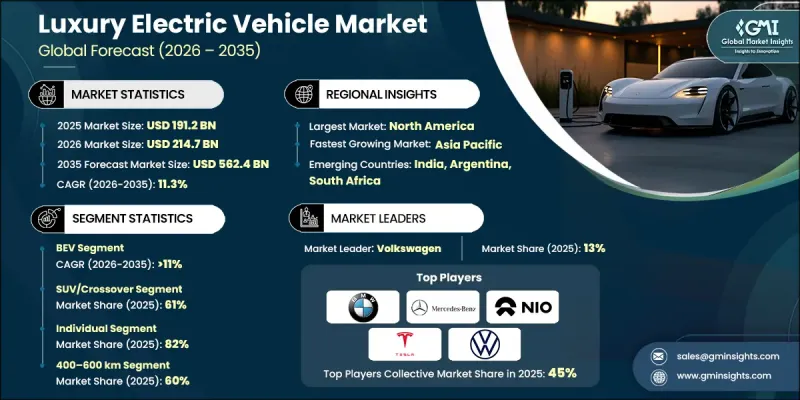
급속한 전동화와 프리미엄 브랜드 포지셔닝이 결합되어 고급 전기 모빌리티 솔루션에 대한 수요가 가속화되고 있습니다. 부유층 소비자들은 타협하지 않는 성능, 세련미, 그리고 지위를 기대하면서 지속가능성을 점점 더 중요하게 여기고 있습니다. 자동차 제조업체들은 기존 추진 시스템에 필적하거나 이를 능가하는 긴 항속거리의 배터리 시스템, 첨단 열 관리 기술, 고출력 전기 파워트레인으로 이에 대응하고 있습니다. 고급 전기차는 현재 전 세계 부유층 구매자들에게 동경의 대상이자 친환경적인 교통수단으로 각광받고 있습니다. 첨단 커넥티비티, 지능형 운전 보조 기술, 소프트웨어 중심의 차량 플랫폼이 개인화와 브랜드 차별화를 촉진하는 가운데, 디지털 통합은 이 부문을 더욱 변화시키고 있습니다. 원활한 커넥티비티, 자율주행 지원 시스템, 그리고 지속적인 소프트웨어 개선은 고급차 소유 경험의 중심이 되고 있습니다. 이러한 기술적 정교함, 친환경성, 프리미엄 장인정신의 결합은 고급 자동차 시장 전반에서 가격 결정력과 브랜드 충성도를 강화하여 고급 전기차 산업의 지속적인 성장을 뒷받침하고 있습니다.
| 시장 범위 | |
|---|---|
| 개시 연도 | 2025년 |
| 예측 기간 | 2026-2035년 |
| 개시 시점 시장 규모 | 1,912억 달러 |
| 예측 금액 | 5,624억 달러 |
| CAGR | 11.3% |
2025년에는 배터리 전기자동차(BEV) 부문이 시장 점유율의 80%를 차지했으며, 2026년부터 2035년까지 연평균 복합 성장률(CAGR) 11%를 나타낼 것으로 예측됩니다. 대용량 리튬 이온 배터리 기술의 발전으로 이 부문의 가치 제안이 강화되고 있습니다. 에너지 밀도 향상, 열 관리 개선, 1회 충전 시 500km 이상의 항속거리로 프리미엄 구매자들이 원하는 성능에 대한 기대에 부응하고 있습니다. 향상된 가속 성능과 부드럽고 거의 소음이 없는 주행 성능은 세련되고 강력한 모빌리티 솔루션을 원하는 고소득층 소비자들에게 BEV 모델의 매력을 더욱 높여주고 있습니다.
SUV 및 크로스오버 모델 부문은 2025년 61%의 점유율을 차지했으며, 2026년부터 2035년까지 연평균 11%의 성장률을 보일 것으로 예측됩니다. 높은 운전석 위치, 넓은 실내 공간, 다재다능한 디자인에 대한 전 세계 소비자들의 선호도가 높아지면서 이 부문의 성장에 크게 기여하고 있습니다. 고급 전기 SUV는 강력한 토크 출력, 부드러운 가속력, 첨단 편의사양을 제공하며, 프리미엄 성능과 최첨단 모빌리티 기술뿐만 아니라 실용성을 중시하는 부유층 가족 및 비즈니스 전문가에게 매력적인 선택이 될 수 있습니다.
미국의 고급 전기차 시장은 2025년 88%의 점유율을 차지했으며, 시장 규모는 592억 달러에 달했습니다. 소비자의 높은 구매력과 가처분 소득 증가는 미국 내 고급 전기차의 빠른 보급을 뒷받침하고 있습니다. 부유층 구매자들은 첨단 엔지니어링, 혁신적인 기술, 지속 가능한 성능을 갖춘 차량에 매력을 느낍니다. 유연한 금융 및 리스 제도의 지원과 새로운 기술을 빠르게 도입하는 문화를 통해 경영진과 전문직 종사자들은 편의성과 라이프스타일에 대한 기대치를 훼손하지 않고도 프리미엄 전기 모빌리티에 투자할 수 있게 되었습니다.
자주 묻는 질문
목차
제1장 조사 방법
제2장 주요 요약
제3장 업계 인사이트
제4장 경쟁 구도
제5장 시장 추산 및 예측 : 추진 방식별, 2022-2035
제6장 시장 추산 및 예측 : 차종별, 2022-2035
제7장 시장 추산 및 예측 : 소유 형태별, 2022-2035
제8장 시장 추산 및 예측 : 항속거리별, 2022-2035
제9장 시장 추산 및 예측 : 가격별, 2022-2035
제10장 시장 추산 및 예측 : 지역별, 2021-2034
제11장 기업 개요
LSH 26.04.23The Global Luxury Electric Vehicle Market was valued at USD 191.2 billion in 2025 and is estimated to grow at a CAGR of 11.3% to reach USD 562.4 billion by 2035.
Rapid electrification combined with premium brand positioning is accelerating demand for high-end electric mobility solutions. Affluent consumers are increasingly prioritizing sustainability while expecting uncompromised performance, refinement, and prestige. Automakers are responding with extended-range battery systems, advanced thermal management technologies, and high-output electric drivetrains that compete with or outperform traditional propulsion systems. Luxury electric vehicles are now positioned as both aspirational and environmentally responsible transportation choices for global high-net-worth buyers. Digital integration is further transforming the segment, as advanced connectivity, intelligent driver assistance technologies, and software-centric vehicle platforms enhance personalization and brand differentiation. Seamless connectivity, autonomous-ready systems, and continuous software enhancements are becoming central to the luxury ownership experience. This combination of technological sophistication, environmental responsibility, and premium craftsmanship is strengthening pricing power and brand loyalty across developed automotive markets, supporting sustained growth in the luxury electric vehicle industry.
| Market Scope | |
|---|---|
| Start Year | 2025 |
| Forecast Year | 2026-2035 |
| Start Value | $191.2 Billion |
| Forecast Value | $562.4 Billion |
| CAGR | 11.3% |
The battery electric vehicles segment accounted for 80% share in 2025 and is expected to grow at a CAGR of 11% from 2026 to 2035. Advances in high-capacity lithium-ion battery technology are reinforcing the segment's value proposition. Improvements in energy density, thermal regulation, and extended driving range exceeding 500 kilometers per charge are addressing the performance expectations of premium buyers. Enhanced acceleration capabilities and smooth, near-silent driving dynamics are further elevating the appeal of battery electric models among high-income consumers seeking refined and powerful mobility solutions.
The SUV and crossover models segment held a 61% share in 2025 and is forecast to grow at a CAGR of 11% during 2026-2035. Growing global preference for elevated driving positions, spacious interiors, and versatile design is significantly contributing to segment growth. Luxury electric SUVs deliver strong torque output, smooth acceleration, and advanced comfort features, making them attractive to affluent families and business professionals who value practicality alongside premium performance and cutting-edge mobility technologies.
United States Luxury Electric Vehicle Market held an 88% share, generating USD 59.2 billion in 2025. Strong consumer purchasing power and elevated disposable incomes are supporting rapid luxury EV adoption across the country. High-net-worth buyers are drawn to vehicles that combine advanced engineering, innovative technology, and sustainable performance. A culture of early technology adoption, supported by flexible financing and leasing structures, is enabling executives and professionals to invest in premium electric mobility without compromising convenience or lifestyle expectations.
Key companies operating in the Global Luxury Electric Vehicle Market include Tesla, Mercedes-Benz, BMW, Lucid, Rivian, Volkswagen, NIO, Jaguar, Lotus, and Li Auto. Companies in the Luxury Electric Vehicle Market are strengthening their competitive position through continuous innovation, brand differentiation, and strategic partnerships. Leading automakers are investing heavily in battery research, autonomous driving capabilities, and software-defined vehicle platforms to enhance performance and user experience. Strategic collaborations with technology firms are accelerating advancements in connectivity and digital ecosystems. Manufacturers are expanding production capacity and establishing dedicated EV platforms to improve scalability and cost efficiency. Premium branding initiatives emphasize sustainability, craftsmanship, and cutting-edge design to reinforce exclusivity. Companies are also broadening global distribution networks and investing in charging infrastructure partnerships to support customer convenience.
Table of Contents
Chapter 1 Methodology
- 1.1 Research approach
- 1.2 Quality Commitments
- 1.2.1 GMI AI policy & data integrity commitment
- 1.2.1.1 Source consistency protocol
- 1.2.1 GMI AI policy & data integrity commitment
- 1.3 Research Trail & Confidence Scoring
- 1.3.1 Research Trail Components
- 1.3.2 Scoring Components
- 1.4 Data Collection
- 1.4.1 Partial list of primary sources
- 1.5 Data mining sources
- 1.5.1 Paid sources
- 1.5.2 Sources, by region
- 1.6 Base estimates and calculations
- 1.6.1 Base year calculation for any one approach
- 1.7 Forecast model
- 1.7.1 Quantified market impact analysis
- 1.7.1.1 Mathematical impact of growth parameters on forecast
- 1.7.1 Quantified market impact analysis
- 1.8 Research transparency addendum
- 1.8.1 Source attribution framework
- 1.8.2 Quality assurance metrics
- 1.8.3 Our commitment to trust
Chapter 2 Executive Summary
- 2.1 Industry 360° synopsis, 2022 - 2035
- 2.2 Key market trends
- 2.2.1 Regional
- 2.2.2 Propulsion
- 2.2.3 Vehicle
- 2.2.4 Ownership
- 2.2.5 Driving range
- 2.2.6 Price
- 2.3 TAM Analysis, 2026-2035
- 2.4 CXO perspectives: Strategic imperatives
Chapter 3 Industry Insights
- 3.1 Industry ecosystem analysis
- 3.1.1 Supplier landscape
- 3.1.2 Profit margin analysis
- 3.1.3 Cost structure
- 3.1.4 Value addition at each stage
- 3.1.5 Factor affecting the value chain
- 3.1.6 Disruptions
- 3.2 Industry impact forces
- 3.2.1 Growth drivers
- 3.2.1.1 Growing demand for premium sustainable mobility
- 3.2.1.2 Technological advancements in battery and ADAS
- 3.2.1.3 Expansion of fast-charging infrastructure
- 3.2.1.4 Brand electrification strategies
- 3.2.1.5 Increasing government incentives and emission regulations
- 3.2.2 Industry pitfalls and challenges
- 3.2.2.1 High upfront vehicle cost
- 3.2.2.2 Battery raw material supply constraints
- 3.2.2.3 Charging infrastructure disparity
- 3.2.2.4 Technology obsolescence risks
- 3.2.3 Market opportunities
- 3.2.3.1 Expansion in Asia Pacific luxury segment
- 3.2.3.2 Integration of solid-state batteries
- 3.2.3.3 Autonomous and connected mobility ecosystems
- 3.2.3.4 Subscription and digital sales models
- 3.2.1 Growth drivers
- 3.3 Growth potential analysis
- 3.4 Regulatory landscape
- 3.4.1 North America
- 3.4.1.1 Environmental Protection Agency (EPA)
- 3.4.1.2 National Highway Traffic Safety Administration (NHTSA)
- 3.4.1.3 Occupational Safety and Health Administration (OSHA)
- 3.4.1.4 U.S. Department of Transportation (DOT)
- 3.4.1.5 Canadian Motor Vehicle Safety Standards (CMVSS)
- 3.4.2 Europe
- 3.4.2.1 EU Machinery Regulation
- 3.4.2.2 CE Marking Compliance
- 3.4.2.3 REACH (Registration, Evaluation, Authorisation and Restriction of Chemicals)
- 3.4.2.4 EU Tire Labelling Regulation
- 3.4.2.5 National Type Approval & Road Homologation Requirements
- 3.4.3 Asia Pacific
- 3.4.3.1 China Compulsory Certification (CCC)
- 3.4.3.2 Indian Central Motor Vehicle Rules (CMVR) - Off-Highway Tire Norms
- 3.4.3.3 Japanese Industrial Standards (JIS) for Tires
- 3.4.3.4 ASEAN Harmonized Technical Regulations
- 3.4.3.5 Australian Design Rules (ADR)
- 3.4.4 Latin America
- 3.4.4.1 Brazilian National Institute of Metrology (INMETRO) Regulations
- 3.4.4.2 Brazilian National Traffic Council (CONTRAN)
- 3.4.4.3 Mexican NOM Tire Safety Standards
- 3.4.4.4 Regional Import & Certification Requirements
- 3.4.5 Middle East & Africa
- 3.4.5.1 GCC Standardization Organization (GSO) Tire Regulations
- 3.4.5.2 Saudi Standards, Metrology and Quality Organization (SASO)
- 3.4.5.3 South African National Regulator for Compulsory Specifications (NRCS)
- 3.4.5.4 National Road Traffic Act (NRTA) Compliance
- 3.4.1 North America
- 3.5 Major market trends and disruptions
- 3.6 Future market trends
- 3.7 Porter's analysis
- 3.8 PESTEL analysis
- 3.9 Technology and innovation landscape
- 3.9.1 Current technological trends
- 3.9.2 Emerging technologies
- 3.10 Price analysis (Driven by Primary Research)
- 3.10.1 Historical Price Trend Analysis
- 3.10.2 Pricing Strategy by Player Type (Premium / Value / Cost-plus)
- 3.11 Trade data analysis (Driven by Paid Database)
- 3.11.1 Import/export volume & value trends
- 3.11.2 Key trade corridors & tariff impact
- 3.12 Cost breakdown analysis
- 3.13 Patent analysis (Driven by Primary Research)
- 3.14 Sustainability and environmental aspects
- 3.14.1 Sustainable practices
- 3.14.2 Waste reduction strategies
- 3.14.3 Energy efficiency in production
- 3.14.4 Eco-friendly Initiatives
- 3.14.5 Carbon footprint considerations
- 3.15 Impact of AI & generative AI on the market
- 3.15.1 AI-driven disruption of existing business models
- 3.15.2 GenAI use cases & adoption roadmap by segment
- 3.15.3 Risks, limitations & regulatory considerations
- 3.16 Capacity & production landscape (Driven by Primary Research)
- 3.16.1 Installed capacity by region & key producer
- 3.16.2 Capacity utilization rates & expansion pipelines
- 3.17 Forecast assumptions & scenario analysis (Driven by Primary Research)
- 3.17.1 Base Case - key macro & industry variables driving CAGR
- 3.17.2 Optimistic Scenarios - Favorable macro and industry tailwinds
- 3.17.3 Pessimistic Scenario - Macroeconomic slowdown or industry headwinds
Chapter 4 Competitive Landscape, 2025
- 4.1 Introduction
- 4.2 Company market share analysis
- 4.2.1 North America
- 4.2.2 Europe
- 4.2.3 Asia Pacific
- 4.2.4 LATAM
- 4.2.5 MEA
- 4.3 Competitive analysis of major market players
- 4.4 Competitive positioning matrix
- 4.5 Key developments
- 4.5.1 Mergers & acquisitions
- 4.5.2 Partnerships & collaborations
- 4.5.3 New Product Launches
- 4.5.4 Expansion Plans and funding
- 4.6 Company tier benchmarking
- 4.6.1 Tier classification criteria & qualifying thresholds
- 4.6.2 Tier positioning matrix by revenue, geography & innovation
Chapter 5 Market Estimates & Forecast, By Propulsion, 2022 - 2035 ($Mn, Units)
- 5.1 Key trends
- 5.2 BEV
- 5.3 PHEV
- 5.4 FCEV
Chapter 6 Market Estimates & Forecast, By Vehicle, 2022 - 2035 ($Mn, Units)
- 6.1 Key trends
- 6.2 SUV/Crossover
- 6.3 Sedan
- 6.4 Coupe
- 6.5 Convertible
- 6.6 Sports Car
Chapter 7 Market Estimates & Forecast, By Ownership, 2022 - 2035 ($Mn, Units)
- 7.1 Key trends
- 7.2 Individual
- 7.3 Corporate & fleet
- 7.4 Subscription/Leasing
Chapter 8 Market Estimates & Forecast, By Driving Range, 2022 - 2035 ($Mn, Units)
- 8.1 Key trends
- 8.2 Below 400 km
- 8.3 400-600 km
- 8.4 Above 600 km
Chapter 9 Market Estimates & Forecast, By Price, 2022 - 2035 ($Mn, Units)
- 9.1 Key trends
- 9.2 USD 80,000 - USD 149,999
- 9.3 USD 150,000 - USD 299,999
- 9.4 USD 300,000 - USD 499,999
- 9.5 Above 500,000
Chapter 10 Market Estimates & Forecast, By Region, 2021 - 2034 ($Mn, Units)
- 10.1 Key trends
- 10.2 North America
- 10.2.1 US
- 10.2.2 Canada
- 10.3 Europe
- 10.3.1 UK
- 10.3.2 Germany
- 10.3.3 France
- 10.3.4 Italy
- 10.3.5 Spain
- 10.3.6 Russia
- 10.3.7 Denmark
- 10.3.8 Finland
- 10.3.9 Norway
- 10.3.10 Sweden
- 10.4 Asia Pacific
- 10.4.1 China
- 10.4.2 India
- 10.4.3 Japan
- 10.4.4 South Korea
- 10.4.5 ANZ
- 10.4.6 Singapore
- 10.4.7 Thailand
- 10.4.8 Indonesia
- 10.4.9 Vietnam
- 10.5 Latin America
- 10.5.1 Brazil
- 10.5.2 Mexico
- 10.5.3 Argentina
- 10.6 MEA
- 10.6.1 South Africa
- 10.6.2 Saudi Arabia
- 10.6.3 UAE
Chapter 11 Company Profiles
- 11.1 Global Players
- 11.1.1 Audi
- 11.1.2 BMW
- 11.1.3 Cadillac
- 11.1.4 Jaguar
- 11.1.5 Lexus
- 11.1.6 Lucid
- 11.1.7 Mercedes EQ
- 11.1.8 Porsche
- 11.1.9 Rivian
- 11.1.10 Tesla
- 11.2 Regional Players
- 11.2.1 Genesis
- 11.2.2 Karma
- 11.2.3 Lotus
- 11.2.4 Maserati
- 11.2.5 Volvo
- 11.3 Emerging Players
- 11.3.1 Denza
- 11.3.2 Hongqi
- 11.3.3 Voyah
- 11.3.4 XPeng
- 11.3.5 Zeekr