

|
시장보고서
상품코드
1998808
동물 사료용 프로바이오틱스 시장 비즈니스 기회, 성장요인, 업계 동향 분석 및 예측(2026-2035년)Animal Feed Probiotics Market Opportunity, Growth Drivers, Industry Trend Analysis, and Forecast 2026 - 2035 |
||||||

세계의 동물용 사료 프로바이오틱스 시장은 2025년에 2억 6,730만 달러로 평가되었고, CAGR 7.7%로 성장하여 2035년까지 5억 5,120만 달러에 달할 것으로 예측됩니다.
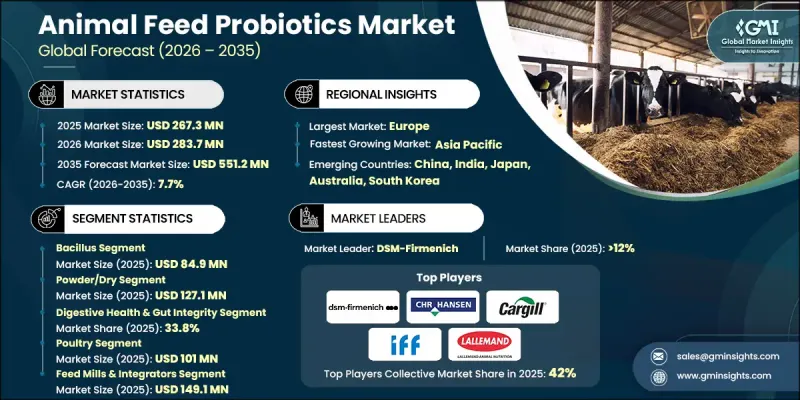
동물 사료용 프로바이오틱스 시장의 성장은 항생제를 사용하지 않는 축산 시스템을 장려하는 규제 정책의 발전과 밀접한 관련이 있습니다. 사료와 물에 동물용 항생제를 일상적으로 사용하는 것에 대한 규제가 강화됨에 따라 생산자들은 영양 개선과 생물학적 솔루션에 중점을 둔 대체 건강 관리 전략을 채택하고 있습니다. 그 결과, 프로바이오틱스는 가축의 장내 세균총 균형을 유지하는 귀중한 첨가물로 널리 인식되고 있습니다. 전 세계 사료 생산 규모가 매우 크기 때문에 프로바이오틱스 첨가제 도입률이 미미하더라도 시장은 크게 성장할 수 있습니다. 규제에 대한 영향 외에도 업계에서는 프로바이오틱스 보충제의 일관된 성능상의 이점을 인식하고 있습니다. 다양한 축종에 대한 수많은 사료 공급 시험을 통해 동물의 건강 상태, 성장 성능 및 비용 효율성에서 측정 가능한 개선이 입증되었습니다. 이러한 성과는 성장률 향상, 질병 발생률 감소, 제품 품질 향상에 기여하고 있으며, 프로바이오틱스는 가축의 예방적 건강관리에서 중요한 요소로 자리매김하고 있습니다. 프로바이오틱스는 영양소 이용 효율을 높이고 환경 부하를 줄이는 데 기여하기 때문에 지속가능성에 대한 고려도 시장 수요를 촉진하고 있습니다. 정밀 사료 공급 기술의 지속적인 발전과 보다 강력한 유효성 데이터에 대한 접근이 가능해짐에 따라, 동물동물 사료용 프로바이오틱스 시장은 생산자들이 세계 식량 수요 증가와 변화하는 규제 기준에 대응하면서 장기적인 성장세를 유지할 것으로 예측됩니다.
| 시장 범위 | |
|---|---|
| 개시 연도 | 2025년 |
| 예측 기간 | 2026-2035년 |
| 개시 연도 시장 규모 | 2억 6,730만 달러 |
| 예측액 | 5억 5,120만 달러 |
| CAGR | 7.7% |
바실러스(Bacillus) 부문은 2025년 8,490만 달러 시장 규모를 기록했으며, 사료 배합에서 가장 널리 채택된 프로바이오틱스 카테고리 중 하나입니다. 바실러스계 프로바이오틱스는 고온에 견디고 내구성 있는 포자를 형성하는 능력이 뛰어나 열 스트레스를 수반하는 사료의 가공 및 보관 조건에서도 안정성을 유지할 수 있습니다. 그 생물학적 활성은 소화의 균형을 돕고, 가축이 생리적 스트레스를 받는 기간 동안 장내 환경을 안정적으로 유지하도록 돕습니다. 또한, 이러한 프로바이오틱스는 영양소 소화를 개선하는 유익한 효소를 생성하는 것으로 알려져 있으며, 이는 다양한 축산 프로그램에서 널리 채택되고 있는 요인입니다.
2025년에는 소화기 건강 및 장 건강 부문이 33.8%의 점유율을 차지했습니다. 장내 환경의 균형을 유지하는 것은 동물 영양 프로그램에 프로바이오틱스를 포함시키는 주된 이유 중 하나입니다. 건강한 소화기관은 가축이 영양분을 보다 효율적으로 흡수할 수 있도록 도와주며, 동시에 소화관 내 미생물 균형을 안정화시킵니다. 이러한 장점은 동물이 소화기 질환에 취약하여 전체 생산성에 악영향을 미칠 수 있는 성장 초기 단계와 사료 전환기에 특히 중요합니다. 그 결과, 소화기 건강에 초점을 맞춘 프로바이오틱스 솔루션은 시장 내 주요 응용 분야로 남아 있습니다.
북미 동물동물 사료용 프로바이오틱스 시장은 2035년까지 1억 4,700만 달러에 달할 것으로 예측됩니다. 북미는 고도로 발달된 축산 시스템, 명확한 규제 프레임워크, 무항생제 사료에 대한 업계의 관심 증가로 인해 중요한 성장 지역으로 부상하고 있습니다. 이 지역의 정밀 영양 전략과 지속 가능한 축산업에 대한 강한 집중은 첨단 프로바이오틱스 기술 도입에 유리한 조건을 조성하고 있습니다. 프로바이오틱스 배합 및 전달 시스템의 지속적인 혁신은 이 지역 전체에서 시장 확대를 더욱 촉진하고 있습니다.
자주 묻는 질문
목차
제1장 조사 방법과 범위
제2장 주요 요약
제3장 업계 인사이트
제4장 경쟁 구도
제5장 시장 추산 및 예측 : 제품 유형별, 2022-2035
제6장 시장 추산 및 예측 : 형태별, 2022-2035
제7장 시장 추산 및 예측 : 기능별, 2022-2035
제8장 시장 추산 및 예측 : 가축별, 2022-2035
제9장 시장 추산 및 예측 : 유통 채널별, 2022-2035
제10장 시장 추산 및 예측 : 최종사용자별, 2022-2035
제11장 시장 추산 및 예측 : 지역별, 2022-2035
제12장 기업 개요
LSH 26.04.23The Global Animal Feed Probiotics Market was valued at USD 267.3 million in 2025 and is estimated to grow at a CAGR of 7.7% to reach USD 551.2 million by 2035.
Growth in the animal feed probiotics market is linked to evolving regulatory policies that encourage antibiotic-free livestock production systems. Increasing restrictions on the routine use of veterinary antibiotics in feed and water have encouraged producers to adopt alternative health management strategies that focus on improved nutrition and biological solutions. As a result, probiotics are gaining widespread recognition as valuable additives that support a balanced gut microbiome in livestock. The massive scale of global feed production means that even modest adoption rates of probiotic additives can translate into substantial market growth. In addition to regulatory influences, the industry is also recognizing the consistent performance advantages associated with probiotic supplementation. Numerous feeding trials across different livestock categories have demonstrated measurable improvements in animal health, growth performance, and cost efficiency. These outcomes contribute to stronger growth rates, lower disease incidence, and improved product quality, positioning probiotics as a key element in preventive livestock health management. Sustainability considerations are also reinforcing market demand, as probiotics support improved nutrient utilization and reduced environmental impact. With the continued development of precision feeding technologies and the availability of stronger efficacy data, the animal feed probiotics market is expected to maintain long-term growth as producers respond to rising global food demand and evolving regulatory standards.
| Market Scope | |
|---|---|
| Start Year | 2025 |
| Forecast Year | 2026-2035 |
| Start Value | $267.3 Million |
| Forecast Value | $551.2 Million |
| CAGR | 7.7% |
The bacillus segment generated USD 84.9 million in 2025 and represents one of the most widely adopted probiotic categories used in feed formulations. Bacillus-based probiotics are particularly valued for their ability to withstand high temperatures and form durable spores, allowing them to remain stable during feed processing and storage conditions that involve thermal stress. Their biological activity supports digestive balance and helps maintain gut stability during periods of physiological stress in livestock. Additionally, these probiotics are known to produce beneficial enzymes that improve nutrient digestion, which has contributed to their strong presence across several animal production programs.
The digestive health and gut integrity segment accounted for 33.8% share in 2025. Maintaining a balanced intestinal environment remains one of the primary reasons for incorporating probiotics into animal nutrition programs. Healthy digestive systems allow livestock to absorb nutrients more efficiently while maintaining a stable microbial balance in the gastrointestinal tract. These benefits are particularly valuable during early growth stages and during dietary transitions, when animals are more vulnerable to digestive disturbances that can negatively affect overall performance. As a result, probiotic solutions focused on digestive health continue to represent a major application area within the market.
North America Animal Feed Probiotics Market is projected to reach USD 104.7 million by 2035. North America has emerged as an important growth region due to its highly developed livestock production systems, well-defined regulatory frameworks, and increasing industry emphasis on antibiotic-free feeding practices. The region's strong focus on precision nutrition strategies and sustainable livestock production has created favorable conditions for the adoption of advanced probiotic technologies. Continued innovation in probiotic formulations and delivery systems is further supporting the market's expansion across the region.
Major companies operating in the Global Animal Feed Probiotics Market include Cargill Animal Nutrition, DSM-Firmenich, Chr. Hansen (Novonesis), IFF, Lallemand Animal Nutrition, Alltech, Kemin Industries, Evonik Industries, Novus International, Lesaffre Group, Angel Yeast, Nutreco, Biomin, and MicroSynbiotiX. Companies operating in the Global Animal Feed Probiotics Market are strengthening their market position through innovation, strategic partnerships, and expansion of research capabilities. Many firms are investing heavily in microbiome research to develop advanced probiotic strains that deliver improved performance and stability in animal feed applications. Strategic collaborations with feed manufacturers and livestock producers help companies integrate probiotic solutions into large-scale nutrition programs. Businesses are also focusing on expanding production capacity and improving formulation technologies to enhance product stability during feed processing. Additionally, organizations are increasing their presence in emerging livestock markets while strengthening distribution networks worldwide. Continuous investment in scientific validation, field trials, and regulatory approvals further supports product credibility and helps companies build stronger relationships with producers seeking reliable alternatives to antibiotic-based growth promoters.
Table of Contents
Chapter 1 Methodology & Scope
- 1.1 Market scope and definition
- 1.2 Research design
- 1.2.1 Research approach
- 1.2.2 Data collection methods
- 1.3 Data mining sources
- 1.3.1 Global
- 1.3.2 Regional/Country
- 1.4 Base estimates and calculations
- 1.4.1 Base year calculation
- 1.4.2 Key trends for market estimation
- 1.5 Primary research and validation
- 1.5.1 Primary sources
- 1.6 Forecast model
- 1.7 Research assumptions and limitations
Chapter 2 Executive Summary
- 2.1 Industry 360° synopsis
- 2.2 Key market trends
- 2.2.1 Regional
- 2.2.2 Product Type
- 2.2.3 Form
- 2.2.4 Function
- 2.2.5 Livestock
- 2.2.6 Distribution Channel
- 2.2.7 End-User
- 2.3 TAM Analysis, 2026-2035
- 2.4 CXO perspectives: Strategic imperatives
- 2.4.1 Executive decision points
- 2.4.2 Critical success factors
- 2.5 Future Outlook and Strategic Recommendations
Chapter 3 Industry Insights
- 3.1 Industry ecosystem analysis
- 3.1.1 Supplier landscape
- 3.1.2 Profit margin
- 3.1.3 Value addition at each stage
- 3.1.4 Factor affecting the value chain
- 3.1.5 Disruptions
- 3.2 Industry impact forces
- 3.2.1 Growth drivers
- 3.2.1.1 Science-backed performance gains
- 3.2.1.2 Stewardship and trade requirements
- 3.2.1.3 Precision farming & stability tech
- 3.2.2 Industry pitfalls and challenges
- 3.2.2.1 Strain variability & dosing
- 3.2.2.2 Regulatory complexity
- 3.2.3 Market opportunities
- 3.2.3.1 Methane and nutrient management
- 3.2.3.2 Aquaculture and pet nutrition.
- 3.2.1 Growth drivers
- 3.3 Growth potential analysis
- 3.4 Regulatory landscape
- 3.4.1 North America
- 3.4.2 Europe
- 3.4.3 Asia Pacific
- 3.4.4 Latin America
- 3.4.5 Middle East & Africa
- 3.5 Porter's analysis
- 3.6 PESTEL analysis
- 3.7 Price trends
- 3.7.1 By region
- 3.7.2 By product type
- 3.8 Future market trends
- 3.9 Technology and Innovation landscape
- 3.9.1 Current technological trends
- 3.9.2 Emerging technologies
- 3.10 Patent Landscape
- 3.11 Trade statistics (HS code)
- 3.11.1 Major importing countries
- 3.11.2 Major exporting countries
- 3.12 Sustainability and environmental aspects
- 3.12.1 Sustainable practices
- 3.12.2 Waste reduction strategies
- 3.12.3 Energy efficiency in production
- 3.12.4 Eco-friendly initiatives
- 3.13 Carbon footprint consideration
Chapter 4 Competitive Landscape, 2025
- 4.1 Introduction
- 4.2 Company market share analysis
- 4.2.1 By region
- 4.2.1.1 North America
- 4.2.1.2 Europe
- 4.2.1.3 Asia Pacific
- 4.2.1.4 LATAM
- 4.2.1.5 MEA
- 4.2.1 By region
- 4.3 Company matrix analysis
- 4.4 Competitive analysis of major market players
- 4.5 Competitive positioning matrix
- 4.6 Key developments
- 4.6.1 Mergers & acquisitions
- 4.6.2 Partnerships & collaborations
- 4.6.3 New Product Launches
- 4.6.4 Expansion Plans
Chapter 5 Market Estimates and Forecast, By Product Type, 2022-2035 (USD Million) (Kilo Tons)
- 5.1 Key trends
- 5.2 Bacillus
- 5.3 Lactobacilli
- 5.4 Saccharomyces (Yeast-Based)
- 5.5 Bifidobacterium
- 5.6 Enterococcus
- 5.7 Postbiotics
- 5.8 Streptococcus
- 5.9 Others
Chapter 6 Market Estimates and Forecast, By Form, 2022-2035 (USD Million) (Kilo Tons)
- 6.1 Key trends
- 6.2 Powder/Dry
- 6.3 Microencapsulated
- 6.4 Liquid/Soluble
- 6.5 Granules
- 6.6 Others
Chapter 7 Market Estimates and Forecast, By Function, 2022-2035 (USD Million) (Kilo Tons)
- 7.1 Key trends
- 7.2 Digestive health & gut integrity
- 7.3 Immune support & modulation
- 7.4 Growth promotion & feed efficiency
- 7.5 Pathogen control & competitive exclusion
- 7.6 Stress management
- 7.7 Others
Chapter 8 Market Estimates and Forecast, By Livestock, 2022-2035 (USD Million) (Kilo Tons)
- 8.1 Key trends
- 8.2 Poultry
- 8.2.1 Broilers
- 8.2.2 Layers
- 8.2.3 Breeders
- 8.2.4 Others
- 8.3 Swine
- 8.3.1 Piglets (pre-weaning & post-weaning)
- 8.3.2 Growers
- 8.3.3 Finishers
- 8.3.4 Others
- 8.4 Cattle (ruminants)
- 8.4.1 Dairy cattle
- 8.4.2 Beef cattle
- 8.5 Aquaculture
- 8.5.1 Salmon
- 8.5.2 Trout
- 8.5.3 Shrimp
- 8.5.4 Carp
- 8.5.5 Others
- 8.6 Pet food
- 8.6.1 Dogs
- 8.6.2 Cats
- 8.7 Equine
- 8.8 Others
Chapter 9 Market Estimates and Forecast, By Distribution Channel, 2022-2035 (USD Million) (Kilo Tons)
- 9.1 Key trends
- 9.2 Feed mills & integrators
- 9.3 Veterinary distributors
- 9.4 Direct sales (manufacturer to farm)
- 9.5 Online/e-commerce
- 9.6 Others
Chapter 10 Market Estimates and Forecast, By End-User, 2022-2035 (USD Million) (Kilo Tons)
- 10.1 Key trends
- 10.2 Commercial/industrial farms
- 10.3 Small-scale/backyard operations
- 10.4 Others
Chapter 11 Market Estimates and Forecast, By Region, 2022-2035 (USD Million) (Kilo Tons)
- 11.1 Key trends
- 11.2 North America
- 11.2.1 U.S.
- 11.2.2 Canada
- 11.3 Europe
- 11.3.1 Germany
- 11.3.2 UK
- 11.3.3 France
- 11.3.4 Spain
- 11.3.5 Italy
- 11.3.6 Rest of Europe
- 11.4 Asia Pacific
- 11.4.1 China
- 11.4.2 India
- 11.4.3 Japan
- 11.4.4 Australia
- 11.4.5 South Korea
- 11.4.6 Rest of Asia Pacific
- 11.5 Latin America
- 11.5.1 Brazil
- 11.5.2 Mexico
- 11.5.3 Argentina
- 11.5.4 Rest of Latin America
- 11.6 Middle East and Africa
- 11.6.1 Saudi Arabia
- 11.6.2 South Africa
- 11.6.3 UAE
- 11.6.4 Rest of Middle East and Africa
Chapter 12 Company Profiles
- 12.1 DSM-Firmenich
- 12.2 Chr. Hansen (Novonesis)
- 12.3 Cargill Animal Nutrition
- 12.4 IFF
- 12.5 Lallemand Animal Nutrition
- 12.6 Alltech
- 12.7 Kemin Industries
- 12.8 Evonik Industries
- 12.9 Novus International
- 12.10 Lesaffre Group
- 12.11 Angel Yeast
- 12.12 Biomin
- 12.13 Nutreco
- 12.14 MicroSynbiotiX


