

|
시장보고서
상품코드
1998809
자동차 무선 업데이트 시장 기회, 성장 촉진요인, 업계 동향 분석 및 예측(2026-2035년)Automotive Over-The-Air (OTA) Update Market Opportunity, Growth Drivers, Industry Trend Analysis, and Forecast 2026 - 2035 |
||||||

세계의 자동차 무선 업데이트 시장은 2025년에 49억 달러로 평가되었고, 2035년까지 연평균 복합 성장률(CAGR) 19.5%로 성장하여 290억 달러에 달할 것으로 예측됩니다.
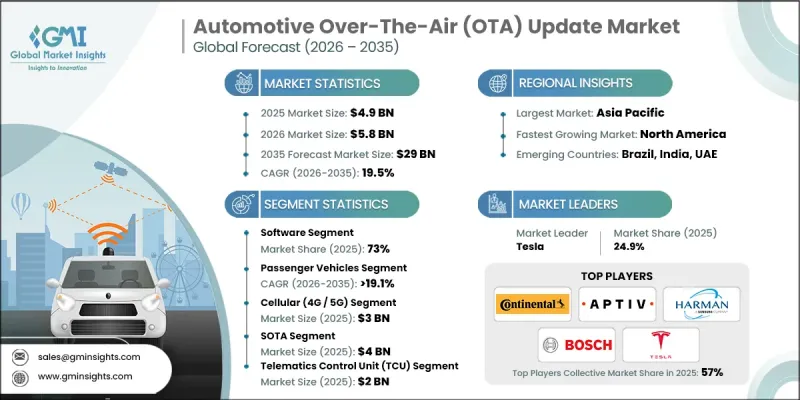
소프트웨어 정의 차량(SDV), 커넥티드 기술 및 전기 모빌리티가 전 세계적으로 확산됨에 따라 이 시장은 빠르게 성장하고 있습니다. 자동차 제조업체들은 차량의 기능, 안전성 및 사용자 경험을 향상시키기 위해 안전하고 확장 가능한 실시간 OTA 업데이트 기능에 점점 더 많은 관심을 기울이고 있습니다. 북미, 유럽, 아시아태평양에서 사이버 보안, 기능 안전 및 소프트웨어 컴플라이언스에 대한 규제 요건이 강화됨에 따라 OEM과 기술 제공업체들은 승용차와 상용차 모두에서 고급 OTA 프레임워크를 채택하고 있습니다. 이러한 수요는 리콜 비용 최소화, 기능 출시 가속화, 고객 만족도 향상에 대한 요구로 인해 더욱 강화되고 있습니다. 커넥티드 전기차, 상용차 및 텔레매틱스 기반 플랫폼의 채택이 확대됨에 따라 강력한 FOTA(Firmware over the Air) 및 SOTA(Software over the Air) 솔루션에 대한 요구사항이 강화되고 있으며, 지속적인 성능 최적화와 라이프사이클 관리를 가능하게 하고 있습니다.
| 시장 범위 | |
|---|---|
| 개시 연도 | 2025년 |
| 예측 기간 | 2026-2035년 |
| 개시 금액 | 49억 달러 |
| 예측 금액 | 290억 달러 |
| CAGR | 19.5% |
소프트웨어 부문은 73%의 점유율을 차지하고 있으며, 2026년부터 2035년까지 연평균 복합 성장률(CAGR) 19%를 나타낼 것으로 예측됩니다. 이러한 우위는 안전한 소프트웨어 및 펌웨어 관리 플랫폼, 예지보전 도구, 클라우드 기반 차량 라이프사이클 시스템 도입 확대로 뒷받침되고 있습니다. OEM과 차량 사업자는 ECU, 인포테인먼트 시스템, 주행 제어 장치 및 안전에 중요한 용도에 대한 실시간 업데이트를 제공하기 위해 소프트웨어 솔루션에 크게 의존하고 있습니다. AI, 텔레매틱스 및 커넥티비티 플랫폼의 통합은 승용차 및 상용 전기차 전반에 걸쳐 소프트웨어 솔루션의 역할을 더욱 강화하여 규제 준수, 성능 최적화 및 비용 절감을 보장합니다.
승용차 부문은 2025년 76%의 점유율을 차지했으며, 2035년까지 연평균 복합 성장률(CAGR) 19.1%를 나타낼 것으로 예측됩니다. 전기 승용차의 보급 확대와 더불어 배터리 관리, 모터 신뢰성, 인포테인먼트 기능 강화, 실시간 소프트웨어 업데이트에 대한 요구가 증가함에 따라 이 부문의 우위가 더욱 강화되고 있습니다. OEM 및 서비스 네트워크는 승용 전기차에 대한 OTA 솔루션을 표준화하여 보증 요건을 준수하는 데이터 기반 업데이트, 예지보전 및 성능 최적화를 실현하고 있습니다. 중국, 유럽, 북미의 높은 승용 전기차 보급률은 지속적인 OTA 도입을 촉진하고 이 부문에서 시장 리더십을 더욱 공고히 하고 있습니다.
중국의 자동차 OTA(Over The Air) 업데이트 시장은 51%의 점유율을 차지하며, 2025년에는 8억 달러 규모에 도달했습니다. 이러한 성장은 중국 내 견조한 전기차 생산, 커넥티드카 및 소프트웨어 정의 차량의 보급, 배터리, 모터, 소프트웨어 유지보수 솔루션의 대규모 도입에 힘입은 바 큽니다. OEM, fleet operator, 디지털 서비스 제공업체 간의 협력을 통해 예지보전, 소프트웨어 업데이트, 차량 모니터링 플랫폼의 효율적인 도입이 가능해져 승용차 및 상용차에서 OTA의 채택을 촉진하고 있습니다.
자주 묻는 질문
목차
제1장 조사 방법과 범위
제2장 주요 요약
제3장 업계 인사이트
제4장 경쟁 구도
제5장 시장 추산 및 예측 : 컴포넌트별, 2022년-2035년
제6장 시장 추산 및 예측 : 차종별, 2022년-2035년
제7장 시장 추산 및 예측 : 접속 방식별, 2022년-2035년
제8장 시장 추산 및 예측 : 기술별, 2022년-2035년
제9장 시장 추산 및 예측 : 용도별, 2022년-2035년
제10장 시장 추산 및 예측 : 지역별, 2022년-2035년
제11장 기업 개요
LSH 26.04.23The Global Automotive Over-The-Air (OTA) Update Market was valued at USD 4.9 billion in 2025 and is estimated to grow at a CAGR of 19.5% to reach USD 29 billion by 2035.
The market is experiencing rapid expansion as software-defined vehicles (SDVs), connected technologies, and electric mobility gain traction worldwide. Automakers are increasingly focusing on secure, scalable, and real-time OTA update capabilities to enhance vehicle functionality, safety, and user experience. Rising regulatory mandates related to cybersecurity, functional safety, and software compliance across North America, Europe, and Asia Pacific are pushing OEMs and technology providers to adopt advanced OTA frameworks for both passenger and commercial vehicles. The demand is further fueled by the need to minimize recall costs, accelerate feature deployment, and enhance customer satisfaction. Expanding adoption of connected EVs, commercial fleets, and telematics-driven platforms reinforces the requirement for robust firmware-over-the-air (FOTA) and software-over-the-air (SOTA) solutions, enabling continuous performance optimization and lifecycle management.
| Market Scope | |
|---|---|
| Start Year | 2025 |
| Forecast Year | 2026-2035 |
| Start Value | $4.9 Billion |
| Forecast Value | $29 Billion |
| CAGR | 19.5% |
The software segment held 73% share and is expected to grow at a CAGR of 19% from 2026 to 2035. This dominance is driven by the increasing deployment of secure software and firmware management platforms, predictive diagnostics tools, and cloud-based vehicle lifecycle systems. OEMs and fleet operators rely heavily on software solutions to provide real-time updates for ECUs, infotainment systems, drive-control mechanisms, and safety-critical applications. Integration of AI, telematics, and connectivity platforms further strengthens the role of software solutions across passenger and commercial EVs, ensuring regulatory compliance, performance optimization, and cost reduction.
The passenger vehicle segment held 76% share in 2025 and is expected to grow at a CAGR of 19.1% through 2035. The widespread adoption of electric passenger vehicles and the increasing need for battery management, motor reliability, infotainment enhancements, and real-time software updates reinforce this segment's dominance. OEMs and service networks are standardizing OTA solutions for passenger EVs, ensuring warranty-compliant, data-driven updates, predictive maintenance, and performance optimization. High penetration of passenger EVs across China, Europe, and North America drives recurring OTA deployments, further solidifying market leadership in this segment.
China Automotive Over-The-Air (OTA) Update Market held a 51% share, generating USD 0.8 billion in 2025. Growth is driven by the nation's strong EV production, widespread adoption of connected and software-defined vehicles, and large-scale deployment of battery, motor, and software maintenance solutions. Collaborations between OEMs, fleet operators, and digital service providers enable efficient implementation of predictive diagnostics, software updates, and vehicle monitoring platforms, driving OTA adoption across passenger and commercial vehicles.
Major players in the Global Automotive Over-The-Air (OTA) Update Market include BYD Auto, Hyundai Motor, Tesla, BMW, HARMAN International, Qualcomm, Robert Bosch, NXP Semiconductors, Aptiv, and Continental. Companies operating in the Automotive Over-The-Air (OTA) Update Market strengthen their position by investing in scalable, secure, and AI-driven software platforms that support real-time vehicle updates. Strategic collaborations with OEMs, telematics providers, and cloud service firms enhance global reach and enable seamless integration of OTA solutions. Expanding capabilities for predictive diagnostics, battery management, and advanced driver assistance systems improves product differentiation. Firms also focus on regional expansion into high-growth EV markets, ensuring regulatory compliance and cybersecurity standards.
Table of Contents
Chapter 1 Methodology & Scope
- 1.1 Market scope and definition
- 1.2 Research design
- 1.2.1 Research approach
- 1.2.2 Data collection methods
- 1.3 Data mining sources
- 1.3.1 Global
- 1.3.2 Regional/Country
- 1.4 Base estimates and calculations
- 1.4.1 Base year calculation
- 1.4.2 Key trends for market estimation
- 1.5 Primary research and validation
- 1.5.1 Primary sources
- 1.6 Forecast
- 1.7 Research assumptions and limitations
Chapter 2 Executive Summary
- 2.1 Industry 360° synopsis, 2022 - 2035
- 2.2 Key market trends
- 2.2.1 Regional
- 2.2.2 Component
- 2.2.3 Vehicle
- 2.2.4 Connectivity
- 2.2.5 Technology
- 2.2.6 Application
- 2.3 TAM Analysis, 2026-2035
- 2.4 CXO perspectives: Strategic imperatives
- 2.4.1 Executive decision points
- 2.4.2 Critical success factors
- 2.5 Future outlook and strategic recommendations
Chapter 3 Industry Insights
- 3.1 Industry ecosystem analysis
- 3.1.1 Supplier Landscape
- 3.1.2 Profit Margin
- 3.1.3 Cost structure
- 3.1.4 Value addition at each stage
- 3.1.5 Factor affecting the value chain
- 3.1.6 Disruptions
- 3.2 Industry impact forces
- 3.2.1 Growth drivers
- 3.2.1.1 Rising Software-Defined Vehicles (SDVs)
- 3.2.1.2 Growth in Connected & Electric Vehicles
- 3.2.1.3 Need for Cost Reduction
- 3.2.1.4 Cybersecurity & Regulatory Compliance
- 3.2.2 Industry pitfalls and challenges
- 3.2.2.1 Cybersecurity Risks
- 3.2.2.2 Complex ECU Integration
- 3.2.3 Market opportunities
- 3.2.3.1 5G Expansion
- 3.2.3.2 Fleet & Commercial Vehicle Digitization
- 3.2.3.3 AI-Powered Predictive Maintenance Integration
- 3.2.3.4 Feature-on-Demand & Subscription Services
- 3.2.1 Growth drivers
- 3.3 Growth potential analysis
- 3.4 Regulatory landscape
- 3.4.1 North America
- 3.4.1.1 U.S.: NHTSA, EPA, CARB Standards
- 3.4.1.2 Canada: Transport Canada, CMVSS 305
- 3.4.2 Europe
- 3.4.2.1 Germany: BMDV, UNECE R155/R156 Compliance
- 3.4.2.2 France: Ministry of Transport, UNECE Regulations
- 3.4.2.3 UK: Department for Transport, UNECE Compliance
- 3.4.2.4 Italy: Ministry of Infrastructure & Transport, Emission & Safety Compliance
- 3.4.3 Asia Pacific
- 3.4.3.1 China: MIIT, Cybersecurity & OTA Standards
- 3.4.3.2 Japan: MLIT, JIS Compliance
- 3.4.3.3 South Korea: MOLIT, KS OTA Standards
- 3.4.3.4 India: MoRTH, BS6 & Cybersecurity Guidelines
- 3.4.4 Latin America
- 3.4.4.1 Brazil: DENATRAN, CONAMA Standards
- 3.4.4.2 Mexico: Ministry of Communications & Transport, NOM Emission Regulations
- 3.4.5 Middle East and Africa
- 3.4.5.1 UAE: RTA, ESMA OTA Guidelines
- 3.4.5.2 Saudi Arabia: Ministry of Transport, SASO OTA Regulations
- 3.4.1 North America
- 3.5 Porter's analysis
- 3.6 PESTEL analysis
- 3.7 Technology and Innovation Landscape
- 3.7.1 Current technological trends
- 3.7.2 Emerging technologies
- 3.8 Price analysis (Driven by Primary Research)
- 3.8.1 Historical Price Trend Analysis
- 3.8.2 Pricing Strategy by Player Type (Premium / Value / Cost-plus)
- 3.9 Cost breakdown analysis
- 3.10 Patent analysis (Driven by Primary Research)
- 3.11 Impact of Artificial Intelligence (AI)
- 3.11.1 AI-Driven Disruption of Existing Business Models
- 3.11.2 GenAI Use Cases & Adoption Roadmap by Segment
- 3.11.3 Risks, Limitations & Regulatory Considerations
- 3.12 Sustainability and Environmental Aspects
- 3.12.1 Sustainable practices
- 3.12.2 Waste reduction strategies
- 3.12.3 Energy efficiency in production
- 3.12.4 Eco-friendly initiatives
- 3.12.5 Carbon footprint considerations
- 3.13 Use case scenarios
Chapter 4 Competitive Landscape, 2025
- 4.1 Introduction
- 4.2 Company market share analysis
- 4.2.1 North America
- 4.2.2 Europe
- 4.2.3 Asia Pacific
- 4.2.4 Latin America
- 4.2.5 Middle East & Africa
- 4.3 Competitive analysis of major market players
- 4.4 Competitive positioning matrix
- 4.5 Strategic outlook matrix
- 4.6 Key developments
- 4.6.1 Mergers & acquisitions
- 4.6.2 Partnerships & collaborations
- 4.6.3 New product launches
- 4.6.4 Expansion plans and funding
Chapter 5 Market Estimates & Forecast, By Component, 2022 - 2035 ($Bn)
- 5.1 Key trends
- 5.2 Software
- 5.2.1 Update Management Platform
- 5.2.2 Security Solutions
- 5.2.3 Data Analytics & Monitoring
- 5.3 Services
- 5.3.1 Consulting & Advisory
- 5.3.2 Implementation & Integration
- 5.3.3 Testing & Validation
- 5.3.4 Managed Services
Chapter 6 Market Estimates & Forecast, By Vehicle, 2022 - 2035 ($Bn)
- 6.1 Key trends
- 6.2 Passenger vehicles
- 6.2.1 Hatchbacks
- 6.2.2 Sedans
- 6.2.3 SUV
- 6.3 Commercial vehicles
- 6.3.1 Light commercial vehicles (LCV)
- 6.3.2 Medium commercial vehicles (MCV)
- 6.3.3 Heavy commercial vehicles (HCV)
Chapter 7 Market Estimates & Forecast, By Connectivity, 2022 - 2035 ($Bn)
- 7.1 Key trends
- 7.2 Cellular (4G / 5G)
- 7.3 Wi-Fi
- 7.4 Satellite
Chapter 8 Market Estimates & Forecast, By Technology, 2022 - 2035 ($Bn)
- 8.1 Key trends
- 8.2 SOTA
- 8.2.1 Infotainment & Navigation Updates
- 8.2.2 Drive Control & Safety-Critical Updates
- 8.3 FOTA
- 8.3.1 ECU Firmware Updates
- 8.3.2 Bootloader & Low-Level System Updates
Chapter 9 Market Estimates & Forecast, By Application, 2022 - 2035 ($Bn)
- 9.1 Key trends
- 9.2 Telematics Control Unit (TCU)
- 9.3 Electronic Control Unit (ECU)
- 9.4 Infotainment Systems
- 9.5 Safety & Security Systems
- 9.6 Others
Chapter 10 Market Estimates & Forecast, By Region, 2022 - 2035 ($Bn)
- 10.1 Key trends
- 10.2 North America
- 10.2.1 US
- 10.2.2 Canada
- 10.3 Europe
- 10.3.1 UK
- 10.3.2 Germany
- 10.3.3 France
- 10.3.4 Italy
- 10.3.5 Spain
- 10.3.6 Belgium
- 10.3.7 Netherlands
- 10.3.8 Sweden
- 10.4 Asia Pacific
- 10.4.1 China
- 10.4.2 India
- 10.4.3 Japan
- 10.4.4 Australia
- 10.4.5 Singapore
- 10.4.6 South Korea
- 10.4.7 Vietnam
- 10.4.8 Indonesia
- 10.5 Latin America
- 10.5.1 Brazil
- 10.5.2 Mexico
- 10.5.3 Argentina
- 10.6 MEA
- 10.6.1 UAE
- 10.6.2 South Africa
- 10.6.3 Saudi Arabia
Chapter 11 Company Profiles
- 11.1 Global Player
- 11.1.1 Aptiv
- 11.1.2 BMW
- 11.1.3 BYD Auto
- 11.1.4 Continental
- 11.1.5 HARMAN International
- 11.1.6 Hyundai Motor
- 11.1.7 NXP Semiconductors
- 11.1.8 Qualcomm
- 11.1.9 Robert Bosch
- 11.1.10 Tesla
- 11.2 Regional Player
- 11.2.1 CATL
- 11.2.2 Denso Tec
- 11.2.3 ElringKlinger
- 11.2.4 Faurecia (FORVIA)
- 11.2.5 Futaba Industrial
- 11.2.6 Gotion High-Tech
- 11.2.7 Panasonic Automotive
- 11.2.8 Tenneco
- 11.2.9 Valeo SA
- 11.2.10 ZF Friedrichshafen


