



|
시장보고서
상품코드
2027592
과일 배합 워터 : 시장 기회, 성장 촉진요인, 업계 동향 분석 및 예측(2026-2035년)Fruit Infused Water Market Opportunity, Growth Drivers, Industry Trend Analysis, and Forecast 2026 - 2035 |
||||||

세계의 과일 배합 워터 시장은 2025년에 170억 달러로 평가되었고 CAGR 6.8%를 나타내 2035년까지 327억 달러에 이를 것으로 추정되고 있습니다.
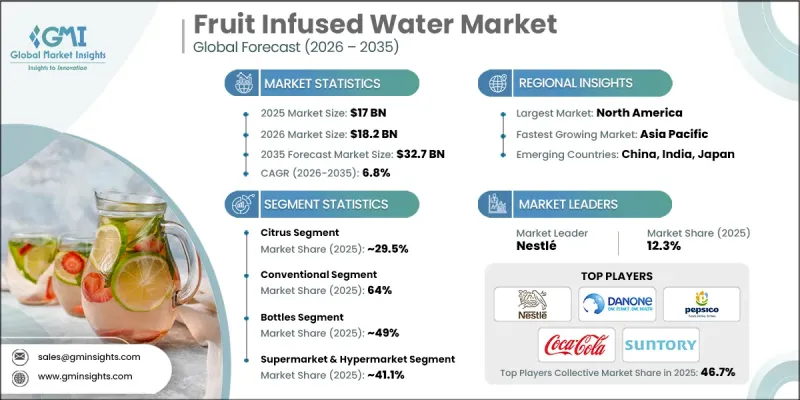
소비자들이 더 건강하고 자연에서 추출한 맛을 가진 수분 보충제를 선호하는 경향이 강해짐에 따라 과일 배합 워터 산업은 꾸준히 성장하고 있습니다. 웰빙과 적절한 수분 섭취에 대한 인식이 높아지면서 설탕이 많이 함유된 음료에서 더 깨끗한 대체품으로 전환하는 추세입니다. 이 카테고리는 청량감과 건강 지원이라는 두 가지 가치를 모두 제공하며 기능성 음료 시장에서 중요한 한 축을 담당하고 있습니다. 과일 배합 워터는 천연 재료와 투명성을 중시하는 현대인의 식생활 취향에 부합하는 저칼로리 선택지를 제공합니다. 이 구성은 클린 라벨에 대한 기대에 부응하는 동시에 인공 첨가물을 사용하지 않아도 됩니다. 이 음료는 수분 보충과 더불어, 함유된 성분의 추가적인 영양가도 함께 제공되어 전반적인 건강 증진과 활동적인 라이프스타일을 지원하는 데 도움이 됩니다. 편리하고 바로 마실 수 있는 형태에 대한 관심이 높아지면서 여러 최종 사용 부문에서 수요가 더욱 가속화되고 있습니다. 소비자의 우선순위가 건강 지향적 소비로 계속 진화함에 따라, 세계의 과일 배합 워터 시장은 강력한 성장세를 유지할 것으로 예측됩니다.
| 시장 범위 | |
|---|---|
| 시작 연도 | 2025년 |
| 예측 기간 | 2026-2035년 |
| 개시 연도 시장 규모 | 170억 달러 |
| 예측액 | 327억 달러 |
| CAGR | 6.8% |
2025년 감귤류 향료 부문은 29.5%의 점유율을 차지했으며, 2035년까지 연평균 6.5%의 성장률을 나타낼 것으로 예측됩니다. 이 부문은 상큼한 맛과 소비자의 높은 지지를 바탕으로 시장을 선도하고 있습니다. 시장에서의 맛의 트렌드는 맛과 건강 효과를 겸비한 천연 유래 및 기능적인 선택에 대한 선호도가 높아지고 있음을 반영하고 있습니다. 소비자들이 더 건강한 음료 선택에 집중하는 동시에 다양성과 감각적 경험을 추구함에 따라 과일 베이스 맛에 대한 수요는 계속 증가하고 있습니다.
병 부문은 2025년 49%의 점유율을 차지했으며, 2035년까지 연평균 복합 성장률(CAGR) 6.5%를 나타낼 것으로 예측됩니다. 소비자들이 편리성, 휴대성, 지속가능성을 중시하는 가운데, 포장의 혁신은 시장 확대를 이끄는 중요한 요인으로 작용하고 있습니다. 병은 사용 편의성과 소매 채널 전반에 걸친 광범위한 가용성으로 인해 계속해서 시장을 장악하고 있습니다. 환경에 대한 인식이 높아지면서 가볍고 재활용이 가능한 소재가 선호되고 있습니다. 또한, 다양한 소비자의 니즈를 충족시키기 위해 대체 포장 형태도 진화하고 있으며, 시장 전체의 발전에 기여하고 있습니다.
슈퍼마켓 및 대형마트 부문은 2025년 41.1%의 점유율을 차지했으며, 2035년까지 연평균 7.1%의 성장률을 나타낼 것으로 전망됩니다. 이러한 소매 채널은 광범위한 도달 범위와 풍부한 제품 라인업을 제공할 수 있기 때문에 주요 유통 플랫폼으로 남아 있습니다. 이는 브랜드 인지도를 높이고 소비자들이 한 곳에서 다양한 선택권을 가질 수 있도록 하는 데 매우 중요한 역할을 합니다. 소매 네트워크의 확대와 구매 행동의 변화는 이 부문의 성장을 더욱 촉진하고 있습니다.
북미의 과일 배합 워터 시장은 천연 및 저칼로리 음료에 대한 수요 증가와 건강 및 웰빙에 대한 인식 향상에 힘입어 2025년 33.5%의 점유율을 차지했습니다. 소비자들은 클린 라벨, 무설탕 등 기호에 맞는 제품을 적극적으로 찾고 있습니다. 맛 개발과 포장 디자인의 혁신은 브랜드의 매력도를 높이는데 기여하고 있습니다. 소매 및 온라인 유통 채널의 확대에 힘입어 이동 중에도 소비하는 소비 트렌드 증가는 계속해서 지역 수요를 견인하고 있습니다.
자주 묻는 질문
목차
제1장 조사 방법과 범위
제2장 주요 요약
제3장 업계 인사이트
제4장 경쟁 구도
제5장 시장 추산 및 예측 : 향료별(2022-2035년)
제6장 시장 추산 및 예측 : 카테고리별(2022-2035년)
제7장 시장 추산 및 예측 : 포장 유형별(2022-2035년)
제8장 시장 추산 및 예측 : 유통 채널별(2022-2035년)
제9장 시장 추산 및 예측 : 지역별(2022-2035년)
제10장 기업 개요
KTH 26.05.20The Global Fruit Infused Water Market was valued at USD 17 billion in 2025 and is estimated to grow at a CAGR of 6.8% to reach USD 32.7 billion by 2035.
The fruit infused water industry has been expanding steadily as consumers increasingly gravitate toward healthier, naturally flavored hydration choices. Rising awareness of wellness and proper hydration habits is encouraging a shift away from sugar-loaded beverages toward cleaner alternatives. This category has become a key part of the functional beverage space, offering both refreshment and perceived health support. Fruit-infused water delivers a low-calorie option that aligns with modern dietary preferences focused on natural ingredients and transparency. Its composition supports clean-label expectations while eliminating the need for artificial additives. In addition to hydration, these beverages are associated with added nutritional value derived from infused ingredients, contributing to overall well-being and supporting active lifestyles. The growing appeal of convenient, ready-to-drink formats is further accelerating demand across multiple end-use sectors. As consumer priorities continue to evolve toward health-conscious consumption, the global fruit infused water market is expected to maintain strong growth momentum.
| Market Scope | |
|---|---|
| Start Year | 2025 |
| Forecast Year | 2026-2035 |
| Start Value | $17 Billion |
| Forecast Value | $32.7 Billion |
| CAGR | 6.8% |
In 2025, the citrus flavors segment accounted for 29.5% share and is projected to grow at a CAGR of 6.5% through 2035. This segment continues to lead due to its refreshing taste profile and strong consumer acceptance. Flavor trends within the market reflect a growing preference for natural and functional options that combine taste with perceived wellness benefits. Demand for fruit-based flavor profiles continues to rise as consumers seek variety and enhanced sensory experiences while maintaining a focus on healthier beverage choices.
The bottles segment held a share of 49% in 2025 and is expected to grow at a CAGR of 6.5% through 2035. Packaging innovation remains a key factor driving market expansion, as consumers prioritize convenience, portability, and sustainability. Bottles continue to dominate due to ease of use and widespread availability across retail channels. Lightweight and recyclable materials are gaining preference as environmental awareness increases. Alternative packaging formats are also evolving to meet diverse consumer needs, contributing to overall market development.
The supermarkets and hypermarkets segment accounted for 41.1% share in 2025 and is projected to grow at a CAGR of 7.1% through 2035. These retail channels remain the primary distribution platforms due to their broad reach and ability to offer extensive product selections. They play a critical role in enhancing brand visibility and enabling consumers to access a wide range of options in one location. Expanding retail networks and changing purchasing behaviors are further supporting growth in this segment.
North America Fruit Infused Water Market held a 33.5% share in 2025, driven by increasing demand for natural, low-calorie beverages and rising awareness of health and wellness. Consumers are actively seeking products that align with clean-label and sugar-free preferences. Innovation in flavor development and packaging design is helping brands strengthen their appeal. The growing trend of on-the-go consumption, supported by expanding retail and online distribution channels, continues to drive regional demand.
Key players operating in the Global Fruit Infused Water Market include PepsiCo, The Coca-Cola Company, Nestle, Danone, SUNTORY BEVERAGE & FOOD LIMITED, LaCroix Beverages, Inc., Hint Inc., Bai Brands, JUST Water, PATH Water, Flow Water, Primo Brands, Ozarka Water (BlueTriton Brands), Mountain Valley Spring Water, and Sanzo. Companies in the Fruit Infused Water Market are reinforcing their market position through innovation, branding, and strategic expansion. They are introducing new flavor profiles and clean-label formulations to meet evolving consumer preferences. Investments in sustainable packaging and environmentally responsible practices are helping companies align with growing eco-conscious demand. Strategic partnerships and distribution expansions are enabling broader market reach and improved product accessibility. Additionally, companies are strengthening their digital presence and leveraging e-commerce platforms to capture changing purchasing behaviors while focusing on product differentiation and premium positioning to enhance brand loyalty and competitiveness.
Table of Contents
Chapter 1 Methodology & Scope
- 1.1 Market scope and definition
- 1.2 Research design
- 1.2.1 Research approach
- 1.2.2 Data collection methods
- 1.3 Data mining sources
- 1.3.1 Global
- 1.3.2 Regional/Country
- 1.4 Base estimates and calculations
- 1.4.1 Base year calculation
- 1.4.2 Key trends for market estimation
- 1.5 Primary research and validation
- 1.5.1 Primary sources
- 1.6 Forecast model
- 1.7 Research assumptions and limitations
Chapter 2 Executive Summary
- 2.1 Industry 360° synopsis
- 2.2 Key market trends
- 2.2.1 Regional
- 2.2.2 Flavor type
- 2.2.3 Category
- 2.2.4 Packaging type
- 2.2.5 Distribution channel
- 2.3 TAM Analysis, 2026-2035
- 2.4 CXO perspectives: Strategic imperatives
- 2.4.1 Executive decision points
Chapter 3 Industry Insights
- 3.1 Industry ecosystem analysis
- 3.1.1 Supplier landscape
- 3.1.2 Profit margin
- 3.1.3 Value addition at each stage
- 3.1.4 Factor affecting the value chain
- 3.1.5 Disruptions
- 3.2 Industry impact forces
- 3.2.1 Growth drivers
- 3.2.2 Industry pitfalls and challenges
- 3.2.3 Market opportunities
- 3.3 Growth potential analysis
- 3.4 Regulatory landscape
- 3.4.1 North America
- 3.4.2 Europe
- 3.4.3 Asia Pacific
- 3.4.4 Latin America
- 3.4.5 Middle East & Africa
- 3.5 Porter's analysis
- 3.6 PESTEL analysis
- 3.7 Price trends
- 3.7.1 By region
- 3.7.2 By type
- 3.8 Future market trends
- 3.9 Technology and Innovation landscape
- 3.9.1 Current technological trends
- 3.9.2 Emerging technologies
- 3.10 Patent Landscape
- 3.11 Trade statistics (HS code)
- 3.11.1 Major importing countries
- 3.11.2 Major exporting countries
- 3.12 Sustainability and environmental aspects
- 3.12.1 Sustainable practices
- 3.12.2 Waste reduction strategies
- 3.12.3 Energy efficiency in production
- 3.12.4 Eco-friendly initiatives
- 3.13 Carbon footprint consideration
Chapter 4 Competitive Landscape, 2025
- 4.1 Introduction
- 4.2 Company market share analysis
- 4.2.1 By region
- 4.2.1.1 North America
- 4.2.1.2 Europe
- 4.2.1.3 Asia Pacific
- 4.2.1.4 LATAM
- 4.2.1.5 MEA
- 4.2.1 By region
- 4.3 Company matrix analysis
- 4.4 Competitive analysis of major market players
- 4.5 Competitive positioning matrix
- 4.6 Key developments
- 4.6.1 Mergers & acquisitions
- 4.6.2 Partnerships & collaborations
- 4.6.3 New Product Launches
- 4.6.4 Expansion Plans
Chapter 5 Market Estimates and Forecast, By Flavor Type, 2022-2035 (USD Billion) (Thousand Liters)
- 5.1 Key trends
- 5.2 Citrus
- 5.2.1 Lemon
- 5.2.2 Lime
- 5.2.3 Orange
- 5.2.4 Grapefruit
- 5.3 Berries
- 5.3.1 Strawberry
- 5.3.2 Blueberry
- 5.3.3 Raspberry
- 5.3.4 Blackberry
- 5.4 Tropical Fruits
- 5.4.1 Mango
- 5.4.2 Pineapple
- 5.4.3 Passion Fruit
- 5.4.4 Guava
- 5.5 Apples and Pears
- 5.6 Others
Chapter 6 Market Estimates and Forecast, By Category, 2022-2035 (USD Billion) (Thousand Liters)
- 6.1 Key trends
- 6.2 Organic
- 6.3 Conventional
Chapter 7 Market Estimates and Forecast, By Packaging Type, 2022-2035 (USD Billion) (Thousand Liters)
- 7.1 Key trends
- 7.2 Bottles
- 7.3 Cans
- 7.4 Jugs
- 7.5 Pouches
Chapter 8 Market Estimates and Forecast, By Distribution Channel, 2022-2035 (USD Billion) (Thousand Liters)
- 8.1 Key trends
- 8.2 Supermarkets and hypermarkets
- 8.3 Convenience stores
- 8.4 Online retail
- 8.5 Others (e.g., direct sales, vending machines)
Chapter 9 Market Estimates and Forecast, By Region, 2022-2035 (USD Billion) (Thousand Liters)
- 9.1 Key trends
- 9.2 North America
- 9.2.1 U.S.
- 9.2.2 Canada
- 9.3 Europe
- 9.3.1 Germany
- 9.3.2 UK
- 9.3.3 France
- 9.3.4 Spain
- 9.3.5 Italy
- 9.3.6 Rest of Europe
- 9.4 Asia Pacific
- 9.4.1 China
- 9.4.2 India
- 9.4.3 Japan
- 9.4.4 Australia
- 9.4.5 South Korea
- 9.4.6 Rest of Asia Pacific
- 9.5 Latin America
- 9.5.1 Brazil
- 9.5.2 Mexico
- 9.5.3 Argentina
- 9.5.4 Rest of Latin America
- 9.6 Middle East and Africa
- 9.6.1 Saudi Arabia
- 9.6.2 South Africa
- 9.6.3 UAE
- 9.6.4 Rest of Middle East and Africa
Chapter 10 Company Profiles
- 10.1 Bai Brands
- 10.2 Danone
- 10.3 Flow Water
- 10.4 Hint Inc.
- 10.5 JUST Water
- 10.6 LaCroix Beverages, Inc.
- 10.7 Mountain Valley Spring Water
- 10.8 Nestle
- 10.9 Ozarka Water (BlueTriton Brands)
- 10.10 PATH Water
- 10.11 PepsiCo
- 10.12 Primo Brands
- 10.13 Sanzo
- 10.14 SUNTORY BEVERAGE & FOOD LIMITED.
- 10.15 The Coca-Cola Company

(주말 및 공휴일 제외)


