

|
시장보고서
상품코드
2038319
로봇 비전 시스템 시장 : 시장 기회, 성장요인, 업계 동향 분석 및 예측(2026-2035년)Robotic Vision Systems Market Opportunity, Growth Drivers, Industry Trend Analysis, and Forecast 2026 - 2035 |
||||||

세계의 로봇 비전 시스템 시장은 2025년에 45억 달러로 평가되었고, CAGR 11.5%로 성장할 전망이며, 2035년까지 132억 달러에 이를 것으로 예측됩니다.
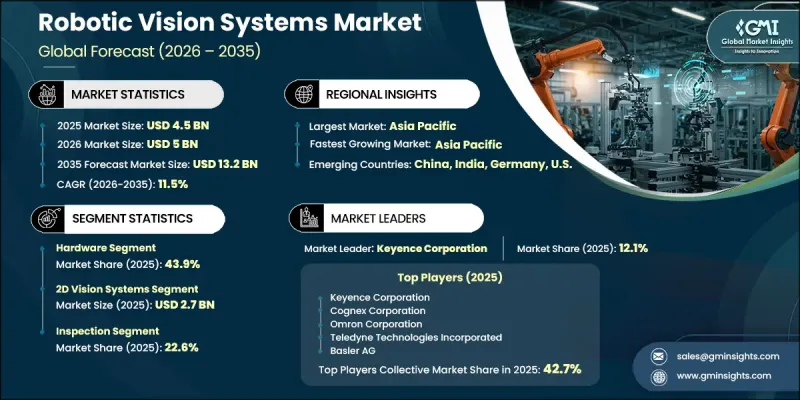
검사, 측정 및 물체 취급에 있어 정밀도가 매우 중요한 산업 환경에서 자동화 도입이 가속화됨에 따라 로봇 비전 시스템 산업은 강한 추진력을 보이고 있습니다. 기업들은 업무 효율을 높이고 일관된 품질 기준을 유지하기 위해 첨단 비전 기능을 갖춘 로봇을 점점 더 많이 도입하고 있습니다. 인공지능과 머신비전의 통합, 그리고 실시간 분석은 보다 스마트한 의사결정과 적응형 프로세스를 가능하게 하여 생산 시스템 운영 방식에 변화를 가져오고 있습니다. 또한, 조직이 생산성을 높이고 수작업을 줄이기 위해 노력함에 따라 더 넓은 산업 분야에서 수요가 증가하고 있습니다. 자동화 기술이 계속 진화하는 가운데, 로봇 비전 시스템은 현대 산업 생태계에서 필수적인 요소로 자리 잡고 있으며, 확장 가능한 고성능 운영을 지원하고 장기적인 시장 확대를 주도하고 있습니다.
| 시장 범위 | |
|---|---|
| 개시 연도 | 2025년 |
| 예측 기간 | 2026-2035년 |
| 개시 연도 시장 규모 | 45억 달러 |
| 예측 시장 규모 | 132억 달러 |
| CAGR | 11.5% |
로봇 비전 시스템 시장의 성장은 전 세계 생산 시스템의 급속한 자동화 발전에 영향을 받고 있습니다. 여기서 시각적 지능은 정확성과 효율성을 유지하는 데 중요한 역할을 합니다. 기업들은 처리 속도와 일관성을 높이기 위해 수작업 검사 방식을 자동화 비전 가이드 솔루션으로 대체하고 있습니다. 또한, 공급망 업무 전반에 걸쳐 자동화가 확대되고 있는 것도 수요 증가에 기여하고 있으며, 조직은 워크플로우의 효율성과 비효율성을 최소화하기 위해 고도의 비전 시스템에 의존하고 있습니다. 업무의 복잡성이 증가함에 따라 고속 작업을 처리할 수 있는 지능형 비전 시스템에 대한 요구가 지속적으로 증가하고 있으며, 이는 시장 수요를 촉진하고 있습니다.
2025년에는 하드웨어 부문이 시장 점유율의 43.9%를 차지했습니다. 이는 이미징 장치, 센서, 프로세서, 통합 비전 모듈 등 필수 구성요소가 광범위하게 도입되었기 때문입니다. 이러한 요소들은 로봇 비전 기능의 기반이 되어 이미지 촬영, 정밀 측정, 표면 검사, 시스템 탐색 등의 작업을 가능하게 합니다. 이러한 요소들이 정확하고 신뢰할 수 있는 자동화를 실현하는 데 있어 중요한 역할을 하고 있으며, 특히 각 산업계가 첨단 로봇 기술에 대한 투자를 지속하고 있는 상황에서 지속적인 수요를 보장하고 있습니다.
2D 비전 시스템 부문은 2025년 27억 달러 시장 규모를 기록했습니다. 이 부문은 검사, 식별 및 측정 프로세스에서의 광범위한 적용 가능성으로 인해 계속해서 선도적인 위치를 유지하고 있습니다. 비용 효율성, 도입 용이성, 기존 운영 환경과의 호환성으로 인해 대규모 도입 시 선호되는 선택이 되고 있습니다. 탄탄한 공급업체 생태계와 대량 생산 환경에서의 실적은 시장에서의 지속적인 선도적 지위를 더욱 뒷받침하고 있습니다.
2025년 북미의 로봇 비전 시스템 시장은 28.5%의 점유율을 차지했습니다. 이 지역은 정밀 제조와 고생산성 운영에 대한 강한 집중과 산업 분야 전반에 걸친 자동화 기술의 광범위한 채택에 힘입어 꾸준한 성장세를 보이고 있습니다. 생산 시스템에 비전 기능을 갖춘 로봇의 통합이 진행됨에 따라 고급 이미징 솔루션에 대한 수요가 증가하고 있습니다. 또한, 인공지능, 스마트 제조 기술 및 디지털 전환에 대한 지속적인 투자가 로봇 비전 시스템의 도입을 가속화하고 있습니다. 업무 효율성 향상과 공급망 성능 강화를 위한 민관 모두의 노력은 이 지역 전체에서 시장 확대를 더욱 촉진하고 있습니다.
자주 묻는 질문
목차
제1장 조사 방법 및 범위
제2장 주요 요약
제3장 업계 인사이트
제4장 경쟁 구도
제5장 시장 추산 및 예측 : 컴포넌트별(2022-2035년)
제6장 시장 추산 및 예측 : 기술 유형별(2022-2035년)
제7장 시장 추산 및 예측 : 용도별(2022-2035년)
제8장 시장 추산 및 예측 : 최종 사용자 산업별(2022-2035년)
제9장 시장 추산 및 예측 : 지역별(2022-2035년)
제10장 기업 개요
AJY 26.06.11The Global Robotic Vision Systems Market was valued at USD 4.5 billion in 2025 and is estimated to grow at a CAGR of 11.5% to reach USD 13.2 billion by 2035.
The robotic vision systems industry is gaining strong momentum due to the accelerating adoption of automation across industrial environments, where precision in inspection, measurement, and object handling is critical. Businesses are increasingly deploying advanced vision-enabled robotics to enhance operational efficiency and maintain consistent quality standards. The integration of artificial intelligence with machine vision, along with real-time analytics, is transforming how production systems operate by enabling smarter decision-making and adaptive processes. Demand is also rising across a broader set of industries, as organizations seek to improve productivity and reduce manual intervention. As automation technologies continue to evolve, robotic vision systems are becoming an essential component of modern industrial ecosystems, supporting scalable, high-performance operations and driving long-term market expansion.
| Market Scope | |
|---|---|
| Start Year | 2025 |
| Forecast Year | 2026-2035 |
| Start Value | $4.5 Billion |
| Forecast Value | $13.2 Billion |
| CAGR | 11.5% |
Growth in the robotic vision systems market is influenced by the rapid pace of automation across global production systems, where visual intelligence plays a key role in maintaining accuracy and efficiency. Companies are replacing manual inspection methods with automated vision-guided solutions to achieve faster processing speeds and improved consistency. The expansion of automation across supply chain operations is also contributing to increased demand, as organizations rely on advanced vision systems to streamline workflows and minimize inefficiencies. As operational complexity increases, the need for intelligent visual systems capable of handling high-speed tasks continues to grow, reinforcing market demand.
The hardware segment accounted for 43.9% share in 2025, driven by widespread deployment of essential components such as imaging devices, sensors, processors, and integrated vision modules. These elements serve as the backbone of robotic vision functionality, enabling tasks such as image capture, precision measurement, surface inspection, and system navigation. Their critical role in enabling accurate and reliable automation ensures sustained demand, particularly as industries continue investing in advanced robotic technologies.
The 2D vision systems segment captured USD 2.7 billion in 2025. This segment continues to lead due to its broad applicability in inspection, identification, and measurement processes. Its cost efficiency, straightforward implementation, and compatibility with existing operational setups make it a preferred choice for large-scale deployments. The well-established supplier ecosystem and proven performance in high-volume environments further support its continued leadership in the market.
North America Robotic Vision Systems Market held a 28.5% share in 2025. The region is experiencing steady growth due to the widespread adoption of automation technologies across industrial sectors, supported by a strong focus on precision-driven manufacturing and high-output operations. Increasing integration of vision-enabled robotics into production systems is strengthening demand for advanced imaging solutions. Additionally, ongoing investment in artificial intelligence, smart manufacturing technologies, and digital transformation initiatives is accelerating the adoption of robotic vision systems. Both public and private sector efforts aimed at improving operational efficiency and enhancing supply chain performance are further driving market expansion across the region.
Leading companies in the Global Robotic Vision Systems Market include Cognex Corporation, ABB Ltd., Keyence Corporation, FANUC Corporation, Omron Corporation, Basler AG, Teledyne Technologies Incorporated, SICK AG, KUKA AG, Yaskawa Electric Corporation, Intel Corporation, Sony Semiconductor Solutions Corporation, Zebra Technologies Corporation, National Instruments (Emerson Electric), and LMI Technologies Inc. Companies operating in the Robotic Vision Systems Market are focusing on strengthening their competitive position through continuous innovation and strategic expansion. Significant investments are being directed toward integrating artificial intelligence and machine learning capabilities into vision systems to enhance accuracy and adaptability. Organizations are also forming partnerships and collaborations to accelerate technology development and expand their global footprint. Increasing emphasis is placed on improving hardware performance, including sensors and imaging components, to support advanced automation needs. In addition, companies are expanding production capacities and targeting high-growth regions to capture emerging opportunities.
Table of Contents
Chapter 1 Methodology and Scope
- 1.1 Market scope and definition
- 1.2 Research design
- 1.2.1 Research approach
- 1.2.2 Data collection methods
- 1.3 Data mining sources
- 1.3.1 Global
- 1.3.2 Regional/Country
- 1.4 Base estimates and calculations
- 1.4.1 Base year calculation
- 1.4.2 Key trends for market estimation
- 1.5 Primary research and validation
- 1.5.1 Primary sources
- 1.6 Forecast model
- 1.7 Research assumptions and limitations
Chapter 2 Executive Summary
- 2.1 Industry 360° synopsis, 2022 - 2035
- 2.2 Key market trends
- 2.2.1 Component trends
- 2.2.2 Technology type trends
- 2.2.3 Application trends
- 2.2.4 End-user industry trends
- 2.2.5 Regional trends
- 2.3 TAM Analysis, 2026-2035
- 2.4 CXO perspectives: Strategic imperatives
Chapter 3 Industry Insights
- 3.1 Industry ecosystem analysis
- 3.1.1 Supplier Landscape
- 3.1.2 Profit Margin
- 3.1.3 Cost structure
- 3.1.4 Value addition at each stage
- 3.1.5 Factor affecting the value chain
- 3.1.6 Disruptions
- 3.2 Industry impact forces
- 3.2.1 Growth drivers
- 3.2.1.1 Increasing shift toward automation in manufacturing and quality inspection
- 3.2.1.2 Rising deployment of vision-guided robots in logistics and e-commerce
- 3.2.1.3 Advancement of AI-powered image recognition and deep-learning algorithms
- 3.2.1.4 Growing need for high-accuracy inspection in electronics, semiconductor, and precision manufacturing
- 3.2.1.5 Expansion of robotics applications in healthcare, agriculture, and food processing
- 3.2.2 Industry pitfalls and challenges
- 3.2.2.1 High cost of advanced robotic vision hardware and integration
- 3.2.2.2 Complexity in data processing and dependence on skilled technical workforce
- 3.2.3 Market opportunities
- 3.2.3.1 Expansion of autonomous systems and collaborative robots (cobots)
- 3.2.3.2 Integration of robotic vision in emerging smart-infrastructure and safety applications
- 3.2.1 Growth drivers
- 3.3 Growth potential analysis
- 3.4 Regulatory landscape
- 3.4.1 North America
- 3.4.2 Europe
- 3.4.3 Asia Pacific
- 3.4.4 Latin America
- 3.4.5 Middle East & Africa
- 3.5 Porter's analysis
- 3.6 PESTEL analysis
- 3.7 Technology and Innovation landscape
- 3.7.1 Current technological trends
- 3.7.2 Emerging technologies
- 3.8 Price trends
- 3.8.1 By region
- 3.8.2 By product
- 3.9 Pricing Strategies
- 3.10 Emerging Business Models
- 3.11 Compliance Requirements
- 3.12 Patent and IP analysis
Chapter 4 Competitive Landscape, 2025
- 4.1 Introduction
- 4.2 Company market share analysis
- 4.2.1 By region
- 4.2.1.1 North America
- 4.2.1.2 Europe
- 4.2.1.3 Asia Pacific
- 4.2.1.4 Latin America
- 4.2.1.5 Middle East & Africa
- 4.2.2 Market concentration analysis
- 4.2.1 By region
- 4.3 Competitive benchmarking of key players
- 4.3.1 Financial performance comparison
- 4.3.1.1 Revenue
- 4.3.1.2 Profit margin
- 4.3.1.3 R&D
- 4.3.2 Product portfolio comparison
- 4.3.2.1 Product range breadth
- 4.3.2.2 Technology
- 4.3.2.3 Innovation
- 4.3.3 Geographic presence comparison
- 4.3.3.1 Global footprint analysis
- 4.3.3.2 Service network coverage
- 4.3.3.3 Market penetration by region
- 4.3.4 Competitive positioning matrix
- 4.3.4.1 Leaders
- 4.3.4.2 Challengers
- 4.3.4.3 Followers
- 4.3.4.4 Niche players
- 4.3.5 Strategic outlook matrix
- 4.3.1 Financial performance comparison
- 4.4 Key developments
- 4.4.1 Mergers and acquisitions
- 4.4.2 Partnerships and collaborations
- 4.4.3 Technological advancements
- 4.4.4 Expansion and investment strategies
- 4.4.5 Digital transformation initiatives
- 4.5 Emerging/ startup competitors landscape
Chapter 5 Market Estimates and Forecast, By Component, 2022 - 2035 (USD Million)
- 5.1 Key trends
- 5.2 Hardware
- 5.3 Software
- 5.4 Services
Chapter 6 Market Estimates and Forecast, By Technology Type, 2022 - 2035 (USD Million)
- 6.1 Key trends
- 6.2 2D vision systems
- 6.3 3D vision systems
Chapter 7 Market Estimates and Forecast, By Application, 2022 - 2035 (USD Million)
- 7.1 Key trends
- 7.2 Handling
- 7.3 Inspection
- 7.4 Assembly
- 7.5 Navigation
- 7.6 Processing
Chapter 8 Market Estimates and Forecast, By End-User Industry, 2022 - 2035 (USD Million)
- 8.1 Key trends
- 8.2 Automotive
- 8.3 Electronics & semiconductors
- 8.4 Food & beverage
- 8.5 Pharmaceutical & healthcare
- 8.6 Logistics & e-commerce
- 8.7 Aerospace & defense
- 8.8 Metals & machinery
- 8.9 General manufacturing
- 8.10 Other industries
Chapter 9 Market Estimates and Forecast, By Region, 2022 - 2035 (USD Million)
- 9.1 Key trends
- 9.2 North America
- 9.2.1 U.S.
- 9.2.2 Canada
- 9.3 Europe
- 9.3.1 Germany
- 9.3.2 UK
- 9.3.3 France
- 9.3.4 Spain
- 9.3.5 Italy
- 9.3.6 Russia
- 9.4 Asia Pacific
- 9.4.1 China
- 9.4.2 India
- 9.4.3 Japan
- 9.4.4 Australia
- 9.4.5 South Korea
- 9.5 Latin America
- 9.5.1 Brazil
- 9.5.2 Mexico
- 9.5.3 Argentina
- 9.6 Middle East and Africa
- 9.6.1 South Africa
- 9.6.2 Saudi Arabia
- 9.6.3 UAE
Chapter 10 Company Profiles
- 10.1 Global Key Players
- 10.1.1 Keyence Corporation
- 10.1.2 Cognex Corporation
- 10.1.3 Omron Corporation
- 10.1.4 Teledyne Technologies Incorporated
- 10.1.5 Basler AG
- 10.2 Regional key players
- 10.2.1 North America
- 10.2.1.1 Zebra Technologies Corporation
- 10.2.1.2 National Instruments (Emerson Electric)
- 10.2.1.3 LMI Technologies Inc.
- 10.2.2 Asia Pacific
- 10.2.2.1 FANUC Corporation
- 10.2.2.2 Yaskawa Electric Corporation
- 10.2.2.3 Sony Semiconductor Solutions Corporation
- 10.2.2.4 Intel Corporation
- 10.2.3 Europe
- 10.2.3.1 SICK AG
- 10.2.3.2 ABB Ltd.
- 10.2.3.3 KUKA AG
- 10.2.1 North America


