

|
시장보고서
상품코드
2038320
반도체 공정 제어 장비 시장 기회, 성장요인, 업계 동향 분석 및 예측(2026-2035년)Semiconductor Process Control Equipment Market Opportunity, Growth Drivers, Industry Trend Analysis, and Forecast 2026 - 2035 |
||||||

세계의 반도체 공정 제어 장비 시장은 2025년에 126억 달러로 평가되었고 CAGR 8.1%로 성장하여 2035년까지 273억 달러에 이를 것으로 예측됩니다.
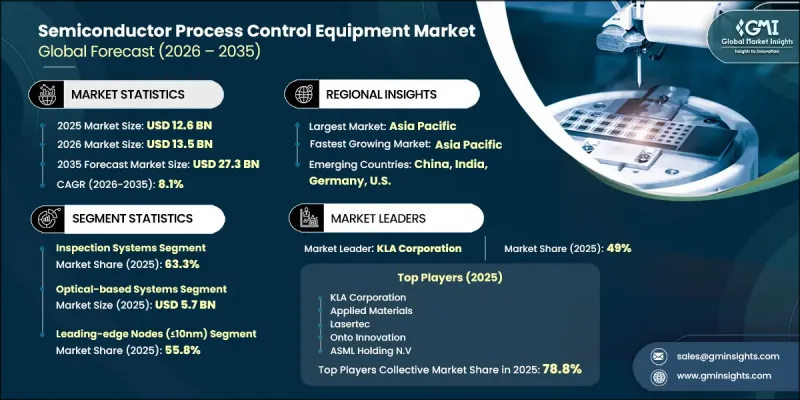
이러한 성장은 반도체 생산 규모의 확대와 제조 공정 전반에 걸쳐 엄격한 품질 기준을 유지해야 할 필요성이 증가함에 따라 뒷받침되고 있습니다. 제조업체들은 결함 감소, 엄격한 공차, 생산 단계 전반에 걸친 지속적인 모니터링을 위해 고급공정제어(APC) 솔루션을 우선적으로 도입하고 있습니다. 칩 설계 및 제조 기술이 복잡해짐에 따라 고정밀 검사 및 측정 시스템에 대한 수요는 더욱 가속화되고 있습니다. 또한, 제조 역량 강화와 기술 업그레이드를 위한 지속적인 투자도 업계에 훈풍이 되고 있습니다. 반도체 디바이스가 점점 더 복잡해짐에 따라, 기업들은 데이터 기반 제조 접근 방식과 고도의 장비 통합을 통해 수율 향상, 공정 안정성 강화, 운영 성능 최적화에 더욱 집중하고 있습니다.
| 시장 범위 | |
|---|---|
| 시작 연도 | 2025년 |
| 예측 기간 | 2026-2035년 |
| 시작 연도 시장 규모 | 126억 달러 |
| 예측 시장 규모 | 273억 달러 |
| CAGR | 8.1% |
반도체 공정 제어 장비 시장은 제조 인프라에 대한 대규모 투자와 세계 반도체 밸류체인 전반에 걸친 확장 이니셔티브에 의해 더욱 강화되고 있습니다. 로직 및 메모리 제조 공정이 복잡해짐에 따라 결함에 대한 민감도가 더욱 높아지고 있으며, 생산 효율성을 유지하기 위해서는 공정 제어 장비가 필수적입니다. 반도체 제조업체는 제조 및 패키징 단계 모두에서 결함 감지 능력 향상, 공정 일관성 확보, 생산성 향상에 주력하고 있습니다. 또한, 첨단 제조 기술 및 통합 기술의 급속한 도입도 검사 및 제어 시스템에 대한 수요 증가에 기여하고 있습니다.
2025년에는 검사 시스템 부문이 63.3%의 점유율을 차지했습니다. 반도체 제조의 여러 공정에서 광범위하게 사용되는 이 시스템은 결함을 조기에 발견하고 생산 수율을 유지하는 데 기여하고 있습니다. 이러한 시스템은 이상 징후를 식별하고 제조 공정이 허용 오차 범위 내에 있는지 확인하는 데 중요한 역할을 합니다.
전자빔(e-beam) 기반 시스템 부문은 2026년부터 2035년까지 연평균 9.9%의 성장률을 보일 것으로 예측됩니다. 이러한 성장은 반도체 생산에서 고해상도 분석 및 정밀 측정 기능에 대한 수요 증가에 기인합니다. 디바이스 구조가 점점 더 미세하고 복잡해짐에 따라, 이러한 시스템은 극히 미세한 결함을 감지하고 공정 최적화 및 수율 향상을 지원하는 상세한 분석을 제공하기 위해 점점 더 많이 활용되고 있습니다.
북미 반도체 공정 제어 장비 시장은 2025년 28.5%의 점유율을 차지할 것으로 예측됐습니다. 이 지역은 반도체 제조 기술의 발전과 제조 시설에 대한 투자 확대로 지속적인 성장세를 보이고 있습니다. 첨단 생산 능력의 발전으로 일관성을 보장하고 운영 효율성을 개선하며 고성능 제조 요구 사항을 지원하는 공정 제어 장비에 대한 수요가 증가하고 있습니다.
자주 묻는 질문
목차
제1장 조사 방법과 범위
제2장 주요 요약
제3장 업계 인사이트
제4장 경쟁 구도
제5장 시장 추산 및 예측 : 장비 유형별, 2022-2035년
제6장 시장 추산 및 예측 : 기술 유형별, 2022-2035년
제7장 시장 추산 및 예측 : 용도별, 2022-2035년
제8장 시장 추산 및 예측 : 프로세스 노드별, 2022-2035년
제9장 시장 추산 및 예측 : 최종 사용자별, 2022-2035년
제10장 시장 추산 및 예측 : 지역별, 2022-2035년
제11장 기업 개요
JHS 26.05.29The Global Semiconductor Process Control Equipment Market was valued at USD 12.6 billion in 2025 and is estimated to grow at a CAGR of 8.1% to reach USD 27.3 billion by 2035.
Growth is supported by the increasing scale of semiconductor production and the growing need to maintain strict quality standards throughout fabrication. Manufacturers are prioritizing advanced process control solutions to reduce defects, maintain tighter tolerances, and enable continuous monitoring across production stages. The rising complexity of chip designs and manufacturing techniques is further accelerating demand for highly accurate inspection and metrology systems. In addition, the industry is benefiting from ongoing investments in fabrication capacity and technological upgrades. As semiconductor devices become more intricate, companies are placing greater emphasis on improving yield, enhancing process stability, and optimizing operational performance through data-driven manufacturing approaches and advanced equipment integration.
| Market Scope | |
|---|---|
| Start Year | 2025 |
| Forecast Year | 2026-2035 |
| Start Value | $12.6 Billion |
| Forecast Value | $27.3 Billion |
| CAGR | 8.1% |
The semiconductor process control equipment market is further strengthened by significant investments in fabrication infrastructure and expansion initiatives across the global semiconductor value chain. Increasing complexity in logic and memory manufacturing processes is creating greater sensitivity to defects, making process control equipment essential for maintaining production efficiency. Semiconductor manufacturers are focusing on improving defect detection capabilities, ensuring process consistency, and enhancing productivity across both fabrication and packaging stages. The rapid adoption of advanced manufacturing technologies and integration techniques is also contributing to higher demand for inspection and control systems.
The inspection systems segment accounted for 63.3% share in 2025. Their widespread use across multiple stages of semiconductor manufacturing supports early defect detection and helps maintain production yields. These systems play a critical role in identifying irregularities and ensuring that manufacturing processes remain within acceptable parameters.
The e-beam-based systems segment is anticipated to grow at a CAGR of 9.9% during 2026-2035. This growth is attributed to the increasing requirement for high-resolution analysis and precise measurement capabilities in semiconductor production. As device structures become more compact and complex, these systems are increasingly utilized to detect extremely small defects and provide detailed analysis that supports process optimization and yield improvement.
North America Semiconductor Process Control Equipment Market captured 28.5% share in 2025. The region is witnessing continued growth due to advancements in semiconductor manufacturing technologies and increased investment in fabrication facilities. Ongoing development of advanced production capabilities is driving demand for process control equipment that ensures consistency, improves operational efficiency, and supports high-performance manufacturing requirements.
Key companies operating in the Global Semiconductor Process Control Equipment Market include ASML Holding N.V., Applied Materials Inc., KLA Corporation, Tokyo Electron Limited, Hitachi High-Tech Corporation, Onto Innovation Inc., SCREEN Holdings Co., Ltd, Nova Ltd, Camtek Ltd, Advantest Corporation, Lasertec Corporation, Rudolph Technologies, ZEISS Group, Muetec Co., Ltd, and Multi-21 Solutions Limited. Companies in the Semiconductor Process Control Equipment Market are adopting a range of strategic initiatives to strengthen their competitive position and expand market presence. They are investing heavily in research and development to introduce advanced inspection and metrology solutions that address evolving manufacturing challenges. Many players are focusing on integrating data analytics and automation into their equipment to improve accuracy and operational efficiency. Strategic collaborations and partnerships are being pursued to enhance technological capabilities and broaden product portfolios. Additionally, companies are expanding their global footprint by establishing new facilities and strengthening supply chains to support growing demand.
Table of Contents
Chapter 1 Methodology and Scope
- 1.1 Market scope and definition
- 1.2 Research design
- 1.2.1 Research approach
- 1.2.2 Data collection methods
- 1.3 Data mining sources
- 1.3.1 Global
- 1.3.2 Regional/Country
- 1.4 Base estimates and calculations
- 1.4.1 Base year calculation
- 1.4.2 Key trends for market estimation
- 1.5 Primary research and validation
- 1.5.1 Primary sources
- 1.6 Forecast model
- 1.7 Research assumptions and limitations
Chapter 2 Executive Summary
- 2.1 Industry 360° synopsis, 2022 - 2035
- 2.2 Key market trends
- 2.2.1 Equipment type trends
- 2.2.2 Technology type trends
- 2.2.3 Application trends
- 2.2.4 Process node trends
- 2.2.5 End-user trends
- 2.2.6 Regional trends
- 2.3 TAM Analysis, 2026-2035
- 2.4 CXO perspectives: Strategic imperatives
Chapter 3 Industry Insights
- 3.1 Industry ecosystem analysis
- 3.1.1 Supplier Landscape
- 3.1.2 Profit Margin
- 3.1.3 Cost structure
- 3.1.4 Value addition at each stage
- 3.1.5 Factor affecting the value chain
- 3.1.6 Disruptions
- 3.2 Industry impact forces
- 3.2.1 Growth drivers
- 3.2.1.1 Increasing complexity at advanced semiconductor technology nodes
- 3.2.1.2 Rising investment in new fabs and capacity expansion worldwide
- 3.2.1.3 Growing emphasis on yield improvement and manufacturing efficiency
- 3.2.1.4 Expansion of advanced packaging and heterogeneous integration
- 3.2.1.5 Adoption of data-driven and automated manufacturing environments
- 3.2.2 Industry pitfalls and challenges
- 3.2.2.1 High capital intensity and rising cost of advanced process control tools
- 3.2.2.2 Increasing complexity of tool integration and data overload in fabs
- 3.2.3 Market opportunities
- 3.2.3.1 Expansion of AI-driven and advanced analytics-enabled process control solutions
- 3.2.3.2 Rising deployment of process control tools in advanced packaging and back-end manufacturing
- 3.2.1 Growth drivers
- 3.3 Growth potential analysis
- 3.4 Regulatory landscape
- 3.4.1 North America
- 3.4.2 Europe
- 3.4.3 Asia Pacific
- 3.4.4 Latin America
- 3.4.5 Middle East & Africa
- 3.5 Porter's analysis
- 3.6 PESTEL analysis
- 3.7 Technology and Innovation landscape
- 3.7.1 Current technological trends
- 3.7.2 Emerging technologies
- 3.8 Price trends
- 3.8.1 By region
- 3.8.2 By product
- 3.9 Pricing Strategies
- 3.10 Emerging Business Models
- 3.11 Compliance Requirements
- 3.12 Patent and IP analysis
Chapter 4 Competitive Landscape, 2025
- 4.1 Introduction
- 4.2 Company market share analysis
- 4.2.1 By region
- 4.2.1.1 North America
- 4.2.1.2 Europe
- 4.2.1.3 Asia Pacific
- 4.2.1.4 Latin America
- 4.2.1.5 Middle East & Africa
- 4.2.2 Market concentration analysis
- 4.2.1 By region
- 4.3 Competitive benchmarking of key players
- 4.3.1 Financial performance comparison
- 4.3.1.1 Revenue
- 4.3.1.2 Profit margin
- 4.3.1.3 R&D
- 4.3.2 Product portfolio comparison
- 4.3.2.1 Product range breadth
- 4.3.2.2 Technology
- 4.3.2.3 Innovation
- 4.3.3 Geographic presence comparison
- 4.3.3.1 Global footprint analysis
- 4.3.3.2 Service network coverage
- 4.3.3.3 Market penetration by region
- 4.3.4 Competitive positioning matrix
- 4.3.4.1 Leaders
- 4.3.4.2 Challengers
- 4.3.4.3 Followers
- 4.3.4.4 Niche players
- 4.3.5 Strategic outlook matrix
- 4.3.1 Financial performance comparison
- 4.4 Key developments
- 4.4.1 Mergers and acquisitions
- 4.4.2 Partnerships and collaborations
- 4.4.3 Technological advancements
- 4.4.4 Expansion and investment strategies
- 4.4.5 Digital transformation initiatives
- 4.5 Emerging/ startup competitors landscape
Chapter 5 Market Estimates and Forecast, By Equipment Type, 2022 - 2035 (USD Million)
- 5.1 Key trends
- 5.2 Inspection systems
- 5.2.1 Patterned wafer inspection
- 5.2.2 Unpatterned wafer inspection
- 5.2.3 Defect review systems
- 5.3 Metrology systems
- 5.3.1 Dimensional metrology
- 5.3.2 Material metrology
Chapter 6 Market Estimates and Forecast, By Technology Type, 2022 - 2035 (USD Million)
- 6.1 Key trends
- 6.2 Optical-based systems
- 6.3 E-beam-based systems
- 6.4 Integrated workflow systems
Chapter 7 Market Estimates and Forecast, By Application, 2022 - 2035 (USD Million)
- 7.1 Key trends
- 7.2 Front-end-of-line (FEOL)
- 7.3 Back-end-of-line (BEOL)
- 7.4 Advanced packaging
Chapter 8 Market Estimates and Forecast, By Process Node, 2022 - 2035 (USD Million)
- 8.1 Key trends
- 8.2 Leading-edge nodes (<=10nm)
- 8.3 Mature nodes (>10nm)
Chapter 9 Market Estimates and Forecast, By End-User, 2022 - 2035 (USD Million)
- 9.1 Key trends
- 9.2 Integrated device manufacturers (IDMs)
- 9.3 Pure-play foundries
- 9.4 OSATs
Chapter 10 Market Estimates and Forecast, By Region, 2022 - 2035 (USD Million)
- 10.1 Key trends
- 10.2 North America
- 10.2.1 U.S.
- 10.2.2 Canada
- 10.3 Europe
- 10.3.1 Germany
- 10.3.2 UK
- 10.3.3 France
- 10.3.4 Spain
- 10.3.5 Italy
- 10.3.6 Russia
- 10.4 Asia Pacific
- 10.4.1 China
- 10.4.2 India
- 10.4.3 Japan
- 10.4.4 Australia
- 10.4.5 South Korea
- 10.5 Latin America
- 10.5.1 Brazil
- 10.5.2 Mexico
- 10.5.3 Argentina
- 10.6 Middle East and Africa
- 10.6.1 South Africa
- 10.6.2 Saudi Arabia
- 10.6.3 UAE
Chapter 11 Company Profiles
- 11.1 Global Key Players
- 11.1.1 KLA Corporation
- 11.1.2 Applied Materials
- 11.1.3 Lasertec
- 11.1.4 Onto Innovation
- 11.1.5 ASML Holding N.V
- 11.2 Regional key players
- 11.2.1 North America
- 11.2.1.1 Rudolph Technologies
- 11.2.2 Europe
- 11.2.2.1 Nova Ltd
- 11.2.2.2 ZEISS Group
- 11.2.3 Asia Pacific
- 11.2.3.1 Hitachi High-Tech Corporation
- 11.2.3.2 Tokyo Electron Limited
- 11.2.3.3 SCREEN Holdings Co., Ltd
- 11.2.3.4 Advantest Corporation
- 11.2.3.5 Muetec Co., Ltd
- 11.2.1 North America
- 11.3 Niche Players/Disruptors
- 11.3.1 Camtek Ltd
- 11.3.2 Multi-21 Solutions Limited


