

|
시장보고서
상품코드
2038360
세라믹 볼 시장 : 시장 기회, 성장요인, 업계 동향 분석 및 예측(2026-2035년)Ceramic Balls Market Opportunity, Growth Drivers, Industry Trend Analysis, and Forecast 2026 - 2035 |
||||||

세계의 세라믹 볼 시장은 2025년에 5억 8,290만 달러로 평가되었고, 2035년까지 연평균 복합 성장률(CAGR) 4.3%로 성장할 전망이며, 8억 9,670만 달러에 이를 것으로 예측됩니다.
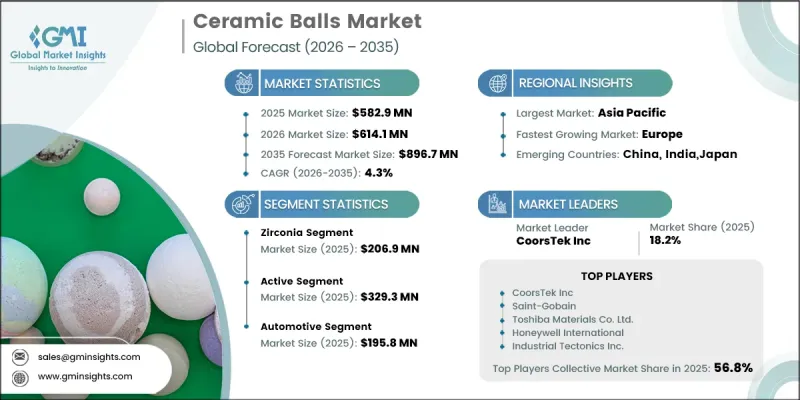
세라믹 볼은 고품질 세라믹 재료로 제조되는 고급 구형 엔지니어링 부품으로, 세라믹 분말을 고온 소결한 후 정밀 성형 공정을 거쳐 치밀하고 균일한 구조를 구현합니다. 이 부품은 높은 경도, 경량성 및 우수한 내식성으로 널리 인정받고 있으며, 열악한 산업 환경에서 사용하기에 적합합니다. 이러한 성능상의 장점으로 인해 극한의 작동 조건에서 내구성이 필수적인 자동차, 항공우주, 화학 처리, 석유 및 가스 등의 분야에서 널리 사용되고 있습니다. 또한, 세라믹 볼은 내마모성, 내열충격성, 내화학적 열화성이 우수하여 기존 시스템부터 고부하 시스템까지 안정적인 성능을 발휘합니다. 많은 용도 분야에서 윤활유 없이 작동할 수 있는 특성은 첨단 기계 시스템에서 그 수요를 더욱 증가시키고 있습니다. 고정밀 엔지니어링 솔루션에 대한 의존도가 높아짐에 따라 효율성과 긴 수명을 중시하는 산업 전반에 걸쳐 채택이 계속 확대되고 있습니다. 정교한 소결 공정 및 정밀 연삭 기술을 포함한 재료 과학 및 생산 기술의 지속적인 발전으로 치수 정확도, 표면 마감 및 진원도 제어가 향상되어 산업에서의 실용성이 더욱 확대되고 있습니다.
| 시장 범위 | |
|---|---|
| 개시 연도 | 2025년 |
| 예측 기간 | 2026-2035년 |
| 개시 시점 시장 규모 | 5억 8,290만 달러 |
| 예측 시장 규모 | 8억 9,670만 달러 |
| CAGR | 4.3% |
지르코니아 세라믹 볼 시장은 2025년에 2억 690만 달러에 달했습니다. 이 부문은 우수한 인성과 파괴 저항성으로 인해 가혹한 조건이 요구되는 베어링 시스템 및 밸브 응용 분야에 매우 적합하기 때문에 견고한 성장세를 유지하고 있습니다. 지르코니아 가공 기술의 향상으로 구조적 안정성과 성능의 일관성이 향상되어 이러한 부품이 산업 환경에서 기계적 응력, 열 사이클 및 충격 하중을 견딜 수 있게 되었습니다.
액티브 세라믹 볼 부문은 2025년 3억 2,930만 달러를 차지했습니다. 이 부문은 베어링 및 정밀 기계의 하중 전달과 운동 제어에 직접적으로 관여하기 때문에 강한 추진력을 보이고 있습니다. 저마찰, 내구성 및 긴 수명이 필수적인 고속 기계 시스템에서 그 채택이 증가하고 있습니다. 또한, 안정적인 회전 효율이 요구되는 첨단 자동차 드라이브 트레인 및 고성능 산업 장비에 사용되면서 수요를 더욱 뒷받침하고 있습니다.
북미의 세라믹 볼 시장은 2025년 1억 8,940만 달러로 평가되었고, 2035년까지 2억 9,780만 달러로 성장할 것으로 예측됩니다. 이 지역 시장 성장은 항공우주 및 자동차 제조 부문의 강력한 수요와 더불어 첨단 생산 기술의 채택 확대에 힘입어 성장세를 보이고 있습니다. 정밀 엔지니어링 기술의 고도화와 하이브리드 베어링 시스템의 사용 증가도 시장 발전에 더욱 기여하고 있습니다. 미국은 전기자동차 생산 증가와 항공우주용 엔진 및 고정밀 산업기계에 대한 용도 확대로 지역 내 소비를 지속적으로 견인하고 있습니다.
자주 묻는 질문
목차
제1장 조사 방법 및 범위
제2장 주요 요약
제3장 업계 인사이트
제4장 경쟁 구도
제5장 시장 추산 및 예측 : 재료별(2022-2035년)
제6장 시장 추산 및 예측 : 기능별(2022-2035년)
제7장 시장 추산 및 예측 : 용도별(2022-2035년)
제8장 시장 추산 및 예측 : 최종 이용 산업별(2022-2035년)
제9장 시장 추산 및 예측 : 지역별(2022-2035년)
제10장 기업 개요
AJY 26.06.11The Global Ceramic Balls Market was valued at USD 582.9 million in 2025 and is estimated to grow at a CAGR of 4.3% to reach USD 896.7 million by 2035.
Ceramic balls are advanced spherical engineering components produced from high-grade ceramic materials through high-temperature sintering of ceramic powders, followed by precision shaping processes to achieve dense and uniform structures. These components are widely recognized for their high hardness, low weight, and strong resistance to corrosion, making them suitable for demanding industrial environments. Their performance advantages make them widely used across automotive, aerospace, chemical processing, and oil and gas applications where durability under extreme operating conditions is critical. Ceramic balls also offer strong resistance to wear, thermal shock, and chemical degradation, which enables stable performance in both conventional and high-stress systems. Their ability to operate without lubrication in many applications further enhances their demand in advanced mechanical systems. Growing reliance on high-precision engineering solutions continues to strengthen their adoption across industries focused on efficiency and long operational life. Continuous advancements in material science and production technologies, including refined sintering processes and precision grinding techniques, have improved control over dimensional accuracy, surface finish, and sphericity, further expanding their industrial usability.
| Market Scope | |
|---|---|
| Start Year | 2025 |
| Forecast Year | 2026-2035 |
| Start Value | $ 582.9 Million |
| Forecast Value | $ 896.7 Million |
| CAGR | 4.3% |
The zirconia-based ceramic balls segment reached USD 206.9 million in 2025. This segment maintains strong momentum due to its excellent toughness and resistance to fracture, making it highly suitable for demanding bearing systems and valve applications. Improvements in zirconia processing have enhanced structural stability and performance consistency, allowing these components to withstand mechanical stress, thermal cycling, and impact loads across industrial environments.
The active ceramic balls segment accounted for USD 329.3 million in 2025. This segment is gaining strong traction as these components play a direct role in load transmission and motion control within bearings and precision machinery. Their adoption is increasing across high-speed mechanical systems where low friction, durability, and extended operational life are essential. Demand is further supported by their use in advanced automotive drivetrains and high-performance industrial equipment requiring stable rotational efficiency.
North America Ceramic Balls Market is expected to grow from USD 189.4 million in 2025 to USD 297.8 million by 2035. Market growth in the region is supported by strong demand from aerospace and automotive manufacturing sectors, along with increasing adoption of advanced production technologies. The expansion of precision engineering capabilities and the rising use of hybrid bearing systems further contribute to market development. The United States continues to dominate regional consumption due to rising electric vehicle production and expanding applications in aerospace engines and high-precision industrial machinery.
Key companies operating in the Global Ceramic Balls Industry include CoorsTek, Inc., Saint-Gobain, Axens, Honeywell International Inc., Boca Bearing Company, Industrial Tectonics Inc., MetalBall, Ortech Advanced Ceramics, Global Precision Ball & Roller, Toshiba Materials Co., Ltd., Fineway Inc., Devson Catalyst Private Limited, and Topack Ceramics Pvt. Ltd. Companies in the ceramic balls market are focusing on material innovation, precision manufacturing, and capacity expansion to strengthen their market position. They are investing in advanced ceramic formulations that improve hardness, durability, and thermal resistance. Automation in grinding and sintering processes is being adopted to enhance dimensional accuracy and reduce production variability. Strategic partnerships with automotive and aerospace manufacturers support customized product development for high-performance applications. Firms are also expanding regional production facilities to improve supply chain efficiency and reduce lead times.
Table of Contents
Chapter 1 Methodology & Scope
- 1.1 Market scope and definition
- 1.2 Research design
- 1.2.1 Research approach
- 1.2.2 Data collection methods
- 1.3 Data mining sources
- 1.3.1 Global
- 1.3.2 Regional/Country
- 1.4 Base estimates and calculations
- 1.4.1 Base year calculation
- 1.4.2 Key trends for market estimation
- 1.5 Primary research and validation
- 1.5.1 Primary sources
- 1.6 Forecast model
- 1.7 Research assumptions and limitations
Chapter 2 Executive Summary
- 2.1 Industry 360° synopsis
- 2.2 Key market trends
- 2.2.1 Material
- 2.2.2 Function
- 2.2.3 Application
- 2.2.4 End-Use Industry
- 2.2.5 Regional
- 2.3 TAM Analysis, 2026-2035
- 2.4 CXO perspectives: Strategic imperatives
Chapter 3 Industry Insights
- 3.1 Industry ecosystem analysis
- 3.1.1 Supplier landscape
- 3.1.2 Profit margin
- 3.1.3 Value addition at each stage
- 3.1.4 Factor affecting the value chain
- 3.1.5 Disruptions
- 3.2 Industry impact forces
- 3.2.1 Growth drivers
- 3.2.2 Industry pitfalls and challenges
- 3.2.3 Market opportunities
- 3.3 Growth potential analysis
- 3.4 Regulatory landscape
- 3.4.1 North America
- 3.4.2 Europe
- 3.4.3 Asia Pacific
- 3.4.4 Latin America
- 3.4.5 Middle East & Africa
- 3.5 Porter's analysis
- 3.6 PESTEL analysis
- 3.7 Price trends
- 3.7.1 By region
- 3.7.2 By product type
- 3.8 Future market trends
- 3.9 Technology and Innovation landscape
- 3.9.1 Current technological trends
- 3.9.2 Emerging technologies
- 3.10 Patent Landscape
- 3.11 Trade statistics (HS code)
- 3.11.1 Major importing countries
- 3.11.2 Major exporting countries
- 3.12 Sustainability and environmental aspects
- 3.12.1 Sustainable practices
- 3.12.2 Waste reduction strategies
- 3.12.3 Energy efficiency in production
- 3.12.4 Eco-friendly initiatives
- 3.13 Carbon footprint consideration
Chapter 4 Competitive Landscape, 2025
- 4.1 Introduction
- 4.2 Company market share analysis
- 4.2.1 By region
- 4.2.1.1 North America
- 4.2.1.2 Europe
- 4.2.1.3 Asia Pacific
- 4.2.1.4 LATAM
- 4.2.1.5 MEA
- 4.2.1 By region
- 4.3 Competitive analysis of major market players
- 4.4 Competitive positioning matrix
- 4.5 Key developments
- 4.5.1 Mergers & acquisitions
- 4.5.2 Partnerships & collaborations
- 4.5.3 New Product Launches
- 4.5.4 Expansion Plans
Chapter 5 Market Estimates and Forecast, By Material, 2022-2035 (USD Billion) (Kilo Tons)
- 5.1 Key trends
- 5.2 Zirconia
- 5.3 Silicon
- 5.4 Alumina
- 5.5 Others
Chapter 6 Market Estimates and Forecast, By Function, 2022-2035 (USD Billion) (Kilo Tons)
- 6.1 Key trends
- 6.2 Active
- 6.3 Inert
Chapter 7 Market Estimates and Forecast, By Application, 2022-2035 (USD Million) (Kilo Tons)
- 7.1 Key trends
- 7.2 Bearing
- 7.3 Grinding
- 7.4 Valve
- 7.5 Others
Chapter 8 Market Estimates and Forecast, By End-Use Industry, 2022-2035 (USD Million) (Kilo Tons)
- 8.1 Key trends
- 8.2 Automotive
- 8.3 Aerospace
- 8.4 Chemical
- 8.5 Oil & Gas
- 8.6 Medical
- 8.7 Others
Chapter 9 Market Estimates and Forecast, By Region, 2022-2035 (USD Million) (Kilo Tons)
- 9.1 Key trends
- 9.2 North America
- 9.2.1 U.S.
- 9.2.2 Canada
- 9.3 Europe
- 9.3.1 Germany
- 9.3.2 UK
- 9.3.3 France
- 9.3.4 Spain
- 9.3.5 Italy
- 9.3.6 Rest of Europe
- 9.4 Asia Pacific
- 9.4.1 China
- 9.4.2 India
- 9.4.3 Japan
- 9.4.4 Australia
- 9.4.5 South Korea
- 9.4.6 Rest of Asia Pacific
- 9.5 Latin America
- 9.5.1 Brazil
- 9.5.2 Mexico
- 9.5.3 Argentina
- 9.5.4 Rest of Latin America
- 9.6 Middle East and Africa
- 9.6.1 Saudi Arabia
- 9.6.2 South Africa
- 9.6.3 UAE
- 9.6.4 Rest of Middle East and Africa
Chapter 10 Company Profiles
- 10.1 Axens
- 10.2 Boca Bearing Company
- 10.3 CoorsTek, Inc. (consolidating CERBEC)
- 10.4 Devson Catalyst Private Limited
- 10.5 Fineway Inc.
- 10.6 Global Precision Ball & Roller
- 10.7 Honeywell International
- 10.8 Industrial Tectonics Inc./Bearings Corp.
- 10.9 MetalBall
- 10.10 Ortech Advanced Ceramics
- 10.11 Saint-Gobain
- 10.12 Topack Ceramics Pvt. Ltd.
- 10.13 Toshiba Materials Co. Ltd.


