

|
시장보고서
상품코드
2038385
로봇 수영장 청소기 시장 : 시장 기회, 성장요인, 업계 동향 분석 및 예측(2026-2035년)Robotic Pool Cleaner Market Opportunity, Growth Drivers, Industry Trend Analysis, and Forecast 2026 - 2035 |
||||||

세계의 로봇 수영장 청소기 시장은 2025년에 11억 8,000만 달러로 평가되었고, 2035년까지 연평균 복합 성장률(CAGR) 23.7%로 성장할 전망이며, 91억 1,000만 달러에 이를 것으로 추정되고 있습니다.
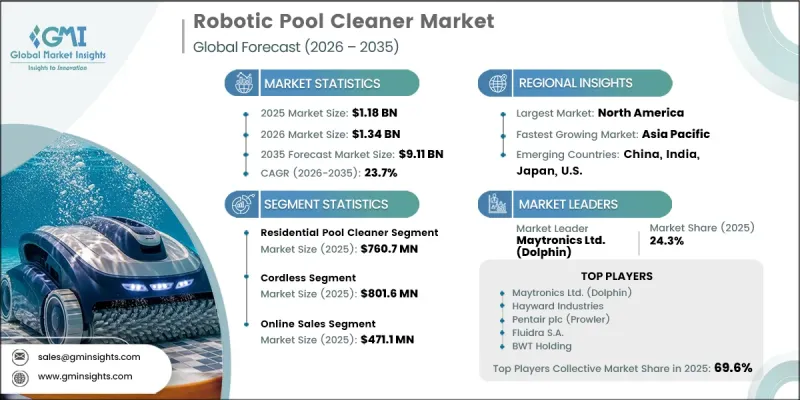
시장 확대는 주거용 및 상업용 수영장 증가와 더불어 자동화되고 유지보수가 적은 청소 솔루션에 대한 수요 증가에 의해 주도되고 있습니다. 로봇 공학, 특히 인공지능 및 센서 기술의 지속적인 발전으로 제품의 효율성과 작동 정확도가 크게 향상되었습니다. 에너지 절약형 수영장 유지관리 시스템에 대한 관심이 높아지면서 각 최종 사용자 부문에서 도입이 더욱 가속화되고 있습니다. 스마트 기술의 통합이 진행됨에 따라 수영장 청소는 고도로 자동화되고 사용자 친화적인 프로세스로 변모하고 있습니다. 최신 로봇 청소기는 수영장 레이아웃을 매핑하고, 구조적 변화에 대응하며, 장애물을 감지하는 지능형 내비게이션 시스템을 탑재하여 사람의 손을 거치지 않고도 구석구석 청소할 수 있습니다. 고급 모델에서는 AI 기반 학습 기능을 활용하여 시간이 지남에 따라 청소 경로를 최적화하여 성능을 향상시키는 동시에 장비의 마모를 줄입니다. 또한, 환경에 대한 인식이 높아지면서 물과 화학물질 사용량을 최소화하는 시스템에 대한 수요가 증가하고 있어 시장 성장 전망을 더욱 견고하게 하고 있습니다.
| 시장 범위 | |
|---|---|
| 개시 연도 | 2025년 |
| 예측 기간 | 2026-2035년 |
| 개시 연도 시장 규모 | 11억 8,000만 달러 |
| 예측 시장 규모 | 91억 1,000만 달러 |
| CAGR | 23.7% |
주거용 수영장 청소기 시장은 2025년 7억 6,070만 달러 규모에 달했습니다. 이 시스템은 개인 주거용 수영장을 위해 특별히 설계된 자동 청소 장치입니다. 지능형 내비게이션, 흡입식 시스템, 압력 구동 메커니즘 등 첨단 로봇 기술을 통합하여 수영장 바닥, 벽면, 수면 근처에서 먼지, 쓰레기, 조류를 효과적으로 제거합니다. 편의성, 에너지 효율성, 수작업 감소를 추구하는 소비자 트렌드가 증가함에 따라, 스마트한 수영장 유지관리 옵션을 원하는 주택 소유주에게 이러한 솔루션은 매우 매력적입니다.
유선 부문은 2025-2036년 연평균 복합 성장률(CAGR) 19.1%를 나타낼 것으로 예측됩니다. 수요는 높은 성능, 연속 가동 및 비용 효율성에 의해 주도되고 있습니다. 이 시스템은 안정적인 흡입력과 중단 없는 청소 주기가 요구되는 대규모 설치 환경에서 널리 선호되며, 집중적인 청소 환경에 적합합니다.
2025년 기준 북미의 로봇 수영장 청소기 시장은 39.1%의 점유율을 차지했습니다. 이 지역의 성장은 주거용 및 상업용 수영장의 대규모 도입 실적과 더불어 자동화된 유지보수 솔루션에 대한 소비자의 관심 증가에 힘입은 바 큽니다. 에너지 절약 기능과 스마트홈과의 호환성을 갖춘 AI 탑재 로봇청소기의 보급은 수요를 더욱 촉진하고 있습니다. 또한, 온라인 소매 플랫폼, 수영장 전문점, 홈센터 등의 판매 채널을 통한 유통 확대도 시장 확대를 뒷받침하고 있으며, 제품의 접근성과 소비자 접근성이 강화되고 있습니다.
자주 묻는 질문
목차
제1장 조사 방법 및 범위
제2장 주요 요약
제3장 업계 인사이트
제4장 경쟁 구도
제5장 시장 추산 및 예측 : 접속 방식별(2022-2035년)
제6장 시장 추산 및 예측 : 풀 사이즈별(2022-2035년)
제7장 시장 추산 및 예측 : 유통 채널별(2022-2035년)
제8장 시장 추산 및 예측 : 최종 사용자별(2022-2035년)
제9장 시장 추산 및 예측 : 지역별(2022-2035년)
제10장 기업 개요
AJY 26.06.11The Global Robotic Pool Cleaner Market was valued at USD 1.18 billion in 2025 and is estimated to grow at a CAGR of 23.7% to reach USD 9.11 billion by 2035.
Market expansion is driven by the rising number of swimming pools across residential and commercial properties, alongside increasing demand for automated and low-maintenance cleaning solutions. Continuous advancements in robotics, particularly in artificial intelligence and sensor-based technologies, are significantly enhancing product efficiency and operational precision. The growing focus on energy-efficient pool maintenance systems is further accelerating adoption across end-use sectors. Increasing integration of smart technologies is transforming pool cleaning into a highly automated and user-friendly process. Modern robotic cleaners are designed with intelligent navigation systems that map pool layouts, adjust to structural variations, and detect obstacles to ensure complete cleaning coverage without human intervention. Advanced models also leverage AI-based learning capabilities to refine cleaning routes over time, improving performance while reducing equipment wear. Rising environmental awareness is also supporting demand for systems that minimize water and chemical usage, further strengthening market growth prospects.
| Market Scope | |
|---|---|
| Start Year | 2025 |
| Forecast Year | 2026-2035 |
| Start Value | $1.18 Billion |
| Forecast Value | $9.11 Billion |
| CAGR | 23.7% |
The residential pool cleaner segment generated USD 760.7 million in 2025. These systems are automated cleaning devices designed specifically for private residential swimming pools. They incorporate advanced robotic technologies, including intelligent navigation, suction-based systems, and pressure-driven mechanisms to effectively eliminate dirt, debris, and algae from pool floors, walls, and waterlines. Increasing consumer preference for convenience, energy efficiency, and reduced manual effort is making these solutions highly attractive for homeowners seeking smart pool maintenance options.
The corded segment is projected to register growth at a CAGR of 19.1% during 2025 to 2036. Demand is driven by their strong performance capabilities, continuous operation, and cost efficiency. These systems are widely preferred for large-scale installations where consistent suction power and uninterrupted cleaning cycles are required, making them suitable for intensive cleaning environments.
North America Robotic Pool Cleaner Market accounted for 39.1% share in 2025. The region's growth is supported by a large installed base of residential and commercial swimming pools, along with rising consumer inclination toward automated maintenance solutions. Strong adoption of AI-powered robotic cleaners with energy-efficient features and smart home compatibility is further boosting demand. Market expansion is also supported by increasing distribution through online retail platforms, pool specialty stores, and home improvement channels, strengthening accessibility and consumer reach.
Key players in the Global Robotic Pool Cleaner Industry include Hayward Industries (AquaVac, TigerShark), Fluidra S.A. (Polaris, Zodiac), Maytronics Ltd. (Dolphin), Pentair plc (Prowler), Fairland Group, BWT Holding, Beatbot, Waterco Limited, Water Tech Corp, Mariner 3S, WEDA Dammann & Westerkamp, Zucchetti Centro Sistemi, Milagrow HumanTech, Paxcess, Hangzhou Gaoyue Technology, and Wybotics. Companies in the Robotic Pool Cleaner Market are focusing on enhancing product intelligence through advanced AI and sensor integration to improve cleaning accuracy and automation levels. Continuous investment in R&D is enabling the development of energy-efficient and high-performance robotic systems. Manufacturers are expanding product portfolios with smart connectivity features, including app-based control and real-time monitoring capabilities. Strategic partnerships with distributors, e-commerce platforms, and retail networks are strengthening global market penetration. Firms are also prioritizing product durability, improved battery performance, and reduced maintenance requirements to enhance customer satisfaction.
Table of Contents
Chapter 1 Methodology and Scope
- 1.1 Market scope and definition
- 1.2 Research design
- 1.2.1 Research approach
- 1.2.2 Data collection methods
- 1.3 Data mining sources
- 1.3.1 Global
- 1.3.2 Regional/Country
- 1.4 Base estimates and calculations
- 1.4.1 Base year calculation
- 1.4.2 Key trends for market estimation
- 1.5 Primary research and validation
- 1.5.1 Primary sources
- 1.6 Forecast model
- 1.7 Research assumptions and limitations
Chapter 2 Executive Summary
- 2.1 Industry 360° synopsis, 2022 - 2035
- 2.2 Key market trends
- 2.2.1 Connectivity trends
- 2.2.2 Pool Size trends
- 2.2.3 Distribution Channel trends
- 2.2.4 End-user trends
- 2.2.5 Regional trends
- 2.3 CXO perspectives: Strategic imperatives
Chapter 3 Industry Insights
- 3.1 Industry ecosystem analysis
- 3.1.1 Supplier Landscape
- 3.1.2 Profit Margin
- 3.1.3 Cost structure
- 3.1.4 Value addition at each stage
- 3.1.5 Factor affecting the value chain
- 3.1.6 Disruptions
- 3.2 Industry impact forces
- 3.2.1 Growth drivers
- 3.2.1.1 Increasing integration in advanced technology, AI and sensors
- 3.2.1.2 Energy-efficient and eco-friendly pool cleaning solutions
- 3.2.1.3 Increasing consumer demand for smart home solutions
- 3.2.1.4 Enhanced energy efficiency and environmental sustainability
- 3.2.1.5 Rising residential and commercial swimming pool installations
- 3.2.2 Industry pitfalls and challenges
- 3.2.2.1 High initial cost of advanced robotic pool cleaners
- 3.2.2.2 Limited adaptability to irregular pool shapes and surfaces
- 3.2.3 Market opportunities
- 3.2.3.1 Expansion of smart robotic solutions for residential pools
- 3.2.3.2 Growth of commercial and hotel pool automation
- 3.2.1 Growth drivers
- 3.3 Growth potential analysis
- 3.4 Regulatory landscape
- 3.4.1 North America
- 3.4.2 Europe
- 3.4.3 Asia Pacific
- 3.4.4 Latin America
- 3.4.5 Middle East & Africa
- 3.5 Porter's analysis
- 3.6 PESTEL analysis
- 3.7 Technology and Innovation landscape
- 3.7.1 Current technological trends
- 3.7.2 Emerging technologies
- 3.8 Price trends
- 3.8.1 By region
- 3.8.2 By product
- 3.9 Pricing Strategies
- 3.10 Emerging Business Models
- 3.11 Compliance Requirements
- 3.12 Patent and IP analysis
Chapter 4 Competitive Landscape, 2025
- 4.1 Introduction
- 4.2 Company market share analysis
- 4.2.1 By region
- 4.2.1.1 North America
- 4.2.1.2 Europe
- 4.2.1.3 Asia Pacific
- 4.2.1.4 Latin America
- 4.2.1.5 Middle East & Africa
- 4.2.2 Market concentration analysis
- 4.2.1 By region
- 4.3 Competitive benchmarking of key players
- 4.3.1 Financial performance comparison
- 4.3.1.1 Revenue
- 4.3.1.2 Profit margin
- 4.3.1.3 R&D
- 4.3.2 Product portfolio comparison
- 4.3.2.1 Product range breadth
- 4.3.2.2 Technology
- 4.3.2.3 Innovation
- 4.3.3 Geographic presence comparison
- 4.3.3.1 Global footprint analysis
- 4.3.3.2 Service network coverage
- 4.3.3.3 Market penetration by region
- 4.3.4 Competitive positioning matrix
- 4.3.4.1 Leaders
- 4.3.4.2 Challengers
- 4.3.4.3 Followers
- 4.3.4.4 Niche players
- 4.3.1 Financial performance comparison
- 4.4 Key developments
- 4.4.1 Mergers and acquisitions
- 4.4.2 Partnerships and collaborations
- 4.4.3 Technological advancements
- 4.4.4 Expansion and investment strategies
- 4.4.5 Digital transformation initiatives
- 4.5 Emerging/ startup competitors landscape
Chapter 5 Market Estimates and Forecast, By Connectivity, 2022 - 2035 (USD Million)
- 5.1 Key trends
- 5.2 Corded Robotic
- 5.3 Cordless Robotic
Chapter 6 Market Estimates and Forecast, By Pool Size, 2022 - 2035 (USD Million)
- 6.1 Key trends
- 6.2 Small Pools (up to 30m2)
- 6.3 Medium Pools (30-60m2)
- 6.4 Large Pools (above 60m2)
- 6.5 Olympic-size Pools
- 6.6 Others
Chapter 7 Market Estimates and Forecast, By Distribution Channel, 2022 - 2035 (USD Million)
- 7.1 Key trends
- 7.2 Online Sales
- 7.2.1 Brand D2C Websites
- 7.2.2 E-commerce Marketplaces
- 7.2.3 Specialty Online Retailers
- 7.3 Home Improvement Stores
- 7.4 Pool Supply Stores
- 7.5 Direct Sales
Chapter 8 Market Estimates and Forecast, By End User, 2022 - 2035 (USD Million)
- 8.1 Key trends
- 8.2 Residential pool
- 8.2.1 Small
- 8.2.2 Medium
- 8.2.3 Large
- 8.3 Commercial pool
- 8.3.1 Hotels and resorts
- 8.3.2 Public swimming
- 8.3.3 Community centers
- 8.3.4 Educational institutions
- 8.3.5 Healthcare facilities
- 8.3.6 Others
- 8.4 Others
Chapter 9 Market Estimates and Forecast, By Region, 2022 - 2035 (USD Million)
- 9.1 Key trends
- 9.2 North America
- 9.2.1 U.S.
- 9.2.2 Canada
- 9.3 Europe
- 9.3.1 Germany
- 9.3.2 UK
- 9.3.3 France
- 9.3.4 Spain
- 9.3.5 Italy
- 9.3.6 Netherlands
- 9.4 Asia Pacific
- 9.4.1 China
- 9.4.2 India
- 9.4.3 Japan
- 9.4.4 Australia
- 9.4.5 South Korea
- 9.5 Latin America
- 9.5.1 Brazil
- 9.5.2 Mexico
- 9.5.3 Argentina
- 9.6 Middle East and Africa
- 9.6.1 South Africa
- 9.6.2 Saudi Arabia
- 9.6.3 UAE
Chapter 10 Company Profiles
- 10.1 Global Key Players
- 10.1.1 Fluidra S.A. (Zodiac, Polaris)
- 10.1.2 Hayward Industries (TigerShark, AquaVac)
- 10.1.3 Maytronics Ltd. (Dolphin)
- 10.1.4 Pentair plc (Prowler)
- 10.1.5 Fairland Group
- 10.2 Regional key players
- 10.2.1 BWT Holding
- 10.2.2 Beatbot
- 10.2.3 Water Tech Corp
- 10.2.4 Waterco Limited
- 10.3 Niche Players/Disruptors
- 10.3.1 WEDA Dammann & Westerkamp
- 10.3.2 Mariner 3S
- 10.3.3 Zucchetti Centro Sistemi
- 10.3.4 Milagrow HumanTech
- 10.3.5 Paxcess
- 10.3.6 Hangzhou Gaoyue Technology
- 10.3.7 Wybotics


