

|
시장보고서
상품코드
2038391
젖산염 시장 : 시장 비즈니스 기회, 성장요인, 업계 동향 분석 및 예측(2026-2035년)Lactate Salt Market Opportunity, Growth Drivers, Industry Trend Analysis, and Forecast 2026 - 2035 |
||||||

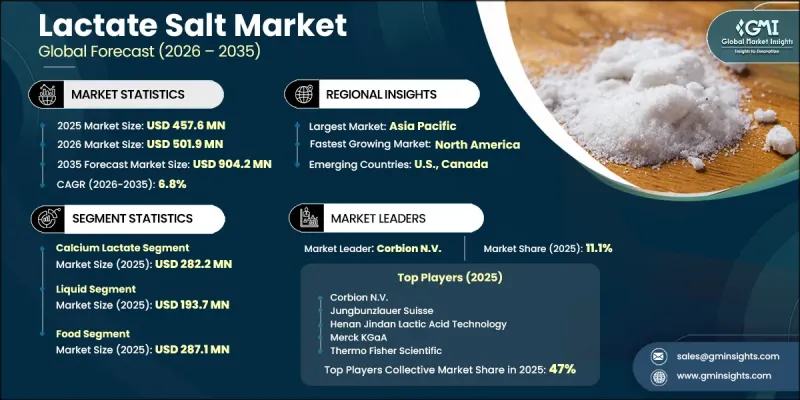
세계의 젖산염 시장은 2025년에 4억 5,760만 달러로 평가되었고, CAGR 6.8%로 성장할 전망이며, 2035년까지 9억 420만 달러에 이를 것으로 추정되고 있습니다.
시장 성장은 여러 최종 사용 산업에서 안정성 향상, 산도 조절, 미네랄 강화를 위한 기능성 원료의 사용이 증가함에 따라 주도되고 있습니다. 젖산염은 젖산을 나트륨, 칼슘, 칼륨, 마그네슘 등의 미네랄 염기로 중화시켜 생성되며, 높은 용해성과 안정된 성능 특성을 가진 화합물이 됩니다. 이 소금은 제제 개발에서 완충제, 산도 조절제 및 미네랄 운반체로서의 역할을 수행하기 때문에 널리 평가받고 있습니다. 그 기능적 다양성은 미네랄 조성에 따라 다르며, 다양한 산업적 요구에 맞는 용도에 적용이 가능합니다. 액체, 분말, 과립 형태로 제공되며, 다양한 가공 및 제조 요건에 대응할 수 있습니다. 순한 맛, 높은 호환성, 그리고 제품의 균일성과 저장 안정성을 향상시키는 효과로 인해 수요가 증가하고 있습니다. 이 시장은 식음료, 제약, 헬스케어, 퍼스널케어 및 산업 분야를 대상으로 하며, 이들 분야에서 젖산염은 제제의 산도 조절, 유통기한 연장 및 질감 안정화를 위해 사용됩니다. 건강 관리 및 제약 분야에서 전해질 용액, 주사제, 미네랄 보충제 제품에 널리 사용되어 생리적 균형과 제품 품질을 유지하는 데 중요한 역할을 합니다.
| 시장 범위 | |
|---|---|
| 개시 연도 | 2025년 |
| 예측 기간 | 2026-2035년 |
| 개시 시점 시장 규모 | 4억 5,760만 달러 |
| 예측 시장 규모 | 9억 420만 달러 |
| CAGR | 6.8% |
젖산 칼슘 부문은 2025년에 2억 8,220만 달러에 달했습니다. 그 수요는 영양 강화 용도, 특히 맛을 바꾸지 않고 미네랄을 강화해야 하는 식품 배합에 광범위하게 사용되어 그 수요를 강력하게 뒷받침하고 있습니다. 중성적인 맛 프로파일과 안정성과 영양가를 높이는 능력으로 인해 베이커리 제품, 유제품 베이스 배합 및 기능성 식품 카테고리에서 널리 사용되고 있습니다.
액체 부문은 2025년 1억 9,370만 달러를 차지했습니다. 액체 젖산염은 취급의 용이성, 빠른 용해성 및 식품, 의약품, 헬스케어 용도 분야 전반에 대한 적응성으로 인해 강력한 추진력을 보이고 있습니다. 연속 처리 시스템과의 호환성을 통해 일관된 생산 효율을 유지할 수 있어 균일성과 운영 안정성이 필수적인 대규모 제조 환경에서 매우 선호되고 있습니다.
북미의 젖산염 시장은 2025년 1억 1,600만 달러로 평가되었고, 2035년까지 1억 9,260만 달러로 성장할 것으로 예측됩니다. 식품 가공, 의약품 제조, 헬스케어 분야에 광범위하게 사용되면서 지역 수요는 꾸준히 증가하고 있습니다. 이러한 분야에서는 제품의 일관성과 규정 준수가 매우 중요하게 여겨지고 있습니다. 가공식품의 소비 트렌드와 지속적인 의약품 생산 활동이 수요 증가를 뒷받침하고 있습니다. 이 지역의 제조업체들은 엄격한 품질 기준을 충족하고 공급망 전반에 걸쳐 신뢰성을 보장하는 안정적인 제형 개발에 주력하고 있으며, 이는 시장의 장기적인 확장을 촉진하고 있습니다.
자주 묻는 질문
목차
제1장 조사 방법 및 범위
제2장 주요 요약
제3장 업계 인사이트
제4장 경쟁 구도
제5장 시장 추산 및 예측 : 제품별(2022-2035년)
제6장 시장 추산 및 예측 : 형태별(2022-2035년)
제7장 시장 추산 및 예측 : 용도별(2022-2035년)
제8장 시장 추산 및 예측 : 지역별(2022-2035년)
제9장 기업 개요
AJY 26.06.11The Global Lactate Salt Market was valued at USD 457.6 million in 2025 and is estimated to grow at a CAGR of 6.8% to reach USD 904.2 million by 2035.
Market growth is driven by the rising use of functional ingredients that enhance stability, acidity control, and mineral enrichment across multiple end-use industries. Lactate salts are derived through the neutralization of lactic acid using mineral bases such as sodium, calcium, potassium, and magnesium, resulting in compounds with strong solubility and stable performance characteristics. These salts are widely valued for their role as buffering agents, acidity regulators, and mineral carriers in formulation development. Their functional versatility varies depending on mineral composition, allowing tailored applications across diverse industrial needs. They are offered in liquid, powder, and granulated forms, supporting different processing and manufacturing requirements. Demand is increasing due to their mild taste profile, high compatibility, and effectiveness in improving product consistency and shelf stability. The market serves food and beverage, pharmaceutical, healthcare, personal care, and industrial sectors, where lactate salts are used to manage acidity, extend shelf life, and stabilize texture in formulations. In healthcare and pharmaceutical applications, they are widely used in electrolyte solutions, injectable formulations, and mineral supplementation products, reflecting their critical role in maintaining physiological balance and product integrity.
| Market Scope | |
|---|---|
| Start Year | 2025 |
| Forecast Year | 2026-2035 |
| Start Value | $457.6 Million |
| Forecast Value | $904.2 Million |
| CAGR | 6.8% |
The calcium lactate segment reached USD 282.2 million in 2025. Its demand is strongly supported by its widespread use in nutritional fortification applications, particularly in food formulations where mineral enrichment is required without altering taste. It is extensively used in bakery products, dairy-based formulations, and functional food categories due to its neutral flavor profile and ability to enhance stability and nutritional value.
The liquid segment accounted for USD 193.7 million in 2025. Liquid lactate salts are gaining strong traction due to their ease of handling, rapid solubility, and suitability across food, pharmaceutical, and healthcare applications. Their compatibility with continuous processing systems supports consistent production efficiency, making them highly preferred in large-scale manufacturing environments where uniformity and operational stability are essential.
North America Lactate Salt Market is projected to grow from USD 101.6 million in 2025 to USD 192.6 million by 2035. Regional demand remains steady due to widespread use in food processing, pharmaceutical manufacturing, and healthcare applications, where product consistency and regulatory compliance are critical. Consumption patterns in processed foods and ongoing pharmaceutical production activities continue to support demand growth. Manufacturers in the region focus on developing stable formulations that meet stringent quality standards and ensure reliability across supply chains, reinforcing the market's long-term expansion.
Major players operating in the Global Lactate Salt Industry include: Corbion N.V., Jungbunzlauer Suisse, Merck KGaA, Thermo Fisher Scientific, Henan Jindan Lactic Acid Technology, Magnesia GmbH, American Elements, Cambridge Isotope Laboratories, FBC Industries, Prathista Industries, and Tokyo Chemical Industry. Key strategies adopted by companies in the Lactate Salt Market include expanding production capacity to meet rising demand from food, pharmaceutical, and healthcare industries while maintaining strict quality control standards. Firms are investing in process innovation to improve purity levels, solubility performance, and cost efficiency of lactate salt production. Strategic collaborations with end-use manufacturers are strengthening application-specific product development. Companies are also focusing on product diversification by offering multiple forms, such as liquid, powder, and granulated variants, to suit different processing needs. Geographic expansion into emerging markets is being prioritized to capture new demand opportunities. In addition, players are increasing R&D investments to develop advanced formulations with improved functional performance, while sustainability initiatives such as bio-based sourcing and environmentally responsible manufacturing practices are gaining importance across the industry.
Table of Contents
Chapter 1 Methodology & Scope
- 1.1 Market scope and definition
- 1.2 Research design
- 1.2.1 Research approach
- 1.2.2 Data collection methods
- 1.3 Data mining sources
- 1.3.1 Global
- 1.3.2 Regional/Country
- 1.4 Base estimates and calculations
- 1.4.1 Base year calculation
- 1.4.2 Key trends for market estimation
- 1.5 Primary research and validation
- 1.5.1 Primary sources
- 1.6 Forecast model
- 1.7 Research assumptions and limitations
Chapter 2 Executive Summary
- 2.1 Industry 360° synopsis
- 2.2 Key market trends
- 2.2.1 Product
- 2.2.2 Form
- 2.2.3 Application
- 2.2.4 Regional
- 2.3 TAM Analysis, 2026-2035
- 2.4 CXO perspectives: Strategic imperatives
- 2.5 Future outlook and strategic recommendations
Chapter 3 Industry Insights
- 3.1 Industry ecosystem analysis
- 3.1.1 Supplier landscape
- 3.1.2 Profit margin
- 3.1.3 Value addition at each stage
- 3.1.4 Factor affecting the value chain
- 3.1.5 Disruptions
- 3.2 Industry impact forces
- 3.2.1 Growth driver
- 3.2.1.1 Expanding use in food processing applications
- 3.2.1.2 Growing demand from pharmaceutical formulations
- 3.2.1.3 Preference for fermentation-based functional ingredients
- 3.2.2 Pitfalls/challenge
- 3.2.2.1 Raw material price and supply variability
- 3.2.2.2 Storage sensitivity for liquid lactate salts
- 3.2.3 Opportunities
- 3.2.3.1 Increased adoption in clean-label foods
- 3.2.3.2 Rising demand for medical nutrition products
- 3.2.3.3 Process improvements enhancing product stability
- 3.2.1 Growth driver
- 3.3 Growth potential analysis
- 3.4 Regulatory landscape
- 3.4.1 North America
- 3.4.2 Europe
- 3.4.3 Asia Pacific
- 3.4.4 Latin America
- 3.4.5 Middle East & Africa
- 3.5 Porter's analysis
- 3.6 PESTEL analysis
- 3.7 Technology and innovation landscape
- 3.7.1 Current technological trends
- 3.7.2 Emerging technologies
- 3.8 Price trends
- 3.8.1 By region
- 3.8.2 By product
- 3.9 Future market trends
- 3.10 Technology and innovation landscape
- 3.10.1 Current technological trends
- 3.10.2 Emerging technologies
- 3.11 Patent landscape
- 3.12 Trade statistics (HS code)
- 3.12.1 Major importing countries
- 3.12.2 Major exporting countries
- 3.13 Sustainability and environmental aspects
- 3.13.1 Sustainable practices
- 3.13.2 Waste reduction strategies
- 3.13.3 Energy efficiency in production
- 3.13.4 Eco-friendly initiatives
- 3.14 Carbon footprint consideration
Chapter 4 Competitive Landscape, 2025
- 4.1 Introduction
- 4.2 Company market share analysis
- 4.2.1 By region
- 4.2.1.1 North America
- 4.2.1.2 Europe
- 4.2.1.3 Asia Pacific
- 4.2.1.4 LATAM
- 4.2.1.5 MEA
- 4.2.1 By region
- 4.3 Company matrix analysis
- 4.4 Competitive analysis of major market players
- 4.5 Competitive positioning matrix
- 4.6 Key developments
- 4.6.1 Mergers & acquisitions
- 4.6.2 Partnerships & collaborations
- 4.6.3 New product launches
- 4.6.4 Expansion plans
Chapter 5 Market Estimates and Forecast, By Product, 2022-2035 (USD Million) (Kilo Tons)
- 5.1 Key trends
- 5.2 Sodium lactate
- 5.3 Calcium lactate
- 5.4 Magnesium lactate
- 5.5 Potassium lactate
- 5.6 Others
Chapter 6 Market Estimates and Forecast, By Form, 2022-2035 (USD Million) (Kilo Tons)
- 6.1 Key trends
- 6.2 Liquid
- 6.3 Powder
- 6.4 Granules
- 6.5 Others
Chapter 7 Market Estimates and Forecast, By Application, 2022-2035 (USD Million) (Kilo Tons)
- 7.1 Key trends
- 7.2 Food
- 7.3 Cosmetics
- 7.4 Pharmaceuticals
- 7.5 Others
Chapter 8 Market Estimates and Forecast, By Region, 2022-2035 (USD Million) (Kilo Tons)
- 8.1 Key trends
- 8.2 North America
- 8.2.1 U.S.
- 8.2.2 Canada
- 8.3 Europe
- 8.3.1 Germany
- 8.3.2 UK
- 8.3.3 France
- 8.3.4 Spain
- 8.3.5 Italy
- 8.3.6 Rest of Europe
- 8.4 Asia Pacific
- 8.4.1 China
- 8.4.2 India
- 8.4.3 Japan
- 8.4.4 Australia
- 8.4.5 South Korea
- 8.4.6 Rest of Asia Pacific
- 8.5 Latin America
- 8.5.1 Brazil
- 8.5.2 Mexico
- 8.5.3 Argentina
- 8.5.4 Rest of Latin America
- 8.6 Middle East and Africa
- 8.6.1 Saudi Arabia
- 8.6.2 South Africa
- 8.6.3 UAE
- 8.6.4 Rest of Middle East and Africa
Chapter 9 Company Profiles
- 9.1 American Elements
- 9.2 Cambridge Isotope Laboratories
- 9.3 Corbion N.V.
- 9.4 FBC Industries
- 9.5 Henan Jindan Lactic Acid Technology
- 9.6 Jungbunzlauer Suisse
- 9.7 Magnesia GmBh
- 9.8 Merck KGaA
- 9.9 Prathista Industries
- 9.10 Thermo Fisher Scientific
- 9.11 Tokyo Chemical Industry


