

|
시장보고서
상품코드
2038393
일회용 요관경 시장 : 시장 기회, 성장요인, 업계 동향 분석 및 예측(2026-2035년)Disposable Ureteroscope Market Opportunity, Growth Drivers, Industry Trend Analysis, and Forecast 2026 - 2035 |
||||||

세계의 일회용 요관경 시장은 2025년에 3억 1,010만 달러로 평가되었고, CAGR 15.6%로 성장할 전망이며, 2035년에는 13억 달러에 이를 것으로 예측됩니다.
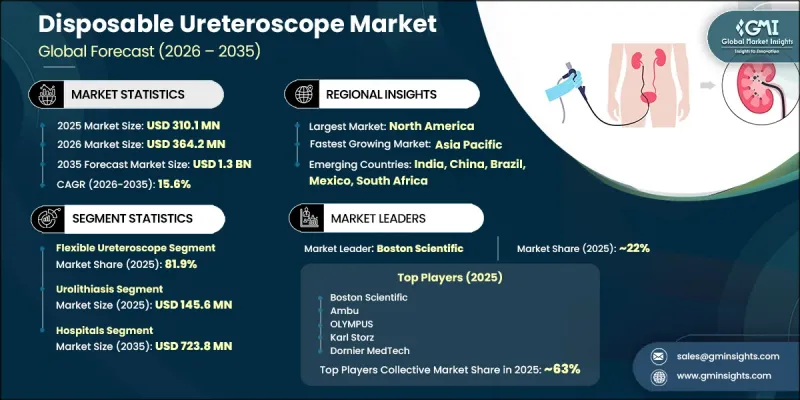
이러한 시장 확대는 요로결석 유병률 증가, 영상진단 및 내시경 기술의 지속적인 발전, 저침습적 비뇨기과 수술에 대한 선호도 증가에 영향을 받고 있습니다. 또한, 의료진이 신속한 진료와 감염 위험 감소를 우선시하는 가운데, 외래수술센터(ASC)에서의 채용이 증가하고 있는 것도 수요를 촉진하고 있습니다. 일회용 요관경은 요관 및 신장 질환의 시각화 및 치료를 목적으로 설계된 일회용 내시경 기구로, 통합된 영상 시스템을 갖춘 유연한 또는 반강체 구성을 제공합니다. 이 장치는 신장 결석, 요관 협착, 요로 종양의 정확한 진단과 관리를 지원하며, 교차 오염의 위험을 크게 줄이고 재처리 및 멸균의 필요성을 제거합니다. 그 운영 효율성과 일관된 성능으로 인해 현대 비뇨기과 진료에서 점점 더 선호되고 있습니다. 또한, 의료비 증가와 신흥 지역의 고급 외과 의료에 대한 접근성 확대도 도입을 촉진하고 있습니다. 또한, 가치 중심의 의료 모델로의 전환이 진행되고 있는 것도 비용 효율성이 높은 일회용 기기의 사용을 촉진하여 장기적인 시장 침투에 기여하고 있습니다.
| 시장 범위 | |
|---|---|
| 개시 연도 | 2025년 |
| 예측 기간 | 2026-2035년 |
| 개시 연도 시장 규모 | 3억 1,010만 달러 |
| 예측 시장 규모 | 13억 달러 |
| CAGR | 15.6% |
2025년 플렉서블 요관경 부문은 저침습적 비뇨기과 수술에서 높은 임상 도입률과 우수한 조작성을 바탕으로 81.9%의 점유율을 차지했습니다. 이 부문이 선두를 달리고 있는 이유는 복잡한 신장 구조 내 탐색 및 시각화 능력이 뛰어나고, 요관경 검사 및 역행성 신내 수술과 같은 시술에 매우 적합하기 때문입니다. 감염 관리, 시술의 일관성 및 업무 효율성에 대한 관심이 높아지면서 병원 및 외래 수술 환경에서 일회용 플렉서블 요관경에 대한 선호도가 더욱 높아지고 있습니다.
요로결석증 부문은 2025년 1억 4,560만 달러에 달했습니다. 일반적으로 신결석증으로 알려진 요로결석증은 전 세계적으로 많은 사람들에게 영향을 미치고 있으며, 비뇨기과적 개입의 주요 원인 중 하나입니다. 비만과 당뇨병의 유병률 증가, 그리고 생활습관과 관련된 식습관의 변화로 결석 형성률이 높아지면서 이 질환은 지속적으로 증가하고 있습니다. 이러한 질병 부담 증가는 효과적인 진단 및 치료 솔루션에 대한 수요를 가속화시키고 있습니다. 일회용 요관경은 고화질 영상 촬영 능력으로 요로 내 결석을 정확하게 감지하고 치료하여 임상 결과를 개선할 수 있어 이 분야에서 널리 사용되고 있습니다.
2025년 북미의 일회용 요관경 시장은 38.7%의 점유율을 차지했습니다. 이 지역의 우위는 신장결석, 요로감염증, 요관협착증, 신장암 등 비뇨기 질환의 높은 유병률에 기인합니다. 의료 시스템이 효율적이고 최소 침습적인 치료를 제공하기 위해 첨단 내시경 솔루션에 계속 의존하고 있는 가운데, 병원과 외래수술센터(ASC)의 시술 건수 증가로 인해 수요가 더욱 증가하고 있습니다.
자주 묻는 질문
목차
제1장 조사 방법
제2장 주요 요약
제3장 업계 인사이트
제4장 경쟁 구도
제5장 시장 추산 및 예측 : 제품별(2022-2035년)
제6장 시장 추산 및 예측 : 용도별(2022-2035년)
제7장 시장 추산 및 예측 : 최종 용도별(2022-2035년)
제8장 시장 추산 및 예측 : 지역별(2022-2035년)
제9장 기업 개요
AJY 26.06.11The Global Disposable Ureteroscope Market was valued at USD 310.1 million in 2025 and is estimated to grow at a CAGR of 15.6% to reach USD 1.3 billion in 2035.
The market expansion is influenced by the rising incidence of urolithiasis, continuous advancements in imaging and endoscopic technologies, and growing preference for minimally invasive urological procedures. Increasing adoption across ambulatory surgical centers is also reinforcing demand, as healthcare providers prioritize faster turnaround times and reduced infection risks. Disposable ureteroscopes are single-use endoscopic instruments designed for visualization and treatment of ureter and kidney conditions, offering flexible or semi-rigid configurations with integrated imaging systems. These devices support accurate diagnosis and management of kidney stones, ureteral strictures, and urinary tract tumors while significantly reducing cross-contamination risks and eliminating the need for reprocessing and sterilization. Their operational efficiency and consistent performance are making them increasingly preferred in modern urology practices. In addition, rising healthcare expenditure and expanding access to advanced surgical care in emerging regions are further supporting adoption. The growing shift toward value-based healthcare models is also encouraging the use of cost-efficient single-use devices, contributing to long-term market penetration.
| Market Scope | |
|---|---|
| Start Year | 2025 |
| Forecast Year | 2026-2035 |
| Start Value | $310.1 Million |
| Forecast Value | $1.3 Billion |
| CAGR | 15.6% |
The flexible ureteroscope segment held a share of 81.9% in 2025, supported by strong clinical adoption and superior maneuverability in minimally invasive urological procedures. This segment's leadership is attributed to its ability to provide enhanced navigation and visualization within complex renal structures, making it highly suitable for procedures such as ureteroscopy and retrograde intrarenal surgery. Increasing emphasis on infection control, procedural consistency, and operational efficiency is further driving preference for single-use flexible ureteroscopes across hospitals and ambulatory surgical environments.
The urolithiasis segment reached USD 145.6 million in 2025. Urolithiasis, commonly known as kidney stone disease, affects a significant global population and remains a leading cause of urological interventions. The condition continues to rise due to increasing prevalence of obesity, diabetes, and lifestyle-related dietary changes, which collectively contribute to higher stone formation rates. This growing disease burden is accelerating demand for effective diagnostic and therapeutic solutions. Disposable ureteroscopes are widely utilized in this segment due to their high-definition imaging capabilities, enabling precise detection and treatment of stones within the urinary tract and improving clinical outcomes.
North America Disposable Ureteroscope Market captured 38.7% share in 2025. The region's dominance is supported by a high prevalence of urological conditions such as kidney stones, urinary tract infections, ureteral strictures, and renal cancers. Increasing procedural volumes across hospitals and ambulatory surgical centers are further strengthening demand, as healthcare systems continue to rely on advanced endoscopic solutions for efficient and minimally invasive treatment delivery.
Key players operating in the Global Disposable Ureteroscope Market include Ambu, Becton, Dickinson and Company, Boston Scientific, Coloplast, Cook Medical, Dornier MedTech, Karl Storz, NeoScope, OLYMPUS, OPCOM Medical, OTU Medical, Richard Wolf, STERIS, and Zhuhai Pusen Medical Technology. Companies in the disposable ureteroscope market are actively focusing on product innovation to enhance imaging quality, flexibility, and ergonomic design for improved procedural efficiency. Many manufacturers are investing in advanced digital visualization technologies and integrated imaging systems to support more accurate diagnosis and treatment outcomes. Strategic collaborations with hospitals and ambulatory surgical centers are being used to expand product adoption and strengthen distribution networks. Firms are also prioritizing cost optimization strategies to make single-use devices more accessible across diverse healthcare settings. Expansion into emerging healthcare markets is supporting revenue diversification and broader geographic reach.
Table of Contents
Chapter 1 Research Methodology
- 1.1 Research approach
- 1.2 Quality commitments
- 1.2.1 GMI AI policy & data integrity commitment
- 1.2.1.1 Source consistency protocol
- 1.2.1 GMI AI policy & data integrity commitment
- 1.3 Research trail & confidence scoring
- 1.3.1 Research trail components
- 1.3.2 Scoring components
- 1.4 Data collection
- 1.4.1 Partial list of primary sources
- 1.5 Data mining sources
- 1.5.1 Paid sources
- 1.5.1.1 Sources, by region
- 1.5.1 Paid sources
- 1.6 Base estimates and calculations
- 1.6.1 Base year calculation for any one approach
- 1.7 Forecast model
- 1.7.1 Quantified market impact analysis
- 1.7.1.1 Mathematical impact of growth parameters on forecast
- 1.7.1 Quantified market impact analysis
- 1.8 Research transparency addendum
- 1.8.1 Source attribution framework
- 1.8.2 Quality assurance metrics
- 1.8.3 Our commitment to trust
Chapter 2 Executive Summary
- 2.1 Industry 3600 synopsis
- 2.2 Key market trends
- 2.2.1 Regional trends
- 2.2.2 Product trends
- 2.2.3 Application trends
- 2.2.4 End use trends
- 2.3 CXO perspectives: Strategic imperatives
Chapter 3 Industry Insights
- 3.1 Industry ecosystem analysis
- 3.2 Industry impact forces
- 3.2.1 Growth drivers
- 3.2.1.1 Rising prevalence of urolithiasis & kidney stone disease globally
- 3.2.1.2 Technological advancements in disposable endoscopes
- 3.2.1.3 Increasing preference for minimally invasive urological procedures
- 3.2.2 Industry pitfalls and challenges
- 3.2.2.1 High cost of ureteroscopy procedures
- 3.2.2.2 Insurance coverage and reimbursement challenges in emerging markets
- 3.2.3 Market opportunities
- 3.2.3.1 Expansion into emerging markets with growing urology infrastructure
- 3.2.3.2 Miniaturization for pediatric and complex anatomical applications
- 3.2.1 Growth drivers
- 3.3 Growth potential analysis
- 3.4 Regulatory landscape (Driven by primary research)
- 3.4.1 North America
- 3.4.2 Europe
- 3.4.3 Asia Pacific
- 3.4.4 Latin America
- 3.4.5 Middle East and Africa
- 3.5 Technology landscape
- 3.5.1 Current technological trends
- 3.5.2 Emerging technologies
- 3.6 Future market trends
- 3.7 Patent landscape (Driven by primary research)
- 3.8 Investment and funding analysis
- 3.9 Cost-effectiveness analysis: disposable vs. reusable ureteroscopes
- 3.10 Impact of AI & Generative AI on the Market
- 3.10.1 AI-driven disruption of existing business models
- 3.10.2 GenAI use cases and adoption roadmap by segment
- 3.10.3 Risks, Limitations and regulatory considerations
- 3.11 Porter's analysis
- 3.12 PESTEL analysis
- 3.13 Customer insights (Driven by primary research)
- 3.14 Start-up scenarios
- 3.15 Value chain analysis
- 3.16 Gap analysis
Chapter 4 Competitive Landscape, 2025
- 4.1 Introduction
- 4.2 Company matrix analysis
- 4.3 Company market share analysis (Driven by primary research)
- 4.3.1 Global
- 4.3.2 North America
- 4.3.3 Europe
- 4.3.4 Asia Pacific
- 4.4 Competitive positioning matrix
- 4.5 Competitive analysis of major market players
- 4.6 Key developments
- 4.6.1 Mergers & acquisitions
- 4.6.2 Partnerships & collaborations
- 4.6.3 New product launches
- 4.6.4 Expansion plans
Chapter 5 Market Estimates and Forecast, By Product, 2022 - 2035 ($ Mn)
- 5.1 Key trends
- 5.2 Flexible ureteroscope
- 5.3 Rigid ureteroscope
Chapter 6 Market Estimates and Forecast, By Application, 2022 - 2035 ($ Mn)
- 6.1 Key trends
- 6.2 Urolithiasis
- 6.3 Urethral stricture
- 6.4 Kidney cancer
- 6.5 Other applications
Chapter 7 Market Estimates and Forecast, By End Use, 2022 - 2035 ($ Mn)
- 7.1 Key trends
- 7.2 Hospitals
- 7.3 Ambulatory surgical centers
- 7.4 Other end users
Chapter 8 Market Estimates and Forecast, By Region, 2022 - 2035 ($ Mn)
- 8.1 Key trends
- 8.2 North America
- 8.2.1 U.S.
- 8.2.2 Canada
- 8.3 Europe
- 8.3.1 Germany
- 8.3.2 UK
- 8.3.3 France
- 8.3.4 Spain
- 8.3.5 Italy
- 8.3.6 Netherlands
- 8.4 Asia Pacific
- 8.4.1 China
- 8.4.2 Japan
- 8.4.3 India
- 8.4.4 Australia
- 8.4.5 South Korea
- 8.5 Latin America
- 8.5.1 Brazil
- 8.5.2 Mexico
- 8.5.3 Argentina
- 8.6 Middle East and Africa
- 8.6.1 South Africa
- 8.6.2 Saudi Arabia
- 8.6.3 UAE
Chapter 9 Company Profiles
- 9.1 Ambu
- 9.2 Becton, Dickinson and Company
- 9.3 Boston Scientific
- 9.4 Coloplast
- 9.5 Cook Medical
- 9.6 Dornier MedTech
- 9.7 Karl Storz
- 9.8 NeoScope
- 9.9 OLYMPUS
- 9.10 OPCOM Medical
- 9.11 OTU Medical
- 9.12 Richard Wolf
- 9.13 STERIS
- 9.14 Zhuhai Pusen Medical Technology


