

|
시장보고서
상품코드
2038440
저전압 복합 절연체 시장 : 시장 비즈니스 기회, 성장요인, 업계 동향 분석 및 예측(2026-2035년)Low Voltage Composite Insulators Market Opportunity, Growth Drivers, Industry Trend Analysis, and Forecast 2026 - 2035 |
||||||

세계의 저전압 복합 절연체 시장은 2025년에 6억 8,210만 달러로 평가되었고, CAGR 6.9%로 성장할 전망이며, 2035년까지 13억 3,000만 달러에 이를 것으로 예측됩니다.
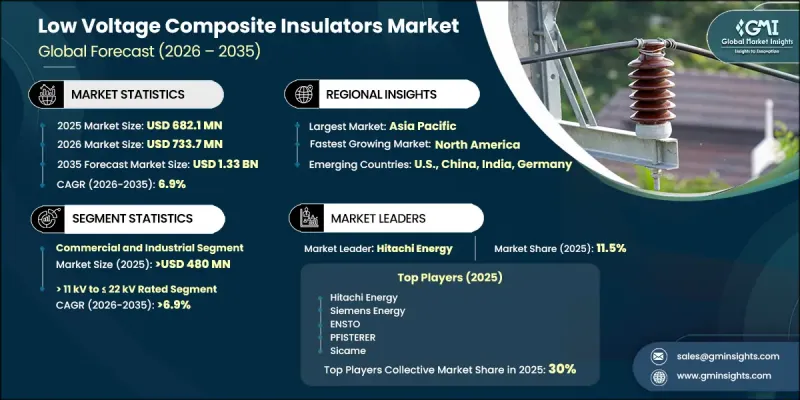
주거, 상업, 산업 부문의 전력 소비 증가와 더불어 세계 전력망의 지속적인 현대화로 인해 시장은 더욱 탄력을 받고 있습니다. 전력회사와 규제 당국은 신뢰도 향상, 정전 위험 감소, 증가하는 전력 수요에 대응하기 위해 송배전 인프라 업그레이드에 적극적으로 투자하고 있습니다. 송전망 확장 프로젝트에 대한 설비 투자 증가와 더불어 개발도상국의 전기화 추진 노력도 시장 성장을 더욱 촉진하고 있습니다. 스마트 그리드, 분산형 에너지 시스템 및 재생에너지 통합의 도입 확대는 업계 트렌드를 새롭게 바꾸고 첨단 절연 기술의 채택을 가속화했습니다. 저전압 복합 절연체는 경량 구조, 우수한 기계적 강도 및 높은 비용 효율성으로 인해 기존의 세라믹 및 유리로 만든 대체품을 대체하고 있습니다. 오염에 대한 내성, 긴 수명, 최소한의 유지보수 요구 사항으로 인해 열악한 운영 환경에 매우 적합할 뿐만 아니라 전력 사업자의 수명주기 비용을 절감할 수 있습니다.
| 시장 범위 | |
|---|---|
| 개시 연도 | 2025년 |
| 예측 기간 | 2026-2035년 |
| 개시 연도 시장 규모 | 6억 8,210만 달러 |
| 예측 시장 규모 | 13억 3,000만 달러 |
| CAGR | 6.9% |
상업 및 산업 부문은 2025년 4억 8,000만 달러에 달했으며, 2026-2035년 연평균 복합 성장률(CAGR) 7%로 성장할 것으로 전망됩니다. 전력 소비의 견조한 성장, 급속한 산업화, 송배전 인프라의 지속적인 확장이 이 부문을 이끄는 주요 요인으로 작용하고 있습니다. 도시개발과 에너지 수요 증가에 따른 상업 및 산업시설의 건설 증가가 시장 확대를 견인하고 있습니다. 전력망 업그레이드와 노후화된 송배전 인프라의 갱신에 초점을 맞춘 정부 주도의 노력은 시스템의 신뢰성을 더욱 향상시키고 이 부문의 성장을 뒷받침하고 있습니다.
정격 전압 11kV 이상-22kV 이하 부문은 2025년 2억 2,000만 달러 규모에 이르렀으며, 2035년까지 연평균 6.9%의 성장률을 보일 것으로 예측됩니다. 이 전압 범위에 대한 수요는 배전망과 주거 및 상업용 사용자에게 안정적이고 지속적인 전력 공급을 보장하기 위한 인프라 프로젝트에서 광범위하게 사용되고 있습니다. 마이크로그리드 도입 확대와 배전 시스템 강화를 위한 투자 증가는 마이크로그리드 도입을 더욱 촉진하고 있습니다. 송전망의 내재해성 향상과 현대화를 위한 정부 프로그램도 시장의 지속적인 확대에 기여하고 있습니다.
북미의 저전압 복합 절연체 시장은 73.7%의 점유율을 차지했으며, 2025년 7,390만 달러 시장 규모를 기록했습니다. 이 지역의 성장은 전력 인프라의 확장 및 기존 전력망에 재생에너지의 통합을 위한 투자 증가에 힘입은 바 있습니다. 전력회사와 정부 기관은 신뢰성을 높이고, 용량을 확대하며, 청정 에너지로의 전환 목표를 달성하기 위해 노후화된 전력 시스템을 갱신하는 데 주력하고 있습니다. 노후화된 전력망 구성 요소의 지속적인 업데이트와 배전망의 현대화는 미국 전역 시장 성과를 더욱 강화시키고 있습니다.
자주 묻는 질문
목차
제1장 조사 방법 및 범위
제2장 주요 요약
제3장 업계 인사이트
제4장 경쟁 구도
제5장 시장 규모 및 예측 : 용도별(2022-2035년)
제6장 시장 규모 및 예측 : 정격별(2022-2035년)
제7장 시장 규모 및 예측 : 지역별(2022-2035년)
제8장 기업 개요
AJY 26.06.11The Global Low Voltage Composite Insulators Market was valued at USD 682.1 million in 2025 and is estimated to grow at a CAGR of 6.9% to reach USD 1.33 billion by 2035.
The market is gaining momentum owing to rising electricity consumption across residential, commercial, and industrial sectors, alongside continuous modernization of global power grids. Utilities and regulatory bodies are actively investing in upgrading transmission and distribution infrastructure to enhance reliability, reduce outage risks, and support growing power demand. Increasing capital expenditure on grid expansion projects, along with electrification initiatives in developing regions, is further strengthening market growth. Expanding deployment of smart grids, distributed energy systems, and renewable energy integration is reshaping industry dynamics and accelerating the adoption of advanced insulation technologies. Low voltage composite insulators are increasingly replacing traditional ceramic and glass-based alternatives due to their lightweight structure, superior mechanical strength, and cost efficiency. Their resistance to pollution, long service life, and minimal maintenance requirements make them highly suitable for harsh operating environments while reducing lifecycle costs for utilities.
| Market Scope | |
|---|---|
| Start Year | 2025 |
| Forecast Year | 2026-2035 |
| Start Value | $ 682.1 Million |
| Forecast Value | $1.33 Billion |
| CAGR | 6.9% |
The commercial and industrial segment reached USD 480 million in 2025 and is projected to grow at a CAGR of 7% from 2026 to 2035. Strong growth in electricity consumption, rapid industrialization, and continuous expansion of transmission and distribution infrastructure are key factors driving this segment. Rising construction of commercial complexes and industrial facilities, supported by urban development and increasing energy demand, is reinforcing market expansion. Government-led initiatives focused on upgrading electrical networks and replacing aging grid infrastructure are further improving system reliability and supporting segment growth.
The > 11 kV to <=22 kV rated segment was valued at USD 202 million in 2025 and is expected to grow at a CAGR of 6.9% through 2035. Demand for this voltage range is driven by its widespread use in distribution networks and infrastructure projects aimed at ensuring a stable and continuous electricity supply to residential and commercial users. Expanding microgrid installations and increasing investments in strengthening power distribution systems are further supporting adoption. Government programs aimed at improving grid resilience and modernization are also contributing to sustained market expansion.
North America Low Voltage Composite Insulators Market held a 73.7% share, generating USD 73.9 million in 2025. The region's growth is supported by rising investments in power infrastructure expansion and the integration of renewable energy into existing grids. Utilities and government agencies are focusing on upgrading aging electrical systems to improve reliability, increase capacity, and support clean energy transition goals. Continuous replacement of outdated grid components and modernization of distribution networks are further strengthening market performance across the country.
Key companies operating in the Global Low Voltage Composite Insulators Market include Siemens Energy, Hitachi Energy, ENSTO, Pfisterer, Sicame, Aditya Birla Insulators, CYG Insulator, Rayphen, Elsewedy Electric, TID Power System, Deccan Enterprises, Jiangxi Johnson Electric, Cowin Electrical, PPC Santana Electric Equipment, ASASOFT, Vexila, Simmu Energy International, Wuhan Line Power Transmission Equipment, Bonomi Eugenio, Bonle Fujian Electric Manufacturing, POINSA, Al Yamuna Densons, and SICAME. Companies in the Low Voltage Composite Insulators Market are actively focusing on strengthening product performance through advanced material engineering and improving resistance to environmental stress, contamination, and mechanical load. A strong emphasis is placed on developing lightweight, high-strength insulators that reduce installation complexity and enhance operational efficiency for utilities. Manufacturers are increasing investments in R&D to improve insulation reliability, extend product lifespan, and support integration with modern grid systems, including smart grids and renewable energy networks. Strategic collaborations with utility providers and grid infrastructure developers are being used to secure long-term supply contracts and expand market penetration.
Table of Contents
Chapter 1 Methodology & Scope
- 1.1 Research design
- 1.2 Quality commitment
- 1.2.1 GMI AI policy & data integrity commitment
- 1.2.1.1 Source consistency protocol
- 1.2.1 GMI AI policy & data integrity commitment
- 1.3 Research Trail & Confidence Scoring
- 1.3.1 Research Trail Components
- 1.3.2 Scoring components
- 1.4 Data Collection
- 1.4.1 Partial list of primary sources
- 1.5 Data mining sources
- 1.5.1 Paid Sources
- 1.5.1.1 Sources, by region
- 1.5.1 Paid Sources
- 1.6 Base estimates and calculations
- 1.6.1 Base year calculation for any one approach
- 1.7 Market estimates & forecasts parameters
- 1.8 Forecast model
- 1.8.1 Quantified market impact analysis
- 1.8.1.1 Mathematical impact of growth parameters on forecast
- 1.8.1 Quantified market impact analysis
- 1.9 Research transparency addendum
- 1.9.1 Source attribution framework
- 1.9.2 Quality assurance metrics
- 1.9.3 Our commitment to trust
- 1.10 Market definitions
Chapter 2 Executive Summary
- 2.1 Industry synopsis, 2022 - 2035
- 2.2 Business trends
- 2.3 End-use trends
- 2.4 Rating trends
- 2.5 Regional trends
Chapter 3 Industry Insights
- 3.1 Industry ecosystem analysis
- 3.1.1 Raw material availability & sourcing analysis
- 3.1.2 Key factors affecting the value chain
- 3.1.3 Disruptions
- 3.2 Industry impact forces
- 3.2.1 Growth drivers
- 3.2.2 Industry pitfalls & challenges
- 3.3 Growth potential analysis
- 3.4 Regulatory landscape
- 3.5 Porter's analysis
- 3.5.1 Bargaining power of suppliers
- 3.5.2 Bargaining power of buyers
- 3.5.3 Threat of new entrants
- 3.5.4 Threat of substitutes
- 3.6 PESTEL analysis
- 3.6.1 Political factors
- 3.6.2 Economic factors
- 3.6.3 Social factors
- 3.6.4 Technological factors
- 3.6.5 Legal factors
- 3.6.6 Environmental factors
- 3.7 Emerging opportunities & trends
- 3.7.1 Digital transformation with IoT technologies
- 3.7.2 Emerging market penetration
- 3.8 Investment analysis & future outlook
- 3.9 Impact of AI & Generative AI on the market (Solution Core)
- 3.9.1 AI-Driven production optimization (Solution Core)
- 3.9.2 Predictive maintenance & fault detection (Solution Core)
- 3.10 Trade data analysis (Driven by Primary Research)
- 3.10.1 Import/export volume & value trends (Driven by Primary Research)
- 3.10.2 Key trade corridors & tariff impact (Driven by Primary Research)
- 3.11 Capacity & production landscape (Driven by Primary Research)
- 3.11.1 Capacity by region & key producer (Driven by Primary Research)
- 3.11.2 Capacity utilization rates & expansion pipelines (Driven by Primary Research)
Chapter 4 Competitive Landscape, 2025
- 4.1 Introduction
- 4.2 Company market share analysis, by region, 2025
- 4.2.1 North America
- 4.2.2 Europe
- 4.2.3 Asia Pacific
- 4.2.4 Middle East & Africa
- 4.2.5 Latin America
- 4.3 Competitive positioning matrix
- 4.4 Key developments
- 4.4.1 Mergers & acquisitions
- 4.4.2 Partnerships & collaborations
- 4.4.3 New product launches
- 4.4.4 Expansion plans and funding
Chapter 5 Market Size and Forecast, By End-Use, 2022 - 2035 (USD Million)
- 5.1 Key trends
- 5.2 Residential
- 5.3 Commercial & industrial
Chapter 6 Market Size and Forecast, By Rating, 2022 - 2035 (USD Million)
- 6.1 Key trends
- 6.2 ≤ 11 kV
- 6.3 > 11 kV to ≤ 22 kV
- 6.4 > 22 kV to ≤ 33 kV
- 6.5 > 33 kV to ≤ 72.5 kV
- 6.6 > 72.5 kV
Chapter 7 Market Size and Forecast, By Region, 2022 - 2035 (USD Million)
- 7.1 Key trends
- 7.2 North America
- 7.2.1 U.S.
- 7.2.2 Canada
- 7.2.3 Mexico
- 7.3 Europe
- 7.3.1 UK
- 7.3.2 Germany
- 7.3.3 France
- 7.3.4 Spain
- 7.3.5 Italy
- 7.3.6 Russia
- 7.4 Asia Pacific
- 7.4.1 China
- 7.4.2 Japan
- 7.4.3 India
- 7.4.4 South Korea
- 7.4.5 Australia
- 7.5 Middle East & Africa
- 7.5.1 Saudi Arabia
- 7.5.2 UAE
- 7.5.3 South Africa
- 7.6 Latin America
- 7.6.1 Brazil
- 7.6.2 Argentina
Chapter 8 Company Profiles
- 8.1 Aditya Birla Insulators
- 8.2 Al Yamuna Densons
- 8.3 ASASOFT
- 8.4 Bonomi Eugenio
- 8.5 Bonle Fujian Electric Manufacturing
- 8.6 Cowin Electrical
- 8.7 CYG Insulator
- 8.8 Deccan Enterprises
- 8.9 Elsewedy Electric
- 8.10 ENSTO
- 8.11 Hitachi Energy
- 8.12 Jiangxi Johnson Electric
- 8.13 Pfisterer
- 8.14 POINSA
- 8.15 PPC Santana Electric Equipment
- 8.16 Rayphen
- 8.17 Sicame
- 8.18 Siemens Energy
- 8.19 SIMMU Energy International
- 8.20 TID Power System
- 8.21 Vexila
- 8.22 Wuhan Line Power Transmission Equipment


