
|
시장보고서
상품코드
2038471
미네랄 강화 성분 시장 비즈니스 기회, 성장요인, 업계 동향 분석 및 예측(2026-2035년)Mineral Enrichment Ingredients Market Opportunity, Growth Drivers, Industry Trend Analysis, and Forecast 2026 - 2035 |
||||||

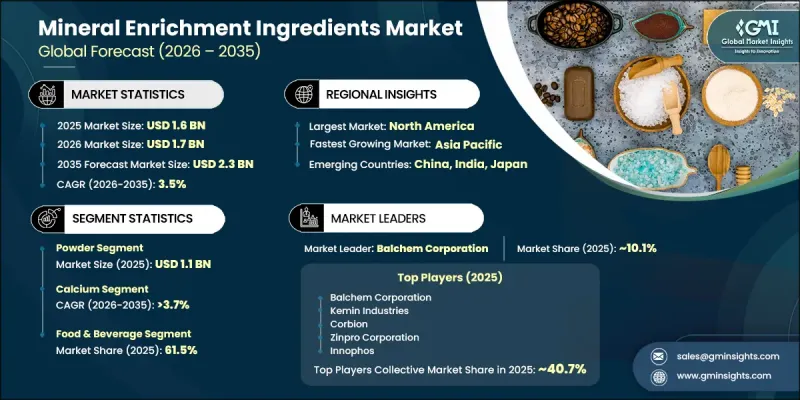
세계의 미네랄 강화 성분 시장은 2025년에 16억 달러로 평가되었고 CAGR 3.5%로 성장하여 2035년까지 23억 달러에 이를 것으로 추정되고 있습니다.
음료 및 건강보조식품 제조업체들이 제품 개발에 있어 영양 강화에 점점 더 많은 관심을 기울이면서 시장은 꾸준한 속도로 성장하고 있습니다. 칼슘, 철, 아연, 마그네슘, 요오드 등 미량 영양소 결핍에 대한 인식이 높아지면서 전 세계 사람들 수요에 큰 영향을 미치고 있습니다. 또한, 영양실조 감소와 예방 의료 성과 향상을 목표로 하는 공중보건 이니셔티브와 정부 주도의 영양 강화 프로그램도 일상적인 식품 카테고리 전반에 걸쳐 미네랄 강화 솔루션의 보급을 촉진하고 있습니다. 소비자들이 단순한 영양 보충을 넘어 부가적인 영양학적 이점을 제공하는 제품으로 눈을 돌리면서 기능성 음료가 큰 주목을 받고 있습니다. 도시형 라이프스타일의 확산, 식습관의 변화, 그리고 면역력, 골밀도, 인지기능, 신진대사 건강에 대한 관심이 높아지면서 이러한 성분의 사용이 더욱 가속화되고 있습니다. 동시에 식물 유래 제품 및 클린 라벨 제품 트렌드가 확대되는 가운데, 각 제조업체들은 맛과 식감, 제품의 보존성을 해치지 않고 복잡한 식품 시스템에 효과적으로 통합할 수 있는 생체 이용률이 높고 안정적이며 배합이 용이한 미네랄 성분을 개발하고 있습니다.
| 시장 규모 | |
|---|---|
| 시작 연도 | 2025년 |
| 예측 기간 | 2026-2035년 |
| 시작 연도 시장 규모 | 16억 달러 |
| 예측 규모 | 23억 달러 |
| CAGR | 3.5% |
분말 부문은 2025년 11억 달러 규모로, 2026년부터 2035년까지 연평균 3.6%의 성장률을 보일 것으로 예측됩니다. 분말 형태의 미네랄 원료는 우수한 용해성, 배합의 용이성 및 식료품, 음료 및 보충제 배합에 광범위하게 사용되어 시장을 지속적으로 지배하고 있습니다. 다양한 가공 시스템과 호환이 가능하여 대규모 생산에 매우 적합합니다. 또한, 과립은 유동성 향상, 분진 발생 억제 및 산업적 제조 환경, 특히 대량 생산의 효율성이 필수적인 상황에서 취급이 용이하다는 장점으로 인해 더욱 각광받고 있습니다.
식음료 부문은 2025년 10억 달러로 61.5%의 점유율을 차지하며 2026년부터 2035년까지 연평균 3.6%의 성장률을 보일 것으로 예측됩니다. 제조업체들이 영양가를 높이고 일상적인 식단 섭취를 지원하기 위해 주식, 기능성 음료, 유제품 대체품, 포장 스낵에 영양을 강화하는 경향이 높아짐에 따라 이 부문이 시장을 주도하고 있습니다. 또한, 특정 건강 및 웰빙 요구를 충족시키기 위해 고안된 건강보조식품, 종합비타민, 단백질 강화 제제에 대한 수요 증가에 힘입어 식이 및 영양 제품 부문도 견조한 성장세를 유지하고 있습니다.
북미 미네랄 강화 성분 시장은 2025년 4억 9,930만 달러 규모에 달했습니다. 이 지역에서는 미량영양소 섭취와 예방의료에 대한 소비자의 높은 인식이 그 배경이 되고 있습니다. 특히, 식품 가공 산업과 첨단 배합 기술을 바탕으로 강화된 기능성 식품, 음료 및 건강 보조 식품에 대한 수요가 활발합니다. 이 지역의 제조업체들은 맛과 질감 등 관능적 품질을 유지하면서 영양가를 높이는 클린 라벨 미네랄 솔루션과 생체 이용률이 높은 배합에 점점 더 많은 노력을 기울이고 있습니다.
자주 묻는 질문
목차
제1장 조사 방법과 범위
제2장 주요 요약
제3장 업계 인사이트
제4장 경쟁 구도
제5장 시장 추산 및 예측 : 형태별, 2022-2035년
제6장 시장 추산 및 예측 : 용도별, 2022-2035년
제7장 시장 추산 및 예측 : 최종 사용자별, 2022-2035년
제8장 시장 추산 및 예측 : 지역별, 2022-2035년
제9장 기업 개요
JHS 26.05.29The Global Mineral Enrichment Ingredients Market was valued at USD 1.6 billion in 2025 and is estimated to grow at a CAGR of 3.5% to reach USD 2.3 billion by 2035.
The market is expanding at a steady pace as food and beverage manufacturers, along with dietary supplement producers, increasingly prioritize nutritional enhancement in product development. Growing awareness of micronutrient deficiencies such as calcium, iron, zinc, magnesium, and iodine is significantly influencing demand across global populations. Public health initiatives and government-backed fortification programs aimed at reducing malnutrition and improving preventive healthcare outcomes are also supporting broader adoption of mineral enrichment solutions across everyday food categories. Functional foods and beverages are gaining strong traction as consumers shift toward products that offer added nutritional benefits beyond basic sustenance. Rising urban lifestyles, evolving dietary patterns, and increased focus on immunity, bone strength, cognitive performance, and metabolic health are further accelerating ingredient usage. In parallel, the growth of plant-based and clean-label product trends is driving manufacturers to develop highly bioavailable, stable, and formulation-friendly mineral ingredients that integrate effectively into complex food systems without compromising taste, texture, or product shelf stability.
| Market Scope | |
|---|---|
| Start Year | 2025 |
| Forecast Year | 2026-2035 |
| Start Value | $1.6 Billion |
| Forecast Value | $2.3 Billion |
| CAGR | 3.5% |
The powder segment was valued at USD 1.1 billion in 2025 and is projected to grow at a CAGR of 3.6% from 2026 to 2035. Powdered mineral ingredients continue to dominate due to their superior solubility, ease of incorporation, and broad application across food, beverage, and supplement formulations. Their compatibility with diverse processing systems makes them highly suitable for large-scale production. Granules are also gaining momentum owing to improved flow characteristics, reduced dust formation, and easier handling in industrial manufacturing environments, particularly where high-volume production efficiency is essential.
The food & beverage segment accounted for USD 1 billion in 2025, holding a share of 61.5%, and is expected to grow at a CAGR of 3.6% from 2026 to 2035. This segment leads the market as manufacturers increasingly fortify staple foods, functional beverages, dairy alternatives, and packaged snacks to enhance nutritional value and support daily dietary intake. The dietary and nutritional products segment also maintains strong growth, driven by rising demand for supplements, multivitamins, and protein-enriched formulations designed to address specific health and wellness requirements.
North America Mineral Enrichment Ingredients Market was valued at USD 499.3 million in 2025. The region benefits from high consumer awareness regarding micronutrient intake and preventive healthcare practices. Demand is particularly strong for fortified functional foods, beverages, and dietary supplements, supported by a well-developed food processing industry and advanced formulation technologies. Manufacturers in the region are increasingly focusing on clean-label mineral solutions and highly bioavailable formulations that enhance nutritional value while maintaining sensory quality such as taste and texture.
Major players operating in the Global Mineral Enrichment Ingredients Industry include Corbion, Kerry Group, Jungbunzlauer, Balchem Corporation, Omya, Zinpro Corporation, Jost Chemical, Kemin Industries, Novus International, Innophos, Dr. Paul Lohmann, Chemische Fabrik Budenheim, Trouw Nutrition (Nutreco), and Gadot Biochemical Industries (Gadot Bio). Companies in the Mineral Enrichment Ingredients Market are strengthening their competitive position through continuous product innovation focused on improving bioavailability, stability, and compatibility with diverse food systems. Strong investment in research and development is enabling the creation of advanced mineral formulations tailored for specific health applications such as immunity, bone health, and energy metabolism. Manufacturers are expanding partnerships with food and beverage producers to integrate enrichment solutions into a wider range of products. Strategic emphasis is also placed on clean-label development, sustainable sourcing, and regulatory compliance to align with evolving consumer expectations. Firms are enhancing production technologies to improve ingredient consistency and scalability while reducing manufacturing costs.
Table of Contents
Chapter 1 Methodology & Scope
- 1.1 Market scope and definition
- 1.2 Research design
- 1.2.1 Research approach
- 1.2.2 Data collection methods
- 1.3 Data mining sources
- 1.3.1 Global
- 1.3.2 Regional/Country
- 1.4 Base estimates and calculations
- 1.4.1 Base year calculation
- 1.4.2 Key trends for market estimation
- 1.5 Primary research and validation
- 1.5.1 Primary sources
- 1.6 Forecast model
- 1.7 Research assumptions and limitations
Chapter 2 Executive Summary
- 2.1 Industry 360° synopsis
- 2.2 Key market trends
- 2.2.1 Regional
- 2.2.2 Form
- 2.2.3 Ingredient Type
- 2.2.4 End Use
- 2.3 TAM Analysis, 2026-2035
- 2.4 CXO perspectives: Strategic imperatives
Chapter 3 Industry Insights
- 3.1 Industry ecosystem analysis
- 3.1.1 Supplier landscape
- 3.1.2 Profit margin
- 3.1.3 Value addition at each stage
- 3.1.4 Factor affecting the value chain
- 3.1.5 Disruptions
- 3.2 Industry impact forces
- 3.2.1 Growth drivers
- 3.2.2 Industry pitfalls and challenges
- 3.2.3 Market opportunities
- 3.3 Growth potential analysis
- 3.4 Regulatory landscape
- 3.4.1 North America
- 3.4.2 Europe
- 3.4.3 Asia Pacific
- 3.4.4 Latin America
- 3.4.5 Middle East & Africa
- 3.5 Porter's analysis
- 3.6 PESTEL analysis
- 3.7 Price trends
- 3.7.1 By region
- 3.7.2 By type
- 3.8 Future market trends
- 3.9 Technology and Innovation landscape
- 3.9.1 Current technological trends
- 3.9.2 Emerging technologies
- 3.10 Patent Landscape
- 3.11 Trade statistics (HS code)
- 3.11.1 Major importing countries
- 3.11.2 Major exporting countries
- 3.12 Sustainability and environmental aspects
- 3.12.1 Sustainable practices
- 3.12.2 Waste reduction strategies
- 3.12.3 Energy efficiency in production
- 3.12.4 Eco-friendly initiatives
- 3.13 Carbon footprint consideration
Chapter 4 Competitive Landscape, 2025
- 4.1 Introduction
- 4.2 Company market share analysis
- 4.2.1 By region
- 4.2.1.1 North America
- 4.2.1.2 Europe
- 4.2.1.3 Asia Pacific
- 4.2.1.4 LATAM
- 4.2.1.5 MEA
- 4.2.1 By region
- 4.3 Company matrix analysis
- 4.4 Competitive analysis of major market players
- 4.5 Competitive positioning matrix
- 4.6 Key developments
- 4.6.1 Mergers & acquisitions
- 4.6.2 Partnerships & collaborations
- 4.6.3 New Product Launches
- 4.6.4 Expansion Plans
Chapter 5 Market Estimates and Forecast, By Form, 2022-2035 (USD Billion) (Kilo Tons)
- 5.1 Key trends
- 5.2 Powder
- 5.3 Granule
- 5.4 Other
Chapter 6 Market Estimates and Forecast, By Function, 2022-2035 (USD Billion) (Kilo Tons)
- 6.1 Key trends
- 6.2 Zinc
- 6.3 Sodium
- 6.4 Potassium
- 6.5 Calcium
- 6.6 Phosphorus
- 6.7 Magnesium
- 6.8 Citrates
- 6.9 Others
Chapter 7 Market Estimates and Forecast, By End User, 2022-2035 (USD Billion) (Kilo Tons)
- 7.1 Key trends
- 7.2 Food & Beverage
- 7.3 Dietary & Nutritional Products
- 7.4 Personal Care & Cosmetics
- 7.5 Pharmaceuticals
- 7.6 Others
Chapter 8 Market Estimates and Forecast, By Region, 2022-2035 (USD Billion) (Kilo Tons)
- 8.1 Key trends
- 8.2 North America
- 8.2.1 U.S.
- 8.2.2 Canada
- 8.3 Europe
- 8.3.1 Germany
- 8.3.2 UK
- 8.3.3 France
- 8.3.4 Spain
- 8.3.5 Italy
- 8.3.6 Rest of Europe
- 8.4 Asia Pacific
- 8.4.1 China
- 8.4.2 India
- 8.4.3 Japan
- 8.4.4 Australia
- 8.4.5 South Korea
- 8.4.6 Rest of Asia Pacific
- 8.5 Latin America
- 8.5.1 Brazil
- 8.5.2 Mexico
- 8.5.3 Argentina
- 8.5.4 Rest of Latin America
- 8.6 Middle East and Africa
- 8.6.1 Saudi Arabia
- 8.6.2 South Africa
- 8.6.3 UAE
- 8.6.4 Rest of Middle East and Africa
Chapter 9 Company Profiles
- 9.1 Balchem Corporation
- 9.2 Jungbunzlauer
- 9.3 Gadot Biochemical Industries (Gadot Bio)
- 9.4 Zinpro Corporation
- 9.5 Dr. Paul Lohmann
- 9.6 Kemin Industries
- 9.7 Omya
- 9.8 Jost Chemical
- 9.9 Innophos
- 9.10 Chemische Fabrik Budenheim
- 9.11 Novus International
- 9.12 Trouw Nutrition (Nutreco)
- 9.13 Corbion
- 9.14 Kerry Group