
|
시장보고서
상품코드
2038483
질화 티타늄 코팅 시장 : 시장 기회, 성장요인, 업계 동향 분석 및 예측(2026-2035년)Titanium Nitride Coating Market Opportunity, Growth Drivers, Industry Trend Analysis, and Forecast 2026 - 2035 |
||||||

세계의 질화 티타늄 코팅 시장은 2025년에 15억 달러로 평가되었고, CAGR 7.1%로 성장할 전망이며, 2035년까지 31억 달러에 이를 것으로 예측됩니다.
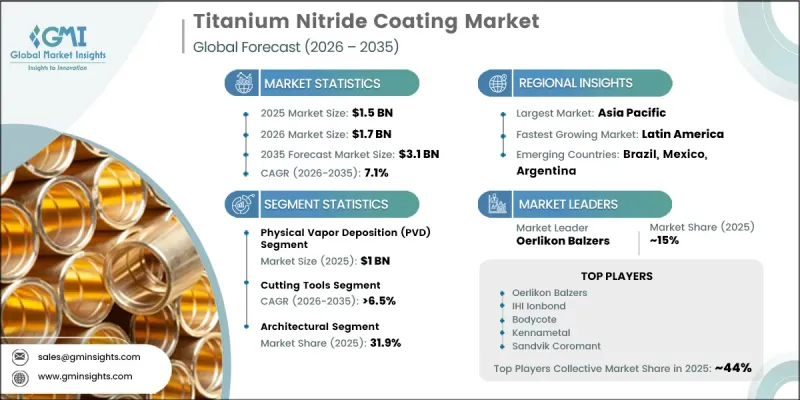
이 시장의 성장은 절삭 공구, 자동차 부품, 의료기기, 장식용 등 다양한 분야에서 질화 티타늄 코팅이 고성능 표면 처리 솔루션으로 널리 채택되고 있기 때문입니다. 이러한 코팅은 높은 경도, 우수한 내마모성, 내식성 및 열 안정성으로 인해 널리 선호되고 있으며, 부품의 수명을 연장하고 열악한 사용 환경에서도 신뢰할 수 있는 성능을 보장합니다. 산업 활동의 활성화와 더불어 가공 정밀도, 업무 효율성, 제품 내구성에 대한 관심이 높아지면서 제조업을 중심으로 한 산업 전반에서 채택이 더욱 활발해지고 있습니다.
| 시장 범위 | |
|---|---|
| 개시 연도 | 2025년 |
| 예측 기간 | 2026-2035년 |
| 개시 연도 시장 규모 | 15억 달러 |
| 예측 시장 규모 | 31억 달러 |
| CAGR | 7.1% |
특히 금속 가공 및 기계 가공 분야에서 수요가 높으며, 자동차, 항공우주 및 일반 기계 공학의 각 공정에서 코팅 가공된 공구가 널리 사용되고 있습니다. 질화티타늄 코팅은 절삭 속도 향상, 마찰 감소, 표면 마감 품질 개선을 통해 대규모 제조 환경에서의 생산성 향상에 기여하고 있습니다. 또한, 의료 분야에서도 이 소재의 생체적합성과 화학적 안정성으로 인해 장기적인 표면 건전성과 내마모성이 요구되는 외과용 기구, 치과용 및 임플란트 부품에 적합하여 시장 확대에 기여하고 있습니다.
물리 기상 성장(PVD) 기술의 발전으로 코팅의 균일성, 접착 강도 및 막 두께 제어가 향상되었습니다. 성막 시스템의 지속적인 개선으로 복잡한 형상이나 고도의 기판에도 대응이 가능해져 산업 분야에서의 적용 범위가 확대되고 있습니다.
물리 기상 성장(PVD) 부문은 2025년에 10억 달러 시장 규모를 기록했으며, 2026-2035년 연평균 6.9%의 성장률을 보일 것으로 예측됩니다. 이 코팅 공정 부문은 높은 균일성, 우수한 접착력, 환경적으로 안정적인 코팅을 형성할 수 있어 지속적으로 주목받고 있습니다. PVD 기술은 기판의 무결성을 유지하면서 코팅 두께를 제어할 수 있기 때문에 정밀 공구, 의료기기, 고부가가치 엔지니어링 부품에서 널리 선호되고 있습니다. 깨끗한 가공 방식과 다양한 재료에 대한 적응성으로 인해 자동차, 항공우주, 전자기기 제조 분야에서 널리 사용되고 있습니다.
절삭 공구 부문은 2025년 4억 4,590만 달러 규모에 달했으며, 2026-2035년 연평균 6.5%의 성장률을 보일 것으로 예측됩니다. 질화 티타늄 코팅은 공구 수명을 크게 연장하고 마찰 손실을 줄이며 가공 정밀도를 향상시키기 때문에 이 용도 분야는 계속해서 시장 수요의 가장 큰 견인차 역할을 하고 있습니다. 또한, 질화 티타늄은 소비재 및 건축용 금속 제품에 내구성이 뛰어난 미적 감각을 제공하기 때문에 장식용 용도 분야도 계속 증가하고 있습니다.
북미의 질화 티타늄 코팅 시장은 2025년 4억 2,120만 달러 규모에 달했습니다. 이 지역 수요는 미국과 캐나다 전역에 구축된 제조 생태계에 의해 뒷받침되고 있습니다. 미국은 강력한 항공우주 제조 거점, 첨단 가공 산업, 대규모 의료기기 생산이 있으며, 이들 모두 고정밀 코팅 솔루션이 필요하기 때문에 지역 내 소비를 주도하고 있습니다. 이 지역 산업계는 일관된 코팅 품질과 연장된 공구 성능을 보장하는 첨단 PVD 시스템을 채택하고 있으며, 이는 산업, 의료, 자동차 분야에서 시장 침투를 더욱 강화하고 있습니다.
목차
제1장 조사 방법 및 범위
제2장 주요 요약
제3장 업계 인사이트
제4장 경쟁 구도
제5장 시장 추산 및 예측 : 코팅 프로세스별(2022-2035년)
제6장 시장 추산 및 예측 : 용도별(2022-2035년)
제7장 시장 추산 및 예측 : 최종 용도별(2022-2035년)
제8장 시장 추산 및 예측 : 지역별(2022-2035년)
제9장 기업 개요
AJYThe Global Titanium Nitride Coating Market was valued at USD 1.5 billion in 2025 and is estimated to grow at a CAGR of 7.1% to reach USD 3.1 billion by 2035.
The market growth is influenced by the widespread use of titanium nitride coatings as a high-performance surface engineering solution across cutting tools, automotive parts, medical devices, and decorative end uses. These coatings are widely preferred due to their high hardness, strong wear resistance, corrosion protection capabilities, and excellent thermal stability, which collectively extend component lifespan and ensure reliable performance in harsh operating environments. Increasing industrial activity and the growing focus on machining precision, operational efficiency, and product durability are further strengthening adoption across manufacturing-heavy industries.
| Market Scope | |
|---|---|
| Start Year | 2025 |
| Forecast Year | 2026-2035 |
| Start Value | $1.5 Billion |
| Forecast Value | $3.1 Billion |
| CAGR | 7.1% |
Demand is particularly high in metalworking and machining sectors, where coated tools are extensively used across automotive, aerospace, and general engineering operations. Titanium nitride coatings enable faster cutting speeds, reduced friction, and improved surface finish quality, supporting productivity improvements in large-scale manufacturing environments. The healthcare sector is also contributing to market expansion due to the material's biocompatibility and chemical stability, which make it suitable for surgical instruments, dental applications, and implantable components requiring long-term surface integrity and resistance to wear.
Advancements in physical vapor deposition technology are improving coating uniformity, adhesion strength, and thickness control. Continuous upgrades in deposition systems are also enabling compatibility with complex geometries and advanced substrate materials, which is expanding industrial applicability.
The physical vapor deposition (PVD) segment was valued at USD 1 billion in 2025 and is projected to register a CAGR of 6.9% from 2026 to 2035. This coating process segment continues to gain traction due to its ability to produce highly uniform, strongly adherent, and environmentally stable coatings. PVD technology is widely preferred for precision tools, medical instruments, and high-value engineered components because it ensures controlled coating thickness while maintaining substrate integrity. Its cleaner processing approach and flexibility across multiple materials support strong adoption across automotive, aerospace, and electronics manufacturing applications.
The cutting tools segment was valued at USD 445.9 million in 2025 and is expected to grow at a CAGR of 6.5% from 2026 to 2035. This application segment remains the largest contributor to market demand as titanium nitride coatings significantly enhance tool life, reduce frictional losses, and improve machining accuracy. Decorative applications also continue to gain traction as titanium nitride delivers durable visual appeal for consumer products and architectural hardware.
North America Titanium Nitride Coating Market accounted for USD 421.2 million in 2025. Demand in the region is supported by well-established manufacturing ecosystems across the United States and Canada. The United States leads regional consumption due to its strong aerospace manufacturing base, advanced machining industry, and large-scale medical device production, all of which require high precision coating solutions. Industries across the region are increasingly adopting advanced PVD systems that ensure consistent coating quality and extended tool performance, further reinforcing market penetration across industrial, healthcare, and automotive sectors.
Key players operating in the Global Titanium Nitride Coating Market include Oerlikon Balzers, IHI Ionbond, Bodycote, Kennametal, Sandvik Coromant, voestalpine eifeler, CemeCon, HEF Group, Walter Tools, Wallwork Cambridge, Techmetals, Richter Precision, Acree Technologies, Paulo Products, and Arka PVD Coating. Companies operating in the titanium nitride coating market are strengthening their position through continuous investments in advanced PVD system upgrades and automation to improve coating precision and consistency. Many players are focusing on expanding production capacities and establishing regional service facilities to reduce turnaround time and improve customer responsiveness. Strategic partnerships with tool manufacturers and end-use industries are being used to secure long-term supply agreements. Firms are also prioritizing R&D efforts to enhance coating adhesion, wear resistance, and process efficiency while developing application-specific solutions. Sustainability initiatives, including energy-efficient deposition systems and waste reduction processes, are gaining importance to meet regulatory expectations.
Table of Contents
Chapter 1 Methodology & Scope
- 1.1 Market scope and definition
- 1.2 Research design
- 1.2.1 Research approach
- 1.2.2 Data collection methods
- 1.3 Data mining sources
- 1.3.1 Global
- 1.3.2 Regional/Country
- 1.4 Base estimates and calculations
- 1.4.1 Base year calculation
- 1.4.2 Key trends for market estimation
- 1.5 Primary research and validation
- 1.5.1 Primary sources
- 1.6 Forecast model
- 1.7 Research assumptions and limitations
Chapter 2 Executive Summary
- 2.1 Industry 360° synopsis
- 2.2 Key market trends
- 2.2.1 Regional
- 2.2.2 Coating Process
- 2.2.3 Application
- 2.2.4 End Use
- 2.3 TAM Analysis, 2026-2035
- 2.4 CXO perspectives: Strategic imperatives
Chapter 3 Industry Insights
- 3.1 Industry ecosystem analysis
- 3.1.1 Supplier landscape
- 3.1.2 Profit margin
- 3.1.3 Value addition at each stage
- 3.1.4 Factor affecting the value chain
- 3.1.5 Disruptions
- 3.2 Industry impact forces
- 3.2.1 Growth drivers
- 3.2.2 Industry pitfalls and challenges
- 3.2.3 Market opportunities
- 3.3 Growth potential analysis
- 3.4 Regulatory landscape
- 3.4.1 North America
- 3.4.2 Europe
- 3.4.3 Asia Pacific
- 3.4.4 Latin America
- 3.4.5 Middle East & Africa
- 3.5 Porter's analysis
- 3.6 PESTEL analysis
- 3.7 Price trends
- 3.7.1 By region
- 3.7.2 By type
- 3.8 Future market trends
- 3.9 Technology and Innovation landscape
- 3.9.1 Current technological trends
- 3.9.2 Emerging technologies
- 3.10 Patent Landscape
- 3.11 Trade statistics (HS code)
- 3.11.1 Major importing countries
- 3.11.2 Major exporting countries
- 3.12 Sustainability and environmental aspects
- 3.12.1 Sustainable practices
- 3.12.2 Waste reduction strategies
- 3.12.3 Energy efficiency in production
- 3.12.4 Eco-friendly initiatives
- 3.13 Carbon footprint consideration
Chapter 4 Competitive Landscape, 2025
- 4.1 Introduction
- 4.2 Company market share analysis
- 4.2.1 By region
- 4.2.1.1 North America
- 4.2.1.2 Europe
- 4.2.1.3 Asia Pacific
- 4.2.1.4 LATAM
- 4.2.1.5 MEA
- 4.2.1 By region
- 4.3 Company matrix analysis
- 4.4 Competitive analysis of major market players
- 4.5 Competitive positioning matrix
- 4.6 Key developments
- 4.6.1 Mergers & acquisitions
- 4.6.2 Partnerships & collaborations
- 4.6.3 New Product Launches
- 4.6.4 Expansion Plans
Chapter 5 Market Estimates and Forecast, By Coating Process, 2022-2035 (USD Billion) (Kilo Tons)
- 5.1 Key trends
- 5.2 Physical Vapor Deposition (PVD)
- 5.2.1 Arc PVD
- 5.2.2 Sputtering PVD
- 5.2.3 Hybrid/Multilayer PVD
- 5.2.4 Others
- 5.3 Chemical Vapor Deposition (CVD)
- 5.3.1 Thermal CVD
- 5.3.2 Plasma-Enhanced CVD (PECVD)
- 5.3.3 Low-Pressure CVD (LPCVD)
- 5.3.4 Others
Chapter 6 Market Estimates and Forecast, By Application, 2022-2035 (USD Billion) (Kilo Tons)
- 6.1 Key trends
- 6.2 Cutting Tools
- 6.3 Decorative Coatings
- 6.4 Mold & Dies
- 6.5 Tooling & Industrial Equipment
- 6.6 Cutlery and Kitchenware
- 6.7 Others
Chapter 7 Market Estimates and Forecast, By End Use, 2022-2035 (USD Billion) (Kilo Tons)
- 7.1 Key trends
- 7.2 Automotive
- 7.3 Aerospace
- 7.4 Chemical
- 7.5 Consumer Goods
- 7.6 Others
Chapter 8 Market Estimates and Forecast, By Region, 2022-2035 (USD Billion) (Kilo Tons)
- 8.1 Key trends
- 8.2 North America
- 8.2.1 U.S.
- 8.2.2 Canada
- 8.3 Europe
- 8.3.1 Germany
- 8.3.2 UK
- 8.3.3 France
- 8.3.4 Spain
- 8.3.5 Italy
- 8.3.6 Rest of Europe
- 8.4 Asia Pacific
- 8.4.1 China
- 8.4.2 India
- 8.4.3 Japan
- 8.4.4 Australia
- 8.4.5 South Korea
- 8.4.6 Rest of Asia Pacific
- 8.5 Latin America
- 8.5.1 Brazil
- 8.5.2 Mexico
- 8.5.3 Argentina
- 8.5.4 Rest of Latin America
- 8.6 Middle East and Africa
- 8.6.1 Saudi Arabia
- 8.6.2 South Africa
- 8.6.3 UAE
- 8.6.4 Rest of Middle East and Africa
Chapter 9 Company Profiles
- 9.1 Oerlikon Balzers
- 9.2 IHI Ionbond
- 9.3 Bodycote
- 9.4 Kennametal
- 9.5 Sandvik Coromant
- 9.6 voestalpine eifeler
- 9.7 CemeCon
- 9.8 HEF Group
- 9.9 Walter Tools
- 9.10 Wallwork Cambridge
- 9.11 Techmetals
- 9.12 Richter Precision
- 9.13 Acree Technologies
- 9.14 Paulo Products
- 9.15 Arka PVD Coating