

|
시장보고서
상품코드
2038677
비행 검사 시장 : 시장 비즈니스 기회, 성장요인, 업계 동향 분석 및 예측(2026-2035년)Flight Inspection Market Opportunity, Growth Drivers, Industry Trend Analysis, and Forecast 2026 - 2035 |
||||||

세계의 비행 검사 시장은 2025년에 61억 달러로 평가되었고, CAGR 4.7%로 성장할 전망이며, 2035년까지 96억 달러에 이를 것으로 예측됩니다.
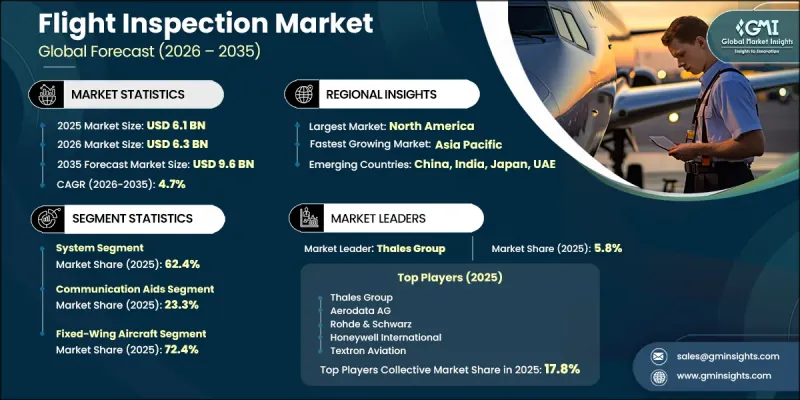
시장 확대는 검사 정확도, 운영 효율성 및 처리 속도를 향상시키는 비행 검사 기술의 지속적인 발전에 의해 주도되고 있습니다. 자동 검사 시스템, AI를 활용한 분석 및 첨단 센서 기술의 통합으로 실시간 데이터 처리 및 신속한 의사결정 주기와 함께 매우 정확한 평가 결과를 얻을 수 있습니다. 이러한 혁신은 보다 빈번하고 종합적인 검사 주기를 지원하여 착륙 시스템, 활주로 조명, 항법 보조 장비와 같은 중요한 항공 인프라의 작동 중단을 방지하는 동시에 엄격한 규정 준수와 항공 안전 기준을 유지합니다. 항공우주 제조업체와 기술 제공업체 간의 협력이 강화되면서 통합 비행 검사 역량이 더욱 강화되고 있습니다. 항공 기술 및 서비스 분야의 공동 이니셔티브를 통해 전 세계 공항 및 국방 항공 네트워크의 진화하는 요구 사항을 충족하도록 설계된 첨단 검사 솔루션을 개발할 수 있게 되었습니다. 또한, 항공 인프라 현대화를 위한 투자 증가도 차세대 검사 시스템에 대한 수요를 촉진하고 있습니다.
| 시장 범위 | |
|---|---|
| 개시 연도 | 2025년 |
| 예측 기간 | 2026-2035년 |
| 개시 연도 시장 규모 | 61억 달러 |
| 예측 시장 규모 | 96억 달러 |
| CAGR | 4.7% |
2025년에는 시스템 부문이 62.4%의 점유율을 차지했습니다. 이 부문은 기내 교정 기술, 항법 평가 장비, 공항 및 공역 평가에 사용되는 통합 항공전자 시스템 등 첨단 비행 검사 플랫폼의 도입이 증가함에 따라 지속적으로 확대되고 있습니다. 통신, 항법, 감시 인프라에 대한 투자 증가는 고정밀 검사 시스템에 대한 수요를 더욱 강화하고 있습니다. 지속적인 기술 혁신을 통해 자동화, 정확성 및 운영 효율성이 크게 향상되어 민간 및 국방 항공 네트워크 전반에 걸쳐 보다 유연하고 신뢰할 수 있는 검사 임무 수행이 가능해졌습니다.
2025년 기준 항법 보조 장치 부문 점유율은 16.8%로 나타났습니다. 이 부문의 성장은 계기 착륙 장치, 초단파 항법 시스템, 위성 항법 절차 등 항법 시스템의 정확한 교정에 대한 요구가 증가함에 따라 성장세를 보이고 있습니다. 공항 인프라의 확장 및 항법 기술의 지속적인 현대화로 인해 정기적인 검사 및 검증 활동의 필요성이 증가하고 있습니다. 이러한 시스템은 정확한 비행 유도, 안전한 착륙, 세계 항공 안전 표준 준수를 보장하는 데 필수적이며, 이는 이 부문의 성장을 지속적으로 뒷받침하고 있습니다.
북미의 비행 검사 시장은 2025년 41.1%의 점유율을 차지했습니다. 이 지역은 광범위한 항공 인프라, 잘 정비된 공항 네트워크 및 항공 당국의 엄격한 규제 감독으로 인해 여전히 고도로 발전하고 있습니다. 항공 안전 기준 향상을 위한 지속적인 노력과 통신, 항법 및 감시 시스템의 끊임없는 현대화가 결합되어 비행 검사 서비스에 대한 지속적인 수요를 견인하고 있습니다. 주요 항공우주 제조업체와 기술 전문 기업의 강력한 입지는 자동 검사 시스템, 디지털 데이터 처리 및 첨단 항법 검증 기술 분야의 혁신을 더욱 가속화시키고 있으며, 그 결과 지역 전체에서 차세대 비행 검사 역량에 대한 꾸준한 투자가 이루어지고 있습니다.
자주 묻는 질문
목차
제1장 조사 방법 및 범위
제2장 주요 요약
제3장 업계 인사이트
제4장 경쟁 구도
제5장 시장 추산 및 예측 : 솔루션 유형별(2022-2035년)
제6장 시장 추산 및 예측 : 시스템 유형별(2022-2035년)
제7장 시장 추산 및 예측 : 플랫폼 유형별(2022-2035년)
제8장 시장 추산 및 예측 : 서비스 유형별(2022-2035년)
제9장 시장 추산 및 예측 : 최종 사용자별(2022-2035년)
제10장 시장 추산 및 예측 : 지역별(2022-2035년)
제11장 기업 개요
AJY 26.06.11The Global Flight Inspection Market was valued at USD 6.1 billion in 2025 and is estimated to grow at a CAGR of 4.7% to reach USD 9.6 billion by 2035.
The market expansion is driven by continuous advancements in flight inspection technologies that enhance inspection accuracy, operational efficiency, and turnaround speed. The integration of automated inspection systems, AI-powered analytics, and advanced sensor technologies is enabling highly precise evaluation outcomes along with real-time data processing and faster decision cycles. These innovations support more frequent and comprehensive inspection cycles, ensuring uninterrupted functionality of critical aviation infrastructure, including landing systems, runway lighting, and navigation aids, while maintaining strict regulatory compliance and aviation safety standards. Rising cooperation among aerospace manufacturers and technology providers is further strengthening integrated flight inspection capabilities. Collaborative initiatives across aviation technology and services are enabling the development of advanced inspection solutions designed to meet the evolving requirements of global airports and defense aviation networks. Increasing investments in aviation infrastructure modernization are also reinforcing demand for next-generation inspection systems.
| Market Scope | |
|---|---|
| Start Year | 2025 |
| Forecast Year | 2026-2035 |
| Start Value | $6.1 Billion |
| Forecast Value | $9.6 Billion |
| CAGR | 4.7% |
The system segment accounted for 62.4% share in 2025. This segment continues to expand due to increasing deployment of advanced flight inspection platforms, including onboard calibration technologies, navigation assessment instruments, and integrated avionics systems used for airport and airspace evaluation. Rising investments in communication, navigation, and surveillance infrastructure are further strengthening demand for high-precision inspection systems. Continuous technological improvements have significantly enhanced automation, accuracy, and operational efficiency, enabling more flexible and reliable execution of inspection missions across civil and defense aviation networks.
The navigation aids segment held a 16.8% share in 2025. Growth in this segment is supported by the increasing need for accurate calibration of navigation systems, including instrument landing systems, very high frequency navigation systems, and satellite-based navigation procedures. Expanding airport infrastructure and continuous modernization of navigation technologies are increasing the requirement for regular inspection and validation activities. These systems are essential for ensuring precise flight guidance, safe landing operations, and compliance with global aviation safety standards, which continues to support segment growth.
North America Flight Inspection Market accounted for 41.1% share in 2025. The region remains highly advanced due to its extensive aviation infrastructure, well-developed airport network, and strict regulatory oversight by aviation authorities. Ongoing efforts to enhance air safety standards, combined with continuous modernization of communication, navigation, and surveillance systems, are driving sustained demand for flight inspection services. The strong presence of leading aerospace manufacturers and technology specialists is further accelerating innovation in automated inspection systems, digital data processing, and advanced navigation validation technologies, resulting in consistent investment in next-generation flight inspection capabilities across the region.
Prominent players operating in the Global Flight Inspection Industry include Aerodata AG, Thales Group, Honeywell International, Rohde & Schwarz, and Textron Aviation. Key strategies adopted by companies in the Flight Inspection Market include increasing investment in automation and AI-based analytics to improve inspection accuracy and reduce operational turnaround time. Market participants are focusing on developing highly integrated flight inspection platforms that combine advanced sensors, avionics, and real-time data processing capabilities. Strategic collaborations with aviation authorities, airport operators, and defense agencies are being used to expand service reach and strengthen long-term contracts. Companies are also prioritizing modernization of legacy systems by introducing modular and software-driven solutions that enhance operational flexibility. Expansion of R&D activities is supporting the development of next-generation inspection technologies with higher precision and reliability.
Table of Contents
Chapter 1 Methodology and Scope
- 1.1 Research approach
- 1.2 Quality Commitments
- 1.2.1 GMI AI policy & data integrity commitment
- 1.2.1.1 Source consistency protocol
- 1.2.1 GMI AI policy & data integrity commitment
- 1.3 Research Trail & Confidence Scoring
- 1.3.1 Research Trail Components
- 1.3.2 Scoring Components
- 1.4 Data Collection
- 1.4.1 Partial list of primary sources
- 1.5 Data mining sources
- 1.5.1 Paid sources
- 1.5.1.1 Sources, by region
- 1.5.1 Paid sources
- 1.6 Base estimates and calculations
- 1.6.1 Base year calculation
- 1.7 Forecast model
- 1.7.1 Quantified market impact analysis
- 1.7.1.1 Mathematical impact of growth parameters on forecast
- 1.7.1 Quantified market impact analysis
- 1.8 Research transparency addendum
- 1.8.1 Source attribution framework
- 1.8.2 Quality assurance metrics
- 1.8.3 Our commitment to trust
Chapter 2 Executive Summary
- 2.1 Industry 360° synopsis, 2022 - 2035
- 2.2 Key market trends
- 2.2.1 Solution type trends
- 2.2.2 System type trends
- 2.2.3 Platform type trends
- 2.2.4 Service type trends
- 2.2.5 End user trends
- 2.2.6 Regional trends
- 2.3 TAM Analysis, 2026-2035
- 2.4 CXO perspectives: Strategic imperatives
Chapter 3 Industry Insights
- 3.1 Industry ecosystem analysis
- 3.1.1 Supplier Landscape
- 3.1.2 Profit Margin
- 3.1.3 Cost structure
- 3.1.4 Value addition at each stage
- 3.1.5 Factor affecting the value chain
- 3.1.6 Disruptions
- 3.2 Industry impact forces
- 3.2.1 Growth drivers
- 3.2.1.1 Surge in global air traffic
- 3.2.1.2 Growing focus on airport expansion and aviation infrastructure development
- 3.2.1.3 Increasing safety & regulatory compliance
- 3.2.1.4 Technological advancements in flight inspection systems
- 3.2.1.5 Modernization of navigation systems
- 3.2.2 Industry pitfalls and challenges
- 3.2.2.1 High cost of equipment & services
- 3.2.2.2 Data privacy & security
- 3.2.3 Market opportunities
- 3.2.3.1 Integration of satellite-based navigation systems (GNSS)
- 3.2.3.2 Emergence of unmanned and autonomous inspection platforms
- 3.2.1 Growth drivers
- 3.3 Growth potential analysis
- 3.4 Pricing Analysis (Driven by Primary Research)
- 3.4.1 Historical Price Trend Analysis
- 3.4.2 Pricing Strategy by Player Type (Premium / Value / Cost-plus)
- 3.5 Regulatory landscape
- 3.5.1 North America
- 3.5.2 Europe
- 3.5.3 Asia-Pacific
- 3.5.4 Latin America
- 3.5.5 Middle East and Africa
- 3.6 Porter's analysis
- 3.7 PESTEL analysis
- 3.8 Trade Data Analysis (Based on Paid Database)
- 3.8.1 Import/Export Volume & Value Trends
- 3.8.2 Key Trade Corridors & Tariff Impact
- 3.9 Impact of AI & Generative AI on the Market (Driven by Primary Research)
- 3.9.1 AI-Driven Disruption of Existing Business Models
- 3.9.2 GenAI Use Cases & Adoption Roadmap by Segment
- 3.9.3 Risks, Limitations & Regulatory Considerations
- 3.10 Capacity & Production Landscape (Driven by Primary Research)
- 3.10.1 Production Capacity by Region & Key Producer
- 3.10.2 Capacity Utilization Rates & Expansion Pipelines
Chapter 4 Competitive Landscape, 2025
- 4.1 Introduction
- 4.2 Company market share analysis
- 4.2.1 By region
- 4.2.1.1 North America
- 4.2.1.2 Europe
- 4.2.1.3 Asia Pacific
- 4.2.1.4 Latin America
- 4.2.1.5 Middle East & Africa
- 4.2.2 Market concentration analysis
- 4.2.1 By region
- 4.3 Competitive benchmarking of key players
- 4.4 Competitive positioning matrix
- 4.5 Key developments
- 4.5.1 Mergers and acquisitions
- 4.5.2 Partnerships and collaborations
- 4.5.3 New product launches
- 4.5.4 Expansion plans and funding
- 4.6 Company tier benchmarking
- 4.6.1 Tier classification criteria & qualifying thresholds
- 4.6.2 Tier positioning matrix by revenue, geography & innovation
Chapter 5 Market Estimates and Forecast, By Solution Type, 2022 - 2035 (USD Million)
- 5.1 Key trends
- 5.2 Systems
- 5.2.1 Onboard Flight Inspection Equipment
- 5.2.2 Ground-Based Support Systems
- 5.2.3 Automated Flight Inspection Systems (AFIS)
- 5.2.4 Others
- 5.3 Service
- 5.3.1 In-Flight Inspection Services
- 5.3.2 Maintenance & Support Services
- 5.3.3 Training & Certification Services
- 5.3.4 Others
Chapter 6 Market Estimates and Forecast, By System Type, 2022 - 2035 (USD Million)
- 6.1 Key trends
- 6.2 Communication Aids
- 6.2.1 VHF Communication Systems
- 6.2.2 Satellite Communication Systems
- 6.2.3 Emergency Communication Systems
- 6.3 Navigation Aids
- 6.3.1 Instrument Landing System (ILS)
- 6.3.2 VHF Omnidirectional Range (VOR)
- 6.3.3 Distance Measuring Equipment (DME)
- 6.3.4 Global Navigation Satellite System (GNSS)
- 6.3.5 Others
- 6.4 Surveillance Systems
- 6.4.1 Primary Surveillance Radar (PSR)
- 6.4.2 Secondary Surveillance Radar (SSR)
- 6.4.3 Others
Chapter 7 Market Estimates and Forecast, By Platform Type, 2022 - 2035 (USD Million)
- 7.1 Key trends
- 7.2 Fixed-Wing Aircraft
- 7.2.1 Business Jets
- 7.2.2 Turboprop Aircraft
- 7.2.3 Regional Jets
- 7.2.4 Narrow-Body Aircraft
- 7.3 Rotary-Wing Aircraft
- 7.3.1 Single Rotor Helicopters
- 7.3.2 Twin Rotor Helicopters
- 7.4 Unmanned Aerial Systems (UAS)
- 7.4.1 Fixed-Wing Drones
- 7.4.2 Multirotor Drones
- 7.4.3 Others
Chapter 8 Market Estimates and Forecast, By Service Type, 2022 - 2035 (USD Million)
- 8.1 Key trends
- 8.2 Scheduled Inspections
- 8.3 On-Demand Inspections
- 8.4 Emergency Inspections
Chapter 9 Market Estimates and Forecast, By End User, 2022 - 2035 (USD Million)
- 9.1 Key trends
- 9.2 Civil Aviation Authorities
- 9.2.1 National Aviation Authorities
- 9.2.2 Regional Aviation Authorities
- 9.2.3 International Aviation Organizations
- 9.3 Military Organizations
- 9.3.1 Air Force
- 9.3.2 Defense Aviation Agencies
- 9.3.3 Others
- 9.4 Airport Operators
- 9.4.1 International Airports
- 9.4.2 Regional Airports
- 9.4.3 Others
- 9.5 Private Operators
- 9.5.1 Commercial Flight Inspection Service Providers
- 9.5.2 Third-Party Service Contractors
- 9.5.3 Others
Chapter 10 Market Estimates and Forecast, By Region, 2022 - 2035 (USD Million)
- 10.1 Key trends
- 10.2 North America
- 10.2.1 U.S.
- 10.2.2 Canada
- 10.3 Europe
- 10.3.1 Germany
- 10.3.2 UK
- 10.3.3 France
- 10.3.4 Spain
- 10.3.5 Italy
- 10.3.6 Netherlands
- 10.3.7 Rest of Europe
- 10.4 Asia Pacific
- 10.4.1 China
- 10.4.2 India
- 10.4.3 Japan
- 10.4.4 Australia
- 10.4.5 South Korea
- 10.4.6 Rest of Asia Pacific
- 10.5 Latin America
- 10.5.1 Brazil
- 10.5.2 Mexico
- 10.5.3 Argentina
- 10.5.4 Rest of Latin America
- 10.6 Middle East and Africa
- 10.6.1 South Africa
- 10.6.2 Saudi Arabia
- 10.6.3 UAE
- 10.6.4 Rest of MEA
Chapter 11 Company Profiles
- 11.1 Global Players
- 11.1.1 Honeywell International
- 11.1.2 Thales Group
- 11.1.3 Textron Aviation
- 11.1.4 Rohde & Schwarz
- 11.1.5 Cobham plc
- 11.1.6 Indra Sistemas SA
- 11.2 Regional Players
- 11.2.1 Aerodata AG
- 11.2.2 Flight Precision Ltd
- 11.2.3 Aerial Services Inc
- 11.2.4 COPASA
- 11.2.5 Asia Pacific Flight Calibration Pte Ltd
- 11.2.6 Norwegian Special Mission AS
- 11.2.7 AeroVision Canada Inc
- 11.3 Emerging players
- 11.3.1 Arab Organization for Aviation Industries
- 11.3.2 UNIFIS GmbH
- 11.3.3 Primoco UAV SE


