

|
시장보고서
상품코드
2038713
정형외과용 소프트웨어 시장 : 시장 기회, 성장요인, 업계 동향 분석 및 예측(2026-2035년)Orthopedic Software Market Opportunity, Growth Drivers, Industry Trend Analysis, and Forecast 2026 - 2035 |
||||||

세계의 정형외과용 소프트웨어 시장은 2025년에 4억 1,950만 달러로 평가되었고, CAGR 7.3%로 성장할 전망이며, 2035년까지 7억 8,260만 달러에 이를 것으로 예측됩니다.
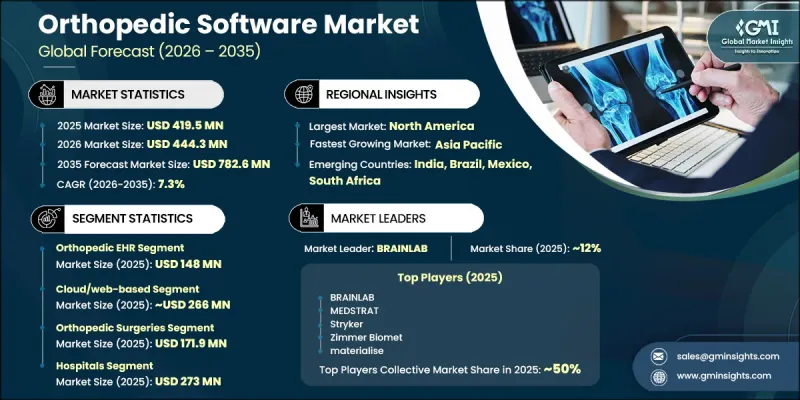
이러한 성장은 정형외과 질환의 발생률 증가와 최소침습 수술에 대한 선호도가 높아지면서 뒷받침되고 있습니다. 정형외과용 소프트웨어는 첨단 디지털 도구를 통해 임상의가 근골격계 질환을 진단, 계획, 관리할 수 있도록 돕습니다. 이러한 플랫폼은 영상 진단의 상세한 분석, 수술 시뮬레이션, 효율적인 환자 데이터 관리를 가능하게 함으로써 임상적 판단의 정확성을 높입니다. 수술의 정확도 향상, 환자 결과 개선, 재수술 감소에 대한 수요 증가로 수술의 도입이 더욱 가속화되고 있습니다. 고령화와 스포츠 및 신체활동 참여 증가에 따른 근골격계 질환의 부담 증가가 시장 확대에 크게 기여하고 있습니다. 의료 디지털화와 워크플로우 효율화에 대한 관심이 높아짐에 따라, 의료 서비스 제공업체들은 정형외과 진료 제공을 간소화하고 전체 의료시설의 운영 성과를 향상시킬 수 있는 통합 소프트웨어 솔루션을 도입하고 있습니다.
| 시장 범위 | |
|---|---|
| 개시 연도 | 2025년 |
| 예측 기간 | 2026-2035년 |
| 개시 시점 시장 규모 | 4억 1,950만 달러 |
| 예측 시장 규모 | 7억 8,260만 달러 |
| CAGR | 7.3% |
정형외과용 소프트웨어 시장도 디지털 의료 시스템의 통합이 진행되면서 상호 운용 가능한 플랫폼에 대한 수요가 증가함에 따라 확대되고 있습니다. 의료 서비스 제공업체들은 첨단 소프트웨어 솔루션을 통해 임상, 관리, 진단 워크플로우 간 연계 강화에 집중하고 있습니다. 지속적인 기술 혁신을 통해 데이터 접근성 향상, 영상 진단의 통합, 치료 계획 수립 능력 강화가 가능해졌습니다. 가치 기반 의료 모델에 대한 인식이 높아짐에 따라 효율성을 높이고 치료의 편차를 줄이는 디지털 정형외과 솔루션의 도입이 더욱 활발해지고 있습니다. 의료 인프라의 확대와 디지털 헬스 기술에 대한 투자 증가도 전 세계 각 지역의 지속적인 시장 성장에 기여하고 있습니다.
정형외과용 전자건강기록(EHR) 부문은 2025년 1억 4,800만 달러를 차지했습니다. 그 우위는 임상 기록의 효율성과 정형외과 진료 전반의 워크플로우 효율성을 향상시킬 수 있는 능력에 기반하고 있습니다. 이러한 시스템은 근골격계 치료에 맞춤화되어 있으며, 부상 추적, 임플란트 기록, 치료 결과 모니터링 등의 기능을 지원하기 때문에 널리 채택되고 있습니다. 통합된 환자 기록과 영상 진단 시스템 및 청구 시스템과의 원활한 연계에 대한 수요가 증가하면서 이 부문의 성장을 더욱 촉진하고 있습니다. 데이터 기반 의료 서비스로의 전환은 정형외과 의료 환경에서 그 중요성이 지속적으로 증가하고 있습니다.
클라우드 및 웹 기반 부문은 2025년 2억 6,600만 달러에 달했습니다. 이 부문은 확장성, 비용 효율성, 다양한 규모의 의료시설에 쉽게 도입할 수 있다는 점에서 강력한 추진력을 보이고 있습니다. 이를 통해 실시간 데이터 액세스, 원격 협업, 다른 의료 시스템과의 원활한 통합이 가능합니다. 구독형 모델에 대한 선호도가 높아지고, 인프라 요구사항이 줄어들면서 도입이 더욱 가속화되고 있습니다. 강화된 데이터 보안 조치와 지속적인 소프트웨어 업데이트도 클라우드 기반 정형외과 솔루션의 보급을 뒷받침하고 있습니다.
북미의 정형외과 소프트웨어 시장은 2025년 1억 6,460만 달러 규모에 달했습니다. 이 지역은 첨단 의료 인프라, 디지털 기술의 적극적인 도입, 통합 임상 시스템에 대한 수요 증가의 혜택을 누리고 있습니다. 이 지역의 의료 서비스 제공업체들은 업무 효율을 높이고 환자 치료 결과를 개선하기 위해 디지털 정형외과 솔루션을 빠르게 도입하고 있습니다. 클라우드 기반 플랫폼으로의 전환이 진행되고 있으며, 전자의무기록 도입과 데이터 상호운용성에 대한 규제적 지원과 함께 병원, 클리닉, 수술센터 전체에서 시장 성장이 더욱 강화되고 있습니다.
자주 묻는 질문
목차
제1장 조사 방법
제2장 주요 요약
제3장 업계 인사이트
제4장 경쟁 구도
제5장 시장 추산 및 예측 : 제품 유형별(2022-2035년)
제6장 시장 추산 및 예측 : 유통 형태별(2022-2035년)
제7장 시장 추산 및 예측 : 용도별(2022-2035년)
제8장 시장 추산 및 예측 : 최종 용도별(2022-2035년)
제9장 시장 추산 및 예측 : 지역별(2022-2035년)
제10장 기업 개요
AJY 26.06.11The Global Orthopedic Software Market was valued at USD 419.5 million in 2025 and is estimated to grow at a CAGR of 7.3% to reach USD 782.6 million by 2035.
Growth is supported by the rising incidence of orthopedic disorders and the increasing preference for minimally invasive surgical procedures. Orthopedic software is designed to support clinicians in diagnosing, planning, and managing musculoskeletal conditions through advanced digital tools. These platforms enhance accuracy in clinical decision-making by enabling detailed analysis of diagnostic imaging, surgical simulation, and efficient patient data management. Increasing demand for improved surgical precision, better patient outcomes, and reduced revision procedures is further driving adoption. The rising burden of musculoskeletal conditions, fueled by aging populations and higher participation in sports and physical activities, is significantly contributing to market expansion. Growing emphasis on healthcare digitization and workflow efficiency is encouraging providers to adopt integrated software solutions that streamline orthopedic care delivery and improve overall operational performance across healthcare facilities.
| Market Scope | |
|---|---|
| Start Year | 2025 |
| Forecast Year | 2026-2035 |
| Start Value | $419.5 Million |
| Forecast Value | $782.6 Million |
| CAGR | 7.3% |
The orthopedic software market is also advancing due to the growing integration of digital healthcare systems and the increasing need for interoperable platforms. Healthcare providers are focusing on improving coordination between clinical, administrative, and diagnostic workflows through advanced software solutions. Continuous technological improvements are enabling better data accessibility, improved imaging integration, and enhanced treatment planning capabilities. Rising awareness of value-based care models is further encouraging the adoption of digital orthopedic solutions that improve efficiency and reduce treatment variability. Expanding healthcare infrastructure and increasing investment in digital health technologies are also contributing to sustained market growth across global regions.
The orthopedic EHR segment accounted for USD 148 million in 2025. Its dominance is driven by its ability to streamline clinical documentation and improve workflow efficiency across orthopedic practices. These systems are widely adopted due to their customization for musculoskeletal care, supporting functions such as injury tracking, implant documentation, and treatment outcome monitoring. Increasing demand for integrated patient records and seamless connectivity with imaging and billing systems is further strengthening segment growth. The shift toward data-driven healthcare delivery continues to reinforce its importance in orthopedic care environments.
The cloud/web-based segment reached USD 266 million in 2025. This segment is gaining strong traction due to its scalability, cost efficiency, and ease of implementation across healthcare facilities of varying sizes. It enables real-time data access, remote collaboration, and smooth integration with other healthcare systems. Growing preference for subscription-based models and reduced infrastructure requirements is further accelerating adoption. Enhanced data security measures and continuous software updates are also supporting widespread use of cloud-based orthopedic solutions.
North America Orthopedic Software Market generated USD 164.6 million in 2025. The region benefits from advanced healthcare infrastructure, strong digital adoption, and increasing demand for integrated clinical systems. Healthcare providers across the region are rapidly adopting digital orthopedic solutions to enhance operational efficiency and improve patient outcomes. The growing shift toward cloud-based platforms, combined with regulatory support for electronic health record adoption and data interoperability, is further strengthening market growth across hospitals, clinics, and surgical centers.
Key companies operating in the Orthopedic Software Market include Siemens Healthineers, Stryker, GE HealthCare, Philips, McKESSON, Zimmer Biomet, BRAINLAB, Carestream, Esaote, Intellijoint Surgical, Materialise, MEDSTRAT and Surgimap. Companies in the orthopedic software market are focusing on innovation, integration, and strategic expansion to strengthen their market position. They are investing in advanced technologies such as artificial intelligence and data analytics to improve diagnostic accuracy and surgical planning capabilities. Strategic partnerships with hospitals and healthcare networks are helping companies expand product adoption and enhance workflow integration. Many firms are prioritizing cloud-based solutions to improve scalability, accessibility, and cost efficiency. Continuous upgrades in interoperability and system integration are enabling seamless connectivity across healthcare platforms.
Table of Contents
Chapter 1 Research Methodology
- 1.1 Research approach
- 1.2 Quality commitments
- 1.2.1 GMI AI policy & data integrity commitment
- 1.2.1.1 Source consistency protocol
- 1.2.1 GMI AI policy & data integrity commitment
- 1.3 Research trail & confidence scoring
- 1.3.1 Research trail components
- 1.3.2 Scoring components
- 1.4 Data collection
- 1.4.1 Partial list of primary sources
- 1.5 Data mining sources
- 1.5.1 Paid sources
- 1.5.1.1 Sources, by region
- 1.5.1 Paid sources
- 1.6 Base estimates and calculations
- 1.6.1 Base year calculation for any one approach
- 1.7 Forecast model
- 1.7.1 Quantified market impact analysis
- 1.7.1.1 Mathematical impact of growth parameters on forecast
- 1.7.1 Quantified market impact analysis
- 1.8 Research transparency addendum
- 1.8.1 Source attribution framework
- 1.8.2 Quality assurance metrics
- 1.8.3 Our commitment to trust
Chapter 2 Executive Summary
- 2.1 Industry 3600 synopsis
- 2.2 Key market trends
- 2.2.1 Product type trends
- 2.2.2 Delivery mode trends
- 2.2.3 Application trends
- 2.2.4 End use trends
- 2.2.5 Regional trends
- 2.3 CXO perspectives: Strategic imperatives
Chapter 3 Industry Insights
- 3.1 Industry ecosystem analysis
- 3.2 Industry impact forces
- 3.2.1 Growth drivers
- 3.2.1.1 Increasing prevalence of orthopedic disorders
- 3.2.1.2 Technological advancements in orthopedic software
- 3.2.1.3 Growing demand for minimally invasive surgeries
- 3.2.1.4 Surging demand for improved surgical outcomes, efficiency, and reduced revision rates
- 3.2.2 Industry pitfalls and challenges
- 3.2.2.1 Potential risks of software malfunction
- 3.2.2.2 High implementation and maintenance costs
- 3.2.3 Market opportunities
- 3.2.3.1 Growing demand for AI-enabled surgical planning and decision-support software
- 3.2.1 Growth drivers
- 3.3 Growth potential analysis
- 3.4 Regulatory landscape
- 3.4.1 North America
- 3.4.2 Europe
- 3.4.3 Asia Pacific
- 3.4.4 Latin America
- 3.4.5 Middle East and Africa
- 3.5 Technology landscape
- 3.5.1 Current technological trends (Driven by primary research)
- 3.5.2 Emerging technologies
- 3.6 Future market trends (Driven by primary research)
- 3.7 Patent landscape (Driven by Primary Research)
- 3.8 Impact of AI and Generative AI on the market (Driven by primary research)
- 3.9 Porter's analysis
- 3.10 PESTEL analysis
Chapter 4 Competitive Landscape, 2025
- 4.1 Introduction
- 4.2 Company market share analysis
- 4.2.1 Global
- 4.2.2 North America
- 4.2.3 Europe
- 4.2.4 Asia Pacific
- 4.3 Company matrix analysis
- 4.4 Competitive analysis of major market players
- 4.5 Competitive positioning matrix
- 4.6 Key developments
- 4.6.1 Mergers and acquisitions
- 4.6.2 Partnerships and collaborations
- 4.6.3 New product launches
- 4.6.4 Expansion plans
Chapter 5 Market Estimates and Forecast, By Product Type, 2022 - 2035 ($ Mn)
- 5.1 Key trends
- 5.2 Orthopedic EHR
- 5.3 Orthopedic PACS
- 5.4 Orthopedic RCM
- 5.5 Orthopedic practice management
- 5.6 Digital templating/Preoperative planning software
Chapter 6 Market Estimates and Forecast, By Delivery Mode, 2022 - 2035 ($ Mn)
- 6.1 Key trends
- 6.2 Cloud/web-based
- 6.3 On premises
Chapter 7 Market Estimates and Forecast, By Application, 2022 - 2035 ($ Mn)
- 7.1 Key trends
- 7.2 Orthopedic surgeries
- 7.3 Fracture management
- 7.4 Joint replacement
- 7.5 Other applications
Chapter 8 Market Estimates and Forecast, By End Use, 2022 - 2035 ($ Mn)
- 8.1 Key trends
- 8.2 Hospitals
- 8.3 Ambulatory surgical centers
- 8.4 Other end users
Chapter 9 Market Estimates and Forecast, By Region, 2022 - 2035 ($ Mn)
- 9.1 Key trends
- 9.2 North America
- 9.2.1 U.S.
- 9.2.2 Canada
- 9.3 Europe
- 9.3.1 Germany
- 9.3.2 UK
- 9.3.3 France
- 9.3.4 Spain
- 9.3.5 Italy
- 9.3.6 Netherlands
- 9.4 Asia Pacific
- 9.4.1 China
- 9.4.2 Japan
- 9.4.3 India
- 9.4.4 Australia
- 9.4.5 South Korea
- 9.5 Latin America
- 9.5.1 Brazil
- 9.5.2 Mexico
- 9.5.3 Argentina
- 9.6 Middle East and Africa
- 9.6.1 South Africa
- 9.6.2 Saudi Arabia
- 9.6.3 UAE
Chapter 10 Company Profiles
- 10.1 BRAINLAB
- 10.2 Carestream
- 10.3 Esaote
- 10.4 GE HealthCare
- 10.5 intellijoint surgical
- 10.6 materialise
- 10.7 McKESSON
- 10.8 MEDSTRAT
- 10.9 merative
- 10.10 Philips
- 10.11 Siemens Healthineers
- 10.12 Stryker
- 10.13 Surgimap
- 10.14 Zimmer Biomet


