|
시장보고서
상품코드
2038737
원격 환자 모니터링 기기 시장 : 시장 비즈니스 기회, 성장요인, 업계 동향 분석 및 예측(2026-2035년)Remote Patient Monitoring (RPM) Devices Market Opportunity, Growth Drivers, Industry Trend Analysis, and Forecast 2026 - 2035 |
||||||

세계의 원격 환자 모니터링 기기 시장은 2025년에 262억 달러로 평가되었고, CAGR 11.2%로 성장할 전망이며, 2035년까지 743억 달러에 이를 것으로 추정되고 있습니다.
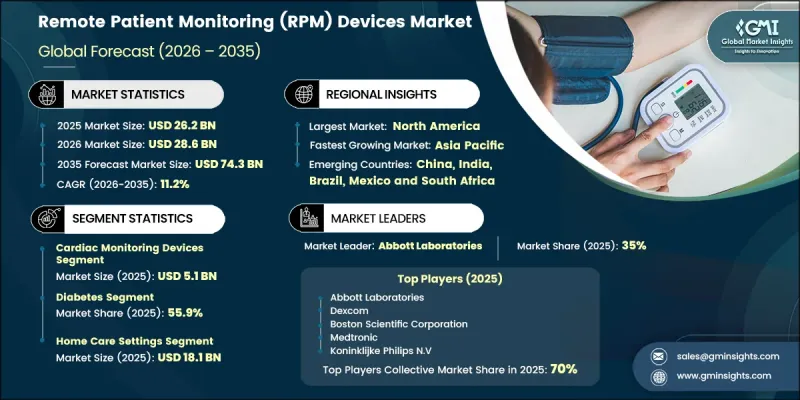
시장 성장은 만성 질환의 유병률 증가, 의료의 급속한 디지털화, 재입원 및 전체 의료비 절감에 대한 요구가 증가함에 따라 주도되고 있습니다. 원격 환자 모니터링(RPM)을 통해 기존 임상 현장 밖에서도 환자의 활력 징후와 건강 상태를 지속적으로 추적할 수 있어 의사는 데이터에 기반한 신속한 의사결정을 내릴 수 있고, 환자의 치료 계획 준수율을 높일 수 있습니다. 스마트폰, 커넥티드 의료기기, 클라우드 기반 플랫폼의 보급으로 RPM 솔루션의 사용 편의성, 정확성, 확장성이 크게 향상되었습니다. 이러한 기술들은 종합적으로 보다 적극적이고 예방적인 치료 모델을 지원하여 응급실 방문을 줄이고 의료 인프라에 대한 부담을 줄일 수 있습니다.
| 시장 범위 | |
|---|---|
| 개시 연도 | 2025년 |
| 예측 기간 | 2026-2035년 |
| 개시 연도 시장 규모 | 262억 달러 |
| 예측 시장 규모 | 743억 달러 |
| CAGR | 11.2% |
세계적으로 가치 중심의 의료 및 재택치료로의 전환으로 인해 RPM 기기에 대한 수요가 더욱 가속화되고 있습니다. 보험사와 의료 서비스 제공업체들은 입원일수 단축, 재입원 페널티 감소, 고위험군 환자군의 적절한 관리 등 원격 모니터링의 경제적 이점을 점점 더 많이 인식하고 있습니다. 또한, 전 세계 고령화 및 당뇨병, 심혈관질환, 호흡기질환 등의 유병률 증가로 인해 RPM의 대상 환자층이 확대되고 있습니다. 디지털 건강 증진, 원격 의료에 대한 보험 환급, 표준 치료 과정에 원격 모니터링의 통합과 같은 정부의 이니셔티브도 예측 기간 동안 시장 침투를 확대하는 데 중요한 역할을 할 것으로 보입니다.
심장 모니터링 기기 부문은 2025년 51억 달러 시장 규모를 기록했습니다. 이 부문에는 부정맥, 심부전 악화, 기타 심장 이상을 실시간으로 감지하는 데 사용되는 심전도(ECG) 기기, 이식형 심장 모니터, 웨어러블 심장 모니터, 이벤트 레코더 등이 포함됩니다. 전 세계 심혈관 질환의 큰 부담과 고위험 심장 환자들에 대한 지속적인 모니터링이 시급한 상황과 맞물려 이 부문의 주요 성장 요인으로 작용하고 있습니다. 원격 심전도 모니터링은 잦은 대면 진료의 필요성을 줄이고, 생명을 위협하는 사건을 조기에 발견할 수 있으며, 보다 적절한 약물 조정을 돕습니다.
홈케어 환경 부문은 편안함을 높이고 비용을 절감하며 재입원을 최소화하기 위해 의료서비스가 병원에서 환자의 집으로 이동함에 따라 2025년 181억 달러 규모에 달했습니다. 이 부문에서는 활력징후 모니터, 혈당 측정기, 심장 웨어러블 기기, 커넥티드 맥박 산소포화도 측정기 등 원격 모니터링 기기가 만성질환자, 수술 후 환자, 고령자를 대상으로 지속적 또는 정기적인 추적관찰에 사용되고 있습니다. 재택 모니터링을 통해 환자는 익숙한 환경에 머물면서 의료 전문가의 원격 모니터링을 받을 수 있어 치료 순응도와 삶의 질을 향상시킬 수 있습니다.
북미의 원격 환자 모니터링(RPM) 기기 시장은 2024년 42.3%의 점유율을 차지했으며, 지역별로 가장 큰 점유율을 차지할 것으로 예측됩니다. 이 지역의 선도적 지위는 탄탄한 의료 인프라, 높은 의료비 지출, 그리고 디지털 헬스 기술의 적극적인 도입으로 뒷받침되고 있습니다. 특히 미국에서는 원격 모니터링 서비스에 대한 유리한 보상 체계로 인해 의료 서비스 제공업체들이 만성질환 관리 프로그램에 RPM을 도입하는 데 큰 도움이 되고 있습니다. 또한, 높은 생활습관병 유병률, 고령 인구 증가, 그리고 인터넷과 스마트 기기에 대한 광범위한 접근성은 원격 모니터링 솔루션 도입에 이상적인 환경을 조성하고 있습니다.
목차
제1장 조사 방법
제2장 주요 요약
제3장 업계 인사이트
제4장 경쟁 구도
제5장 시장 추산 및 예측 : 제품별(2022-2035년)
제6장 시장 추산 및 예측 : 용도별(2022-2035년)
제7장 시장 추산 및 예측 : 최종 용도별(2022-2035년)
제8장 시장 추산 및 예측 : 지역별(2022-2035년)
제9장 기업 개요
AJYThe Global Remote Patient Monitoring Devices Market was valued at USD 26.2 billion in 2025 and is estimated to grow at a CAGR of 11.2% to reach USD 74.3 billion by 2035.
Market growth is driven by the rising prevalence of chronic diseases, rapid digitalization of healthcare, and the growing need to reduce hospital readmissions and overall care costs. Remote patient monitoring (RPM) enables continuous tracking of patients' vital signs and health status outside traditional clinical settings, empowering physicians to make faster, data-driven decisions and improving patient adherence to treatment plans. Rising adoption of smartphones, connected medical devices, and cloud-based platforms has significantly enhanced the usability, accuracy, and scalability of RPM solutions. These technologies collectively support more proactive and preventive care models, reducing emergency visits and easing the burden on healthcare infrastructure.
| Market Scope | |
|---|---|
| Start Year | 2025 |
| Forecast Year | 2026-2035 |
| Start Value | $26.2 Billion |
| Forecast Value | $74.3 Billion |
| CAGR | 11.2% |
The global shift towards value-based care and home-based healthcare is further accelerating the demand for RPM devices. Payers and providers are increasingly recognizing the economic benefits of remote monitoring, such as reduced inpatient days, lower readmission penalties, and better management of high-risk patient cohorts. Additionally, aging populations worldwide and the rising incidence of conditions like diabetes, cardiovascular diseases, and respiratory disorders are expanding the addressable patient pool for RPM. Government initiatives promoting digital health, telehealth reimbursement, and integration of remote monitoring into standard care pathways are also playing a critical role in enhancing market penetration over the forecast period.
The cardiac monitoring devices segment generated USD 5.1 billion in 2025. This segment includes ECG devices, implantable cardiac monitors, wearable heart monitors, and event recorders used to detect arrhythmias, heart failure exacerbations, and other cardiac abnormalities in real time. The high burden of cardiovascular diseases globally, combined with the critical need for continuous surveillance of high-risk cardiac patients, is a core driver for this segment. Remote cardiac monitoring reduces the need for frequent in-person consultations, enables early identification of life-threatening events, and supports better medication titration.
The home care settings segment captured USD 18.1 billion in 2025 as healthcare delivery shifted from hospitals to patients' homes to improve comfort, reduce costs, and minimize hospital readmissions. In this segment, remote monitoring devices such as vital signs monitors, glucose meters, cardiac wearables, and connected oximeters are used to track patients with chronic conditions, post-operative cases, and elderly individuals on a continuous or scheduled basis. Home-based monitoring enables patients to remain in a familiar environment while still being under the virtual supervision of healthcare professionals, which enhances treatment adherence and quality of life.
North America Remote Patient Monitoring Devices Market held 42.3% share in 2024, accounting for the largest regional share. The region's leadership is supported by a well-established healthcare infrastructure, high healthcare expenditure, and strong adoption of digital health technologies. Favorable reimbursement frameworks for remote monitoring services, particularly in the United States, have significantly encouraged providers to incorporate RPM into chronic disease management programs. Additionally, a high prevalence of lifestyle-related disorders, a large elderly population, and widespread access to the internet and smart devices create an ideal environment for the deployment of remote monitoring solutions.
Key players operating in the Global Remote Patient Monitoring Devices Market include Philips Healthcare, Medtronic plc, GE HealthCare, Abbott Laboratories, Boston Scientific Corporation, Nihon Kohden Corporation, ResMed Inc., Dexcom, Inc., and Masimo Corporation. These companies focus on continuous product innovation, integrating advanced sensors, wireless connectivity, and data analytics into their device portfolios. They are also actively involved in strategic partnerships with hospitals, telehealth platforms, and payers to expand their installed base and enhance recurring revenue streams via monitoring services and software subscriptions. Many of these players are investing in AI-enabled platforms that can automatically flag abnormal readings, support predictive risk scoring, and simplify clinical workflows, making remote monitoring more scalable and effective for large patient populations.
Table of Contents
Chapter 1 Research Methodology
- 1.1 Research approach
- 1.2 Quality commitments
- 1.2.1 GMI AI policy & data integrity commitment
- 1.2.1.1 Source consistency protocol
- 1.2.1 GMI AI policy & data integrity commitment
- 1.3 Research trail & confidence scoring
- 1.3.1 Research trail components
- 1.3.2 Scoring components
- 1.4 Data collection
- 1.4.1 Partial list of primary sources
- 1.5 Data mining sources
- 1.5.1 Paid sources
- 1.5.1.1 Sources, by region
- 1.5.1 Paid sources
- 1.6 Base estimates and calculations
- 1.6.1 Base year calculation for any one approach
- 1.7 Forecast model
- 1.7.1 Quantified market impact analysis
- 1.7.1.1 Mathematical impact of growth parameters on forecast
- 1.7.1 Quantified market impact analysis
- 1.8 Research transparency addendum
- 1.8.1 Source attribution framework
- 1.8.2 Quality assurance metrics
- 1.8.3 Our commitment to trust
Chapter 2 Executive Summary
- 2.1 Industry 360° synopsis
- 2.1.1 Key market trends
- 2.1.2 Product trends
- 2.1.3 Application trends
- 2.1.4 End use trends
- 2.1.5 Regional trends
- 2.2 CXO perspectives: Strategic imperatives
Chapter 3 Industry Insights
- 3.1 Industry ecosystem analysis
- 3.2 Industry impact forces
- 3.2.1 Growth drivers
- 3.2.1.1 Rising incidence of chronic diseases across the globe
- 3.2.1.2 Growing disposable income and healthcare expenditure in emerging countries
- 3.2.1.3 Technological advancement in developed nations
- 3.2.1.4 Growing adoption of remote patient monitoring devices
- 3.2.2 Industry pitfalls and challenges
- 3.2.2.1 High cost of devices
- 3.2.2.2 Stringent regulatory framework
- 3.2.3 Market opportunity
- 3.2.3.1 Increasing adoption of AI-powered predictive monitoring tools
- 3.2.3.2 Emergence of wearable biosensors for continuous, real-time health tracking
- 3.2.1 Growth drivers
- 3.3 Growth potential analysis
- 3.4 Regulatory landscape (Driven by Primary Research)
- 3.4.1 North America
- 3.4.2 Europe
- 3.4.3 Asia Pacific
- 3.5 Technological landscape (Driven by Primary Research)
- 3.5.1 Current technologies
- 3.5.1.1 Connected vital signs monitoring devices
- 3.5.1.2 Bluetooth and cellular enabled RPM devices
- 3.5.1.3 Cloud based monitoring platforms and clinical dashboards
- 3.5.1.4 Telehealth integrated rpm solutions
- 3.5.2 Emerging technologies
- 3.5.2.1 AI powered predictive monitoring and clinical decision support
- 3.5.2.2 Wearable biosensors and skin-integrated monitoring patches
- 3.5.2.3 Multi parameter monitoring wearables
- 3.5.2.4 Interoperable RPM ecosystems with standardized data protocols
- 3.5.1 Current technologies
- 3.6 Future market trends (Driven by Primary Research)
- 3.7 Patent analysis (Driven by Primary Research)
- 3.8 Impact of AI and Generative AI on the market (Driven by Primary Research)
- 3.9 Porter's analysis
- 3.10 PESTEL analysis
Chapter 4 Competitive Landscape, 2025
- 4.1 Introduction
- 4.2 Company market share analysis
- 4.3 Company matrix analysis
- 4.4 Competitive analysis of major market players
- 4.5 Competitive positioning matrix
- 4.6 Key developments
- 4.6.1 Merger and acquisition
- 4.6.2 Partnership and collaboration
- 4.6.3 New product launches
- 4.6.4 Expansion plans
Chapter 5 Market Estimates and Forecast, By Product, 2022 - 2035 ($ Mn)
- 5.1 Key trends
- 5.2 Cardiac monitoring devices
- 5.3 Blood pressure monitoring devices
- 5.4 Neurological monitoring devices
- 5.5 Respiratory monitoring devices
- 5.6 Multiparameter monitoring devices
- 5.7 Blood glucose monitoring devices
- 5.8 Fetal and neonatal monitoring devices
- 5.9 Sleep monitoring devices
- 5.10 Other products
Chapter 6 Market Estimates and Forecast, By Application, 2022 - 2035 ($ Mn)
- 6.1 Key trends
- 6.2 Cardiovascular diseases
- 6.3 Cancer
- 6.4 Diabetes
- 6.5 Neurological disorders
- 6.6 Infectious diseases
- 6.7 Respiratory diseases
- 6.8 Other applications
Chapter 7 Market Estimates and Forecast, By End Use, 2022 - 2035 ($ Mn)
- 7.1 Key trends
- 7.2 Home-care settings
- 7.3 Long-term care
- 7.4 Other end users
Chapter 8 Market Estimates and Forecast, By Region, 2022 - 2035 ($ Mn)
- 8.1 Key trends
- 8.2 North America
- 8.2.1 U.S.
- 8.2.2 Canada
- 8.3 Europe
- 8.3.1 Germany
- 8.3.2 UK
- 8.3.3 France
- 8.3.4 Spain
- 8.3.5 Italy
- 8.3.6 Netherlands
- 8.4 Asia Pacific
- 8.4.1 China
- 8.4.2 Japan
- 8.4.3 India
- 8.4.4 Australia
- 8.4.5 South Korea
- 8.5 Latin America
- 8.5.1 Brazil
- 8.5.2 Mexico
- 8.5.3 Argentina
- 8.6 Middle East and Africa
- 8.6.1 South Africa
- 8.6.2 Saudi Arabia
- 8.6.3 UAE
Chapter 9 Company Profiles
- 9.1 Abbott Laboratories
- 9.2 Baxter International
- 9.3 Boston Scientific Corporation
- 9.4 BIOTRONIK SE & Co. KG
- 9.5 DexCom
- 9.6 F. Hoffmann-La Roche
- 9.7 GE Healthcare
- 9.8 Johnson & Johnson
- 9.9 Koninklijke Philips
- 9.10 Medtronic
- 9.11 OMRON Corporation
- 9.12 Sotera Wireless
- 9.13 VitalConnect