

|
시장보고서
상품코드
2038739
과일 통조림 시장 : 시장 비즈니스 기회, 성장요인, 업계 동향 분석 및 예측(2026-2035년)Canned Fruits Market Opportunity, Growth Drivers, Industry Trend Analysis, and Forecast 2026 - 2035 |
||||||

세계의 과일 통조림 시장은 2025년에 111억 달러로 평가되었고, CAGR 5.3%로 성장할 전망이며, 2035년까지 186억 달러에 이를 것으로 추정되고 있습니다.
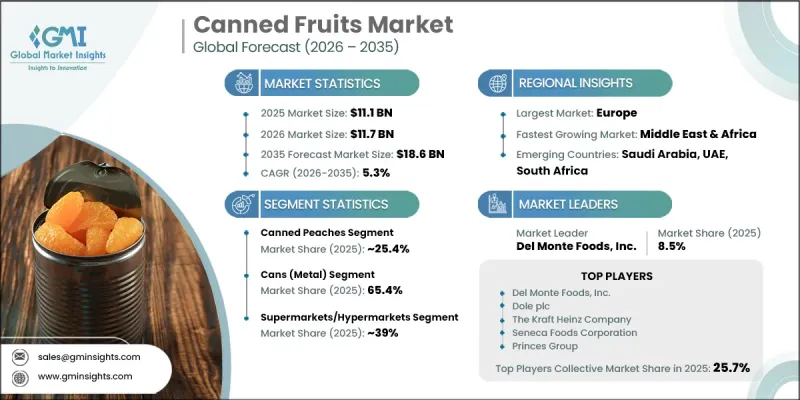
시장 성장은 일반 가정과 외식 산업에서 편리하고 상온 보관이 가능하며 영양가가 높은 과일 베이스 식품에 대한 소비자의 선호도가 높아짐에 따라 성장세를 보이고 있습니다. 도시화의 진전과 바쁜 라이프스타일의 확산으로 인해 준비의 번거로움을 최소화하면서 필수 영양소를 섭취할 수 있는 '바로 먹을 수 있는' 과일 제품에 대한 수요가 증가하고 있습니다. 과일 통조림은 디저트, 베이킹, 샐러드, 음료 등 다양한 용도로 활용되고 있으며, 가정 및 상업용 주방에서 활용도가 높은 식재료입니다. 또한, 최신 가공 기술로 필수 비타민과 미네랄을 보존하고 있어 건강을 중시하는 소비자들의 지지를 받고 있습니다. 이 제품 카테고리는 다양한 맛의 취향과 계절에 따른 공급 공백에 대응할 수 있는 다양한 유형의 과일을 제공합니다. 또한, 특히 신선식품에 대한 접근성이 제한되어 있는 지역에서 저렴한 가격과 연중 내내 이용할 수 있다는 점이 시장에서의 입지를 더욱 강화시키고 있습니다. 유통기한이 길어짐에 따라 음식물 쓰레기 감량에도 기여하며, 그 가치 제안이 더욱 높아졌습니다. 소매 네트워크의 꾸준한 확대와 함께 조직화된 식품 유통 채널과 온라인 식료품 플랫폼의 침투가 진행됨에 따라 세계 시장에서 제품의 가용성과 소비가 더욱 가속화되고 있습니다.
| 시장 범위 | |
|---|---|
| 개시 연도 | 2025년 |
| 예측 기간 | 2026-2035년 |
| 개시 연도 시장 규모 | 111억 달러 |
| 예측 시장 규모 | 186억 달러 |
| CAGR | 5.3% |
복숭아 통조림 부문은 2025년 25.4%의 점유율을 차지했으며, 2035년까지 연평균 5.5%의 성장률을 보일 것으로 전망됩니다. 이 부문은 높은 소비자 인지도, 기분 좋은 맛, 그리고 직접 소비부터 요리에 이르기까지 다양한 용도로 사용할 수 있다는 장점으로 과일 통조림 시장을 주도하고 있습니다. 복숭아 통조림은 디저트, 구운 과자, 간식 요리에 많이 사용되기 때문에 가정의 식료품 저장실뿐만 아니라 외식 산업에서도 빼놓을 수 없는 존재가 되었습니다. 안정적인 맛과 식감을 유지하며 다양한 요리에 쉽게 접목할 수 있다는 점이 지속적인 수요를 뒷받침하고 있습니다. 또한, 이 부문은 높은 브랜드 인지도와 확고한 소비 습관의 혜택을 누리고 있으며, 이는 재구매로 이어지고 있습니다. 또한, 상업용 주방 및 가공식품 제조에서 '바로 사용할 수 있는' 과일 원료에 대한 수요가 증가하면서 이 부문의 성장을 견인하고 있습니다. 시럽의 양, 저당분, 무방부제 등의 혁신은 소비자의 관심을 더욱 높이고 건강을 중시하는 계층의 이용 확대를 촉진하고 있습니다.
금속 캔 부문은 2025년 65.4%의 점유율을 차지했으며, 2026-2035년 연평균 복합 성장률(CAGR) 5%로 성장할 것으로 전망됩니다. 패키징의 혁신과 지속가능성에 대한 고려가 이 부문을 형성하는 주요 동인이 되고 있습니다. 금속 캔은 내구성, 장기 보존성, 그리고 장기간 제품의 신선도를 유지하는 능력으로 인해 여전히 선호되는 포장 형태입니다. 경량 구조와 높은 오염 저항성을 결합하여 대량 보관 및 소매 유통에 모두 적합합니다. 또한, 이 포장 형태는 효율적인 운송을 가능하게 하고, 제품의 부패를 방지하여 대규모 식품 공급망에서 중요한 이점이 되고 있습니다. 재활용이 가능하고 친환경적인 포장 솔루션에 대한 관심이 높아지면서 금속 캔의 채택이 더욱 증가하고 있습니다. 제조업체들은 제품의 품질을 유지하면서 지속가능성 성능을 향상시키기 위해 코팅 기술을 개선하고 재료 사용량을 줄이는 데 점점 더 많은 노력을 기울이고 있습니다.
2025년 북미의 과일 통조림 시장은 24.5%의 점유율을 차지했습니다. 이 지역은 영양가 높은 식품 선택에 대한 소비자의 인식이 높고, 유기농 식품과 건강 지향적인 가공식품에 대한 선호도가 높은 것이 특징입니다. 특히 바쁜 생활패턴을 가진 도시인들을 중심으로 편리하고 바로 먹을 수 있는 과일 제품에 대한 수요가 증가하고 있습니다. 과일 통조림은 휴대성, 긴 보존 기간, 가정 요리 및 외식 산업에서 사용하기 쉽기 때문에 점점 더 선호되고 있습니다. 소매 유통은 슈퍼마켓과 대형마트에 의해 강력하게 뒷받침되는 반면, 디지털화의 진전과 편의성을 중시하는 구매 행동의 확산으로 인해 온라인 식품 판매 플랫폼도 성장세를 보이고 있습니다. 또한, 지속가능성 트렌드도 시장 성장에 영향을 미치고 있으며, 각 제조업체들은 재활용 가능한 소재와 친환경적인 포장 형태를 채택하고 있습니다. 지속적인 제품 혁신, 맛의 다양화, 클린 라벨 전략의 추진은 이 지역 전체에서 시장 확대를 더욱 촉진하고 있습니다.
자주 묻는 질문
목차
제1장 조사 방법 및 범위
제2장 주요 요약
제3장 업계 인사이트
제4장 경쟁 구도
제5장 시장 추산 및 예측 : 제품 유형별(2022-2035년)
제6장 시장 추산 및 예측 : 포장 유형별(2022-2035년)
제7장 시장 추산 및 예측 : 유통 채널별(2022-2035년)
제8장 시장 추산 및 예측 : 지역별(2022-2035년)
제9장 기업 개요
AJY 26.06.11The Global Canned Fruits Market was valued at USD 11.1 billion in 2025 and is estimated to grow at a CAGR of 5.3% to reach USD 18.6 billion by 2035.
Market growth is supported by rising consumer preference for convenient, shelf-stable, and nutritious fruit-based food options across households and foodservice industries. Increasing urbanization and fast-paced lifestyles are encouraging demand for ready-to-eat fruit products that require minimal preparation while still offering essential nutrients. Canned fruits are widely used across desserts, baking applications, salads, and beverages, making them a versatile ingredient in both domestic and commercial kitchens. They retain essential vitamins and minerals through modern processing methods, which enhances their appeal among health-conscious consumers. The product category offers a wide assortment of fruit varieties that cater to diverse taste preferences and seasonal availability gaps. In addition, affordability and year-round accessibility continue to strengthen their market position, particularly in regions with limited access to fresh produce. Longer shelf life also helps reduce food waste, further improving their value proposition. The steady expansion of retail networks, combined with increasing penetration of organized food distribution channels and online grocery platforms, is further accelerating product availability and consumption across global markets.
| Market Scope | |
|---|---|
| Start Year | 2025 |
| Forecast Year | 2026-2035 |
| Start Value | $11.1 Billion |
| Forecast Value | $18.6 Billion |
| CAGR | 5.3% |
The canned peaches segment accounted for a 25.4% share in 2025 and is projected to grow at a CAGR of 5.5% through 2035. This segment continues to lead the canned fruits market due to its strong consumer familiarity, pleasant taste profile, and wide usability across both direct consumption and culinary applications. Canned peaches are frequently used in desserts, baking recipes, and snack preparations, making them a staple in household pantries as well as foodservice operations. Their consistent flavor, texture retention, and ease of incorporation into multiple dishes support sustained demand. The segment also benefits from strong brand recognition and established consumption habits, which contribute to repeat purchases. Additionally, increasing demand for ready-to-use fruit ingredients in commercial kitchens and packaged food production continues to reinforce segment growth. Product innovation in syrup levels, reduced sugar formulations, and preservative-free options is further enhancing consumer appeal and expanding usage across health-conscious demographics.
The metal cans segment held a share of 65.4% in 2025 and is anticipated to grow at a CAGR of 5% between 2026 and 2035. Packaging innovation and sustainability considerations are key drivers shaping this segment. Metal cans remain the preferred packaging format due to their durability, long shelf life protection, and ability to preserve product freshness over extended periods. Their lightweight structure, combined with high resistance to contamination, makes them suitable for both bulk storage and retail distribution. The packaging type also supports efficient transportation and reduces product spoilage, which is a critical advantage in large-scale food supply chains. Growing emphasis on recyclable and environmentally responsible packaging solutions is further strengthening the adoption of metal cans. Manufacturers are increasingly focusing on improving coating technologies and reducing material usage to enhance sustainability performance while maintaining product integrity.
North America Canned Fruits Market accounted for a 24.5% share in 2025. The region is characterized by strong consumer awareness regarding nutritional food choices and a growing preference for organic and health-oriented packaged foods. Demand for convenient, ready-to-eat fruit products is rising, particularly among urban populations with fast-paced lifestyles. Canned fruits are increasingly being preferred for their portability, long shelf life, and ease of use in home cooking and foodservice applications. Retail distribution is strongly supported by supermarkets and hypermarkets, while online grocery platforms are gaining momentum due to rising digital adoption and convenience-driven shopping behavior. Sustainability trends are also influencing market growth, with manufacturers adopting recyclable materials and eco-friendly packaging formats. Continuous product innovation, flavor diversification, and clean-label positioning are further strengthening market expansion across the region.
Major players operating in the Global Canned Fruits Industry include CHB Group, A. Clouet & Co. (KL) Sdn. Bhd., Conserve Italia, Dole plc, Del Monte Foods, Inc., Goya Foods, Inc., Golden Circle, Kangfa Food Co., Ltd., Princes Group, RFG Foods, Rhodes Food Group, Seneca Foods Corporation, and The Kraft Heinz Company. Companies in the Canned Fruits Market are focusing on expanding product portfolios through diversified fruit offerings and healthier formulations with reduced sugar and preservative content. They are strengthening supply chain efficiency by investing in advanced processing technologies and automation to ensure consistent quality and longer shelf life. Strategic partnerships with retail chains and foodservice distributors are being used to improve market penetration. Firms are also investing heavily in sustainable packaging solutions, particularly recyclable and lightweight metal cans, to align with environmental expectations. Digital marketing and e-commerce expansion are playing a key role in enhancing brand visibility and consumer reach. Additionally, companies are introducing premium and organic product lines to target health-conscious consumers, while innovation in flavor combinations and packaging formats is helping to differentiate offerings in a competitive market landscape.
Table of Contents
Chapter 1 Methodology & Scope
- 1.1 Market scope and definition
- 1.2 Research design
- 1.2.1 Research approach
- 1.2.2 Data collection methods
- 1.3 Data mining sources
- 1.3.1 Global
- 1.3.2 Regional/Country
- 1.4 Base estimates and calculations
- 1.4.1 Base year calculation
- 1.4.2 Key trends for market estimation
- 1.5 Primary research and validation
- 1.5.1 Primary sources
- 1.6 Forecast model
- 1.7 Research assumptions and limitations
Chapter 2 Executive Summary
- 2.1 Industry 360° synopsis
- 2.2 Key market trends
- 2.2.1 Regional
- 2.2.2 Product Type
- 2.2.3 Packaging type
- 2.2.4 Distribution channel
- 2.3 TAM Analysis, 2026-2035
- 2.4 CXO perspectives: Strategic imperatives
- 2.4.1 Executive decision points
Chapter 3 Industry Insights
- 3.1 Industry ecosystem analysis
- 3.1.1 Supplier landscape
- 3.1.2 Profit margin
- 3.1.3 Value addition at each stage
- 3.1.4 Factor affecting the value chain
- 3.1.5 Disruptions
- 3.2 Industry impact forces
- 3.2.1 Growth drivers
- 3.2.2 Industry pitfalls and challenges
- 3.2.3 Market opportunities
- 3.3 Growth potential analysis
- 3.4 Regulatory landscape
- 3.4.1 North America
- 3.4.2 Europe
- 3.4.3 Asia Pacific
- 3.4.4 Latin America
- 3.4.5 Middle East & Africa
- 3.5 Porter's analysis
- 3.6 PESTEL analysis
- 3.7 Price trends
- 3.7.1 By region
- 3.7.2 By type
- 3.8 Future market trends
- 3.9 Technology and Innovation landscape
- 3.9.1 Current technological trends
- 3.9.2 Emerging technologies
- 3.10 Patent Landscape
- 3.11 Trade statistics (HS code)
- 3.11.1 Major importing countries
- 3.11.2 Major exporting countries
- 3.12 Sustainability and environmental aspects
- 3.12.1 Sustainable practices
- 3.12.2 Waste reduction strategies
- 3.12.3 Energy efficiency in production
- 3.12.4 Eco-friendly initiatives
- 3.13 Carbon footprint consideration
Chapter 4 Competitive Landscape, 2025
- 4.1 Introduction
- 4.2 Company market share analysis
- 4.2.1 By region
- 4.2.1.1 North America
- 4.2.1.2 Europe
- 4.2.1.3 Asia Pacific
- 4.2.1.4 LATAM
- 4.2.1.5 MEA
- 4.2.1 By region
- 4.3 Company matrix analysis
- 4.4 Competitive analysis of major market players
- 4.5 Competitive positioning matrix
- 4.6 Key developments
- 4.6.1 Mergers & acquisitions
- 4.6.2 Partnerships & collaborations
- 4.6.3 New Product Launches
- 4.6.4 Expansion Plans
Chapter 5 Market Estimates and Forecast, By Product Type, 2022-2035 (USD Billion) (Kilo Tons)
- 5.1 Key trends
- 5.2 Canned apples
- 5.3 Canned apricots
- 5.4 Canned berries
- 5.5 Canned cherries
- 5.6 Canned citrus fruits
- 5.7 Canned grapes
- 5.8 Canned mixed fruits
- 5.9 Canned peaches
- 5.10 Canned pears
- 5.11 Canned pineapples
- 5.12 Canned plums
- 5.13 Others
Chapter 6 Market Estimates and Forecast, By Packaging Type, 2022-2035 (USD Billion) (Kilo Tons)
- 6.1 Key trends
- 6.2 Cans (metal)
- 6.3 Glass jars
- 6.4 Others
Chapter 7 Market Estimates and Forecast, By Distribution Channel, 2022-2035 (USD Billion) (Kilo Tons)
- 7.1 Key trends
- 7.2 Supermarkets/hypermarkets
- 7.3 Convenience stores
- 7.4 Online retail
- 7.5 Specialty stores
- 7.6 Others
Chapter 8 Market Estimates and Forecast, By Region, 2022-2035 (USD Billion) (Kilo Tons)
- 8.1 Key trends
- 8.2 North America
- 8.2.1 U.S.
- 8.2.2 Canada
- 8.3 Europe
- 8.3.1 Germany
- 8.3.2 UK
- 8.3.3 France
- 8.3.4 Spain
- 8.3.5 Italy
- 8.3.6 Rest of Europe
- 8.4 Asia Pacific
- 8.4.1 China
- 8.4.2 India
- 8.4.3 Japan
- 8.4.4 Australia
- 8.4.5 South Korea
- 8.4.6 Rest of Asia Pacific
- 8.5 Latin America
- 8.5.1 Brazil
- 8.5.2 Mexico
- 8.5.3 Argentina
- 8.5.4 Rest of Latin America
- 8.6 Middle East and Africa
- 8.6.1 Saudi Arabia
- 8.6.2 South Africa
- 8.6.3 UAE
- 8.6.4 Rest of Middle East and Africa
Chapter 9 Company Profiles
- 9.1 A. Clouet & Co. (KL) Sdn. Bhd.
- 9.2 CHB Group
- 9.3 Conserve Italia
- 9.4 Del Monte Foods, Inc.
- 9.5 Dole plc
- 9.6 Golden Circle
- 9.7 Goya Foods, Inc.
- 9.8 Kangfa Food Co., Ltd.
- 9.9 Princes Group
- 9.10 RFG Foods
- 9.11 Rhodes Food Group
- 9.12 Seneca Foods Corporation
- 9.13 The Kraft Heinz Company


