|
시장보고서
상품코드
2038748
예비 발전기 시장 : 시장 기회, 성장요인, 업계 동향 분석 및 예측(2026-2035년)Standby Generator Sets Market Opportunity, Growth Drivers, Industry Trend Analysis, and Forecast 2026 - 2035 |
||||||

세계의 예비 발전기 시장은 2025년에 293억 달러로 평가되었고, CAGR 8.7%로 성장할 전망이며, 2035년까지 674억 달러에 이를 것으로 추정되고 있습니다.
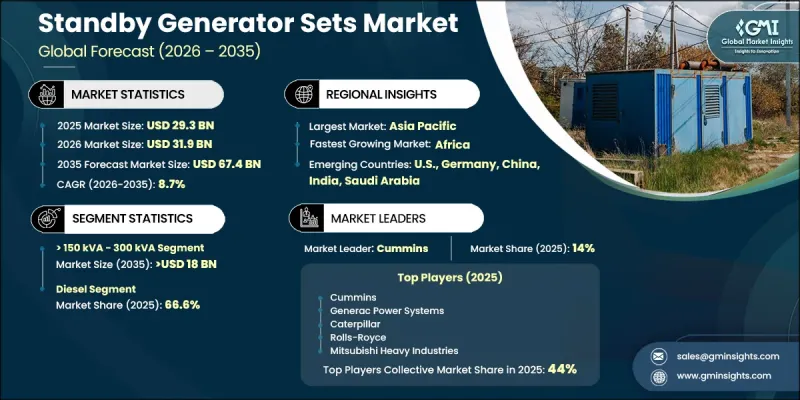
전력 공급 중단, 기후 변화 관련 사건 증가, 디지털 인프라에 대한 의존도가 높아지면서 중단 없는 전력 공급에 대한 수요가 증가함에 따라 이 산업은 강한 모멘텀을 보이고 있습니다. 기업이나 가정에서는 업무의 연속성과 안전을 유지하기 위해 비상용 전원 솔루션을 우선적으로 도입하고 있습니다. 신흥 경제국의 급속한 도시화, 인프라 개발 및 전기화의 진전은 시장 수요를 더욱 촉진하고 있습니다. 또한, 에너지 안보에 대한 투자 확대, 전력망 현대화, 스마트 기술 통합이 진행되면서 경쟁 구도가 재편되고 있습니다. 각 제조업체들은 변화하는 규제 프레임워크와 소비자의 기대에 부응하기 위해 첨단, 연비, 친환경 솔루션에 집중하고 있습니다. 신뢰할 수 있고 자동화된 백업 시스템으로의 전환으로 예비 발전기는 여러 최종 사용 부문에서 필수적인 구성 요소로 자리매김하고 있으며, 이는 업계의 장기적인 확장을 뒷받침하고 있습니다.
| 시장 범위 | |
|---|---|
| 개시 연도 | 2025년 |
| 예측 기간 | 2026-2035년 |
| 개시 연도 시장 규모 | 293억 달러 |
| 예측 시장 규모 | 674억 달러 |
| CAGR | 8.7% |
예비 발전기는 정전 시 전력을 공급하도록 설계된 자동 백업 시스템 역할을 하며, 엔진과 발전기가 일체화된 메커니즘으로 작동합니다. 이 시스템은 주전원이 중단되었을 때 작동하며, 전원이 복구되면 대기 모드로 돌아갑니다. 도시 인구 증가와 인프라 투자 확대에 힘입어 주거, 상업, 산업 분야에서의 도입 확대가 시장 성장을 견인하고 있습니다. 중요한 업무에서 안정적인 전력에 대한 수요가 증가하고 에너지 신뢰성에 대한 인식이 높아짐에 따라 제품 도입이 가속화되고 있습니다. 에너지 복원력과 지속가능성에 초점을 맞춘 정부의 지원책과 더불어 스마트 그리드 기술의 발전은 시장의 잠재력을 더욱 높이고 있습니다.
정격 출력 150kVA-300kVA의 예비 발전기 시장은 2035년까지 180억 달러에 달할 것으로 예측됩니다. 전력의 신뢰성에 대한 우려가 높아짐에 따라, 조직들은 대규모 업무를 지원할 수 있는 대용량 시스템을 도입하고 있습니다. 원격 모니터링, 예지보전 기능 등의 기술 혁신으로 시스템의 성능과 운영 효율성이 향상되고 있습니다. 또한, 에너지 탄력성 및 청정 대체 에너지에 대한 관심이 높아지면서 이 용량 범위의 하이브리드 및 대체 연료 발전 솔루션의 개발이 촉진되고 있습니다.
2025년 기준, 디젤식 예비 발전기는 66.6%의 점유율을 차지했습니다. 이러한 시스템은 신뢰성과 다양한 분야에서 안정적인 백업 전력을 공급할 수 있는 능력으로 인해 여전히 널리 사용되고 있습니다. 지속적인 전력 공급에 대한 수요 증가와 함께 인프라 확장 및 산업 성장과 함께 이 부문의 우위는 계속 유지되고 있습니다. 부동산 활동의 확대와 중소기업의 발전도 디젤 시스템에 대한 지속적인 수요에 더욱 기여하고 있습니다.
2025년 미국의 예비 발전기 시장 규모는 64억 달러로 평가됐습니다. 잦은 기상이변과 더불어 전력 인프라의 노후화 및 송전망의 비효율성으로 인해 신뢰할 수 있는 백업 솔루션에 대한 수요가 증가하고 있습니다. 스마트 기술의 도입, 연결 기능 강화, 에너지 효율 향상으로 제품 혁신이 이루어지고 있습니다. 또한, 인프라 개발에 대한 투자 증가와 산업 활동의 확대는 전체 시장 전망을 더욱 견고하게 만들고 있습니다.
자주 묻는 질문
목차
제1장 조사 방법 및 범위
제2장 주요 요약
제3장 업계 인사이트
제4장 경쟁 구도
제5장 시장 규모 및 예측 : 출력별(2022-2035년)
제6장 시장 규모 및 예측 : 연료별(2022-2035년)
제7장 시장 규모 및 예측 : 용도별(2022-2035년)
제8장 시장 규모 및 예측 : 지역별(2022-2035년)
제9장 기업 개요
AJY 26.06.11The Global Standby Generator Sets Market was valued at USD 29.3 billion in 2025 and is estimated to grow at a CAGR of 8.7% to reach USD 67.4 billion by 2035.
The industry is gaining strong momentum owing to the growing requirement for uninterrupted electricity supply amid increasing power disruptions, climate-related events, and rising reliance on digital infrastructure. Businesses and households are prioritizing backup power solutions to maintain operational continuity and safety. Rapid urban expansion, infrastructure development, and increasing electrification across emerging economies are further strengthening market demand. In addition, rising investments in energy security, modernization of grid networks, and the integration of smart technologies are reshaping the competitive landscape. Manufacturers are focusing on advanced, fuel-efficient, and environmentally aligned solutions to meet evolving regulatory frameworks and consumer expectations. The shift toward reliable and automated backup systems continues to position standby generator sets as a critical component across multiple end-use sectors, supporting long-term industry expansion.
| Market Scope | |
|---|---|
| Start Year | 2025 |
| Forecast Year | 2026-2035 |
| Start Value | $29.3 Billion |
| Forecast Value | $67.4 Billion |
| CAGR | 8.7% |
Standby generator sets function as automatic backup systems designed to supply electricity during outages, operating through integrated engine and alternator mechanisms. These systems activate when the primary power source fails and return to standby mode once electricity is restored. Increasing adoption across residential, commercial, and industrial applications is driving market growth, supported by expanding urban populations and rising infrastructure investments. The growing need for dependable electricity in critical operations, coupled with increasing awareness of energy reliability, is accelerating product deployment. Supportive government initiatives focused on energy resilience and sustainability, along with advancements in smart grid technologies, are further enhancing market potential.
The >150 kVA-300 kVA rated standby generator sets segment is expected to reach USD 18 billion by 2035. Rising concerns regarding power reliability are encouraging organizations to deploy higher-capacity systems capable of supporting large-scale operations. Technological innovations, including remote monitoring and predictive maintenance capabilities, are improving system performance and operational efficiency. Additionally, increasing emphasis on energy resilience and cleaner energy alternatives is driving the development of hybrid and alternative-fuel generator solutions within this capacity range.
The diesel-powered standby generator sets accounted for 66.6% share in 2025. These systems remain widely utilized due to their reliability and ability to deliver consistent backup power across diverse sectors. Growing demand for continuous electricity supply, combined with infrastructure expansion and industrial growth, continues to support segment dominance. The expansion of real estate activities and the increasing development of small and medium-sized enterprises are further contributing to sustained demand for diesel-based systems.
U.S. Standby Generator Sets Market was valued at USD 6.4 billion in 2025. Increasing frequency of extreme weather events, along with aging power infrastructure and grid inefficiencies, is driving demand for reliable backup solutions. The adoption of smart technologies, enhanced connectivity features, and improved energy efficiency is shaping product innovation. Furthermore, rising investments in infrastructure development and growing industrial activities are strengthening the overall market outlook.
Key companies operating in the Standby Generator Sets Market include AKSA Power Generation, Kirloskar, Cummins, Atlas Copco, Mahindra Powerol, Wartsila, Generac Power Systems, Caterpillar, Eaton, Mitsubishi Heavy Industries, Yamaha Motor, Rolls-Royce, Ashok Leyland, Briggs & Stratton, HIPOWER Systems, HIMOINSA, Kawasaki Heavy Industries, Yanmar Holdings, Pramac, Rehlko, Powerica, Gillette Generators, Kubota Corporation, and J C Bamford Excavators. Companies in the standby generator sets market are strengthening their competitive position by investing in advanced technologies such as remote monitoring, IoT-enabled systems, and predictive maintenance solutions to enhance performance and reliability. They are focusing on developing fuel-efficient and low-emission generators to align with evolving environmental regulations and sustainability goals. Strategic partnerships, mergers, and acquisitions are being used to expand geographic presence and product portfolios. Manufacturers are also prioritizing customization to meet diverse application requirements across industries.
Table of Contents
Chapter 1 Methodology & Scope
- 1.1 Research approach
- 1.2 Quality commitments
- 1.2.1 GMI AI policy & data integrity commitment
- 1.2.1.1 Source consistency protocol
- 1.2.1 GMI AI policy & data integrity commitment
- 1.3 Research trail & confidence scoring
- 1.3.1 Research trail components
- 1.3.2 Scoring components
- 1.4 Data collection
- 1.4.1 Partial list of primary sources
- 1.5 Data mining sources
- 1.5.1 Paid sources
- 1.5.1.1 Sources, by region
- 1.5.1 Paid sources
- 1.6 Base estimates and calculations
- 1.6.1 Base year calculation for any one approach
- 1.7 Market estimates & forecasts parameters
- 1.8 Forecast model
- 1.8.1 Quantified market impact analysis
- 1.8.1.1 Mathematical impact of growth parameters on forecast
- 1.8.1 Quantified market impact analysis
- 1.9 Research transparency addendum
- 1.9.1 Source attribution framework
- 1.9.2 Quality assurance metrics
- 1.9.3 Our commitment to trust
- 1.10 Market definitions
Chapter 2 Executive Summary
- 2.1 Industry synopsis, 2022 - 2035
- 2.1.1 Business trends
- 2.1.2 Power rating trends
- 2.1.3 Fuel trends
- 2.1.4 Application trends
- 2.1.5 Regional trends
Chapter 3 Industry Insights
- 3.1 Industry ecosystem analysis
- 3.1.1 Raw material availability & sourcing analysis
- 3.1.2 Manufacturing capacity assessment
- 3.1.3 Supply chain resilience & risk factors
- 3.1.4 Distribution network analysis
- 3.2 Industry impact forces
- 3.2.1 Growth drivers
- 3.2.2 Industry pitfalls & challenges
- 3.3 Regulatory landscape
- 3.4 Growth potential analysis
- 3.5 Porter's analysis
- 3.5.1 Bargaining power of suppliers
- 3.5.2 Bargaining power of buyers
- 3.5.3 Threat of new entrants
- 3.5.4 Threat of substitutes
- 3.6 PESTEL analysis
- 3.6.1 Political factors
- 3.6.2 Economic factors
- 3.6.3 Social factors
- 3.6.4 Technological factors
- 3.6.5 Legal factors
- 3.6.6 Environmental factors
- 3.7 Cost structure analysis of standby generator sets
- 3.8 Emerging opportunities & trends
- 3.9 Digitalization & IoT integration
- 3.10 Investment analysis & future prospects
- 3.11 Price trend analysis (USD/Unit) (Driven by Primary Research)
- 3.11.1 By region (Driven by Primary Research)
- 3.11.2 By power rating (Driven by Primary Research)
- 3.12 Trade data analysis (Driven by Primary Research)
- 3.12.1 Import/export value trends (Driven by Primary Research)
- 3.12.2 Key trade corridors & tariff impact (Driven by Primary Research)
- 3.13 Capacity & production landscape (Driven by Primary Research)
- 3.13.1 Capacity by region & key producer (Driven by Primary Research)
- 3.13.2 Capacity utilization rates & expansion pipelines (Driven by Primary Research)
- 3.14 Impact of AI & Generative AI on the market (Driven by Primary Research)
- 3.14.1 AI-Driven production optimization (Driven by Primary Research)
- 3.14.2 Predictive maintenance & fault detection (Driven by Primary Research)
Chapter 4 Competitive Landscape, 2026
- 4.1 Introduction
- 4.2 Company market share analysis, by region, 2025
- 4.2.1 North America
- 4.2.2 Europe
- 4.2.3 Asia Pacific
- 4.2.4 Middle East
- 4.2.5 Africa
- 4.2.6 Latin America
- 4.3 Competitive analysis of major market players
- 4.4 Competitive positioning matrix
- 4.5 Key developments
- 4.5.1 Mergers & acquisitions
- 4.5.2 Partnerships & collaborations
- 4.5.3 New product launches
- 4.5.4 Expansion plans & funding
- 4.6 Company tier benchmarking
- 4.6.1 Tier classification criteria & qualifying thresholds
- 4.6.2 Tier positioning matrix by revenue, geography & innovation
Chapter 5 Market Size and Forecast, By Power Rating, 2022 - 2035 (USD Million & '000 Units)
- 5.1 Key trends
- 5.2 ≤ 50 kVA
- 5.3 > 50 kVA - 150 kVA
- 5.4 > 150 kVA - 300 kVA
- 5.5 > 300 kVA - 500 kVA
- 5.6 > 500 kVA
Chapter 6 Market Size and Forecast, By Fuel, 2022 - 2035 (USD Million & '000 Units)
- 6.1 Key trends
- 6.2 Diesel
- 6.3 Gas
- 6.4 Others
Chapter 7 Market Size and Forecast, By Application, 2022 - 2035 (USD Million & '000 Units)
- 7.1 Key trends
- 7.2 Residential
- 7.3 Commercial
- 7.4 Industrial
Chapter 8 Market Size and Forecast, By Region, 2022 - 2035 (USD Million & '000 Units)
- 8.1 Key trends
- 8.2 North America
- 8.2.1 U.S.
- 8.2.2 Canada
- 8.3 Europe
- 8.3.1 Russia
- 8.3.2 UK
- 8.3.3 Germany
- 8.3.4 France
- 8.3.5 Spain
- 8.3.6 Austria
- 8.3.7 Italy
- 8.4 Asia Pacific
- 8.4.1 China
- 8.4.2 Australia
- 8.4.3 India
- 8.4.4 Japan
- 8.4.5 South Korea
- 8.4.6 Indonesia
- 8.4.7 Malaysia
- 8.4.8 Thailand
- 8.4.9 Vietnam
- 8.4.10 Philippines
- 8.5 Middle East
- 8.5.1 Saudi Arabia
- 8.5.2 UAE
- 8.5.3 Qatar
- 8.5.4 Turkey
- 8.5.5 Iran
- 8.5.6 Oman
- 8.6 Africa
- 8.6.1 Egypt
- 8.6.2 Nigeria
- 8.6.3 Algeria
- 8.6.4 South Africa
- 8.6.5 Angola
- 8.7 Latin America
- 8.7.1 Brazil
- 8.7.2 Mexico
- 8.7.3 Argentina
- 8.7.4 Chile
Chapter 9 Company Profiles
- 9.1 AKSA POWER GENERATION
- 9.2 Ashok Leyland
- 9.3 Atlas Copco
- 9.4 Briggs and Stratton
- 9.5 Caterpillar
- 9.6 Cummins
- 9.7 Eaton
- 9.8 Generac Power Systems
- 9.9 Gillette Generators
- 9.10 HIMOINSA
- 9.11 HIPOWER SYSTEMS
- 9.12 J C Bamford Excavators
- 9.13 Kawasaki Heavy Industries
- 9.14 Kirloskar
- 9.15 KUBOTA Corporation
- 9.16 Pramac
- 9.17 Rehlko
- 9.18 Mahindra Powerol
- 9.19 Mitsubishi Heavy Industries
- 9.20 Powerica Limited
- 9.21 Rolls-Royce
- 9.22 Wartsila
- 9.23 Yamaha Motor
- 9.24 Yanmar Holdings