

|
시장보고서
상품코드
2038764
항공교통 관제 시장 : 시장 기회, 성장요인, 업계 동향 분석 및 예측(2026-2035년)Air Traffic Control Market Opportunity, Growth Drivers, Industry Trend Analysis, and Forecast 2026 - 2035 |
||||||

세계의 항공교통 관제 시장은 2025년에 100억 달러로 평가되었고, CAGR 8.7%로 성장할 전망이며, 2035년까지 226억 달러에 이를 것으로 추정되고 있습니다.
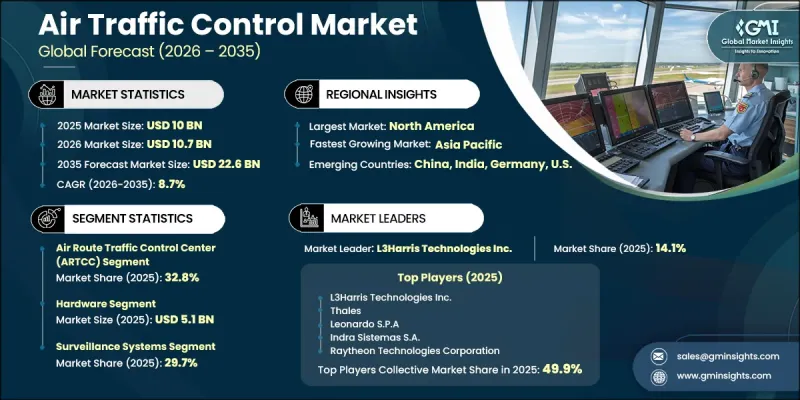
이러한 시장 확대는 국제선 여객 및 화물 운송에서 세계 경제가 항공 운송에 대한 의존도를 높이고 있는 것에 기인합니다. 항공 안전 확보는 여전히 최우선 과제이며, 이는 첨단 항공 교통 관리 시스템에 대한 지속적인 투자를 촉진하고 있습니다. 고성능 레이더 시스템, 위성항법 등 최신 기술을 통해 상황 인식이 향상되어 공중 충돌 사고의 위험이 감소하고 있습니다. 공유 공역에 무인항공기(UAV)와 드론의 통합이 진행됨에 따라 운영상의 복잡성이 증가함에 따라 고급 교통 관리 솔루션에 대한 요구가 증가하고 있습니다. 신흥국의 항공 인프라 확대도 항공교통관제 시스템에 대한 수요 증가에 기여하고 있습니다. 업계는 디지털화를 향한 구조적 변화의 한가운데에 있으며, 원격 타워 솔루션을 통해 고해상도 모니터링 시스템과 실시간 데이터 전송을 통해 여러 공항을 중앙 집중식으로 제어할 수 있게 되었습니다. 의사결정의 정확성 향상, 관제사의 업무 부담 경감, 그리고 예측 분석과 머신러닝 기반의 교통 최적화를 통한 공역 전반의 효율화를 위해 인공지능(AI)과 자동화 기술의 도입이 점점 더 많이 진행되고 있습니다.
| 시장 범위 | |
|---|---|
| 개시 연도 | 2025년 |
| 예측 기간 | 2026-2035년 |
| 개시 연도 시장 규모 | 100억 달러 |
| 예측 시장 규모 | 226억 달러 |
| CAGR | 8.7% |
항공교통관제탑(ATCT) 부문은 디지털 모니터링 시스템 및 원격 관제탑 기술의 도입 확대에 힘입어 2035년까지 연평균 10%의 성장률을 보일 것으로 예측됩니다. 이러한 시스템은 특히 기존 인프라의 업그레이드가 제한적인 소규모 공항 및 지방 공항 운영에서 운영 가시성을 높이고, 안전 기준을 향상시키며, 비용 효율성을 최적화합니다.
하드웨어 부문은 2025년 51억 달러를 차지했으며, 시장에서 가장 큰 점유율을 유지했습니다. 이 부문의 성장은 정확성과 운영 신뢰성을 향상시키는 첨단 레이더 시스템, 통신 네트워크 및 센서 기반 기술에 대한 수요 증가에 힘입어 성장세를 보이고 있습니다. 이러한 시스템을 디지털 항공 교통 관리 플랫폼과 통합하면 실시간 모니터링이 가능해져 전 세계 항공 인프라의 현대화를 지원할 수 있습니다.
북미의 항공교통 관제 시장은 2025년 31.5%의 점유율을 차지했습니다. 이 지역의 성장은 항공 교통 관리 인프라의 현대화 및 운영 효율성 향상을 위한 AI 기반 시스템 도입에 대한 막대한 투자에 의해 주도되고 있습니다. 디지털 관제탑 도입, 위성 항법 기술, 사이버 보안 강화에 대한 강력한 노력은 이 지역 전체의 영공 관리 능력 향상에 더욱 박차를 가하고 있습니다.
자주 묻는 질문
목차
제1장 조사 방법 및 범위
제2장 주요 요약
제3장 업계 인사이트
제4장 경쟁 구도
제5장 시장 추산 및 예측 : 컴포넌트별(2022-2035년)
제6장 시장 추산 및 예측 : 센터별(2022-2035년)
제7장 시장 추산 및 예측 : 용도별(2022-2035년)
제8장 시장 추산 및 예측 : 최종 사용자별(2022-2035년)
제9장 시장 추산 및 예측 : 지역별(2022-2035년)
제10장 기업 개요
AJY 26.06.11The Global Air Traffic Control Market was valued at USD 10 billion in 2025 and is estimated to grow at a CAGR of 8.7% to reach USD 22.6 billion by 2035.
The market expansion is supported by the increasing dependence of the global economy on air transportation for the movement of passengers and cargo across international routes. Ensuring aviation safety remains a top priority, driving continuous investment in advanced air traffic management systems. Modern technologies such as enhanced radar systems and satellite-based navigation are improving situational awareness and reducing the risk of mid-air incidents. The growing integration of unmanned aerial vehicles and drones into shared airspace is introducing new operational complexities, increasing the need for sophisticated traffic management solutions. Expansion of aviation infrastructure in emerging economies is also contributing to the rising demand for air traffic control systems. The industry is undergoing a structural shift toward digitalization, with remote tower solutions enabling centralized control of multiple airports through high-definition surveillance systems and real-time data transmission. Artificial intelligence and automation are increasingly being adopted to improve decision-making accuracy, reduce controller workload, and enhance overall airspace efficiency through predictive analytics and machine learning-based traffic optimization.
| Market Scope | |
|---|---|
| Start Year | 2025 |
| Forecast Year | 2026-2035 |
| Start Value | $10 Billion |
| Forecast Value | $22.6 Billion |
| CAGR | 8.7% |
The air traffic control tower (ATCT) segment is projected to grow at a CAGR of 10% through 2035, supported by the increasing adoption of digital monitoring systems and remote tower technologies. These systems enhance operational visibility, improve safety standards, and optimize cost efficiency, particularly in smaller and regional airport operations where traditional infrastructure upgrades are limited.
The hardware segment accounted for USD 5.1 billion in 2025, holding the largest share of the market. Growth in this segment is driven by increasing demand for advanced radar systems, communication networks, and sensor-based technologies that improve precision and operational reliability. Integration of these systems with digital air traffic management platforms enables real-time monitoring and supports the modernization of global aviation infrastructure.
North America Air Traffic Control Market captured 31.5% share in 2025. The region's growth is driven by significant investments in modernizing air traffic management infrastructure and adopting AI-based systems to improve operational efficiency. Strong emphasis on digital tower deployment, satellite navigation technologies, and cybersecurity enhancements is further supporting the advancement of airspace management capabilities across the region.
Key companies operating in the Global Air Traffic Control Industry include L3Harris Technologies Inc., Thales, Raytheon Technologies Corporation, Leonardo S.P.A., Indra Sistemas S.A., and NAV Canada. Companies in the Air Traffic Control Market are focusing on accelerating digital transformation by investing in AI-driven airspace management systems that improve predictive analytics and decision-making efficiency. Many players are upgrading legacy infrastructure with integrated radar, satellite navigation, and communication technologies to enhance system interoperability and real-time data exchange. Expansion of remote and digital tower solutions is a key strategy to reduce operational costs and improve control flexibility across multiple airports. Firms are also prioritizing cybersecurity enhancements to protect critical aviation data and ensure system resilience. Strategic partnerships with aviation authorities and airport operators are supporting large-scale modernization programs.
Table of Contents
Chapter 1 Methodology and Scope
- 1.1 Market scope and definition
- 1.2 Research design
- 1.2.1 Research approach
- 1.2.2 Data collection methods
- 1.3 Data mining sources
- 1.3.1 Global
- 1.3.2 Regional/Country
- 1.4 Base estimates and calculations
- 1.4.1 Base year calculation
- 1.4.2 Key trends for market estimation
- 1.5 Primary research and validation
- 1.5.1 Primary sources
- 1.6 Forecast model
- 1.7 Research assumptions and limitations
Chapter 2 Executive Summary
- 2.1 Industry 360° synopsis, 2022 - 2035
- 2.2 Key market trends
- 2.2.1 Platform trends
- 2.2.2 Degree of autonomy trends
- 2.2.3 Weapon type trends
- 2.2.4 Application type trends
- 2.2.5 Regional trends
- 2.3 TAM Analysis, 2026-2035
- 2.4 CXO perspectives: Strategic imperatives
Chapter 3 Industry Insights
- 3.1 Industry ecosystem analysis
- 3.1.1 Supplier Landscape
- 3.1.2 Profit Margin
- 3.1.3 Cost structure
- 3.1.4 Value addition at each stage
- 3.1.5 Factor affecting the value chain
- 3.1.6 Disruptions
- 3.2 Industry impact forces
- 3.2.1 Growth drivers
- 3.2.1.1 Increasing air travel demand
- 3.2.1.2 Technological advancements to transform ATC operations
- 3.2.1.3 Modernization of air traffic control infrastructure
- 3.2.1.4 Growing demand for urban air mobility and drones
- 3.2.1.5 Adoption of advanced ATC practices and technologies worldwide
- 3.2.2 Industry pitfalls and challenges
- 3.2.2.1 Technological integration challenges
- 3.2.2.2 Skilled workforce shortage
- 3.2.3 Market opportunities
- 3.2.3.1 Increasing adoption of digital and remote tower solutions
- 3.2.3.2 Modernization of legacy air traffic control systems in developed regions
- 3.2.1 Growth drivers
- 3.3 Growth potential analysis
- 3.4 Regulatory landscape
- 3.4.1 North America
- 3.4.2 Europe
- 3.4.3 Asia Pacific
- 3.4.4 Latin America
- 3.4.5 Middle East & Africa
- 3.5 Porter's analysis
- 3.6 PESTEL analysis
- 3.7 Technology and Innovation landscape
- 3.7.1 Current technological trends
- 3.7.2 Emerging technologies
- 3.8 Emerging business models
- 3.9 Compliance requirements
- 3.10 Defense budget analysis
- 3.11 Global defense spending trends
- 3.12 Regional defense budget allocation
- 3.12.1 North America
- 3.12.2 Europe
- 3.12.3 Asia Pacific
- 3.12.4 Middle East and Africa
- 3.12.5 Latin America
- 3.13 Key defense modernization programs
- 3.14 Budget forecast (2025-2034)
- 3.14.1 Impact on industry growth
- 3.14.2 Defense budgets by country
- 3.14.3 Defense budget allocation by segment
- 3.14.3.1 Personnel
- 3.14.3.2 Operations and maintenance
- 3.14.3.3 Procurement
- 3.14.3.4 Research, development, test and evaluation
- 3.14.3.5 Infrastructure and construction
- 3.14.3.6 Technology and innovation
- 3.15 Supply chain resilience
- 3.16 Geopolitical analysis
- 3.17 Workforce analysis
- 3.18 Digital transformation
- 3.19 Mergers, acquisitions, and strategic partnerships landscape
- 3.20 Risk assessment and management
- 3.21 Major contract awards (2022-2025)
Chapter 4 Competitive Landscape, 2025
- 4.1 Introduction
- 4.2 Company market share analysis
- 4.2.1 By region
- 4.2.1.1 North America
- 4.2.1.2 Europe
- 4.2.1.3 Asia Pacific
- 4.2.1.4 Latin America
- 4.2.1.5 Middle East & Africa
- 4.2.2 Market concentration analysis
- 4.2.1 By region
- 4.3 Competitive benchmarking of key players
- 4.3.1 Financial performance comparison
- 4.3.1.1 Revenue
- 4.3.1.2 Profit margin
- 4.3.1.3 R&D
- 4.3.2 Product portfolio comparison
- 4.3.2.1 Product range breadth
- 4.3.2.2 Technology
- 4.3.2.3 Innovation
- 4.3.3 Geographic presence comparison
- 4.3.3.1 Global footprint analysis
- 4.3.3.2 Service network coverage
- 4.3.3.3 Market penetration by region
- 4.3.4 Competitive positioning matrix
- 4.3.4.1 Leaders
- 4.3.4.2 Challengers
- 4.3.4.3 Followers
- 4.3.4.4 Niche players
- 4.3.5 Strategic outlook matrix
- 4.3.1 Financial performance comparison
- 4.4 Key developments
- 4.4.1 Mergers and acquisitions
- 4.4.2 Partnerships and collaborations
- 4.4.3 Technological advancements
- 4.4.4 Expansion and investment strategies
- 4.4.5 Digital transformation initiatives
- 4.5 Emerging/ startup competitors landscape
Chapter 5 Market Estimates and Forecast, By Component, 2022 - 2035 (USD Million)
- 5.1 Key trends
- 5.2 Hardware
- 5.2.1 Sensors
- 5.2.2 GPS systems
- 5.2.3 OBD port
- 5.2.4 Others
- 5.3 Software
- 5.4 Services
Chapter 6 Market Estimates and Forecast, By Center, 2022 - 2035 (USD Million)
- 6.1 Key trends
- 6.2 Air Route Traffic Control Center (ARTCC)
- 6.3 Terminal Radar Approach Control (TRACON)
- 6.4 Air Traffic Control Tower (ATCT)
- 6.5 Flight Service Station (FSS)
- 6.6 Others
Chapter 7 Market Estimates and Forecast, By Application, 2022 - 2035 (USD Million)
- 7.1 Key trends
- 7.2 Communication systems
- 7.3 Navigation systems
- 7.4 Surveillance systems
- 7.5 Automation & simulation systems
- 7.6 Others
Chapter 8 Market Estimates and Forecast, By End User, 2022 - 2035 (USD Million)
- 8.1 Key trends
- 8.2 Air Navigation Service Providers (ANSPs)
- 8.3 Airports
- 8.4 Military & Defense
- 8.5 Others
Chapter 9 Market Estimates and Forecast, By Region, 2022 - 2035 (USD Million)
- 9.1 Key trends
- 9.2 North America
- 9.2.1 U.S.
- 9.2.2 Canada
- 9.3 Europe
- 9.3.1 Germany
- 9.3.2 UK
- 9.3.3 France
- 9.3.4 Spain
- 9.3.5 Italy
- 9.3.6 Russia
- 9.3.7 Rest of Europe
- 9.4 Asia Pacific
- 9.4.1 China
- 9.4.2 India
- 9.4.3 Japan
- 9.4.4 Australia
- 9.4.5 South Korea
- 9.4.6 Rest of Asia Pacific
- 9.5 Latin America
- 9.5.1 Brazil
- 9.5.2 Mexico
- 9.5.3 Argentina
- 9.5.4 Rest of Latin America
- 9.6 Middle East and Africa
- 9.6.1 South Africa
- 9.6.2 Saudi Arabia
- 9.6.3 UAE
- 9.6.4 Rest of Middle East & Africa
Chapter 10 Company Profiles
- 10.1 Global Key Players
- 10.1.1 Thales Group
- 10.1.2 Raytheon Technologies Corporation
- 10.1.3 L3Harris Technologies Inc.
- 10.1.4 Honeywell International Inc.
- 10.1.5 Lockheed Martin Corporation
- 10.2 Regional key players
- 10.2.1 Indra Sistemas S.A.
- 10.2.2 Leonardo S.p.A.
- 10.2.3 Saab AB
- 10.2.4 NATS Holdings Limited
- 10.2.5 NAV Canada
- 10.3 Niche Players/Disruptors
- 10.3.1 Advanced Navigation and Positioning Corporation
- 10.3.2 BAE Systems
- 10.3.3 SITA


