

|
시장보고서
상품코드
2045688
에틸렌글리콜 시장 기회, 성장요인, 업계 동향 분석 및 예측(2026-2035년)Ethylene Glycol Market Opportunity, Growth Drivers, Industry Trend Analysis, and Forecast 2026 - 2035 |
||||||

세계의 에틸렌글리콜 시장은 2025년에 430억 달러로 평가되었고 CAGR 6.7%로 성장하여 2035년까지 826억 달러에 이를 것으로 추정되고 있습니다.
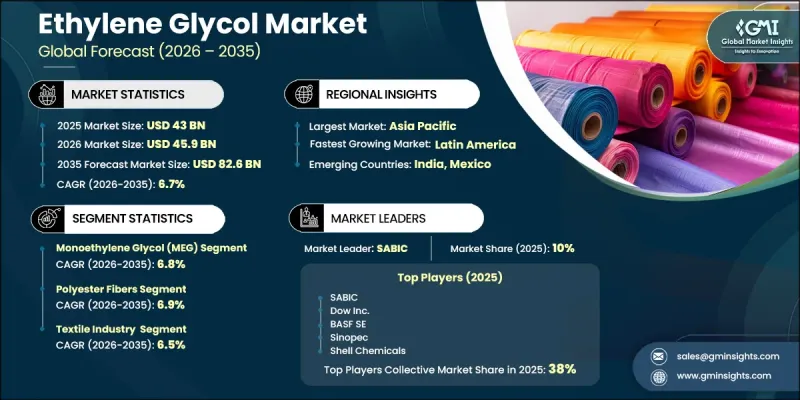
자동차, 섬유, 포장 등 주요 최종 사용 산업에서 소비가 증가함에 따라 시장이 안정적으로 확대되고 있습니다. 자동차 생산 증가와 운송 시스템에서 경량 소재로의 전환은 에틸렌 글리콜 수요를 크게 증가시키고 있습니다. 특히 개발도상국의 섬유 및 의류 제조의 확대도 폴리에스테르계 섬유의 소비를 증가시키고 있습니다. 이와 함께, 지속 가능한 생산 관행으로 전환하는 세계는 제조업체들이 보다 깨끗하고 효율적인 화학 처리 기술에 대한 투자를 촉진하고 있습니다. 재활용 가능성과 친환경 소재에 대한 관심이 높아지면서 장기적인 수요 패턴을 더욱 형성하고 있습니다. 또한, 지속적인 산업 확대와 효율성과 생산 품질을 향상시키는 생산기술의 개선도 수요를 뒷받침하고 있습니다. 가볍고 내구성이 뛰어나며 재활용이 가능한 포장재에 대한 선호도가 높아짐에 따라 PET 응용 분야에서 에틸렌글리콜의 사용 확대에 기여하고 있습니다. 또한, 지속적인 기술 발전으로 바이오 및 재활용 에틸렌 글리콜의 개발이 가능해짐에 따라 시장은 세계 지속가능성 목표와 규제적 기대에 부응할 수 있게 되었습니다. 이러한 요인들이 복합적으로 작용하여 예측 기간 동안 세계 에틸렌글리콜 산업 전체가 꾸준한 성장을 지속할 것으로 예측됩니다.
| 시장 범위 | |
|---|---|
| 시작 연도 | 2025년 |
| 예측 기간 | 2026-2035년 |
| 시작 연도 시장 규모 | 430억 달러 |
| 예측 시장 규모 | 826억 달러 |
| CAGR | 6.7% |
모노에틸렌글리콜(MEG) 부문은 2025년 90.2%의 점유율을 차지해, 2035년까지 연평균 6.8%의 성장률을 보일 것으로 예측됩니다. MEG는 폴리에스테르 섬유 및 PET 수지 생산에 필수적인 역할을 하기 때문에 여전히 가장 널리 사용되는 형태입니다. MEG는 용기, 병 등 포장 용도로 널리 사용되는 PET 제조의 주요 원료로 사용되고 있습니다. 재활용 가능하고 가벼운 포장 솔루션에 대한 수요가 증가함에 따라 MEG의 소비가 계속 증가하고 있습니다. 또한, 섬유 산업에서 폴리에스테르 섬유의 생산 확대도 MEG 기반 용도 수요 증가를 더욱 뒷받침하고 있습니다.
폴리에스테르 섬유 부문은 2025년 45.7%의 점유율을 차지하고, 2026년부터 2035년까지 연평균 복합 성장률(CAGR) 6.9%를 나타낼 것으로 예측됩니다. 이 부문은 의류, 인테리어 및 산업 분야에서 합성섬유에 대한 의존도가 높아지면서 빠르게 성장하고 있습니다. 에틸렌 글리콜, 특히 MEG는 대규모 섬유 제조를 지원하는 폴리에스테르 생산에 중요한 역할을 합니다. 합리적인 가격과 내구성, 다용도 직물 솔루션에 대한 수요가 증가함에 따라 여러 최종 사용 산업에서 폴리 에스테르 섬유의 사용이 더욱 가속화되고 있습니다.
북미 에틸렌글리콜 시장은 탄탄한 산업 인프라와 다양한 최종 용도 수요에 힘입어 2025년 22.5%의 점유율을 차지했습니다. 이 지역은 높은 석유화학 생산 능력과 더불어 자동차 제조, 포장 및 산업 부문의 안정적인 수요의 혜택을 누리고 있습니다. 강력한 규제 프레임워크와 지속 가능한 제조 방법의 채택 확대도 시장 발전에 기여하고 있습니다. 생산 효율의 지속적인 향상과 환경 기준을 준수하는 화학 공정에 대한 관심이 높아짐에 따라 이 지역의 경쟁력이 더욱 강화되고 있습니다.
자주 묻는 질문
목차
제1장 조사 방법과 범위
제2장 주요 요약
제3장 업계 인사이트
제4장 경쟁 구도
제5장 시장 추산 및 예측 : 제품 유형별, 2022-2035년
제6장 시장 추산 및 예측 : 용도별, 2022-2035년
제7장 시장 추산 및 예측 : 최종 용도별, 2022-2035년
제8장 시장 추산 및 예측 : 지역별, 2022-2035년
제9장 기업 개요
JHS 26.06.11The Global Ethylene Glycol Market was valued at USD 43 billion in 2025 and is estimated to grow at a CAGR of 6.7% to reach USD 82.6 billion by 2035.
The market is witnessing stable expansion due to rising consumption across key end-use industries, including automotive, textiles, and packaging. Growth in vehicle production and the shift toward lightweight material usage in transportation systems are significantly strengthening demand for ethylene glycol. Expanding textile and apparel manufacturing, particularly in developing economies, is also increasing the consumption of polyester-based fibers. In parallel, the global transition toward sustainable production practices is encouraging manufacturers to invest in cleaner and more efficient chemical processing technologies. The growing focus on recyclability and environmentally responsible materials is further shaping long-term demand patterns. Demand is also supported by continuous industrial expansion and improvements in production technologies that enhance efficiency and output quality. The increasing preference for lightweight, durable, and recyclable packaging materials is contributing to higher utilization of ethylene glycol in PET applications. In addition, ongoing technological advancements are enabling the development of bio-based and recycled ethylene glycol variants, aligning the market with global sustainability goals and regulatory expectations. Collectively, these factors are expected to sustain consistent growth across the global ethylene glycol industry throughout the forecast period.
| Market Scope | |
|---|---|
| Start Year | 2025 |
| Forecast Year | 2026-2035 |
| Start Value | $43 Billion |
| Forecast Value | $82.6 Billion |
| CAGR | 6.7% |
The monoethylene glycol (MEG) segment held a 90.2% share in 2025 and is expected to grow at a CAGR of 6.8% through 2035. MEG remains the most widely used form due to its essential role in polyester fiber and PET resin production. It serves as a key raw material in manufacturing PET, which is extensively used in packaging applications such as containers and bottles. Rising demand for recyclable and lightweight packaging solutions continues to reinforce MEG consumption. Additionally, expanding polyester fiber production in the textile industry further supports demand growth for MEG-based applications.
The polyester fibers segment accounted for 45.7% share in 2025 and is projected to grow at a CAGR of 6.9% during 2026-2035. The segment is expanding rapidly due to increasing reliance on synthetic textiles across apparel, home furnishings, and industrial applications. Ethylene glycol, particularly MEG, plays a critical role in polyester production, which supports large-scale textile manufacturing. Growing demand for affordable, durable, and versatile fabric solutions is further accelerating the use of polyester fibers across multiple end-use industries.
North America Ethylene Glycol Market held a 22.5% share in 2025, supported by strong industrial infrastructure and diversified end-use demand. The region benefits from advanced petrochemical production capabilities and consistent demand from automotive manufacturing, packaging, and industrial sectors. Strong regulatory frameworks and increasing adoption of sustainable manufacturing practices are also contributing to market development. Ongoing improvements in production efficiency and growing emphasis on environmentally compliant chemical processes are further strengthening the region's competitive position.
Major companies operating in the Ethylene Glycol Market include BASF SE, Dow Inc., SABIC, Shell Chemicals, LyondellBasell, Sinopec, Reliance Industries, Formosa Plastics Group, INEOS, Indorama Ventures, LOTTE Chemical Corporation, Kuwait Petroleum Corporation, PTT Global Chemical, and India Glycols Limited. Companies in the ethylene glycol market are focusing on expanding production capacities to meet rising global demand across the packaging, automotive, and textile industries. Strategic investments in advanced manufacturing technologies are helping improve operational efficiency and product quality. Many players are prioritizing the development of bio-based and recycled ethylene glycol to align with sustainability goals and regulatory requirements. Partnerships and long-term supply agreements with downstream industries are strengthening market integration and ensuring stable demand channels. Firms are also investing in research and development to enhance process innovation and reduce carbon emissions. Expansion into emerging markets is enabling companies to diversify revenue streams and strengthen their global presence.
Table of Contents
Chapter 1 Methodology & Scope
- 1.1 Market scope and definition
- 1.2 Research design
- 1.2.1 Research approach
- 1.2.2 Data collection methods
- 1.3 Data mining sources
- 1.3.1 Global
- 1.3.2 Regional/Country
- 1.4 Base estimates and calculations
- 1.4.1 Base year calculation
- 1.4.2 Key trends for market estimation
- 1.5 Primary research and validation
- 1.5.1 Primary sources
- 1.6 Forecast model
- 1.7 Research assumptions and limitations
Chapter 2 Executive Summary
- 2.1 Industry 360° synopsis
- 2.2 Key market trends
- 2.2.1 Regional
- 2.2.2 Product Type
- 2.2.3 Application
- 2.2.4 End-Use
- 2.3 TAM Analysis, 2026-2035
- 2.4 CXO perspectives: Strategic imperatives
- 2.4.1 Executive decision points
- 2.4.2 Critical success factors
- 2.5 Future Outlook and Strategic Recommendations
Chapter 3 Industry Insights
- 3.1 Industry ecosystem analysis
- 3.1.1 Supplier landscape
- 3.1.2 Profit margin
- 3.1.3 Value addition at each stage
- 3.1.4 Factor affecting the value chain
- 3.1.5 Disruptions
- 3.2 Industry impact forces
- 3.2.1 Growth drivers
- 3.2.1.1 Increasing demand from the automotive sector
- 3.2.1.2 Expanding polyester production
- 3.2.1.3 Growth in PET production
- 3.2.2 Industry pitfalls and challenges
- 3.2.2.1 Volatility in raw material prices
- 3.2.2.2 Environmental regulations
- 3.2.3 Market opportunities
- 3.2.3.1 Shift toward bio-based & sustainable production methods
- 3.2.3.2 Recycling & circular economy initiatives for PET
- 3.2.1 Growth drivers
- 3.3 Growth potential analysis
- 3.4 Regulatory landscape
- 3.4.1 North America
- 3.4.2 Europe
- 3.4.3 Asia Pacific
- 3.4.4 Latin America
- 3.4.5 Middle East & Africa
- 3.5 Porter's analysis
- 3.6 PESTEL analysis
- 3.7 Price trends
- 3.7.1 By region
- 3.7.2 By product type
- 3.8 Future market trends
- 3.9 Technology and Innovation landscape
- 3.9.1 Current technological trends
- 3.9.2 Emerging technologies
- 3.10 Patent Landscape
- 3.11 Trade statistics (HS code)
- 3.11.1 Major importing countries
- 3.11.2 Major exporting countries
- 3.12 Sustainability and environmental aspects
- 3.12.1 Sustainable practices
- 3.12.2 Waste reduction strategies
- 3.12.3 Energy efficiency in production
- 3.12.4 Eco-friendly initiatives
- 3.13 Carbon footprint consideration
Chapter 4 Competitive Landscape, 2025
- 4.1 Introduction
- 4.2 Company market share analysis
- 4.2.1 By region
- 4.2.1.1 North America
- 4.2.1.2 Europe
- 4.2.1.3 Asia Pacific
- 4.2.1.4 LATAM
- 4.2.1.5 MEA
- 4.2.1 By region
- 4.3 Company matrix analysis
- 4.4 Competitive analysis of major market players
- 4.5 Competitive positioning matrix
- 4.6 Key developments
- 4.6.1 Mergers & acquisitions
- 4.6.2 Partnerships & collaborations
- 4.6.3 New Product Launches
- 4.6.4 Expansion Plans
Chapter 5 Market Estimates and Forecast, By Product Type, 2022-2035 (USD Billion) (Kilo Tons)
- 5.1 Key trends
- 5.2 Monoethylene glycol (MEG)
- 5.3 Diethylene glycol (MEG)
- 5.4 Triethylene glycol (TEG)
Chapter 6 Market Estimates and Forecast, By Application, 2022-2035 (USD Billion) (Kilo Tons)
- 6.1 Key trends
- 6.2 Polyester fibers
- 6.3 PET resins
- 6.4 Antifreeze & coolants
- 6.5 Others (e.g. heat transfer fluids, dehydrating agents)
Chapter 7 Market Estimates and Forecast, By End Use, 2022-2035 (USD Billion) (Kilo Tons)
- 7.1 Key trends
- 7.2 Textile industry
- 7.3 Automotive industry
- 7.4 Healthcare and pharmaceuticals
- 7.5 Industrial applications
- 7.6 Chemical industry
- 7.7 Packaging industry
- 7.8 Construction industry
Chapter 8 Market Estimates and Forecast, By Region, 2022-2035 (USD Billion) (Kilo Tons)
- 8.1 Key trends
- 8.2 North America
- 8.2.1 U.S.
- 8.2.2 Canada
- 8.3 Europe
- 8.3.1 Germany
- 8.3.2 UK
- 8.3.3 France
- 8.3.4 Spain
- 8.3.5 Italy
- 8.3.6 Rest of Europe
- 8.4 Asia Pacific
- 8.4.1 China
- 8.4.2 India
- 8.4.3 Japan
- 8.4.4 Australia
- 8.4.5 South Korea
- 8.4.6 Rest of Asia Pacific
- 8.5 Latin America
- 8.5.1 Brazil
- 8.5.2 Mexico
- 8.5.3 Argentina
- 8.5.4 Rest of Latin America
- 8.6 Middle East and Africa
- 8.6.1 Saudi Arabia
- 8.6.2 South Africa
- 8.6.3 UAE
- 8.6.4 Rest of Middle East and Africa
Chapter 9 Company Profiles
- 9.1 SABIC
- 9.2 Dow Inc.
- 9.3 BASF SE
- 9.4 Sinopec
- 9.5 Shell Chemicals
- 9.6 LyondellBasell
- 9.7 Reliance Industries
- 9.8 Formosa Plastics Group
- 9.9 LOTTE Chemical Corporation
- 9.10 Kuwait Petroleum Corporation
- 9.11 INEOS
- 9.12 Indorama Ventures
- 9.13 PTT Global Chemical
- 9.14 India Glycols Limited


