

|
시장보고서
상품코드
2045691
연조직 수복 시장 : 시장 비즈니스 기회, 성장요인, 업계 동향 분석 및 예측(2026-2035년)Soft Tissue Repair Market Opportunity, Growth Drivers, Industry Trend Analysis, and Forecast 2026 - 2035 |
||||||

세계의 연조직 수복 시장은 2025년에 164억 달러로 평가되었고, CAGR 5.8%로 성장할 전망이며, 2035년까지 292억 달러에 이를 것으로 추정되고 있습니다.
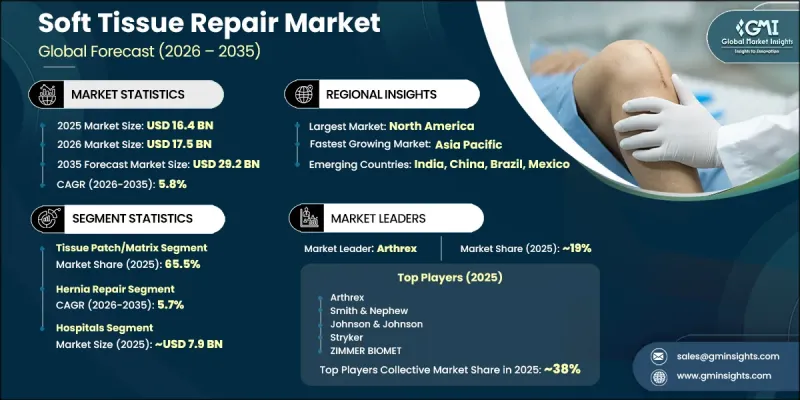
시장의 성장은 스포츠 관련 부상 및 외상 증가와 더불어 전 세계 의료 시스템에서 최소침습 수술에 대한 선호도가 높아짐에 따라 성장하고 있습니다. 조기 개입과 고급 재건술에 대한 임상적 인식이 높아짐에 따라 수술 분야에서의 채택이 더욱 가속화되고 있습니다. 또한, 특히 젊은 층을 중심으로 스포츠 활동 참여가 확대되면서 인대, 힘줄, 근육의 손상 발생률이 증가하고 있으며, 이에 따라 회복 솔루션에 대한 수요가 증가하고 있습니다. 특히 신흥국의 의료 인프라 개발에 대한 지속적인 투자는 고급 수술 치료에 대한 접근성을 확대하고 치료 결과를 개선하고 있습니다. 또한, 치유 효율과 환자의 회복 기간을 개선하는 재생의료, 생물학적 제제, 임플란트 기술의 지속적인 발전도 시장에 긍정적인 영향을 미치고 있습니다. 의료비 증가와 함께 퇴행성 연조직 질환에 취약한 고령 인구 증가는 전 세계 각 지역의 장기적인 시장 확대를 더욱 촉진하고 있습니다.
| 시장 범위 | |
|---|---|
| 개시 연도 | 2025년 |
| 예측 기간 | 2026-2035년 |
| 개시 연도 시장 규모 | 164억 달러 |
| 예측 시장 규모 | 292억 달러 |
| CAGR | 5.8% |
탈장 치료 시장은 2035년까지 99억 달러에 달할 것으로 예측됩니다. 이러한 성장은 주로 전 세계 탈장 환자 수 증가와 선진국 및 개발도상국의 의료 시스템에서 복부 수술 건수 증가에 의해 뒷받침되고 있습니다. 메쉬 소재의 지속적인 개선과 더불어 저침습적 수술법의 보급으로 수술 결과가 향상되고 환자의 회복이 빨라지고 있습니다. 이러한 발전은 병원 및 전문 수술 시설에서 이 부문 수요를 더욱 증가시키고 있습니다.
2025년 기준, 병원 부문은 79억 달러를 차지했으며, 시장의 주요 최종 사용자 카테고리로 자리를 지켰습니다. 이러한 우위는 외상 치료, 재건 수술, 탈장 복원 수술 등 병원 환경에서 이루어지는 수술 건수가 많기 때문입니다. 첨단 수술 인프라, 전문 의료팀의 존재, 그리고 다양한 연부조직 복원 제품에 대한 접근성이 병원 시스템 내에서 높은 이용률을 유지하고 있습니다.
미국 연조직 수복 시장은 2025년 5.7억 달러로 평가되었고, 2026-2035년 연평균 5.2%로 성장할 것으로 예측됩니다. 만성질환의 부담 증가, 스포츠 부상 증가, 노화에 따른 근골격계 퇴행성 질환의 발생률 증가가 이 나라의 성장을 견인하고 있습니다. 고령화로 인해 인대 파열, 힘줄 손상, 탈장 등의 질환의 유병률이 증가하고 있으며, 이들 질환은 모두 외과적 수복이 필요한 질환입니다. 동시에, 스포츠 및 신체 활동 참여의 확산으로 인해 부상 사례가 지속적으로 발생하고 있으며, 이는 의료시설 전반에 걸쳐 고급 수리 솔루션에 대한 수요를 더욱 촉진하고 있습니다.
자주 묻는 질문
목차
제1장 조사 방법
제2장 주요 요약
제3장 업계 인사이트
제4장 경쟁 구도
제5장 시장 추산 및 예측 : 제품별(2022-2035년)
제6장 시장 추산 및 예측 : 용도별(2022-2035년)
제7장 시장 추산 및 예측 : 최종 용도별(2022-2035년)
제8장 시장 추산 및 예측 : 지역별(2022-2035년)
제9장 기업 개요
AJY 26.06.09The Global Soft Tissue Repair Market was valued at USD 16.4 billion in 2025 and is estimated to grow at a CAGR of 5.8% to reach USD 29.2 billion by 2035.
Market growth is shaped by a rising number of sports-related injuries and trauma cases, alongside the increasing preference for minimally invasive surgical procedures across healthcare systems worldwide. Growing clinical awareness around early intervention and advanced reconstruction methods is further strengthening adoption across surgical specialties. In addition, expanding participation in athletic activities, particularly among younger demographics, is contributing to a higher incidence of ligament, tendon, and muscle injuries, thereby supporting demand for repair solutions. Continuous investments in healthcare infrastructure development, especially across emerging economies, are also enhancing access to advanced surgical care and improving treatment outcomes. The market also benefits from ongoing advancements in regenerative medicine, biologics, and implant technologies that improve healing efficiency and patient recovery timelines. Rising healthcare expenditure, coupled with a growing aging population more prone to degenerative soft tissue conditions, is further reinforcing long-term market expansion across global regions.
| Market Scope | |
|---|---|
| Start Year | 2025 |
| Forecast Year | 2026-2035 |
| Start Value | $16.4 Billion |
| Forecast Value | $29.2 Billion |
| CAGR | 5.8% |
The hernia repair segment is expected to reach USD 9.9 billion by 2035. This growth is primarily supported by the increasing global prevalence of hernia conditions and the rising number of abdominal surgical procedures across both developed and developing healthcare systems. Continuous improvements in mesh materials, along with the wider adoption of minimally invasive surgical approaches, are enhancing procedural outcomes and encouraging faster patient recovery. These advancements are further strengthening demand within the segment across hospital and specialty surgical settings.
The hospitals segment accounted for USD 7.9 billion in 2025, maintaining its position as the leading end-user category in the market. This dominance is attributed to the high volume of surgical procedures conducted in hospital environments, including trauma care, reconstructive surgeries, and hernia repair operations. The availability of advanced surgical infrastructure, specialized medical teams, and access to a wide range of soft tissue repair products continues to support strong utilization levels within hospital systems.
U.S. Soft Tissue Repair Market was valued at USD 5.7 billion in 2025, and is expected to grow at a CAGR of 5.2% from 2026 to 2035. Growth in the country is driven by a rising burden of chronic disorders, an increasing number of sports injuries, and higher incidence of age-related musculoskeletal degeneration. The expanding elderly population is contributing to a greater prevalence of conditions such as ligament tears, tendon injuries, and hernias, all of which require surgical repair interventions. At the same time, widespread participation in sports and physical activities is generating a steady flow of injury cases, further supporting demand for advanced repair solutions across healthcare facilities.
Key companies operating in the Global Soft Tissue Repair Market include ANIKA, Arthrex, Baxter, Coloplast, CONMED, CryoLife, INTEGRA, Johnson & Johnson, Medprin, Medtronic, Smith & Nephew, Stryker, and ZIMMER BIOMET. Companies in the soft tissue repair market are increasingly focusing on product innovation through next-generation biomaterials, regenerative medicine platforms, and advanced surgical implants designed to enhance healing efficiency and tissue integration. They are strengthening their market position by investing in minimally invasive and arthroscopic repair solutions that reduce recovery time and improve clinical outcomes. Strategic collaborations with hospitals and research institutions accelerate clinical validation and product adoption. Firms are also expanding geographically through distribution partnerships in emerging healthcare markets. Continuous R&D spending is enabling the development of bioresorbable meshes and enhanced fixation systems. Additionally, companies are prioritizing surgeon training programs, regulatory approvals, and cost-effective product portfolios to improve accessibility and strengthen long-term market penetration.
Table of Contents
Chapter 1 Research Methodology
- 1.1 Research approach
- 1.2 Quality commitments
- 1.2.1 GMI AI policy & data integrity commitment
- 1.2.1.1 Source consistency protocol
- 1.2.1 GMI AI policy & data integrity commitment
- 1.3 Research trail & confidence scoring
- 1.3.1 Research trail components
- 1.3.2 Scoring components
- 1.4 Data collection
- 1.4.1 Partial list of primary sources
- 1.5 Data mining sources
- 1.5.1 Paid sources
- 1.5.1.1 Sources, by region
- 1.5.1 Paid sources
- 1.6 Base estimates and calculations
- 1.6.1 Base year calculation
- 1.7 Forecast model
- 1.7.1 Quantified market impact analysis
- 1.7.1.1 Mathematical impact of growth parameters on forecast
- 1.7.1 Quantified market impact analysis
- 1.8 Research transparency addendum
- 1.8.1 Source attribution framework
- 1.8.2 Quality assurance metrics
- 1.8.3 Our commitment to trust
Chapter 2 Executive Summary
- 2.1 Industry 360° synopsis
- 2.2 Key market trends
- 2.2.1 Regional trends
- 2.2.2 Product trends
- 2.2.3 Application trends
- 2.2.4 End use trends
- 2.3 CXO perspectives: Strategic imperatives
Chapter 3 Industry Insights
- 3.1 Industry ecosystem analysis
- 3.2 Industry impact forces
- 3.2.1 Growth drivers
- 3.2.1.1 Increasing incidence of sports injuries and trauma cases
- 3.2.1.2 Growing adoption of minimally invasive surgical techniques
- 3.2.1.3 Technological advancements
- 3.2.1.4 Rising prevalence of orthopedic conditions
- 3.2.2 Industry pitfalls and challenges
- 3.2.2.1 High cost of soft tissue repair procedures
- 3.2.2.2 Stringent regulatory framework
- 3.2.3 Opportunities
- 3.2.3.1 Expansion of healthcare infrastructure and surgical capabilities
- 3.2.1 Growth drivers
- 3.3 Growth potential analysis
- 3.4 Regulatory landscape
- 3.4.1 North America
- 3.4.2 Europe
- 3.4.3 Asia Pacific
- 3.4.4 Latin America
- 3.4.5 MEA
- 3.5 Technology and innovation landscape (Driven by Primary Research)
- 3.5.1 Current technological trends
- 3.5.2 Emerging technologies
- 3.6 Future market trends (Driven by Primary Research)
- 3.7 Impact of AI & Generative AI on the Market (Driven by Primary Research)
- 3.8 Consumer insights
- 3.9 Pricing trend analysis
- 3.10 Investment landscape (Driven by Primary Research)
- 3.11 Pipeline analysis (Driven by Primary Research)
- 3.12 Porter's analysis
- 3.13 PESTEL analysis
Chapter 4 Competitive Landscape, 2025
- 4.1 Introduction
- 4.2 Company matrix analysis
- 4.3 Company market share analysis (Driven by Primary Research)
- 4.3.1 Global
- 4.3.2 North America
- 4.3.3 Europe
- 4.3.4 Asia Pacific
- 4.3.5 LAMEA
- 4.4 Competitive analysis of major market players
- 4.5 Competitive positioning matrix
- 4.6 Key developments
- 4.6.1 Mergers & acquisitions
- 4.6.2 Partnerships & collaborations
- 4.6.3 New product launches
- 4.6.4 Expansion plans
Chapter 5 Market Estimates and Forecast, By Product, 2022 - 2035 ($ Mn)
- 5.1 Key trends
- 5.2 Tissue patch/Matrix
- 5.2.1 Synthetic mesh
- 5.2.2 Biologic mesh
- 5.2.2.1 Allograft
- 5.2.2.2 Xenograft
- 5.3 Tissue fixation devices
- 5.3.1 Suture anchors
- 5.3.2 Sutures
- 5.3.3 Interference screws
- 5.3.4 Other tissue fixation devices
Chapter 6 Market Estimates and Forecast, By Application, 2022 - 2035 ($ Mn)
- 6.1 Key trends
- 6.2 Hernia repair
- 6.3 Orthopedic
- 6.4 Skin repair
- 6.5 Dural repair
- 6.6 Other applications
Chapter 7 Market Estimates and Forecast, By End Use, 2022 - 2035 ($ Mn)
- 7.1 Key trends
- 7.2 Hospitals
- 7.3 Ambulatory surgical centers
- 7.4 Clinics
Chapter 8 Market Estimates and Forecast, By Region, 2022 - 2035 ($ Mn)
- 8.1 Key trends
- 8.2 North America
- 8.2.1 U.S.
- 8.2.2 Canada
- 8.3 Europe
- 8.3.1 Germany
- 8.3.2 UK
- 8.3.3 France
- 8.3.4 Spain
- 8.3.5 Italy
- 8.3.6 Netherlands
- 8.4 Asia Pacific
- 8.4.1 China
- 8.4.2 Japan
- 8.4.3 India
- 8.4.4 Australia
- 8.4.5 South Korea
- 8.5 Latin America
- 8.5.1 Brazil
- 8.5.2 Mexico
- 8.5.3 Argentina
- 8.6 MEA
- 8.6.1 South Africa
- 8.6.2 Saudi Arabia
- 8.6.3 UAE
Chapter 9 Company Profiles
- 9.1 ANIKA
- 9.2 Arthrex
- 9.3 Baxter
- 9.4 Coloplast
- 9.5 CONMED
- 9.6 CryoLife
- 9.7 INTEGRA
- 9.8 Johnson & Johnson
- 9.9 Medprin
- 9.10 Medtronic
- 9.11 Smith & Nephew
- 9.12 Stryker
- 9.13 ZIMMER BIOMET


