

|
시장보고서
상품코드
2045692
요트 시장 기회, 성장요인, 업계 동향 분석 및 예측(2026-2035년)Yacht Market Opportunity, Growth Drivers, Industry Trend Analysis, and Forecast 2026 - 2035 |
||||||

세계의 요트 시장은 2025년에 143억 달러로 평가되었고 CAGR 7%로 성장하여 2035년까지 279억 달러에 이를 것으로 추정되고 있습니다.
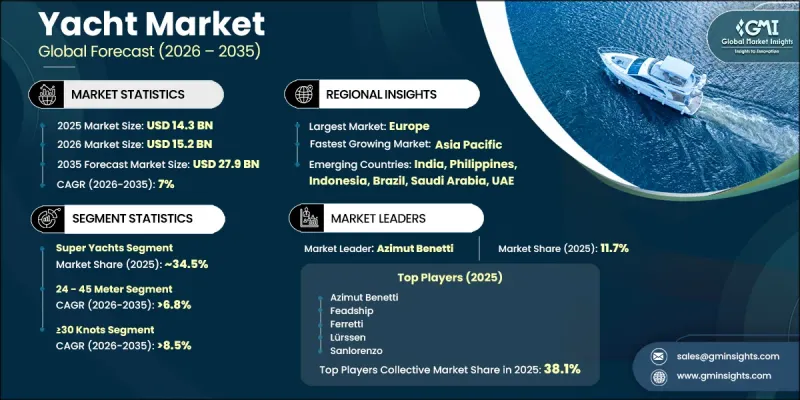
세계 부의 창출 증가와 럭셔리 관광의 급속한 확대로 인해 프리미엄 해양 체험에 대한 수요가 재편되고 있으며, 시장은 변화의 과정에 있습니다. 부유층 증가, 맞춤형 레저 여행에 대한 선호도 증가, 그리고 개인 요트 차터링 이용의 확대는 소유와 이용의 두 가지 추세를 모두 크게 촉진하고 있습니다. 과거 성숙한 해양 지역에 집중되었던 수요는 마리나 인프라와 럭셔리 관광 생태계에 대한 투자에 힘입어 현재 새로운 지역으로 확대되고 있습니다. 요트 대여 및 전세 서비스의 인기가 높아지면서 접근성이 향상되고 있으며, 소비자들은 완전한 소유권 없이도 고급 선박을 경험할 수 있게 되었습니다. 동시에 지속가능성에 대한 기대와 환경 규제 강화로 요트 설계 및 운영 기준도 재편되고 있습니다. 업계 관계자들은 배출량을 줄이고 규제 준수를 개선하기 위해 하이브리드 추진 시스템, 청정 연료 및 에너지 효율적인 해양 기술에 점점 더 많은 관심을 기울이고 있습니다. 친환경 관광에 대한 인식이 높아지면서 구매 결정에 영향을 미치고 있으며, 제조업체들은 친환경 소재, 첨단 선체 공학 및 환경 친화적인 추진 솔루션을 현대 요트 설계에 통합하도록 촉구하고 있습니다. 이러한 요인들이 결합되어 요트 산업은 보다 지속 가능하고 기술 주도적이며 경험 중심의 성장으로 꾸준히 이동하고 있습니다.
| 시장 범위 | |
|---|---|
| 시작 연도 | 2025년 |
| 예측 기간 | 2026-2035년 |
| 시작 연도 시장 규모 | 143억 달러 |
| 예측 시장 규모 | 279억 달러 |
| CAGR | 7% |
슈퍼요트 부문은 2025년 34.5%의 점유율을 차지해, 2035년까지 연평균 복합 성장률(CAGR) 8%로 성장할 것으로 전망됩니다. 이 부문이 업계를 주도하는 것은 주로 높은 수익 기여도와 독특한 해양 럭셔리를 원하는 슈퍼리치들의 강력한 수요에 기인합니다. 슈퍼요트는 고도로 맞춤화된 디자인, 최고급 선내 설비, 첨단 선내 기술이 특징이며, 이는 일반 선박에 비해 종합적인 가치를 크게 높입니다. 판매량은 상대적으로 적지만, 프리미엄 가격 체계로 인해 이 부문은 시장 수익의 대부분을 차지하고 있습니다. 슈퍼요트는 독점성, 명성, 개인화된 럭셔리 경험에 대한 높은 관심으로 인해 전 세계 이동 수단과 프라이빗한 레저 환경을 원하는 부유층 구매자들 사이에서 지속적으로 선호되는 선택이 되고 있습니다.
2025년에는 24-45미터급 부문이 41.8%의 점유율을 차지해, 2026년부터 2035년까지 연평균 복합 성장률(CAGR) 6.8%로 성장할 것으로 전망됩니다. 이 부문은 고급스러운 시설, 운항 편의성 및 전반적인 비용 효율성 사이에서 효과적인 균형을 제공하기 때문에 계속해서 지배적인 지위를 유지하고 있습니다. 이 카테고리의 요트는 일반적으로 여러 개의 갑판, 고급 항해 시스템, 전용 승무원 공간을 갖추고 있으면서도 대형 선박에 비해 소유 및 유지 관리 측면에서 다루기 쉬운 것이 특징입니다. 이러한 다재다능함은 초대형 요트에 따른 비용 증가를 피하면서 프리미엄 해양 체험을 원하는 다양한 부유층에게 매력적인 선택이 될 수 있습니다. 또한, 계류의 용이성, 운항 유연성, 그리고 개인 사용과 전세 서비스 모두에 대한 적합성은 시장의 매력을 더욱 높여주고 있습니다.
2025년 이탈리아 요트 시장은 33.6%의 점유율을 차지하며 17억 9,560만 달러 시장 규모를 기록했습니다. 오랜 해양 문화, 첨단 조선 기술, 그리고 세계적으로 인정받는 요트 제조업체의 지원을 받아 지속적으로 강력한 시장 성장세를 보이고 있습니다. 이탈리아에는 페레티 그룹, 아지무트 베네티, 산 로렌조와 같은 저명한 조선소가 있으며, 모두 요트의 디자인, 성능, 커스터마이징의 혁신에 크게 기여하고 있습니다. 이 나라의 광범위한 해안 인프라, 지중해 관광의 강력한 매력, 그리고 잘 구축된 럭셔리 호스피탈리티 생태계는 소유 시장과 전세 시장 모두에서 요트에 대한 안정적인 수요를 더욱 뒷받침하고 있습니다.
자주 묻는 질문
목차
제1장 조사 방법
제2장 주요 요약
제3장 업계 인사이트
제4장 경쟁 구도
제5장 시장 추산 및 예측 : 유형별, 2022-2035년
제6장 시장 추산 및 예측 : 길이별, 2022-2035년
제7장 시장 추산 및 예측 : 추진력별, 2022-2035년
제8장 시장 추산 및 예측 : 속도별, 2022-2035년
제9장 시장 추산 및 예측 : 지역별, 2022-2035년
제10장 기업 개요
JHS 26.06.11The Global Yacht Market was valued at USD 14.3 billion in 2025 and is estimated to grow at a CAGR of 7% to reach USD 27.9 billion by 2035.
The market is undergoing transformation as rising global wealth creation and the rapid expansion of luxury tourism reshape demand for premium marine experiences. Increasing numbers of high-net-worth individuals, growing preference for customized leisure travel, and rising participation in private yacht charters are significantly boosting both ownership and usage trends. Demand, once concentrated in mature maritime regions, is now expanding into new geographies supported by investments in marina infrastructure and luxury tourism ecosystems. The growing popularity of yacht rental and charter services is also improving accessibility, enabling consumers to experience high-end vessels without full ownership commitments. At the same time, sustainability expectations and tightening environmental regulations are reshaping yacht design and operational standards. Industry participants are increasingly focusing on hybrid propulsion systems, cleaner fuels, and energy-efficient marine technologies to reduce emissions and improve compliance. Growing awareness around eco-friendly tourism is also influencing purchasing decisions, encouraging manufacturers to integrate greener materials, advanced hull engineering, and low-impact propulsion solutions into modern yacht designs. These combined factors are steadily shifting the yacht industry toward more sustainable, technology-driven, and experience-oriented growth.
| Market Scope | |
|---|---|
| Start Year | 2025 |
| Forecast Year | 2026-2035 |
| Start Value | $14.3 Billion |
| Forecast Value | $27.9 Billion |
| CAGR | 7% |
The super yachts segment accounted for 34.5% share in 2025 and is projected to grow at a CAGR of 8% through 2035. This segment leads the industry primarily due to its high revenue contribution and strong demand from ultra-wealthy individuals seeking exclusive marine luxury. Super yachts are characterized by highly customized designs, premium onboard amenities, and advanced onboard technologies, which significantly increase their overall value compared to standard vessels. Even with relatively lower unit sales, this segment generates a disproportionate share of market revenue due to its premium pricing structure. Strong emphasis on exclusivity, prestige, and personalized luxury experiences continues to make super yachts a preferred option among affluent buyers seeking global mobility and private leisure environments.
The 24-45 meter segment held a 41.8% share in 2025 and is expected to grow at a CAGR of 6.8% between 2026 and 2035. This segment remains dominant as it offers an effective balance between luxury features, operational convenience, and overall cost efficiency. Yachts in this category typically include multiple decks, advanced navigation systems, and dedicated crew spaces while remaining more manageable in terms of ownership and maintenance compared to larger vessels. Their versatility makes them attractive to a broader base of high-net-worth individuals who seek premium marine experiences without the significantly higher costs associated with ultra-large yachts. In addition, their ease of docking, operational flexibility, and suitability for both private use and charter services further enhance their market appeal.
Italy Yacht Market held a 33.6% share in 2025 and generated USD 1,795.6 million. The country continues to witness strong market growth supported by its long-standing maritime heritage, advanced shipbuilding capabilities, and globally recognized yacht manufacturers. Italy is home to prominent shipbuilding companies such as Ferretti Group, Azimut Benetti, and Sanlorenzo, all of which contribute significantly to innovation in yacht design, performance, and customization. The country's extensive coastal infrastructure, strong Mediterranean tourism appeal, and established luxury hospitality ecosystem further support consistent demand for yachts across both ownership and charter markets.
Key companies operating in the Global Yacht Market include Azimut Benetti, Bavaria Yachts, Beneteau, Feadship, Ferretti Group, Horizon Yachts, Lurssen, Princess Yachts, and Sanlorenzo. Companies operating in the yacht market are adopting several strategic approaches to strengthen their market presence and enhance competitive positioning. Manufacturers are increasingly focusing on advanced customization options, allowing buyers to design highly personalized luxury vessels tailored to specific lifestyle preferences. Investment in hybrid propulsion systems, fuel-efficient engines, and sustainable marine technologies is also rising to meet stricter environmental regulations and growing eco-conscious demand. Strategic partnerships with luxury tourism operators, charter service providers, and marina developers are helping companies expand their global reach and improve customer accessibility. In addition, firms are expanding shipyard capacities and enhancing production capabilities to meet the rising demand for premium yachts.
Table of Contents
Chapter 1 Methodology
- 1.1 Research approach
- 1.2 Quality Commitments
- 1.2.1 GMI AI policy & data integrity commitment
- 1.2.1.1 Source consistency protocol
- 1.2.1 GMI AI policy & data integrity commitment
- 1.3 Research Trail & Confidence Scoring
- 1.3.1 Research Trail Components
- 1.3.2 Scoring Components
- 1.4 Data Collection
- 1.4.1 Partial list of primary sources
- 1.5 Data mining sources
- 1.5.1 Paid sources
- 1.5.1.1 Sources, by region
- 1.5.1 Paid sources
- 1.6 Base estimates and calculations
- 1.6.1 Base year calculation
- 1.7 Forecast Model
- 1.7.1 Quantified market impact analysis
- 1.7.1.1 Mathematical impact of growth parameters on forecast
- 1.7.1 Quantified market impact analysis
- 1.8 Research transparency addendum
- 1.8.1 Source attribution framework
- 1.8.2 Quality assurance metrics
- 1.8.3 Our commitment to trust
Chapter 2 Executive Summary
- 2.1 Industry 360° synopsis, 2022 - 2035
- 2.2 Key market trends
- 2.2.1 Regional
- 2.2.2 Type
- 2.2.3 Length
- 2.2.4 Propulsion
- 2.2.5 Speed
- 2.3 TAM Analysis, 2026-2035
- 2.4 CXO perspectives: Strategic imperatives
Chapter 3 Industry Insights
- 3.1 Industry ecosystem analysis
- 3.1.1 Supplier landscape
- 3.1.2 Profit margin analysis
- 3.1.3 Cost structure
- 3.1.4 Value addition at each stage
- 3.1.5 Factor affecting the value chain
- 3.1.6 Disruptions
- 3.2 Industry impact forces
- 3.2.1 Growth drivers
- 3.2.1.1 Rising wealth and high net-worth individuals (HNWIs)
- 3.2.1.2 Growing popularity of luxury tourism and leisure activities
- 3.2.1.3 Technological advancements and customization
- 3.2.1.4 Expansion of yacht charter market
- 3.2.1.5 Increasing coastal infrastructure development
- 3.2.2 Industry pitfalls & challenges
- 3.2.2.1 High maintenance and operating costs
- 3.2.2.2 Economic and market volatility.
- 3.2.3 Market opportunities
- 3.2.3.1 Emerging markets and increasing wealth in Asia-Pacific
- 3.2.3.2 Eco-friendly and sustainable yachts
- 3.2.3.3 Digitalization and smart yacht technologies
- 3.2.3.4 Growth of yacht sharing and fractional ownership models
- 3.2.1 Growth drivers
- 3.3 Growth potential analysis
- 3.4 Regulatory guidline
- 3.4.1 North America
- 3.4.1.1 U.S.: U.S. Coast Guard (USCG) Navigation and Vessel Inspection Regulations (46 CFR)
- 3.4.1.2 Canada: Canada Shipping Act, 2001
- 3.4.2 Europe
- 3.4.2.1 Germany: EU Recreational Craft Directive (RCD) (implemented under German law)
- 3.4.2.2 UK: UK Recreational Craft Regulations 2017
- 3.4.2.3 France: Division 240 - French Regulations for Recreational Craft Safety
- 3.4.3 Asia Pacific
- 3.4.3.1 China: Regulations on the Safety Administration of Recreational Boats
- 3.4.3.2 India: Inland Vessels Act, 2021
- 3.4.3.3 Japan: Ship Safety Act
- 3.4.3.4 Australia: Marine Safety (Domestic Commercial Vessel) National Law Act 2012
- 3.4.4 Latin America
- 3.4.4.1 Brazil: Brazilian Maritime Authority Regulations (NORMAM) for Recreational Vessels
- 3.4.4.2 Mexico: Navigation and Maritime Commerce Law
- 3.4.4.3 Argentina: National Navigation Law (Ley de la Navegacion No. 20,094)
- 3.4.5 MEA
- 3.4.5.1 UAE: UAE Maritime Law (Federal Law No. 26 of 1981)
- 3.4.5.2 Saudi Arabia: Maritime Law of the Kingdom of Saudi Arabia
- 3.4.5.3 South Africa: Merchant Shipping Act, 1951
- 3.4.1 North America
- 3.5 Porter's analysis
- 3.6 PESTEL analysis
- 3.7 Technology and Innovation landscape
- 3.7.1 Current technological trends
- 3.7.2 Emerging technologies
- 3.8 Pricing Analysis (Driven by Primary Research)
- 3.8.1 Historical Price Trend Analysis
- 3.8.2 Pricing Strategy by Player Type
- 3.9 Trade Data Analysis (Based on Paid Database)
- 3.9.1 Import/Export Volume & Value Trends
- 3.9.2 Key Trade Corridors & Tariff Impact
- 3.10 Impact of AI & Generative AI on the Market (Driven by Primary Research)
- 3.10.1 AI-Driven Disruption of Existing Business Models
- 3.10.2 GenAI Use Cases & Adoption Roadmap by Segment
- 3.10.3 Risks, Limitations & Regulatory Considerations
- 3.11 Capacity & Production Landscape (Driven by Primary Research)
- 3.11.1 Production Capacity by Region & Key Producer
- 3.11.2 Capacity Utilization Rates & Expansion Pipelines
- 3.12 Patent Landscape (Driven by Primary Research)
- 3.13 Sustainability and environmental aspects
- 3.13.1 Sustainable practices
- 3.13.2 Waste reduction strategies
- 3.13.3 Energy efficiency in production
- 3.13.4 Eco-friendly initiatives
- 3.13.5 Carbon footprint considerations
- 3.14 Forecast assumptions & scenario analysis (Driven by Primary Research)
- 3.14.1 Base Case - key macro & industry variables driving CAGR
- 3.14.2 Optimistic Scenarios - Favorable Macro and Industry Tailwinds
- 3.14.3 Pessimistic Scenario - Macroeconomic slowdown or industry headwinds
Chapter 4 Competitive Landscape, 2025
- 4.1 Introduction
- 4.2 Company market share analysis
- 4.2.1 North America
- 4.2.2 Europe
- 4.2.3 Asia Pacific
- 4.2.4 Latin America
- 4.2.5 MEA
- 4.3 Competitive analysis of major market players
- 4.4 Competitive positioning matrix
- 4.5 Key developments
- 4.5.1 Mergers & acquisitions
- 4.5.2 Partnerships & collaborations
- 4.5.3 New Product Launches
- 4.5.4 Expansion Plans and funding
- 4.6 Company Tier Benchmarking
- 4.6.1 Tier Classification Criteria & Qualifying Thresholds
- 4.6.2 Tier Positioning Matrix by Revenue, Geography & Innovation
Chapter 5 Market Estimates & Forecast, By Type, 2022 - 2035 ($Bn, Units)
- 5.1 Key trends
- 5.2 Flybridge Yacht
- 5.3 Sport Yacht
- 5.4 Super Yachts
- 5.5 Others
Chapter 6 Market Estimates & Forecast, By Length, 2022 - 2035 ($Bn, Units)
- 6.1 Key trends
- 6.2 Below 24 meter
- 6.3 24 - 45 meter
- 6.4 Above 45 meter
Chapter 7 Market Estimates & Forecast, By Propulsion, 2022 - 2035 ($Bn, Units)
- 7.1 Key trends
- 7.2 Motor
- 7.3 Sail
- 7.4 Hybrid/electric
Chapter 8 Market Estimates & Forecast, By Speed, 2022 - 2035 ($Bn, Units)
- 8.1 Key trends
- 8.2 <12 knots
- 8.3 12 to 20 knots
- 8.4 20 to 30 knots
- 8.5 ≥ 30 knots
Chapter 9 Market Estimates & Forecast, By Region, 2022 - 2035 ($Bn, Units)
- 9.1 Key trends
- 9.2 North America
- 9.2.1 US
- 9.2.2 Canada
- 9.3 Europe
- 9.3.1 Germany
- 9.3.2 UK
- 9.3.3 France
- 9.3.4 Italy
- 9.3.5 Spain
- 9.3.6 Russia
- 9.3.7 Netherlands
- 9.3.8 Belgium
- 9.4 Asia Pacific
- 9.4.1 China
- 9.4.2 India
- 9.4.3 Japan
- 9.4.4 Australia
- 9.4.5 South Korea
- 9.4.6 Philippines
- 9.4.7 Indonesia
- 9.5 Latin America
- 9.5.1 Brazil
- 9.5.2 Mexico
- 9.5.3 Argentina
- 9.6 MEA
- 9.6.1 South Africa
- 9.6.2 Saudi Arabia
- 9.6.3 UAE
Chapter 10 Company Profiles
- 10.1 Global Players
- 10.1.1 Azimut Benetti
- 10.1.2 Beneteau
- 10.1.3 Feadship
- 10.1.4 Ferretti
- 10.1.5 Heesen Yachts
- 10.1.6 Lurssen
- 10.1.7 Oceanco
- 10.1.8 Princess Yachts
- 10.1.9 Sanlorenzo
- 10.1.10 Sunseeker International
- 10.2 Regional Players
- 10.2.1 Bavaria Yachts
- 10.2.2 Codecasa
- 10.2.3 Gulf Craft
- 10.2.4 Hallberg-Rassy
- 10.2.5 Horizon Yachts
- 10.2.6 Nautor's Swan
- 10.2.7 Riviera
- 10.2.8 Royal Huisman
- 10.2.9 Viking Yachts
- 10.2.10 Westport Yachts
- 10.3 Emerging Players
- 10.3.1 Baglietto
- 10.3.2 Damen Yachting
- 10.3.3 Moonen Yachts


