

|
시장보고서
상품코드
2045694
현미경 시장 비즈니스 기회, 성장요인, 업계 동향 분석 및 예측(2026-2035년)Microscopy Market Opportunity, Growth Drivers, Industry Trend Analysis, and Forecast 2026 - 2035 |
||||||

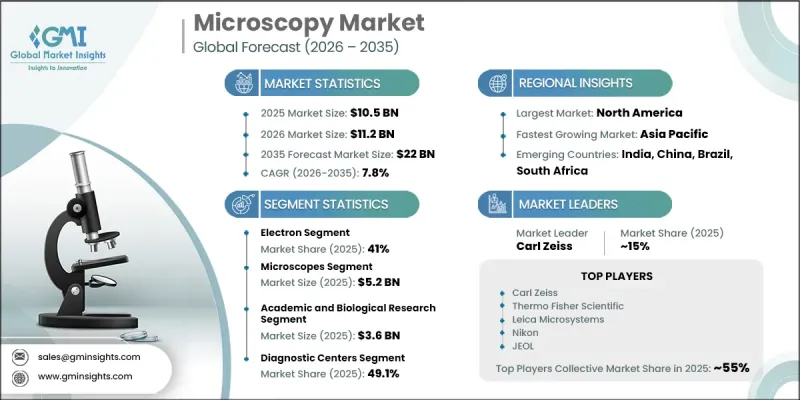
세계의 현미경법시장은 2025년에 105억 달러로 평가되었고 CAGR 7.8%로 성장하여 2035년까지 220억 달러에 이를 것으로 예측됩니다.
이 시장은 급속한 기술 발전과 나노기술, 재생의료, 생명공학, 첨단 재료 연구 분야의 통합 발전에 힘입어 지속적으로 확대되고 있습니다. 이미징 시스템의 지속적인 혁신으로 생명과학 및 산업 분야 모두에서 현미경의 적용이 확대되고 있으며, 현미경이 중요한 분석 도구로 자리매김하고 있습니다. 세포 구조, 분자 간 상호 작용 및 나노 스케일 재료의 고정밀 시각화에 대한 수요가 증가함에 따라 그 보급이 더욱 가속화되고 있습니다. 고해상도 이미징 기술의 발전으로 연구자들은 생물학적 과정과 물질의 거동에 대한 더 깊은 인사이트를 얻을 수 있게 되었으며, 이는 의료 및 과학 연구 분야의 획기적인 발전을 뒷받침하고 있습니다. 디지털 이미징, 자동화, 인공지능의 융합이 진행됨에 따라 현미경 시스템의 분석 정확도와 운영 효율성이 더욱 향상되고 있습니다.
| 시장 범위 | |
|---|---|
| 시작 연도 | 2025년 |
| 예측 기간 | 2026-2035년 |
| 시작 연도 시장 규모 | 105억 달러 |
| 예측 시장 규모 | 220억 달러 |
| CAGR | 7.8% |
현미경법은 육안으로 볼 수 없는 대상을 관찰하고 분석하기 위해 사용되는 과학적인 영상화 기술이라고 정의할 수 있습니다. 이를 통해 세포, 미생물, 조직 및 나노 단위의 구조를 세밀하게 관찰할 수 있습니다. 이 기술은 과학적 발견에서 매우 중요한 역할을 하고 있으며, 생물 의학 연구, 산업 검사, 재료 과학 분야에서 널리 활용되고 있습니다. 최근 몇 년간의 발전으로 유도 방출 감쇠 현미경(STED), 구조화 조명 현미경(SIM), 단일 분자 국소화 현미경(SMLM)과 같은 최첨단 이미징 기법이 도입되었습니다. 이러한 첨단 기술을 통해 기존 해상도의 한계를 뛰어넘는 시각화가 가능해져 연구자들은 역동적인 생물학적 활동과 분자 수준의 구조를 매우 선명하게 연구할 수 있게 되었습니다. 현미경 기술은 세포 내 과정과 구조적 상호작용을 실시간으로 관찰할 수 있게 함으로써 약물 전달 시스템, 조직공학, 나노소재 및 생체재료 개발의 혁신을 지속적으로 지원하고 있습니다.
전자현미경 분야는 초고해상도 이미징과 나노 스케일의 구조적 디테일을 포착할 수 있어 2025년 41%의 점유율을 차지했습니다. 이 분야는 나노기술 연구, 반도체 검사 및 첨단 재료 분석에 널리 활용되고 있습니다. 전자현미경 시스템은 원자 수준 및 서브나노미터 단위의 가시화가 가능하기 때문에 생물 시료 및 인공 재료의 미세한 구조적 특성을 연구하는 데 필수적인 시스템입니다. 반도체 제조, 결함 검출 및 품질 보증 프로세스에서 정밀 분석에 대한 수요가 증가함에 따라 도입이 꾸준히 증가하고 있습니다. 첨단 전자 장치, 나노 구조 재료 및 마이크로 전자기계 시스템(MEMS)의 성장으로 전자현미경 솔루션에 대한 수요가 더욱 증가하고 있습니다.
현미경법 부문은 2025년 52억 달러를 차지했습니다. 현미경 시스템은 모든 응용 분야에서 핵심적인 하드웨어이기 때문에 이 부문은 현미경 시장에서 여전히 중심적인 위치를 차지하고 있습니다. 이러한 성장은 광학 설계, 이미지 해상도, 자동화 및 디지털 통합의 지속적인 개선으로 뒷받침되고 있습니다. 기존 장비에서 형광 현미경법, 공초점 현미경법, 전자 현미경법, 라이트 시트 현미경법 등 첨단 시스템으로의 전환으로 시스템의 가치가 높아져 수요 증가를 견인하고 있습니다. 연구 용도의 복잡성 증가와 전문적인 이미징 솔루션에 대한 요구가 증가함에 따라 첨단 현미경 기술의 채택이 더욱 가속화되고 있습니다.
2025년 기준, 북미 현미경법 시장이 가장 큰 점유율을 차지했습니다. 이 지역은 첨단 현미경법 시스템을 광범위하게 활용하는 주요 연구 대학, 정부 지원 연구소 및 학술 의료 기관이 다수 존재한다는 이점이 있습니다. 이 시설들은 신경과학, 종양학, 유전학, 세포생물학, 나노기술, 재료과학 등 다양한 연구 활동을 지원하고 있습니다. 학술 기관 내 공유 현미경 센터가 광범위하게 설립되어 초해상도, 공초점, 라이트 시트 시스템 등 첨단 이미징 플랫폼에 대한 접근성이 확대되었습니다. 이러한 공유 시설의 높은 이용률은 장비 업그레이드 및 차세대 이미징 기술에 대한 지속적인 투자로 이어지고 있습니다.
자주 묻는 질문
목차
제1장 조사 방법
제2장 주요 요약
제3장 업계 인사이트
제4장 경쟁 구도
제5장 시장 추산 및 예측 : 제품별, 2022-2035년
제6장 시장 추산 및 예측 : 컴포넌트별, 2022-2035년
제7장 시장 추산 및 예측 : 용도별, 2022-2035년
제8장 시장 추산 및 예측 : 최종 용도별, 2022-2035년
제9장 시장 추산 및 예측 : 지역별, 2022-2035년
제10장 기업 개요
JHS 26.06.11The Global Microscopy Market was valued at USD 10.5 billion in 2025 and is estimated to grow at a CAGR of 7.8% to reach USD 22 billion by 2035.
The market is experiencing expansion driven by rapid technological advancements and increasing integration across nanotechnology, regenerative medicine, biotechnology, and advanced materials research. Continuous innovation in imaging systems is broadening the use of microscopy in both life sciences and industrial applications, strengthening its position as a critical analytical tool. The growing demand for highly precise visualization of cellular structures, molecular interactions, and nanoscale materials is further accelerating adoption. Advancements in high-resolution imaging technologies are enabling researchers to achieve deeper insights into biological processes and material behaviors, which is supporting breakthroughs across healthcare and scientific research domains. The increasing convergence of digital imaging, automation, and artificial intelligence is further enhancing analytical accuracy and operational efficiency in microscopy systems.
| Market Scope | |
|---|---|
| Start Year | 2025 |
| Forecast Year | 2026-2035 |
| Start Value | $10.5 Billion |
| Forecast Value | $22 Billion |
| CAGR | 7.8% |
Microscopy is defined as a scientific imaging technique used to observe and analyze objects that are not visible to the naked eye. It allows detailed examination of cells, microorganisms, tissues, and nanoscale structures. The technology plays a vital role in scientific discovery and is widely used across biomedical research, industrial inspection, and materials science applications. Recent advancements have introduced cutting-edge imaging modalities such as stimulated emission depletion microscopy (STED), structured illumination microscopy (SIM), and single-molecule localization microscopy (SMLM). These advanced techniques enable visualization beyond traditional resolution limits, allowing researchers to study dynamic biological activities and molecular-level structures with exceptional clarity. Microscopy continues to support innovation in drug delivery systems, tissue engineering, nanomaterials, and biomaterials development by enabling real-time observation of sub-cellular processes and structural interactions.
The electron segment held a 41% share in 2025, driven by its ability to deliver extremely high-resolution imaging and capture nanoscale structural details. This segment is widely used in nanotechnology research, semiconductor inspection, and advanced materials analysis. Electron-based imaging systems allow visualization at atomic and sub-nanometer scales, making them essential for studying fine structural characteristics in biological samples and engineered materials. The increasing demand for precise analysis in semiconductor fabrication, defect detection, and quality assurance processes continues to support strong adoption. The growth of advanced electronic devices, nanostructured materials, and microelectromechanical systems is further reinforcing demand for electron microscopy solutions.
The microscopes segment accounted for USD 5.2 billion in 2025. This segment remains central to the microscopy market as microscope systems form the core hardware across all applications. Growth is supported by continuous improvements in optical design, imaging resolution, automation, and digital integration. The transition from conventional instruments to advanced systems such as fluorescence, confocal, electron, and light-sheet microscopes is increasing system value and driving higher demand. The expanding complexity of research applications and the need for specialized imaging solutions are further strengthening the adoption of advanced microscope technologies.
North America Microscopy Market held the largest share in 2025. The region benefits from a strong presence of leading research universities, government-funded laboratories, and academic medical institutions that extensively use advanced microscopy systems. These facilities support a wide range of research activities across neuroscience, oncology, genetics, cell biology, nanotechnology, and materials science. The widespread establishment of shared microscopy centers within academic institutions has increased access to advanced imaging platforms such as super-resolution, confocal, and light-sheet systems. High utilization rates of these shared facilities continue to drive recurring investments in equipment upgrades and next-generation imaging technologies.
Key companies operating in the Global Microscopy Industry include Nikon, Carl Zeiss, Leica Microsystems, Thermo Fisher Scientific, JEOL, Hitachi High-Tech, Oxford Instruments, Bruker, Keyence, Evident, Horiba, Lasertec, Meiji Techno, Motic, and Vision Engineering. Companies in the microscopy market are focusing on advancing imaging performance by developing next-generation high-resolution and multi-modal systems that enhance research accuracy and application scope. They are investing heavily in research and development to improve automation, digital imaging, and AI-enabled analysis capabilities. Strategic collaborations with universities, research institutes, and healthcare organizations are strengthening product adoption and expanding application reach. Manufacturers are also emphasizing software integration and cloud-based data management to improve workflow efficiency and data accessibility. Expansion into emerging research markets and customization of microscopy solutions for specific scientific applications are helping companies strengthen their global footprint.
Table of Contents
Chapter 1 Research Methodology
- 1.1 Research approach
- 1.2 Quality commitments
- 1.2.1 GMI AI policy & data integrity commitment
- 1.2.1.1 Source consistency protocol
- 1.2.1 GMI AI policy & data integrity commitment
- 1.3 Research trail & confidence scoring
- 1.3.1 Research trail components
- 1.3.2 Scoring components
- 1.4 Data collection
- 1.4.1 Partial list of primary sources
- 1.5 Data mining sources
- 1.5.1 Paid sources
- 1.5.1.1 Sources, by region
- 1.5.1 Paid sources
- 1.6 Base estimates and calculations
- 1.6.1 Base year calculation for any one approach
- 1.7 Forecast model
- 1.7.1 Quantified market impact analysis
- 1.7.1.1 Mathematical impact of growth parameters on forecast
- 1.7.1 Quantified market impact analysis
- 1.8 Research transparency addendum
- 1.8.1 Source attribution framework
- 1.8.2 Quality assurance metrics
- 1.8.3 Our commitment to trust
Chapter 2 Executive Summary
- 2.1 Industry 360° synopsis
- 2.1.1 Key market trends
- 2.1.2 Product trends
- 2.1.3 Component trends
- 2.1.4 Application trends
- 2.1.5 End use trends
- 2.1.6 Regional trends
- 2.2 CXO perspectives: Strategic imperatives
Chapter 3 Industry Insights
- 3.1 Industry ecosystem analysis
- 3.2 Industry impact forces
- 3.2.1 Growth drivers
- 3.2.1.1 Increasing application areas of microscopy
- 3.2.1.2 Technological advancement in microscopes
- 3.2.1.3 Rising focus on nanotechnology and regenerative medicine
- 3.2.1.4 Favourable funding scenario for R&D in microscopy
- 3.2.2 Industry pitfalls and challenges
- 3.2.2.1 Dearth of skilled professionals
- 3.2.2.2 Availability of open-source microscopy software
- 3.2.3 Market opportunity
- 3.2.3.1 Integration of cloud-based data management solutions
- 3.2.1 Growth drivers
- 3.3 Growth potential analysis
- 3.4 Regulatory landscape (Driven by Primary Research)
- 3.4.1 North America
- 3.4.2 Europe
- 3.4.3 Asia Pacific
- 3.5 Technological landscape (Driven by Primary Research)
- 3.5.1 Current technologies
- 3.5.1.1 Holographic microscopy advances
- 3.5.1.2 Quantum microscopy and next-generation imaging
- 3.5.2 Emerging technologies
- 3.5.2.1 Miniaturized high-resolution microscopy
- 3.5.2.2 Software-as-a-service (SaaS) models for imaging analysis
- 3.5.1 Current technologies
- 3.6 Future market trends (Driven by Primary Research)
- 3.7 Pricing analysis, 2025 (Driven by Primary Research)
- 3.8 Patent analysis (Driven by Primary Research)
- 3.9 Impact of AI and Generative AI on the market (Driven by Primary Research)
- 3.10 Porter's analysis
- 3.11 PESTEL analysis
Chapter 4 Competitive Landscape, 2025
- 4.1 Introduction
- 4.2 Company market share analysis
- 4.2.1 North America
- 4.2.2 Europe
- 4.2.3 Asia Pacific
- 4.3 Company matrix analysis
- 4.4 Competitive analysis of major market players
- 4.5 Competitive positioning matrix
- 4.6 Key developments
- 4.6.1 Merger and acquisition
- 4.6.2 Partnership and collaboration
- 4.6.3 New product launches
- 4.6.4 Expansion plans
Chapter 5 Market Estimates and Forecast, By Product, 2022 - 2035 ($ Mn)
- 5.1 Key trends
- 5.2 Optical
- 5.2.1 Upright
- 5.2.2 Inverted
- 5.2.3 Stereomicroscopes
- 5.2.4 Phase contrast
- 5.2.5 Fluorescence
- 5.2.6 Confocal scanning
- 5.2.7 Near field scanning
- 5.2.8 Other optical microscopes
- 5.3 Electron
- 5.3.1 Scanning electron
- 5.3.2 Transmission
- 5.4 Scanning probe
Chapter 6 Market Estimates and Forecast, By Component, 2022 - 2035 ($ Mn)
- 6.1 Key trends
- 6.2 Microscopes
- 6.3 Accessories
- 6.4 Software
Chapter 7 Market Estimates and Forecast, By Application, 2022 - 2035 ($ Mn)
- 7.1 Key trends
- 7.2 Drug discovery and development
- 7.3 Clinical diagnostics
- 7.4 Pharmaceutical and biopharmaceutical manufacturing
- 7.5 Academic and biological research
Chapter 8 Market Estimates and Forecast, By End Use, 2022 - 2035 ($ Mn)
- 8.1 Key trends
- 8.2 Diagnostic centers
- 8.3 Academic and research institutes
- 8.4 Other end users
Chapter 9 Market Estimates and Forecast, By Region, 2022 - 2035 ($ Mn)
- 9.1 Key trends
- 9.2 North America
- 9.2.1 U.S.
- 9.2.2 Canada
- 9.3 Europe
- 9.3.1 Germany
- 9.3.2 UK
- 9.3.3 France
- 9.3.4 Spain
- 9.3.5 Italy
- 9.3.6 Netherlands
- 9.4 Asia Pacific
- 9.4.1 China
- 9.4.2 Japan
- 9.4.3 India
- 9.4.4 Australia
- 9.4.5 South Korea
- 9.5 Latin America
- 9.5.1 Brazil
- 9.5.2 Mexico
- 9.5.3 Argentina
- 9.6 Middle East and Africa
- 9.6.1 South Africa
- 9.6.2 Saudi Arabia
- 9.6.3 UAE
Chapter 10 Company Profiles
- 10.1 Bruker Corporation
- 10.2 Carl Zeiss AG
- 10.3 Leica Microsystems
- 10.4 Nikon Corporation
- 10.5 Thermo Fisher Scientific Inc.
- 10.6 JEOL Ltd.
- 10.7 Hitachi High-Tech Corporation
- 10.8 Evident Corporation (Olympus)
- 10.9 Keyence Corporation
- 10.10 Oxford Instruments
- 10.11 Horiba Ltd.
- 10.12 Lasertec Corporation
- 10.13 Motic
- 10.14 Meiji Techno
- 10.15 Vision Engineering Ltd.


