|
시장보고서
상품코드
2045712
자동차 타이어 체인 시장 : 기회, 성장 촉진요인, 업계 동향 분석 및 예측(2026-2035년)Automotive Tire Chains Market Opportunity, Growth Drivers, Industry Trend Analysis, and Forecast 2026 - 2035 |
||||||

세계의 자동차 타이어 체인 시장은 2025년에 11억 달러로 평가되었고 CAGR 5.3%를 나타내 2035년까지 18억 달러에 이를 것으로 예측됩니다.
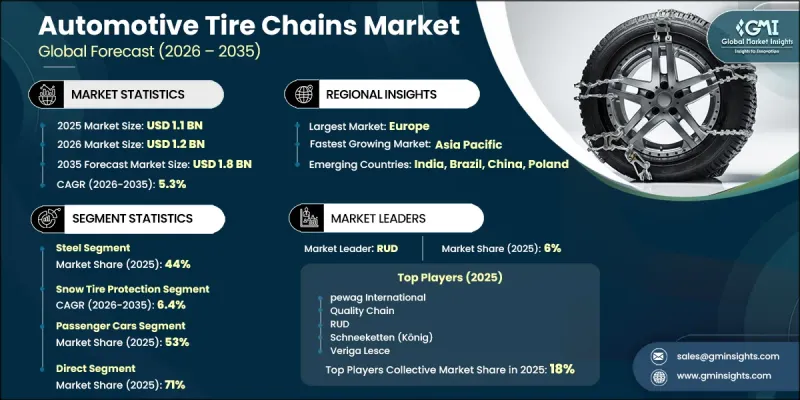
시장 성장은 겨울철 안전 규정의 발전과 강설량이 많은 지역에서 운행되는 차량에 대한 견인력 강화 요구 사항의 강화된 시행에 큰 영향을 받고 있습니다. 이러한 규제 조치는 도로 안전 기준 준수를 향상시키고 악천후 시 사고 위험을 감소시켜 기업 고객과 개인 소비자 모두로부터 안정적인 수요를 유지하고 있습니다. 규제가 까다로운 고산지대 노선과 교통량이 많은 회랑에서 차량을 관리하는 상업용 운송 사업자가 시장 확대의 주요 원동력으로 부상하고 있습니다. 전 세계 무역 활동의 활성화와 더불어 추운 지역과 산악 지역의 전자상거래 물류가 꾸준히 확대되면서 겨울철에도 화물 운송을 중단하지 않는 안정적인 견인 솔루션에 대한 수요가 더욱 증가하고 있습니다. 타이어 체인은 강설 지역에서 운영되는 물류 네트워크에서 배송의 혼란을 최소화하고, 운영 신뢰성을 향상시키며, 안전 성능을 향상시키는 데 매우 중요한 역할을 합니다. 겨울철 이동에 대한 요구 사항이 점점 더 엄격해짐에 따라 자동차 타이어 체인 시장은 승용차 및 상용차 부문 모두에서 꾸준한 보급이 이루어지고 있습니다.
| 시장 범위 | |
|---|---|
| 시작 연도 | 2025년 |
| 예측 기간 | 2026-2035년 |
| 시작 연도 시장 규모 | 11억 달러 |
| 예측 금액 | 18억 달러 |
| CAGR | 5.3% |
철강 부문은 2025년 44%의 점유율을 차지했으며, 2026년부터 2035년까지 연평균 복합 성장률(CAGR) 6.1%를 나타낼 것으로 예측됩니다. 스틸 타이어 체인은 혹독한 겨울철 조건에서 높은 강도, 내구성, 내마모성이 요구되는 용도에 널리 선호되고 있습니다. 이들은 우수한 견인 성능이 필수적인 화물 운송, 광업, 오프로드 주행 환경 등에서 널리 활용되고 있습니다. 혹독한 기상 조건에서도 높은 작동 신뢰성을 발휘하는 반면, 무거운 무게와 일반 도로에서의 주행 편의성에 미치는 영향은 여전히 사용자에게 중요한 고려 사항입니다.
스노우 타이어 보호 부문은 2025년 43.1%의 점유율을 차지했으며, 2026년부터 2035년까지 연평균 6.4%의 성장률을 나타낼 것으로 전망됩니다. 이 부문에는 타이어의 접지력을 높이면서 표면 손상과 타이어 마모를 줄이기 위해 설계된 경량 체인 시스템 및 대체 보호 커버가 포함됩니다. 이러한 솔루션은 주로 눈이 많이 내리는 환경에서 단기적으로 사용하기 위해 승용차에 적용되고 있습니다. 장착의 용이성, 핸들링 특성의 향상, 그리고 운전 편의성의 향상으로 일반 승용차 용도로의 채용이 증가하고 있습니다.
미국의 자동차 타이어 체인 시장은 2025년 2억 2,240만 달러 규모에 달했고 2035년까지 연평균 5.9% 성장할 것으로 예측됩니다. 중국 시장 확대는 산악 지역에서의 겨울철 운전 규제가 강화되고 견인 장치 장착이 점점 더 의무화됨에 따라 뒷받침되고 있습니다. 이러한 규제 프레임워크는 특히 상업용 차량 운행에 영향을 미치고 있으며, 겨울철 폭설 시 화물 운송 경로와 고산지대 회랑에서 채택률을 높이는 데 기여하고 있습니다.
자주 묻는 질문
목차
제1장 조사 방법
제2장 주요 요약
제3장 업계 인사이트
제4장 경쟁 구도
제5장 시장 추산 및 예측 : 소재별(2022-2035년)
제6장 시장 추산 및 예측 : 유형별(2022-2035년)
제7장 시장 추산 및 예측 : 차량별(2022-2035년)
제8장 시장 추산 및 예측 : 유통 채널별(2022-2035년)
제9장 시장 추산 및 예측 : 지역별(2022-2035년)
제10장 기업 개요
KTH 26.06.10The Global Automotive Tire Chains Market was valued at USD 1.1 billion in 2025 and is estimated to grow at a CAGR of 5.3% to reach USD 1.8 billion by 2035.
Market growth is strongly influenced by evolving winter safety regulations and the rising enforcement of traction enhancement requirements for vehicles operating in snow-prone regions. These regulatory measures are improving road safety compliance and reducing accident risks during harsh weather conditions, which in turn is sustaining consistent demand from both institutional buyers and individual consumers. Commercial transportation operators managing fleets across regulated alpine routes and high-traffic corridors are emerging as key contributors to market expansion. Increasing global trade activity, coupled with the steady rise of e-commerce logistics across cold and mountainous terrains, is further strengthening demand for reliable traction solutions that ensure uninterrupted freight movement during winter conditions. Tire chains play a critical role in minimizing delivery disruptions, improving operational reliability, and enhancing safety performance across logistics networks operating in snow-affected geographies. As winter mobility requirements continue to intensify, the automotive tire chains market is witnessing steady adoption across both passenger and commercial vehicle segments.
| Market Scope | |
|---|---|
| Start Year | 2025 |
| Forecast Year | 2026-2035 |
| Start Value | $1.1 Billion |
| Forecast Value | $1.8 Billion |
| CAGR | 5.3% |
The steel segment accounted for 44% share in 2025 and is expected to grow at a CAGR of 6.1% from 2026 to 2035. Steel-based tire chains are widely preferred for demanding applications that require high strength, durability, and resistance to wear under extreme winter conditions. They are extensively utilized in freight transport, mining operations, and off-road driving environments where superior traction performance is essential. Although they provide strong operational reliability in severe weather conditions, their higher weight and impact on driving comfort on standard roads remain key considerations for users.
The snow tire protection segment held a 43.1% share in 2025 and is projected to grow at a CAGR of 6.4% between 2026 and 2035. This segment includes lightweight chain systems and alternative protective covers designed to enhance tire grip while reducing surface damage and tire wear. These solutions are primarily used in passenger vehicles for short-term deployment in snowy environments. Their ease of installation, improved handling characteristics, and enhanced driving comfort are driving their adoption across consumer vehicle applications.
U.S. Automotive Tire Chains Market was valued at USD 222.4 million in 2025 and is projected to grow at a CAGR of 5.9% through 2035. Market expansion in the country is being supported by stricter enforcement of winter driving regulations across mountainous regions, where compliance requirements for traction devices are becoming increasingly mandatory. These regulatory frameworks are particularly impacting commercial fleet operations, leading to higher adoption rates across freight transportation routes and high-altitude corridors during winter storm conditions.
Key companies operating in the Global Automotive Tire Chains Market include Pewag International, RUD, Laclede Chain, Columbus McKinnon, Ottinger, BABAC Tire Chains, Bohu Chain, Nosted, Quality Chain, Schneeketten Konig, and Veriga Lesce. Companies operating in the automotive tire chains market are focusing on strengthening their market position through continuous product innovation and material advancements to improve durability, traction efficiency, and ease of installation. Manufacturers are increasingly investing in lightweight yet high-strength chain designs that enhance vehicle performance while reducing wear on tires and road surfaces. Expansion of distribution networks across regions with severe winter conditions is also being prioritized to improve product availability and accessibility. Strategic partnerships with automotive OEMs, fleet operators, and logistics companies are helping firms secure long-term supply contracts. In addition, companies are enhancing their presence through compliance-driven product development aligned with evolving winter safety regulations.
Table of Contents
Chapter 1 Methodology
- 1.1 Research approach
- 1.2 Quality commitments
- 1.3 GMI AI policy & data integrity commitment
- 1.4 Research trail & confidence scoring
- 1.4.1 Research trail components
- 1.4.2 Scoring components
- 1.5 Data collection
- 1.5.1 Partial list of primary sources
- 1.6 Data mining sources
- 1.6.1 Paid sources
- 1.7 Base estimates and calculations
- 1.7.1 Base year calculation
- 1.8 Forecast model
- 1.9 Research transparency addendum
Chapter 2 Executive Summary
- 2.1 Industry 360° synopsis
- 2.2 Key market trends
- 2.2.1 Regional
- 2.2.2 Material
- 2.2.3 Type
- 2.2.4 Vehicle
- 2.2.5 Distribution channel
- 2.3 TAM analysis, 2026-2035
- 2.4 CXO perspectives: Strategic imperatives
Chapter 3 Industry Insights
- 3.1 Industry ecosystem analysis
- 3.1.1 Supplier landscape
- 3.1.2 Profit margin
- 3.1.3 Cost structure
- 3.1.4 Value addition at each stage
- 3.1.5 Factor affecting the value chain
- 3.1.6 Disruptions
- 3.2 Industry impact forces
- 3.2.1 Growth drivers
- 3.2.1.1 Increasing winter safety regulations
- 3.2.1.2 Growth in commercial freight and logistics
- 3.2.1.3 Rising popularity of SUVs and AWD vehicles
- 3.2.1.4 Expansion of mining and industrial activities
- 3.2.2 Industry pitfalls and challenges
- 3.2.2.1 Seasonal and weather-dependent demand
- 3.2.2.2 Competition from advanced winter tires
- 3.2.3 Market opportunities
- 3.2.3.1 Development of lightweight and easy-to-install chains
- 3.2.3.2 Growth in e-commerce and aftermarket channels
- 3.2.3.3 Rising demand in emerging cold-climate regions
- 3.2.3.4 Increasing adoption in off-highway and industrial vehicle
- 3.2.1 Growth drivers
- 3.3 Growth potential analysis
- 3.4 Technology and innovation landscape
- 3.4.1 Current technological trends
- 3.4.2 Emerging technologies
- 3.5 Pricing analysis (Driven by Primary Research)
- 3.5.1 Historical price trend analysis
- 3.5.2 Pricing strategy by player type (premium / value / cost-plus)
- 3.6 Regulatory landscape
- 3.6.1 North America
- 3.6.1.1 U.S.-Federal Motor Vehicle Safety Standards (FMVSS)
- 3.6.1.2 Canada-Motor Vehicle Tire Safety Regulations
- 3.6.2 Europe
- 3.6.2.1 UK-Road Vehicles (Construction and Use) Regulations 1986
- 3.6.2.2 Germany-StraBenverkehrs-Ordnung (StVO) - Winter Tire & Snow Chain Regulations
- 3.6.2.3 France-Loi Montagne II (Mountain Law II)
- 3.6.3 Asia Pacific
- 3.6.3.1 China-GB/T 23313-2009 Snow Chains for Motor Vehicles
- 3.6.3.2 India-Central Motor Vehicles Rules (CMVR), 1989
- 3.6.4 Latin America
- 3.6.4.1 Brazil- CONTRAN Resolution No. 14/1998
- 3.6.5 Middle East & Africa
- 3.6.5.1 UAE-UAE.S GSO Vehicle Safety Regulations
- 3.6.1 North America
- 3.7 Porter's analysis
- 3.8 PESTEL analysis
- 3.9 Cost breakdown analysis
- 3.10 Patent analysis (Driven by Primary Research)
- 3.11 Trade data analysis (Driven by paid database)
- 3.11.1 Import/export volume & value trends
- 3.11.2 Key trade corridors & tariff impact
- 3.12 Impact of AI & Generative AI on the Market
- 3.12.1 AI-driven disruption of existing business models
- 3.12.2 Gen AI use cases & adoption roadmap by segment
- 3.12.3 Risks, limitations & regulatory considerations
- 3.13 Capacity & Production Landscape (Driven by Primary Research)
- 3.13.1 Production Capacity by Region & Key Producer
- 3.13.2 Capacity Utilization Rates & Expansion Pipelines
- 3.14 Sustainability and environmental aspects
- 3.14.1 Sustainable practices
- 3.14.2 Waste reduction strategies
- 3.14.3 Energy efficiency in production
- 3.14.4 Eco-friendly initiatives
- 3.14.5 Carbon footprint considerations
- 3.15 Forecast assumptions & scenario analysis (Driven by primary research)
- 3.15.1 Base Case - key macro & industry variables driving CAGR
- 3.15.2 Optimistic Scenarios - Favorable macro and industry tailwinds
- 3.15.3 Pessimistic Scenario - Macroeconomic slowdown or industry headwinds
Chapter 4 Competitive Landscape, 2025
- 4.1 Introduction
- 4.2 Company market share analysis
- 4.2.1 North America
- 4.2.2 Europe
- 4.2.3 Asia Pacific
- 4.2.4 LATAM
- 4.2.5 MEA
- 4.3 Competitive analysis of major market players
- 4.4 Competitive positioning matrix
- 4.5 Key developments
- 4.5.1 Mergers & acquisitions
- 4.5.2 Partnerships & collaborations
- 4.5.3 New product launches
- 4.5.4 Expansion plans and funding
Chapter 5 Market Estimates & Forecast, By Material, 2022 - 2035 ($Mn, Mn sets)
- 5.1 Key trends
- 5.2 Rubber
- 5.3 Metal
- 5.4 Steel
- 5.5 Others
Chapter 6 Market Estimates & Forecast, By Type, 2022 - 2035 ($Mn, Mn sets)
- 6.1 Key trends
- 6.2 Traditional tire chain
- 6.3 Snow tire protection
- 6.4 Slag tire protection
- 6.5 Mining tire protection
- 6.6 Others
Chapter 7 Market Estimates & Forecast, By Vehicle, 2022 - 2035 ($Mn, Mn sets)
- 7.1 Key trends
- 7.2 Passenger cars
- 7.2.1 Hatchback
- 7.2.2 Sedan
- 7.2.3 SUV
- 7.3 Commercial vehicles
- 7.3.1 LCV
- 7.3.2 MCV
- 7.3.3 HCV
- 7.4 Off-road & Special Vehicles
Chapter 8 Market Estimates & Forecast, By Distribution channel, 2022 - 2035 ($Mn, Mn sets)
- 8.1 Key trends
- 8.2 Direct
- 8.3 Indirect
Chapter 9 Market Estimates & Forecast, By Region, 2022 - 2035 ($Mn, Mn sets)
- 9.1 Key trends
- 9.2 North America
- 9.2.1 U.S.
- 9.2.2 Canada
- 9.3 Europe
- 9.3.1 Germany
- 9.3.2 UK
- 9.3.3 France
- 9.3.4 Italy
- 9.3.5 Spain
- 9.3.6 Russia
- 9.3.7 Poland
- 9.4 Asia Pacific
- 9.4.1 China
- 9.4.2 India
- 9.4.3 Japan
- 9.4.4 South Korea
- 9.4.5 ANZ
- 9.4.6 Vietnam
- 9.4.7 Indonesia
- 9.4.8 Philippines
- 9.5 Latin America
- 9.5.1 Brazil
- 9.5.2 Mexico
- 9.5.3 Argentina
- 9.6 MEA
- 9.6.1 South Africa
- 9.6.2 Saudi Arabia
- 9.6.3 UAE
Chapter 10 Company Profiles
- 10.1 Global players
- 10.1.1 Bohu Chain
- 10.1.2 Columbus McKinnon
- 10.1.3 Laclede Chain
- 10.1.4 pewag International
- 10.1.5 Quality Chain
- 10.1.6 RUD
- 10.1.7 Schneeketten (Konig)
- 10.1.8 Veriga Lesce
- 10.2 Regional players
- 10.2.1 BABAC Tire Chains
- 10.2.2 Maggi
- 10.2.3 Nosted (TRYGG)
- 10.2.4 Ottinger
- 10.2.5 REX Schneeketten
- 10.2.6 Spikes-Spider
- 10.2.7 TongWei (TW Chains)
- 10.2.8 VBG Group (Onspot)
- 10.3 Emerging players
- 10.3.1 AutoSock Operations
- 10.3.2 ISSE Safety
- 10.3.3 Jinhua Gowin Auto Accessories
- 10.3.4 Lianyi Rubber Components
- 10.3.5 Rotachain (Hildebrand)
- 10.3.6 Security Chain Company (SCC)