

|
시장보고서
상품코드
2045723
산화 스트레스 어세이 시장 : 기회, 성장 촉진요인, 업계 동향 분석 및 예측(2026-2035년)Oxidative Stress Assay Market Opportunity, Growth Drivers, Industry Trend Analysis, and Forecast 2026 - 2035 |
||||||

세계의 산화 스트레스 어세이 시장은 2025년에 11억 달러로 평가되었고 CAGR 9.4%를 나타내 2035년까지 27억 달러에 이를 것으로 추정되고 있습니다.
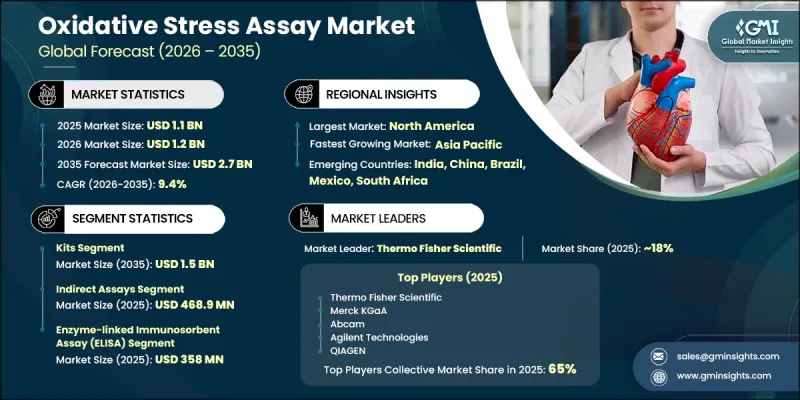
심혈관 질환, 당뇨병, 암, 호흡기 질환, 신경 퇴행성 질환 등의 병태는 산화 스트레스와 밀접한 관련이 있기 때문에 전 세계적으로 증가하는 만성 질환의 부담이 시장 성장을 이끄는 주요 요인으로 작용하고 있습니다. 이 생물학적 과정은 염증, 세포 손상 및 질병 진행에 기여하며, 임상 연구 및 진단에서 산화 스트레스 바이오마커에 대한 수요가 증가하고 있습니다. 이러한 바이오마커는 질병 기전 규명, 진행 모니터링 및 치료 결과 평가에 널리 활용되고 있습니다. 또한, 제약 및 생명공학 분야의 연구 활동의 확대는 시장의 발전을 크게 촉진하고 있습니다. 신약 개발 프로그램에서는 전임상 및 임상 단계에서 약물의 독성, 안전성 프로파일 및 치료 메커니즘을 평가하기 위해 산화 스트레스 분석에 대한 의존도가 높아지고 있습니다. 또한, 맞춤형 의료와 표적치료에 대한 관심이 높아지면서 치료의 최적화와 환자별 반응 평가를 지원하는 바이오마커 기반 검사 솔루션에 대한 수요가 증가하고 있습니다. 생명과학 연구에 대한 투자 확대와 중개 의학 분야에서의 응용 범위 확대는 세계 산화 스트레스 분석 시장의 전반적인 성장 궤도를 더욱 견고하게 만들고 있습니다.
| 시장 범위 | |
|---|---|
| 시작 연도 | 2025년 |
| 예측 기간 | 2026-2035년 |
| 시작 연도 시장 규모 | 11억 달러 |
| 예측 금액 | 27억 달러 |
| CAGR | 9.4% |
키트 시장은 2035년까지 15억 달러에 달할 것으로 예측됩니다. 산화 스트레스 분석 키트는 산화 바이오마커를 검출하는 데 필요한 시약, 완충액, 대조군 및 표준화된 절차가 포함된 사전 구성된 검사 솔루션입니다. 이 키트는 다양한 실험 환경에서도 일관성 있고 재현성 있는 결과를 제공할 수 있어 널리 사용되고 있습니다. 표준화된 설계로 실험 워크플로우를 간소화하고 기술적 복잡성을 줄여 연구 및 임상 현장 모두에서 업무 효율성을 향상시킵니다. 자동화 및 고처리 실험실 시스템의 도입 확대는 분석 키트에 대한 수요를 더욱 증가시키고 있습니다. 이는 확장성을 지원하고, 설정 시간을 단축하며, 대량의 시료에서도 검사 정확도를 향상시키기 위함입니다.
간접 분석 부문은 2025년 4억 6,890만 달러 시장 규모를 기록했습니다. 간접 산화 스트레스 분석은 절차가 간단하고 다양한 실험 환경에서 쉽게 도입할 수 있어 널리 선호되고 있습니다. 이러한 분석은 다양한 수준의 기술 전문 지식을 가진 사용자에게 적합하며, 임상 진단과 연구 모두에 적용할 수 있습니다. 간소화된 워크플로는 검사 속도를 향상시키는 동시에 운영상의 복잡성을 줄여 일상적으로 자주 사용할 수 있도록 도와줍니다. 간접적인 방법은 주로 지질 과산화 및 DNA 산화 지표와 같은 2차 바이오마커에 의존하며, 이는 생물학적 시스템 내 전반적인 산화적 손상에 대한 신뢰할 수 있는 정보를 제공합니다.
2025년 북미 산화 스트레스 분석 시장은 40.3%의 점유율을 차지했습니다. 이 지역 시장 성장은 산화 스트레스와 관련된 건강 상태에 대한 인식이 높아지고 예방 의학에 대한 관심이 높아짐에 따라 주도되고 있습니다. 웰빙과 노화 관련 질환 관리에 대한 관심이 높아지면서 임상 현장에서 항산화제를 이용한 접근법이 채택되고 있습니다. 의료진은 치료 방침을 결정하고 치료 효과를 모니터링하기 위해 산화 스트레스 검사를 점점 더 많이 도입하고 있습니다. 고급 바이오마커 분석에 대한 수요 증가와 임상 연구에서의 응용 분야 확대도 이 지역의 견고한 시장 지위를 더욱 강화하는 데 기여하고 있습니다.
자주 묻는 질문
목차
제1장 조사 방법
제2장 주요 요약
제3장 업계 인사이트
제4장 경쟁 구도
제5장 시장 추산 및 예측 : 제품별(2022-2035년)
제6장 시장 추산 및 예측 : 유형별(2022-2035년)
제7장 시장 추산 및 예측 : 기술별(2022-2035년)
제8장 시장 추산 및 예측 : 질환 유형별(2022-2035년)
제9장 시장 추산 및 예측 : 최종 용도별(2022-2035년)
제10장 시장 추산 및 예측 : 지역별(2022-2035년)
제11장 기업 개요
KTH 26.06.10The Global Oxidative Stress Assay Market was valued at USD 1.1 billion in 2025 and is estimated to grow at a CAGR of 9.4% to reach USD 2.7 billion by 2035.
The rising global burden of chronic diseases is a key factor driving market growth, as conditions such as cardiovascular disorders, diabetes, cancer, respiratory diseases, and neurodegenerative illnesses are closely associated with oxidative stress. This biological process contributes to inflammation, cellular damage, and disease progression, increasing the demand for oxidative stress biomarkers in clinical research and diagnostics. These biomarkers are widely used to study disease mechanisms, monitor progression, and evaluate treatment outcomes. In addition, expanding research activities in the pharmaceutical and biotechnology sectors are significantly supporting market development. Drug discovery programs increasingly rely on oxidative stress assays to assess drug toxicity, safety profiles, and therapeutic mechanisms during both preclinical and clinical stages. The growing focus on personalized medicine and targeted therapies is also accelerating demand for biomarker-based testing solutions that support treatment optimization and patient-specific response evaluation. Increasing investment in life sciences research and expanding applications in translational medicine are further strengthening the overall growth trajectory of the oxidative stress assay market worldwide.
| Market Scope | |
|---|---|
| Start Year | 2025 |
| Forecast Year | 2026-2035 |
| Start Value | $1.1 Billion |
| Forecast Value | $2.7 Billion |
| CAGR | 9.4% |
The kits segment is expected to reach USD 1.5 billion by 2035. Oxidative stress assay kits are preconfigured testing solutions that include essential reagents, buffers, controls, and standardized procedures for detecting oxidative biomarkers. These kits are widely used due to their ability to deliver consistent and reproducible results across different laboratory environments. Their standardized design simplifies experimental workflows, reduces technical complexity, and improves operational efficiency in both research and clinical settings. Growing adoption of automated and high-throughput laboratory systems is further enhancing the demand for assay kits, as they support scalability, reduce setup time, and improve testing accuracy across large sample volumes.
The indirect assays segment generated USD 468.9 million in 2025. Indirect oxidative stress assays are widely preferred due to their simplified procedures and ease of implementation across various laboratory environments. These assays are suitable for users with different levels of technical expertise, making them applicable in both clinical diagnostics and research studies. Their streamlined workflows enhance testing speed while reducing operational complexity, enabling frequent and routine use. Indirect methods primarily rely on secondary biomarkers such as lipid peroxidation and DNA oxidation indicators, which provide reliable insights into overall oxidative damage within biological systems.
North America Oxidative Stress Assay Market accounted for 40.3% share in 2025. Market growth in the region is driven by increasing awareness of oxidative stress-related health conditions and a strong focus on preventive healthcare practices. Growing emphasis on wellness and aging-related disease management is supporting the adoption of antioxidant-based approaches in clinical settings. Healthcare professionals are increasingly incorporating oxidative stress testing to support therapeutic decisions and monitor treatment effectiveness. Rising demand for advanced biomarker analysis and expanding applications in clinical research are further contributing to the region's strong market position.
Major companies operating in the Global Oxidative Stress Assay Market include Abcam, Agilent Technologies, BioVision, Biorbyt, Cayman Chemical, Cell Biolabs, Dojindo Molecular Technologies, Elabscience Bionovation Inc., Enzo Life Sciences, Merck KGaA, Promega Corporation, QIAGEN, RayBiotech, StressMarq Biosciences, and Thermo Fisher Scientific. Companies operating in the oxidative stress assay market are adopting several strategic initiatives to strengthen their competitive positioning and expand global presence. Leading players are heavily investing in research and development to introduce more sensitive, accurate, and high-throughput assay solutions capable of detecting a wide range of oxidative biomarkers. Product innovation remains a core strategy, with companies focusing on developing user-friendly kits and automated assay platforms that reduce complexity and improve reproducibility. Strategic collaborations with pharmaceutical companies, academic research institutes, and clinical laboratories are helping accelerate product validation and adoption. Market participants are also expanding their geographic footprint through distribution partnerships and regional expansion strategies to access emerging markets. In addition, companies are integrating digital technologies and advanced analytics into assay platforms to improve data interpretation and workflow efficiency.
Table of Contents
Chapter 1 Research Methodology
- 1.1 Research approach
- 1.2 Quality commitments
- 1.2.1 GMI AI policy & data integrity commitment
- 1.2.1.1 Source consistency protocol
- 1.2.1 GMI AI policy & data integrity commitment
- 1.3 Research trail & confidence scoring
- 1.3.1 Research trail components
- 1.3.2 Scoring components
- 1.4 Data collection
- 1.4.1 Partial list of primary sources
- 1.5 Data mining sources
- 1.5.1 Paid sources
- 1.5.1.1 Sources, by region
- 1.5.1 Paid sources
- 1.6 Base estimates and calculations
- 1.6.1 Base year calculation for any one approach
- 1.7 Forecast model
- 1.7.1 Quantified market impact analysis
- 1.7.1.1 Mathematical impact of growth parameters on forecast
- 1.7.1 Quantified market impact analysis
- 1.8 Research transparency addendum
- 1.8.1 Source attribution framework
- 1.8.2 Quality assurance metrics
- 1.8.3 Our commitment to trust
Chapter 2 Executive Summary
- 2.1 Industry 3600 synopsis
- 2.2 Key market trends
- 2.2.1 Product trends
- 2.2.2 Type trends
- 2.2.3 Technology trends
- 2.2.4 Disease trends
- 2.2.5 End use trends
- 2.2.6 Regional trends
- 2.3 CXO perspectives: Strategic imperatives
Chapter 3 Industry Insights
- 3.1 Industry ecosystem analysis
- 3.2 Industry impact forces
- 3.2.1 Growth drivers
- 3.2.1.1 Increasing prevalence of chronic diseases
- 3.2.1.2 Advances in diagnostic technologies
- 3.2.1.3 Increasing awareness of antioxidant therapies
- 3.2.1.4 Rising research in drug discovery and development
- 3.2.2 Industry pitfalls and challenges
- 3.2.2.1 High cost of instruments
- 3.2.2.2 Stringent regulatory challenges
- 3.2.3 Market opportunities
- 3.2.3.1 Development of point-of-care testing solutions
- 3.2.1 Growth drivers
- 3.3 Growth potential analysis
- 3.4 Regulatory landscape (Driven by primary research)
- 3.4.1 North America
- 3.4.2 Europe
- 3.4.3 Asia Pacific
- 3.4.4 Latin America
- 3.4.5 Middle East and Africa
- 3.5 Technology landscape (Driven by primary research)
- 3.5.1 Current technological trends
- 3.5.1.1 Widespread adoption of fluorescence-based ROS assays
- 3.5.1.2 Integration with flow cytometry and high-content imaging
- 3.5.2 Emerging technologies
- 3.5.2.1 Development of multiplex oxidative stress assays
- 3.5.2.2 Expansion of high-specificity probes and targeted sensors
- 3.5.1 Current technological trends
- 3.6 Future market trends (Driven by primary research)
- 3.7 Impact of AI and Generative AI on the market (Driven by primary research)
- 3.8 Pricing analysis, 2025 (Driven by primary research)
- 3.9 Porter's analysis
- 3.10 PESTEL analysis
Chapter 4 Competitive Landscape, 2025
- 4.1 Introduction
- 4.2 Company market share analysis
- 4.2.1 Global
- 4.2.2 North America
- 4.2.3 Europe
- 4.2.4 Asia Pacific
- 4.3 Company matrix analysis
- 4.4 Competitive analysis of major market players
- 4.5 Competitive positioning matrix
- 4.6 Key developments
- 4.6.1 Mergers and acquisitions
- 4.6.2 Partnerships and collaborations
- 4.6.3 New product launches
- 4.6.4 Expansion plans
Chapter 5 Market Estimates and Forecast, By Product, 2022 - 2035 ($ Mn)
- 5.1 Key trends
- 5.2 Kits
- 5.3 Reagents
Chapter 6 Market Estimates and Forecast, By Type, 2022 - 2035 ($ Mn)
- 6.1 Key trends
- 6.2 Indirect assays
- 6.2.1 Protein-based assays
- 6.2.2 Lipid-based assays
- 6.2.3 Nucleic acid-based assays
- 6.3 Antioxidant capacity assays
- 6.3.1 Glutathione assays
- 6.3.2 Ascorbic acid assays
- 6.3.3 Cell-based exogenous antioxidant assays
- 6.4 Enzyme-based assays
- 6.5 Reactive oxygen species-based assays
Chapter 7 Market Estimates and Forecast, By Technology, 2022 - 2035 ($ Mn)
- 7.1 Key trends
- 7.2 Enzyme-Linked Immunosorbent Assay
- 7.3 Flow cytometry
- 7.4 Chromatography
- 7.5 Microscopy
- 7.6 Other technologies
Chapter 8 Market Estimates and Forecast, By Disease Type, 2022 - 2035 ($ Mn)
- 8.1 Key trends
- 8.2 Cardiovascular disease
- 8.3 Respiratory diseases
- 8.4 Cancer
- 8.5 Diabetes
- 8.6 Other diseases
Chapter 9 Market Estimates and Forecast, By End Use, 2022 - 2035 ($ Mn)
- 9.1 Key trends
- 9.2 Pharmaceutical and biotechnology industries
- 9.3 Academic research institutes
- 9.4 Contract Research Organizations (CROs)
- 9.5 Clinical laboratories
- 9.6 Other end users
Chapter 10 Market Estimates and Forecast, By Region, 2022 - 2035 ($ Mn)
- 10.1 Key trends
- 10.2 North America
- 10.2.1 U.S.
- 10.2.2 Canada
- 10.3 Europe
- 10.3.1 Germany
- 10.3.2 UK
- 10.3.3 France
- 10.3.4 Spain
- 10.3.5 Italy
- 10.3.6 Netherlands
- 10.4 Asia Pacific
- 10.4.1 China
- 10.4.2 Japan
- 10.4.3 India
- 10.4.4 Australia
- 10.4.5 South Korea
- 10.5 Latin America
- 10.5.1 Brazil
- 10.5.2 Mexico
- 10.5.3 Argentina
- 10.6 Middle East and Africa
- 10.6.1 South Africa
- 10.6.2 Saudi Arabia
- 10.6.3 UAE
Chapter 11 Company Profiles
- 11.1 Abcam
- 11.2 Agilent Technologies
- 11.3 BioVision
- 11.4 Biorbyt
- 11.5 Cayman Chemical
- 11.6 Cell Biolabs
- 11.7 Dojindo Molecular Technologies
- 11.8 Elabscience Bionovation Inc.
- 11.9 Enzo Life Sciences
- 11.10 Merck KGaA
- 11.11 Promega Corporation
- 11.12 QIAGEN
- 11.13 RayBiotech
- 11.14 StressMarq Biosciences
- 11.15 Thermo Fisher Scientific


