

|
시장보고서
상품코드
2061397
목질 패널 시장 기회, 성장요인, 업계 동향 분석 및 예측(2026-2035년)Wood Based Panel Market Opportunity, Growth Drivers, Industry Trend Analysis, and Forecast 2026 - 2035 |
||||||

세계의 목질 패널 시장은 2025년에 1,540억 달러로 평가되고 CAGR 5.1%로 성장하며, 2035년까지 2,526억 달러에 달할 것으로 예측됩니다.
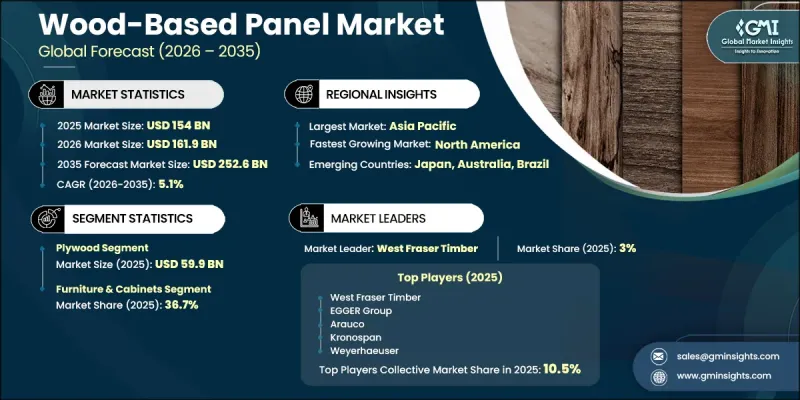
전 세계 건설, 가구, 리모델링 업계의 수요가 증가함에 따라 시장은 꾸준히 성장하고 있습니다. 목재 패널은 기존의 원목에 비해 비용 효율이 높고, 취급이 용이하며, 품질이 균일하고, 신뢰성 높은 성능을 갖추고 있으며, 주택, 상업 시설, 모듈식 건축 등 다양한 용도에서 널리 선호되고 있습니다. 도시화의 진전과 현대적인 인테리어 솔루션에 대한 수요 증가 역시 여러 최종 용도 산업에서 제품의 보급 확대에 기여하고 있습니다. 각 제조사들은 내구성, 표면 마감 품질, 내습성을 향상시킴으로써 패널의 성능을 지속적으로 강화하고 있으며, 이를 통해 이러한 소재들이 더욱 폭넓은 용도로 활용될 수 있게 되었습니다. 또한 소비자, 건설업체, 디자이너 사이에서 높아지고 있는 환경 의식도 시장 동향에 큰 영향을 미치고 있습니다. 지속가능한 방식으로 제조된 제품에 대한 수요가 증가함에 따라 기업은 재생 목재나 저배출 접착제 사용 등 환경을 고려한 생산 방식을 도입하도록 권장받고 있습니다. 이러한 지속가능성에 초점을 맞춘 노력은 제조업체가 규제 준수를 강화하는 데 도움이 될 뿐만 아니라, 소비자의 신뢰를 높이고 전 세계 각지의 장기적인 시장 성장을 지원하고 있습니다.
| 시장 범위 | |
|---|---|
| 시작연도 | 2025년 |
| 예측 기간 | 2026-2035년 |
| 개시 금액 | 1,540억 달러 |
| 예측액 | 2,526억 달러 |
| CAGR | 5.1% |
합판 부문은 2025년에 599억 달러 규모 시장 규모를 기록했습니다. 합판은 강도, 내구성, 범용성, 그리고 뛰어난 가성비를 모두 갖추고 있으며, 업계 내에서 계속해서 주도적인 위치를 유지하고 있습니다. 합판의 적층 구조는 구조적 안정성을 높이고, 균열, 처짐, 치수 변형에 대한 내성을 향상시키기 때문에 다양한 구조용 및 장식용 용도에 적합합니다. 건설 프로젝트, 가구 제조, 인테리어 분야에서의 광범위한 활용은 전 세계 목재 패널 산업에서 합판의 중요성을 계속해서 공고히 하고 있습니다. 장기적인 내구성과 적응성은 다양한 분야에서 합판 제품에 대한 꾸준한 수요를 지원하는 중요한 요인으로 자리 잡고 있습니다.
2025년 기준으로, 가구·캐비닛 분야는 36.7%의 시장 점유율을 차지했습니다. 이 분야의 활발한 수요는 주로 도시형 라이프스타일의 확산과 기능적이면서도 공간 효율이 높고 시각적으로 매력적인 가구 솔루션에 대한 선호도가 높아짐에 따라 주도되고 있습니다. 목재 패널은 매끄러운 표면, 안정적인 품질, 그리고 디자인 및 맞춤 제작에 있으며, 유연성을 제공하므로 가구 및 캐비닛 제조에 널리 사용되고 있습니다. 현대적인 주택 및 상업 시설의 인테리어에 대한 수요가 증가함에 따라 전 세계 가구 제조 업계에서 목재 패널의 채택이 계속해서 확대되고 있습니다.
미국의 목재 패널 시장은 77.6%의 점유율을 차지했으며, 2025년에는 236억 달러 규모의 시장에 도달했습니다. 북미 전역의 시장 성장은 주택 리모델링, 인테리어 가구 용도 및 현대적인 건설 프로젝트에서 비롯된 안정적인 수요에 힘입고 있습니다. 이 지역의 소비자들은 내구성, 디자인의 다용도성, 그리고 지속가능한 제조 공정을 모두 갖춘 제품을 점점 더 중요하게 여기고 있습니다. 이에 대응하여 각 제조사는 재생 목재와 저배출 생산 기술을 활용한 친환경 패널 제품 개발에 주력하고 있습니다. 성능과 표면의 미관을 향상시키기 위한 지속적인 제품 혁신 또한 기업이 변화하는 인테리어 디자인 동향에 대응하고 지역 시장의 성장을 강화하는 데 기여하고 있습니다.
자주 묻는 질문
목차
제1장 조사 방법과 범위
제2장 개요
제3장 업계 인사이트
제4장 경쟁 구도
제5장 시장 추산·예측 : 제품 유형별, 2022-2035년
제6장 시장 추산·예측 : 수지 유형별, 2022-2035년
제7장 시장 추산·예측 : 표면 처리별, 2022-2035년
제8장 시장 추산·예측 : 용도별, 2022-2035년
제9장 시장 추산·예측, 제품 유형 : 용도별, 2022-2035년
제10장 시장 추산·예측 : 지역별, 2022-2035년
제11장 기업 개요
KSA 26.06.24The Global Wood-Based Panel Market was valued at USD 154 billion in 2025 and is estimated to grow at a CAGR of 5.1% to reach USD 252.6 billion by 2035.
The market continues to expand steadily due to rising demand from the construction, furniture, and renovation industries worldwide. Wood-based panels have become widely preferred across residential, commercial, and modular construction applications because they offer cost efficiency, ease of handling, uniform quality, and reliable performance compared to conventional solid wood materials. Growing urbanization and increasing demand for modern interior solutions are also contributing to broader product adoption across multiple end-use industries. Manufacturers are continuously enhancing panel performance by improving durability, surface finish quality, and resistance to moisture, enabling these materials to be utilized across a wider range of applications. In addition, increasing environmental awareness among consumers, builders, and designers is significantly influencing market trends. Demand for sustainably manufactured products is encouraging companies to adopt eco-friendly production methods, including the use of recycled wood materials and low-emission adhesives. These sustainability-focused initiatives are helping manufacturers strengthen regulatory compliance while also improving consumer confidence and supporting long-term market growth across global regions.
| Market Scope | |
|---|---|
| Start Year | 2025 |
| Forecast Year | 2026-2035 |
| Start Value | $154 Billion |
| Forecast Value | $252.6 Billion |
| CAGR | 5.1% |
The plywood segment generated USD 59.9 billion in 2025. Plywood continues to maintain a leading position within the industry due to its combination of strength, durability, versatility, and cost-effectiveness. The layered construction of plywood enhances structural stability and improves resistance to cracking, bending, and dimensional distortion, making it suitable for a broad range of structural and decorative applications. Its widespread use across construction projects, furniture manufacturing, and interior applications continues to reinforce its importance within the global wood-based panel industry. Long-term durability and adaptability remain key factors supporting strong demand for plywood products across multiple sectors.
The furniture and cabinets segment held 36.7% share in 2025. Strong demand from this segment is primarily driven by growing urban lifestyles and increasing preference for functional, space-efficient, and visually appealing furniture solutions. Wood-based panels are extensively utilized in furniture and cabinet manufacturing because they provide smooth surfaces, consistent quality, and flexibility in design and customization. Rising demand for modern residential and commercial interiors continues to support the adoption of wood-based panels across the furniture manufacturing industry worldwide.
U.S. Wood-Based Panel Market generated 77.6% share, generating USD 23.6 billion in 2025. Market growth across North America is being supported by stable demand from home renovation activities, interior furnishing applications, and modern construction projects. Consumers across the region increasingly prioritize products offering durability, design versatility, and sustainable manufacturing practices. In response, manufacturers are focusing on developing environmentally responsible panel products using recycled wood materials and low-emission production technologies. Continuous product innovation aimed at improving performance and surface aesthetics is also helping companies align with evolving interior design preferences and strengthen regional market growth.
Major companies operating in the Global Wood-Based Panel Market include Kronospan Holdings, Egger Group, Swiss Krono Group, Pfleiderer Group, Arauco (CMPC), Weyerhaeuser, West Fraser, Sonae Arauco, Finsa Group, Metsa Wood, Uniboard, PG Bison, Homann Holzwerkstoffe, Unilin Panels, Kastamonu Entegre, Woodeco, Saviola Group, Garnica, Louisiana-Pacific (LP Building Solutions), Roseburg Forest Products, and Arbec Forest Products. Companies operating in the wood-based panel industry are implementing several strategic initiatives to strengthen their market position and expand their global footprint. Leading manufacturers are investing in advanced production technologies to improve panel durability, surface quality, moisture resistance, and overall product performance. Many companies are also prioritizing sustainable manufacturing practices by increasing the use of recycled raw materials and low-emission adhesives to meet evolving environmental regulations and consumer preferences. Strategic expansions, acquisitions, and partnerships are helping market participants enhance production capacities and strengthen regional distribution networks. In addition, manufacturers are focusing on customized product offerings and innovative decorative finishes to align with changing interior design trends and customer expectations.
Table of Contents
Chapter 1 Methodology & Scope
- 1.1 Research approach
- 1.2 Quality Commitments
- 1.2.1 GMI AI policy & data integrity commitment
- 1.2.1.1 Source consistency protocol
- 1.2.1 GMI AI policy & data integrity commitment
- 1.3 Research Trail & Confidence Scoring
- 1.3.1 Research Trail Components
- 1.3.2 Scoring Components
- 1.4 Data Collection
- 1.4.1 Partial list of primary sources
- 1.5 Data mining sources
- 1.5.1 Paid sources
- 1.5.1.1 Sources, by region
- 1.5.1 Paid sources
- 1.6 Base estimates and calculations
- 1.6.1 Base year calculation for any one approach
- 1.7 Forecast model
- 1.7.1 Quantified market impact analysis
- 1.7.1.1 Mathematical impact of growth parameters on forecast
- 1.7.1 Quantified market impact analysis
- 1.8 Research transparency addendum
- 1.8.1 Source attribution framework
- 1.8.2 Quality assurance metrics
- 1.8.2.1 Our commitment to trust
Chapter 2 Executive Summary
- 2.1 Industry 360° synopsis
- 2.2 Key market trends
- 2.2.1 Region
- 2.2.2 Product Type
- 2.2.3 Resin Type
- 2.2.4 Surface Treatment
- 2.2.5 Application
Chapter 3 Industry Insights
- 3.1 Industry ecosystem analysis
- 3.1.1 Value chain analysis
- 3.1.2 Supplier landscape
- 3.1.3 Profit margin
- 3.1.4 Value addition at each stage
- 3.1.5 Factor affecting the value chain
- 3.2 Supply chain analysis
- 3.2.1 Raw material sources
- 3.2.2 Manufacturing and processing stages
- 3.2.3 Distribution channels
- 3.2.4 Supply chain risks and dependencies
- 3.3 Industry impact forces
- 3.3.1 Growth drivers
- 3.3.2 Industry pitfalls & challenges
- 3.3.3 Opportunities
- 3.4 Growth potential analysis
- 3.5 Technology and innovation landscape
- 3.5.1 Current technological trends
- 3.5.2 Emerging technologies including IoT, AI, and automation
- 3.5.3 Smart aquaculture and precision farming systems
- 3.5.4 Recirculating aquaculture systems advancements
- 3.5.5 Remote monitoring and predictive analytics
- 3.6 Price trends
- 3.6.1 Historical price trend analysis driven by primary research
- 3.6.2 Pricing strategy by player type including premium, value, and cost-plus approaches
- 3.6.3 Regional price variation and key drivers
- 3.6.4 Equipment type price benchmarking
- 3.7 Regulatory landscape
- 3.7.1 Global regulatory framework (EUTR, EUDR, CARB, FSC/PEFC)
- 3.7.2 Formaldehyde and VOC emission standards
- 3.7.3 Germany federal emission regulations
- 3.7.3.1 ChemVOCFarbV
- 3.7.3.2 Blauer Engel eco-label
- 3.7.3.3 GEF compliance
- 3.7.3.4 E0 emission class standards
- 3.7.3.5 North America
- 3.7.3.6 Asia Pacific
- 3.7.3.7 Regulatory trends and upcoming changes, 2025-2028
- 3.8 Porter’s analysis
- 3.9 PESTEL analysis
- 3.10 Trade data analysis (driven by paid database) (HS code: 8414.80/8421.21/8907.90/ others)
- 3.10.1 Global import and export volume and value trends, 2019-2024 (driven by primary research)
- 3.10.1.1 Top 10 exporting and importing countries by volume (HS codes 4410-4412)
- 3.10.1.2 Intra-European, Asia-Europe, and Asia-North America trade patterns
- 3.10.2 Key trade corridors and tariff impact (driven by primary research)
- 3.10.2.1 Europe-North America
- 3.10.2.2 China-Europe
- 3.10.2.3 Europe-MEA
- 3.10.2.4 Anti-dumping measures on Chinese plywood (EU) and post-Brexit UK-EU panel flows
- 3.10.3 Germany
- 3.10.1 Global import and export volume and value trends, 2019-2024 (driven by primary research)
- 3.11 Impact of AI and generative AI on the market
- 3.11.1 AI-driven disruption of existing business models
- 3.11.2 GenAI use cases and adoption roadmaps by segment
- 3.11.3 Risks, limitations, and regulatory considerations, including EU AI Act implications for manufacturing
- 3.12 Capacity and production landscape driven by primary research
- 3.12.1 Installed production capacity by region and key producer (2024)
- 3.12.2 Capacity utilization rates and expansion pipelines
- 3.12.3 Germany: installed capacity and utilization data
Chapter 4 Competitive Landscape, 2025
- 4.1 Introduction
- 4.2 Company market share analysis
- 4.2.1 By region
- 4.2.1.1 North America
- 4.2.1.2 Europe
- 4.2.1.2.1 Germany
- 4.2.1.3 Asia Pacific
- 4.2.1.4 Latin America
- 4.2.1.5 Middle East & Africa
- 4.2.1 By region
- 4.3 Company matrix analysis
- 4.4 Competitive analysis of major market players
- 4.5 Competitive positioning matrix
- 4.6 Key developments
- 4.6.1 Mergers & acquisitions
- 4.6.2 Partnerships & collaborations
- 4.6.3 New product launches
- 4.6.4 Expansion plans
Chapter 5 Market Estimates and Forecast, By Product Type, 2022 - 2035 (USD Billion) (Thousand Cubic Meters)
- 5.1 Key trends
- 5.2 Medium Density Fiberboard (MDF)
- 5.3 High Density Fiberboard (HDF)
- 5.4 Particleboard / Chipboard
- 5.5 Plywood
- 5.6 Oriented Strand Board (OSB)
- 5.7 Hardboard
- 5.8 Others
Chapter 6 Market Estimates & Forecast, By Resin Type, 2022-2035 (USD Billion) (Thousand Cubic Meters)
- 6.1 Key trends
- 6.2 Urea Formaldehyde (UF)
- 6.3 Melamine Formaldehyde (MF)
- 6.4 Phenol Formaldehyde (PF)
- 6.5 Methylene Diphenyl Diisocyanate (MDI)
- 6.6 Others
Chapter 7 Market Estimates & Forecast, By Surface Treatment, 2022-2035 (USD Billion) (Thousand Cubic Meters)
- 7.1 Key trends
- 7.2 Raw / Untreated
- 7.3 Laminated (LPL / HPL)
- 7.4 Veneered
- 7.5 Coated / Painted / Digitally Printed
- 7.6 Others
Chapter 8 Market Estimates & Forecast, By Application, 2022-2035 (USD Billion) (Thousand Cubic Meters)
- 8.1 Key trends
- 8.2 Furniture & Cabinets
- 8.3 Construction & Architecture
- 8.4 Flooring
- 8.5 Packaging
- 8.6 Others
Chapter 9 Market Estimates & Forecast, Product Type, By Application, 2022-2035 (USD Billion) (Thousand Cubic Meters)
- 9.1 Key trends
- 9.2 Medium Density Fiberboard (MDF)
- 9.2.1 Furniture & Cabinets
- 9.2.2 Construction & Architecture
- 9.2.3 Flooring
- 9.2.4 Packaging
- 9.2.5 Others
- 9.3 High Density Fiberboard (HDF)
- 9.3.1 Furniture & Cabinets
- 9.3.2 Construction & Architecture
- 9.3.3 Flooring
- 9.3.4 Others
- 9.4 Particleboard / Chipboard
- 9.4.1 Furniture & Cabinets
- 9.4.2 Construction & Architecture
- 9.4.3 Flooring
- 9.4.4 Packaging
- 9.4.5 Others
- 9.5 Plywood
- 9.5.1 Furniture & Cabinets
- 9.5.2 Construction & Architecture
- 9.5.3 Packaging
- 9.5.4 Others
- 9.6 Oriented Strand Board (OSB)
- 9.6.1 Construction & Architecture
- 9.6.2 Packaging
- 9.6.3 Others
- 9.7 Hardboard
- 9.7.1 Furniture & Cabinets
- 9.7.2 Construction & Architecture
- 9.7.3 Flooring
- 9.7.4 Packaging
- 9.7.5 Others
- 9.8 Others
- 9.8.1 Furniture & Cabinets
- 9.8.2 Construction & Architecture
- 9.8.3 Flooring
- 9.8.4 Packaging
- 9.8.5 Others
Chapter 10 Market Estimates & Forecast, By Region, 2022 - 2035, (USD Billion) (Thousand Cubic Meters)
- 10.1 Key trends
- 10.2 North America
- 10.2.1 U.S.
- 10.2.2 Canada
- 10.3 Europe
- 10.3.1 Germany
- 10.3.2 UK
- 10.3.3 France
- 10.3.4 Italy
- 10.3.5 Spain
- 10.4 Asia Pacific
- 10.4.1 China
- 10.4.2 Japan
- 10.4.3 India
- 10.4.4 South Korea
- 10.4.5 Australia
- 10.5 Latin America
- 10.5.1 Brazil
- 10.5.2 Mexico
- 10.6 MEA
- 10.6.1 South Africa
- 10.6.2 Saudi Arabia
- 10.6.3 UAE
Chapter 11 Company Profiles (Business Overview, Financial Data, Product Landscape, Strategic Outlook, SWOT Analysis)
- 11.1 Global Players
- 11.1.1 Kronospan Holdings
- 11.1.2 Egger Group
- 11.1.3 Swiss Krono Group
- 11.1.4 Pfleiderer Group
- 11.1.5 Arauco (CMPC)
- 11.1.6 Weyerhaeuser
- 11.1.7 West Fraser
- 11.2 Regional Champions
- 11.2.1 Sonae Arauco
- 11.2.2 Finsa Group
- 11.2.3 Metsa Wood
- 11.2.4 Uniboard
- 11.2.5 PG Bison
- 11.2.6 Homann Holzwerkstoffe
- 11.2.7 Unilin Panels
- 11.3 Niche/Specialist Players
- 11.3.1 Kastamonu Entegre
- 11.3.2 Woodeco
- 11.3.3 Saviola Group
- 11.3.4 Garnica
- 11.3.5 Louisiana-Pacific (LP Building Solutions)
- 11.3.6 Roseburg Forest Products
- 11.3.7 Arbec Forest Products


