

|
시장보고서
상품코드
2071176
승객 온디맨드 수리 시장 : 기회, 성장요인, 업계 동향 분석 및 예측(2026-2035년)Passenger On-Demand Repair Market Opportunity, Growth Drivers, Industry Trend Analysis, and Forecast 2026 - 2035 |
||||||

세계의 승객 온디맨드 수리 시장은 2025년에 198억 달러 규모가 되어, 2035년까지 연평균 복합 성장률(CAGR) 12.3%로 성장하여 652억 달러에 이를 것으로 추정되고 있습니다.
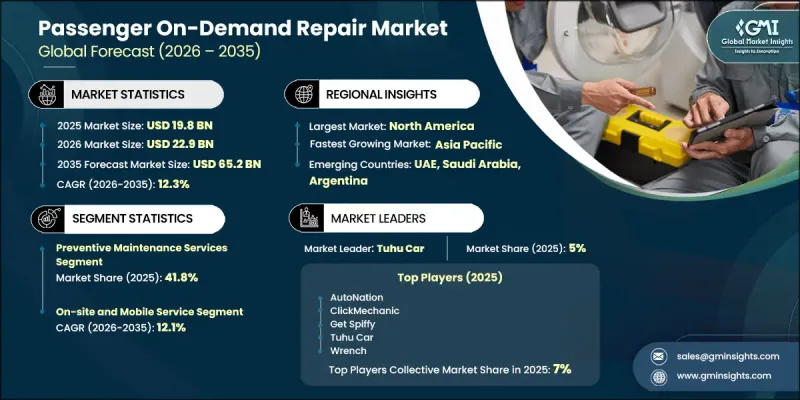
시장 성장을 주도하고 있는 요인은 편의성을 중시하는 차량 정비 솔루션에 대한 소비자의 선호도가 높아지고 있는 점과, 디지털 기술을 활용한 서비스 플랫폼의 보급입니다. 기존의 정비소를 거점으로 한 서비스 모델에서 장소에 구애받지 않는 유연한 수리·정비 서비스로 전환되는 가운데, 자동차 애프터마켓은 큰 변화를 겪고 있습니다. 이러한 발전은 디지털 플랫폼, 제조업체가 지원하는 서비스 네트워크, 그리고 독립 서비스 제공업체에 의해 뒷받침되고 있으며, 이들이 하나로 어우러져 다양한 소비자와 차량 대여 업체의 요구를 충족시키고 있습니다. 특히 도시 지역이나 개발 중인 교외 지역에서 소비자들이 시간 절약과 서비스의 편의성을 점점 더 중요하게 여기게 됨에 따라, 접근성이 뛰어난 장소에서의 차량 정비에 대한 수요는 계속해서 증가하고 있습니다. 차량 소유자들은 일상생활에 미치는 지장을 최소화할 수 있는 정비 솔루션을 원하고 있으며, 이로 인해 모바일 정비 서비스 이용이 더욱 활성화되고 있습니다. 디지털 서비스 생태계는 원활한 예약 시스템, 기술자 파견 관리, 안전한 결제 시스템, 그리고 자동화된 서비스 추적을 통해 고객 경험을 한층 더 향상시키고 있습니다. 또한, 플랫폼 기반 비즈니스 모델은 독립 기술자들 시장 진입 장벽을 낮추고, 더 광범위한 지역에서 서비스를 제공할 수 있게 하며, 서비스의 접근성을 높이고 있습니다. 이러한 동향은 승객 온디맨드 수리 시장의 성장 전망을 종합적으로 강화하는 동시에, 기존의 자동차 서비스 제공 모델을 재구축하고 있습니다.
| 시장 범위 | |
|---|---|
| 시작 연도 | 2025년 |
| 예측 기간 | 2026-2035년 |
| 시작 연도 시장 규모 | 198억 달러 |
| 예측 금액 | 652억 달러 |
| CAGR | 12.3% |
예방 유지보수 서비스 부문은 41.8%의 점유율을 차지하고 있으며, 2035년까지 연평균 성장률(CAGR) 11.6%를 나타낼 것으로 예측됩니다. 이 부문은 정기적으로 예정된 유지보수 요구 사항의 예측 가능성이라는 특징을 활용하고 있으며, 이러한 서비스는 특히 모바일 기반 제공 모델에 적합합니다. 안정적인 수요 덕분에 서비스 제공업체는 기술자의 일정을 최적화하고, 업무 효율을 높이며, 일일 서비스 제공 능력을 극대화할 수 있습니다. 차량 소유자들이 편의성과 예방적 유지보수를 점점 더 중요하게 여기면서, 예방적 유지보수 서비스 제공은 시장 전반에 걸쳐 계속해서 큰 수익 기회를 창출하고 있습니다.
승용차 부문은 2025년에 55%의 점유율을 차지하고, 2026년부터 2035년까지 연평균 성장률(CAGR) 12.1%로 성장할 것으로 전망됩니다. 이 부문이 주도적인 위치를 차지하고 있는 주된 요인은 고객이 기존의 수리 시설을 방문할 필요가 없게 해주는 모바일 서비스 모델이 제공하는 편의성에 있습니다. 서비스 제공업체는 고객이 지정한 장소에서 유지보수 및 수리 작업을 수행할 수 있어 유연성을 높이고 전반적인 사용자 경험을 향상시킬 수 있습니다. 가정에서의 차량 정비가 널리 받아들여지고 있는 것은 접근성이 뛰어나고 시간 효율이 높은 자동차 정비 솔루션에 대한 소비자 수요가 증가하고 있음을 반영하며, 시장 내 이 부문의 우위를 지속적으로 뒷받침하고 있습니다.
북미 승객 온디맨드 수리 시장은 34.6%의 점유율을 차지하고 있으며, 2035년까지 연평균 성장률(CAGR) 11.6%로 성장할 것으로 전망됩니다. 미국은 여러 정비·수리 분야에 걸쳐 지속적인 서비스 수요를 창출하는 방대한 경차 보유 대수에 힘입어, 지역 수요의 최대 견인차 역할을 하고 있습니다. 모바일 자동차 서비스 기능에 대한 지속적인 투자와 디지털 기술을 활용한 정비 솔루션에 대한 소비자의 수용 확대가 해당 지역 시장 성장을 뒷받침하고 있습니다. 성숙한 자동차 생태계, 첨단 디지털 인프라, 그리고 편의성을 중시하는 서비스에 대한 강력한 수요가 맞물리면서, 북미는 승객 온디맨드 수리 솔루션의 주요 시장으로서의 입지를 지속적으로 공고히 하고 있습니다.
자주 묻는 질문
목차
제1장 조사 방법
제2장 주요 요약
제3장 업계 인사이트
제4장 경쟁 구도
제5장 시장 추산 및 예측 : 서비스별, 2022-2035년
제6장 시장 추산 및 예측 : 차량별, 2022-2035년
제7장 시장 추산 및 예측 : 서비스 형태별, 2022-2035년
제8장 시장 추산 및 예측 : 연료별, 2022-2035년
제9장 시장 추산 및 예측 : 프로바이더별, 2022-2035년
제10장 시장 추산 및 예측 : 예약 채널별, 2022-2035년
제11장 시장 추산 및 예측 : 고객별, 2022-2035년
제12장 시장 추산 및 예측 : 지역별, 2022-2035년
제13장 기업 개요
JHS 26.07.01The Global Passenger On-Demand Repair Market was valued at USD 19.8 billion in 2025 and is estimated to grow at a CAGR of 12.3% to reach USD 65.2 billion by 2035.
Market growth is driven by the increasing consumer preference for convenience-focused vehicle maintenance solutions and the widespread adoption of digitally enabled service platforms. The automotive aftermarket is undergoing a significant transformation as traditional workshop-based servicing models give way to flexible, location-based repair and maintenance services. This evolution is being supported by digital platforms, manufacturer-backed service networks, and independent service providers that collectively cater to a broad range of consumer and fleet requirements. Demand for vehicle servicing at convenient locations continues to rise, particularly in urban and developing suburban areas where consumers increasingly prioritize time savings and service accessibility. Vehicle owners are seeking maintenance solutions that minimize disruption to daily routines, encouraging stronger adoption of mobile repair services. Digital service ecosystems are further enhancing customer experiences through seamless appointment scheduling, technician dispatch management, secure payment systems, and automated service tracking. Additionally, platform-based business models are reducing market entry barriers for independent technicians, enabling broader geographic service coverage and increasing service availability. These developments are collectively strengthening the growth outlook for the Passenger On-Demand Repair Market while reshaping traditional automotive service delivery models.
| Market Scope | |
|---|---|
| Start Year | 2025 |
| Forecast Year | 2026-2035 |
| Start Value | $19.8 Billion |
| Forecast Value | $65.2 Billion |
| CAGR | 12.3% |
The preventive maintenance services segment held a 41.8% share and is expected to grow at a CAGR of 11.6% through 2035. The segment benefits from the predictable nature of regularly scheduled maintenance requirements, making these services particularly well suited for mobile delivery models. Consistent demand enables service providers to optimize technician schedules, improve operational efficiency, and maximize daily service capacity. As vehicle owners increasingly prioritize convenience and proactive maintenance, preventive service offerings continue to generate significant revenue opportunities across the market.
The passenger cars segment accounted for 55% share in 2025 and is forecast to grow at a CAGR of 12.1% throughout 2026-2035. The segment's leadership is primarily attributed to the convenience offered by mobile service models, which eliminate the need for customers to visit traditional repair facilities. Service providers can perform maintenance and repair work at locations selected by the customer, creating greater flexibility and enhancing overall user experience. The strong adoption of doorstep vehicle servicing reflects growing consumer demand for accessible, time-efficient automotive maintenance solutions and continues to support the segment's dominant position within the market.
North America Passenger On-Demand Repair Market held a 34.6% share and is projected to grow at a CAGR of 11.6% through 2035. The United States represents the largest contributor to regional demand, supported by a substantial light-duty vehicle population that generates recurring service requirements across multiple maintenance and repair categories. Continued investments in mobile automotive service capabilities and expanding consumer acceptance of digitally enabled repair solutions are reinforcing regional market growth. The combination of a mature automotive ecosystem, advanced digital infrastructure, and strong demand for convenience-based services continues to position North America as a leading market for passenger on-demand repair solutions.
Major companies operating in the Global Passenger On-Demand Repair Market include Wrench, HONK Technologies, AutoNation, Get Spiffy, RAC Motoring Services, ClickMechanic, and Tuhu Car. Companies operating in the Passenger On-Demand Repair Market are adopting a range of strategic initiatives to strengthen their market position and expand their customer base. Technology-driven service delivery remains a primary focus, with businesses investing in mobile applications, digital booking platforms, real-time technician management systems, and customer engagement tools. Companies are also expanding geographic coverage by increasing the number of service technicians and strengthening local service networks. Strategic partnerships, fleet service agreements, and collaborations with automotive manufacturers are helping providers improve market reach and service capabilities. In addition, organizations are enhancing customer retention through subscription-based maintenance plans, transparent pricing models, and personalized service offerings. Continued investments in operational efficiency, workforce training, and digital innovation are enabling companies to differentiate their services and build long-term competitive advantages within the evolving passenger on-demand repair market.
Table of Contents
Chapter 1 Methodology
- 1.1 Research approach
- 1.2 Quality Commitments
- 1.2.1 GMI AI policy & data integrity commitment
- 1.2.1.1 Source consistency protocol
- 1.2.1 GMI AI policy & data integrity commitment
- 1.3 Research Trail & Confidence Scoring
- 1.3.1 Research Trail Components
- 1.3.2 Scoring Components
- 1.4 Data Collection
- 1.4.1 Partial list of primary sources
- 1.5 Data mining sources
- 1.5.1 Paid sources
- 1.5.2 Sources, by region
- 1.6 Base estimates and calculations
- 1.6.1 Base year calculation
- 1.7 Forecast model
- 1.7.1 Quantified market impact analysis
- 1.7.1.1 Mathematical impact of growth parameters on forecast
- 1.7.1 Quantified market impact analysis
- 1.8 Research transparency addendum
- 1.8.1 Source attribution framework
- 1.8.2 Quality assurance metrics
- 1.8.3 Our commitment to trust
Chapter 2 Executive Summary
- 2.1 Industry 360° synopsis, 2022 - 2035
- 2.2 Key market trends
- 2.2.1 Regional
- 2.2.2 Service
- 2.2.3 Vehicle
- 2.2.4 Service Mode
- 2.2.5 Fuel
- 2.2.6 Provider
- 2.2.7 Booking Channel
- 2.2.8 Customer
- 2.3 TAM Analysis, 2026-2035
- 2.4 CXO perspectives: Strategic imperatives
Chapter 3 Industry Insights
- 3.1 Industry ecosystem analysis
- 3.1.1 Supplier landscape
- 3.1.2 Profit margin analysis
- 3.1.3 Cost structure
- 3.1.4 Value addition at each stage
- 3.1.5 Factor affecting the value chain
- 3.1.6 Disruptions
- 3.2 Industry impact forces
- 3.2.1 Growth drivers
- 3.2.1.1 Increasing Consumer Demand for Convenience & Time-Saving Services
- 3.2.1.2 Rising Smartphone Penetration & Digital Platform Adoption
- 3.2.1.3 Aging Vehicle Parc & Growing Aftermarket Service Demand
- 3.2.1.4 Telematics Integration & Connected Vehicle Growth
- 3.2.2 Industry pitfalls and challenges
- 3.2.2.1 Skilled Technician Shortage & Workforce Availability
- 3.2.2.2 High Capital Investment in Mobile Infrastructure
- 3.2.2.3 Limited Service Scope for Complex Repairs Requiring Shop Equipment
- 3.2.2.4 Regulatory Barriers & Licensing Requirements for Mobile Operations
- 3.2.3 Market opportunities
- 3.2.3.1 Expansion into EV & Hybrid Vehicle Servicing
- 3.2.3.2 Subscription-Based Service Models & Recurring Revenue Streams
- 3.2.3.3 Integration with OEM Digital Ecosystems & Connected Services
- 3.2.3.4 Telematics-Driven Predictive Maintenance Services
- 3.2.1 Growth drivers
- 3.3 Growth potential analysis
- 3.4 Regulatory landscape
- 3.4.1 North America
- 3.4.1.1 Environmental Protection Agency (EPA)
- 3.4.1.2 National Highway Traffic Safety Administration (NHTSA)
- 3.4.1.3 Occupational Safety and Health Administration (OSHA)
- 3.4.1.4 U.S. Department of Transportation (DOT)
- 3.4.1.5 Federal Trade Commission (FTC)
- 3.4.2 Europe
- 3.4.2.1 EU Motor Vehicle Block Exemption Regulation (MVBER)
- 3.4.2.2 General Data Protection Regulation (GDPR)
- 3.4.2.3 EU Type Approval Regulation
- 3.4.2.4 REACH (Registration, Evaluation, Authorisation and Restriction of Chemicals)
- 3.4.2.5 Waste Electrical and Electronic Equipment (WEEE) Directive
- 3.4.3 Asia Pacific
- 3.4.3.1 China Automotive Maintenance and Repair Industry Regulations
- 3.4.3.2 China Compulsory Certification (CCC)
- 3.4.3.3 Indian Motor Vehicle Act & Central Motor Vehicle Rules (CMVR)
- 3.4.3.4 Automotive Industry Standard (AIS) Regulations - India
- 3.4.3.5 Japanese Road Transport Vehicle Act
- 3.4.4 Latin America
- 3.4.4.1 Brazilian National Traffic Council (CONTRAN) Regulations
- 3.4.4.2 Brazilian National Institute of Metrology (INMETRO)
- 3.4.4.3 Mexican Official Standards (NOM) for Automotive Repair & Safety
- 3.4.4.4 Argentina National Traffic and Road Safety Agency (ANSV) Regulations
- 3.4.4.5 Regional Consumer Protection & Automotive Service Regulations
- 3.4.5 Middle East & Africa
- 3.4.5.1 GCC Standardization Organization (GSO) Vehicle Service Regulations
- 3.4.5.2 Saudi Standards, Metrology and Quality Organization (SASO)
- 3.4.5.3 UAE Emirates Authority for Standardization and Metrology (ESMA)
- 3.4.5.4 South African National Regulator for Compulsory Specifications (NRCS)
- 3.4.5.5 National Road Traffic Act (NRTA) Compliance
- 3.4.5.6 Vehicle Inspection & Automotive Workshop Licensing Regulations
- 3.4.1 North America
- 3.5 Porter's analysis
- 3.6 PESTEL analysis
- 3.7 Technology and innovation landscape
- 3.7.1 Current technological trends
- 3.7.2 Emerging technologies
- 3.8 Price analysis (Driven by Primary Research)
- 3.8.1 Historical Price Trend Analysis
- 3.8.2 Pricing Strategy by Player Type (Premium / Value / Cost-plus)
- 3.9 Cost breakdown analysis
- 3.10 Patent analysis (Driven by Primary Research)
- 3.11 Impact of AI & generative AI on the market
- 3.11.1 AI-driven disruption of existing business models
- 3.11.2 GenAI use cases & adoption roadmap by segment
- 3.11.3 Risks, limitations & regulatory considerations
- 3.12 Sustainability and environmental aspects
- 3.12.1 Sustainable practices
- 3.12.2 Waste reduction strategies
- 3.12.3 Energy efficiency in production
- 3.12.4 Eco-friendly Initiatives
- 3.12.5 Carbon footprint considerations
- 3.13 Forecast assumptions & scenario analysis (Driven by Primary Research)
- 3.13.1 Base Case key macro & industry variables driving CAGR
- 3.13.2 Optimistic Scenarios Favorable macro and industry tailwinds
- 3.13.3 Pessimistic Scenario Macroeconomic slowdown or industry headwinds
Chapter 4 Competitive Landscape, 2025
- 4.1 Introduction
- 4.2 Company market share analysis
- 4.2.1 North America
- 4.2.2 Europe
- 4.2.3 Asia Pacific
- 4.2.4 LATAM
- 4.2.5 MEA
- 4.3 Competitive analysis of major market players
- 4.4 Competitive positioning matrix
- 4.5 Key developments
- 4.5.1 Mergers & acquisitions
- 4.5.2 Partnerships & collaborations
- 4.5.3 New Product Launches
- 4.5.4 Expansion Plans and funding
- 4.6 Company tier benchmarking
- 4.6.1 Tier classification criteria & qualifying thresholds
- 4.6.2 Tier positioning matrix by revenue, geography & innovation
Chapter 5 Market Estimates & Forecast, By Service, 2022 - 2035 ($Mn)
- 5.1 Key trends
- 5.2 Preventive Maintenance Services
- 5.2.1 Oil & filter changes
- 5.2.2 Fluid replacements
- 5.2.3 Belt & hose replacements
- 5.2.4 Filter replacements
- 5.2.5 Others
- 5.3 Corrective repair services
- 5.3.1 Brake system repairs
- 5.3.2 Engine & drivetrain repairs
- 5.3.3 Suspension & steering repairs
- 5.3.4 Electrical system repair
- 5.3.5 Others
- 5.4 Diagnostic services
- 5.4.1 Check engine light & OBD-II diagnostics
- 5.4.2 No-start diagnostics
- 5.4.3 Pre-purchase vehicle inspections
- 5.4.4 Others
- 5.5 Emergency & roadside assistance
- 5.5.1 Battery jump-start services
- 5.5.2 Flat tire repair & replacement
- 5.5.3 Emergency fuel delivery
- 5.5.4 Others
Chapter 6 Market Estimates & Forecast, By Vehicle, 2022 - 2035 ($Mn, Units)
- 6.1 Key trends
- 6.2 Hatchback
- 6.3 Sedan
- 6.4 SUV
Chapter 7 Market Estimates & Forecast, By Service Mode, 2022 - 2035 ($Mn)
- 7.1 Key trends
- 7.2 On-site/mobile service
- 7.3 Pickup and return service
- 7.4 Remote diagnosis and assistance
Chapter 8 Market Estimates & Forecast, By Fuel, 2022 - 2035 ($Mn, Units)
- 8.1 Key trends
- 8.2 Gasoline
- 8.3 Diesel
- 8.4 All-electric
- 8.5 PHEV
- 8.6 HEV
- 8.7 FCEV
Chapter 9 Market Estimates & Forecast, By Provider, 2022 - 2035 ($Mn)
- 9.1 Key trends
- 9.2 Platform-based aggregators
- 9.3 Independent mobile mechanics
- 9.4 OEM-authorized mobile service networks
- 9.5 Franchise-based mobile service providers
Chapter 10 Market Estimates & Forecast, By Booking Channel, 2022 - 2035 ($Mn)
- 10.1 Key trends
- 10.2 Mobile applications
- 10.3 Websites and web portals
- 10.4 Call centers and phone booking
- 10.5 Telematics and OBD-II auto-booking
- 10.6 OEM in-car integration
Chapter 11 Market Estimates & Forecast, By Customer, 2022 - 2035 ($Mn)
- 11.1 Key trends
- 11.2 B2C
- 11.3 B2B
Chapter 12 Market Estimates & Forecast, By Region, 2022 - 2035 ($Mn, Units)
- 12.1 Key trends
- 12.2 North America
- 12.2.1 US
- 12.2.2 Canada
- 12.3 Europe
- 12.3.1 UK
- 12.3.2 Germany
- 12.3.3 France
- 12.3.4 Italy
- 12.3.5 Spain
- 12.3.6 Russia
- 12.3.7 Nordics
- 12.4 Asia Pacific
- 12.4.1 China
- 12.4.2 India
- 12.4.3 Japan
- 12.4.4 South Korea
- 12.4.5 Southeast Asia
- 12.4.5.1 Indonesia
- 12.4.5.2 Malaysia
- 12.4.5.3 Singapore
- 12.4.5.4 Thailand
- 12.4.5.5 Vietnam
- 12.4.6 ANZ
- 12.5 Latin America
- 12.5.1 Brazil
- 12.5.2 Argentina
- 12.5.3 Mexico
- 12.6 MEA
- 12.6.1 UAE
- 12.6.2 Saudi Arabia
- 12.6.3 South Africa
Chapter 13 Company Profiles
- 13.1 Global Players
- 13.1.1 AutoNation
- 13.1.2 ClickMechanic
- 13.1.3 Get Spiffy
- 13.1.4 HONK Technologies
- 13.1.5 RAC Motoring Services
- 13.1.6 Tuhu Car
- 13.2 Regional Players
- 13.2.1 AutoGuru
- 13.2.2 Autopro
- 13.2.3 Fix-A-Car Mobile
- 13.2.4 Instant Car Fix
- 13.2.5 JET Mobile Auto Service
- 13.2.6 Lube Mobile
- 13.2.7 Mach1 Services
- 13.2.8 Mobile Car Repairs
- 13.2.9 UcarMobile
- 13.2.10 Wrench
- 13.3 Emerging / Local Players
- 13.3.1 AUTO MONKEY
- 13.3.2 Automan Service
- 13.3.3 Autotalab
- 13.3.4 Fast T's Mobile Auto


