

|
시장보고서
상품코드
2071177
재생형 라이프스타일 제품 시장 : 비즈니스 기회, 성장요인, 업계 동향 분석 및 예측(2026-2035년)Regenerative Lifestyle Products Market Opportunity, Growth Drivers, Industry Trend Analysis, and Forecast 2026 - 2035 |
||||||

세계의 재생형 라이프스타일 제품 시장은 2025년에 45억 달러 규모가 되어, 2035년까지 연평균 복합 성장률(CAGR) 12.7%로 성장하여 152억 달러에 이를 것으로 추정되고 있습니다.
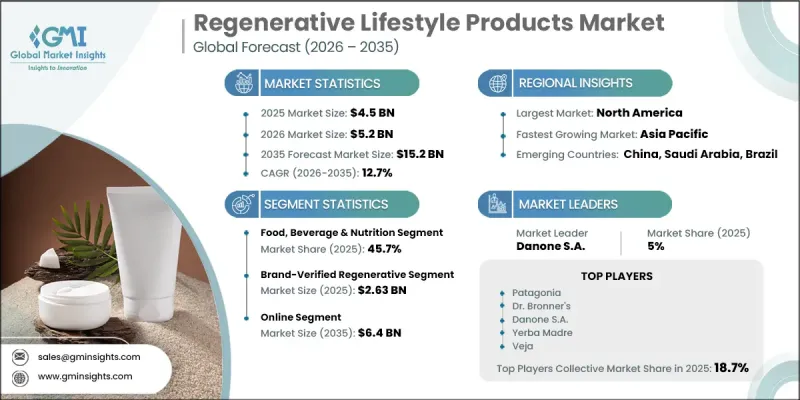
시장 확대는 식품, 개인 위생 용품, 의류, 가정용품 등 여러 소비재 부문에 걸쳐 재생형 조달 방식의 상용화가 진행되고 있는 데 힘입고 있습니다. 주요 소비재 제조업체들이 재생형 농업의 확대와 책임 있는 조달 이니셔티브에 대한 노력을 강화함에 따라, 전 세계 공급망 전반에 걸쳐 인증받은 재생형 원자재의 확보 가능성이 꾸준히 높아지고 있습니다. 동시에, 인증 기준이 강화됨에 따라 제품의 차별화 기회가 더욱 확대되고 있으며, 이는 브랜드가 소비자의 신뢰를 쌓고 프리미엄 가격 전략을 정당화하는 데 도움이 되고 있습니다. 소비자들이 환경 보전, 지속 가능한 생산 방식, 공급망의 투명성을 더욱 중요하게 여기게 됨에 따라, 재생형 제품에 대한 수요는 계속해서 증가하고 있습니다. 그러나 재생형 제품은 기존 대체품보다 비용이 높은 경향이 있어, 프리미엄 가격 책정은 시장에 널리 보급되는 데 있어 과제로 대두되고 있습니다. 공급망이 성숙해지고 생산 규모가 확대됨에 따라 가격 경쟁력이 높아지면서, 재생형 라이프스타일 제품 시장 전반에 걸친 접근성이 향상되고, 이는 장기적인 성장을 뒷받침할 것으로 예측됩니다.
| 시장 범위 | |
|---|---|
| 시작 연도 | 2025년 |
| 예측 기간 | 2026-2035년 |
| 시작 연도 시장 규모 | 45억 달러 |
| 예측 금액 | 152억 달러 |
| CAGR | 12.7% |
식음료 및 영양 부문은 45.7%의 점유율을 차지했으며, 2025년에는 20억 달러의 매출을 올렸습니다. 해당 부문이 시장을 선도하고 있는 주된 요인은 농업 공급망에서 재생형 조달 체계가 비교적 잘 구축되어 있기 때문입니다. 지속 가능한 방식으로 생산된 식품 및 영양 제품에 대한 소비자 수요가 증가함에 따라, 재생형 원료 조달에 대한 투자가 지속적으로 촉진되고 있으며, 이는 해당 부문 전체의 견고한 성장을 뒷받침하고 있습니다. 또한, 전 세계 소비자들의 환경 지속가능성과 책임 있는 식품 생산 관행에 대한 인식이 높아지고 있는 점도 이 부문의 성장에 긍정적인 요인으로 작용하고 있습니다.
온라인 유통 채널 부문은 2035년까지 64억 달러에 달할 것으로 예상되며, 여기에는 소비자 직접 판매 플랫폼과 디지털 마켓플레이스가 포함됩니다. 이 부문은 재생형 라이프스타일 제품 시장에서 앞으로도 가장 빠르게 성장하는 판매 채널로 자리매김할 것으로 전망됩니다. 이러한 강력한 성장은 디지털 플랫폼을 통해 제품 조달 정보, 지속가능성 관련 실적 및 브랜드 가치를 소비자에게 직접 전달할 수 있다는 점에 힘입은 것입니다. 또한, 온라인 채널을 통해 기업은 프리미엄 가격 전략을 유지하고, 고객 참여를 강화하며, 직접적인 관계 구축과 맞춤형 구매 경험을 통해 장기적인 브랜드 충성도를 높일 수 있습니다.
북미의 재생형 라이프스타일 제품 시장은 2025년에 20억 달러 규모를 기록하며 44.6%의 시장 점유율을 차지했습니다. 이 지역 시장 성장은 고도로 발달한 프리미엄 소비재 생태계, 지속 가능한 제품에 대한 수요 증가, 그리고 친환경적인 구매 결정에 대한 소비자들의 높은 인식에 힘입어 이루어지고 있습니다. 확립된 소매 인프라와 선진적인 D2C 판매 네트워크는 북미 전역에서 재생형 라이프스타일 제품의 보급과 확대를 위해 계속해서 유리한 여건을 조성하고 있습니다.
자주 묻는 질문
목차
제1장 조사 방법과 범위
제2장 주요 요약
제3장 업계 인사이트
제4장 경쟁 구도
제5장 시장 규모 및 예측 : 제품 유형별, 2022-2035년
제6장 시장 규모 및 예측 : 조달 및 인증 기준별, 2022-2035년
제7장 시장 규모 및 예측 : 유통 채널별, 2022-2035년
제8장 시장 규모 및 예측 : 지역별, 2022-2035년
제9장 기업 개요
JHS 26.07.01The Global Regenerative Lifestyle Products Market was valued at USD 4.5 billion in 2025 and is estimated to grow at a CAGR of 12.7% to reach USD 15.2 billion by 2035.
Market expansion is driven by the increasing commercialization of regenerative sourcing practices across multiple consumer product categories, including food, personal care, apparel, and household products. Growing commitments from major consumer goods manufacturers to expand regenerative agriculture and responsible sourcing initiatives are steadily increasing the availability of certified regenerative raw materials throughout global supply chains. At the same time, enhanced certification standards are creating stronger product differentiation opportunities, helping brands build consumer confidence and justify premium pricing strategies. Demand for regenerative products continues to rise as consumers place greater emphasis on environmental stewardship, sustainable production methods, and supply chain transparency. However, premium pricing remains a challenge for broader market adoption, as regenerative products often carry higher costs than conventional alternatives. As supply chains mature and production scales increase, greater affordability is expected to improve accessibility and support long-term growth across the regenerative lifestyle products market.
| Market Scope | |
|---|---|
| Start Year | 2025 |
| Forecast Year | 2026-2035 |
| Start Value | $4.5 Billion |
| Forecast Value | $15.2 Billion |
| CAGR | 12.7% |
The food, beverage, and nutrition segment held a 45.7% share, generating USD 2 billion in 2025. Its market leadership is largely attributed to the comparatively advanced development of regenerative sourcing frameworks within agricultural supply chains. Increasing consumer demand for sustainably produced food and nutrition products continues to drive investment in regenerative ingredient sourcing, supporting strong growth across this category. The segment also benefits from rising awareness of environmental sustainability and responsible food production practices among consumers worldwide.
The online distribution channel segment is expected to reach USD 6.4 billion by 2035, including direct-to-consumer platforms and digital marketplaces, is expected to remain the fastest-growing sales channel in the regenerative lifestyle products market. Strong growth is supported by the ability of digital platforms to communicate product sourcing information, sustainability credentials, and brand values directly to consumers. Online channels also enable companies to maintain premium pricing strategies, strengthen customer engagement, and foster long-term brand loyalty through direct relationships and personalized purchasing experiences.
North America Regenerative Lifestyle Products Market accounted for USD 2 billion in 2025 holding 44.6% share. Market growth in the region is supported by a highly developed premium consumer products ecosystem, increasing demand for sustainable goods, and strong consumer awareness regarding environmentally responsible purchasing decisions. Well-established retail infrastructure and advanced direct-to-consumer sales networks continue to create favorable conditions for regenerative lifestyle product adoption and expansion throughout North America.
Major companies operating in the global regenerative lifestyle products market include Danone S.A., Dr. Bronner's, Patagonia, Yerba Madre, Veja, Lundberg Family Farms, General Mills Inc., Manitoba Harvest Hemp Foods, Eileen Fisher Inc., Force of Nature Meats, Herb Pharm, Lotus Foods, prAna, SIMPLi, Groundwork Coffee, evanhealy, Outerknown, FOND Bone Broth, Maggie's Organics, Babylife Organics, and Thrive Natural Care. Companies participating in the regenerative lifestyle products market are implementing a range of strategic initiatives to strengthen their market presence and improve long-term competitiveness. Investment in regenerative sourcing programs remains a key priority as companies work to secure reliable supplies of certified raw materials and improve supply chain transparency. Product innovation and portfolio expansion are helping brands address growing consumer demand for sustainable alternatives across multiple product categories. Strategic partnerships with producers, certification organizations, and supply chain stakeholders are also supporting market growth and strengthening brand credibility. Many companies are increasing investments in digital marketing, direct-to-consumer sales channels, and consumer education initiatives to build stronger customer relationships and enhance brand loyalty.
Table of Contents
Chapter 1 Methodology & Scope
- 1.1 Research approach
- 1.2 Quality commitments
- 1.2.1 GMI AI policy & data integrity commitment
- 1.2.1.1 Source consistency protocol
- 1.2.1 GMI AI policy & data integrity commitment
- 1.3 Research trail & confidence scoring
- 1.3.1 Research trail components
- 1.3.2 Scoring components
- 1.4 Data collection
- 1.4.1 Partial list of primary sources
- 1.5 Data mining sources
- 1.5.1 Paid sources
- 1.5.1.1 Sources, by region
- 1.5.1 Paid sources
- 1.6 Base estimates and calculations
- 1.6.1 Base year calculation for any one approach
- 1.7 Market estimates & forecasts parameters
- 1.8 Forecast model
- 1.8.1 Quantified market impact analysis
- 1.8.1.1 Mathematical impact of growth parameters on forecast
- 1.8.1 Quantified market impact analysis
- 1.9 Research transparency addendum
- 1.9.1 Source attribution framework
- 1.9.2 Quality assurance metrics
- 1.9.3 Our commitment to trust
- 1.10 Market definitions
Chapter 2 Executive Summary
- 2.1 Industry synopsis, 2022 - 2035
- 2.1.1 Business trends
- 2.1.2 Product type trends
- 2.1.3 Sourcing & certification standard trends
- 2.1.4 Distribution channel trends
- 2.1.5 Regional trends
Chapter 3 Industry Insights
- 3.1 Industry ecosystem analysis
- 3.2 Industry impact forces
- 3.2.1 Growth drivers
- 3.2.1.1 Rising Consumer Consciousness Around Soil Health, Climate Impact & Food Transparency
- 3.2.1.2 Accelerating Corporate Sustainability Commitments & Scope 3 Emission Reduction Targets
- 3.2.1.3 Growth of ROC Product Portfolio Across Categories
- 3.2.1.4 Premiumization Trend & Willingness-to-Pay Among Values-Based Shoppers
- 3.2.2 Industry pitfalls and challenges
- 3.2.2.1 Lack of Standardized Global Definition & Certification Fragmentation
- 3.2.2.2 Premium Price Points Limiting Mainstream Consumer Adoption
- 3.2.3 Market opportunities
- 3.2.3.1 Expansion into Underpenetrated Categories (Home & Household, Supplements)
- 3.2.3.2 E-Commerce & DTC Channel Growth Enabling Farm-to-Consumer Storytelling Toys
- 3.2.1 Growth drivers
- 3.3 Growth potential analysis
- 3.4 Regulatory landscape (Driven by primary research)
- 3.4.1 North America
- 3.4.2 Europe
- 3.4.3 Asia Pacific
- 3.4.4 Latin America
- 3.4.5 MEA
- 3.5 Technology landscape
- 3.5.1 Current technological trends
- 3.5.2 Emerging technologies
- 3.6 Pricing trend analysis (Driven by primary research)
- 3.6.1 pricing strategy by player type
- 3.6.2 price premium analysis
- 3.7 Future market trends
- 3.8 Porter's analysis
- 3.9 PESTEL analysis
- 3.10 Trade data analysis (driven by paid database) (HS code: 33049990)
- 3.10.1 Import/export volume & value trends by product category
- 3.10.2 Key trade corridors & tariff impact on regenerative goods
- 3.11 Impact of AI & generative AI on the market
- 3.11.1 AI-driven disruption of existing business models
- 3.11.2 Genai use cases & adoption roadmap by segment
- 3.11.3 Risks, limitations & regulatory considerations
- 3.12 Distribution infrastructure & channel penetration landscape (driven by primary research)
- 3.12.1 Channel coverage by region & format (modern vs. Traditional trade) (driven by primary research)
- 3.12.2 Last-mile infrastructure gaps & emerging channel shifts (driven by primary research)
- 3.13 Consumer insights (Driven by primary research)
Chapter 4 Competitive Landscape, 2025
- 4.1 Introduction
- 4.2 Company market share analysis, by region, 2025
- 4.2.1 North America
- 4.2.2 Europe
- 4.2.3 Asia Pacific
- 4.2.4 Middle East & Africa
- 4.2.5 Latin America
- 4.3 Key developments
- 4.3.1 Key partnerships & collaborations
- 4.3.2 Major M&A activities
- 4.3.3 Product innovations & launches
- 4.3.4 Market expansion strategies
- 4.4 Competitive positioning matrix
Chapter 5 Market Size and Forecast, By Product Type, 2022 - 2035 (USD Billion)
- 5.1 Key trends
- 5.2 Food, Beverage & Nutrition
- 5.2.1 Packaged Food
- 5.2.2 Beverages
- 5.2.3 Dietary Supplements & Functional Nutrition
- 5.3 Personal Care & Beauty
- 5.4 Apparel, Textiles & Home Linens
- 5.5 Home & Household Products
Chapter 6 Market Size and Forecast, By Sourcing & Certification Standard, 2022 - 2035 (USD Billion)
- 6.1 Key trends
- 6.2 Third-Party Certified Regenerative
- 6.3 Regenerative Organic Certified (ROC)
- 6.4 Biodynamic Certified (Demeter)
- 6.5 Pasture-Raised / Grassfed Certified
- 6.6 Brand-Verified Regenerative
Chapter 7 Market Size and Forecast, By Distribution Channel, 2022 - 2035 (USD Billion)
- 7.1 Key trends
- 7.2 Online Channels
- 7.2.1 Direct-to-Consumer (DTC) / Brand-Owned
- 7.2.2 E-Commerce Marketplaces
- 7.3 Specialty & Natural Retail
- 7.4 Mass Retail & Supermarkets
- 7.5 Pharmacy & Drug Stores
Chapter 8 Market Size and Forecast, By Region, 2022 - 2035 (USD Billion)
- 8.1 Key trends
- 8.2 North America
- 8.2.1 U.S.
- 8.2.2 Canada
- 8.3 Europe
- 8.3.1 Germany
- 8.3.2 France
- 8.3.3 UK
- 8.3.4 Netherlands
- 8.3.5 Spain
- 8.3.6 Italy
- 8.4 Asia Pacific
- 8.4.1 China
- 8.4.2 Japan
- 8.4.3 South Korea
- 8.4.4 India
- 8.4.5 Australia
- 8.5 Middle East & Africa
- 8.5.1 Saudi Arabia
- 8.5.2 UAE
- 8.5.3 South Africa
- 8.6 Latin America
- 8.6.1 Brazil
- 8.6.2 Argentina
- 8.6.3 Mexico
Chapter 9 Company Profiles
- 9.1 Global Players
- 9.1.1 Patagonia
- 9.1.2 Dr. Bronner's
- 9.1.3 Danone S.A.
- 9.1.4 General Mills Inc.
- 9.1.5 Eileen Fisher Inc.
- 9.1.6 Veja
- 9.2 Regional Players
- 9.2.1 Lundberg Family Farms
- 9.2.2 Force of Nature Meats
- 9.2.3 Manitoba Harvest Hemp Foods
- 9.2.4 Thrive Natural Care
- 9.2.5 prAna
- 9.2.6 Yerba Madre (fka Guayaki)
- 9.2.7 Groundwork Coffee
- 9.2.8 Maggie's Organics
- 9.3 Niche & Specialist Players
- 9.3.1 SIMPLi
- 9.3.2 FOND Bone Broth
- 9.3.3 Lotus Foods
- 9.3.4 evanhealy
- 9.3.5 Babylife Organics
- 9.3.6 Herb Pharm
- 9.3.7 Outerknown


