

|
시장보고서
상품코드
2071191
미생물 유래 식품 착색료 시장 : 기회, 성장 촉진요인, 업계 동향 분석 및 예측(2026-2035년)Microbial Food Colors Market Opportunity, Growth Drivers, Industry Trend Analysis, and Forecast 2026 - 2035 |
||||||

세계의 미생물 유래 식품 착색료 시장은 2025년에 6억 5,830만 달러로 평가되었고 CAGR 8.5%로 성장하여 2035ㄴ년까지 15억 달러에 이를 것으로 추정되고 있습니다.
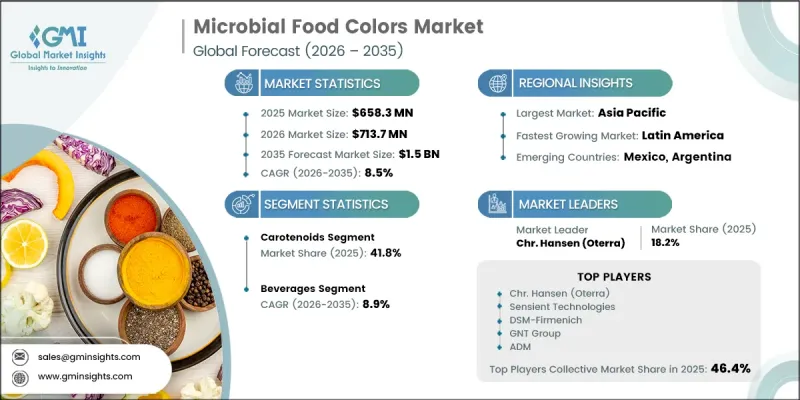
시장 성장을 주도하고 있는 것은 합성 식품 착색료에서 미생물 발효나 생명공학을 기반으로 한 공정을 통해 생산되는 천연 유래 색소로 전환되는 추세가 가속화되고 있다는 점입니다. 이러한 변화는 식품 및 음료 업계에서 일어나고 있는 광범위한 변혁을 반영한 것으로, 각 제조업체들은 원재료의 투명성, 클린 라벨 제품 개발, 그리고 천연 유래 대체재의 도입을 점점 더 중요하게 여기고 있습니다. 미생물 색소 생산의 상업적 실현 가능성 향상은 물론, 규제 요건의 변화와 원료 성분에 대한 소비자의 인식 제고가 맞물리면서 시장 확대를 위한 유리한 환경이 조성되고 있습니다. 특히, 원재료 표기가 구매 결정이나 브랜드 차별화에 중요한 역할을 하는 제품 카테고리에서는 수요가 매우 견조합니다. 주요 시장 전반에 걸쳐 식품 제조업체들은 더 단순한 원재료 목록과 최소한의 가공을 거친 제품을 선호하는 소비자들의 취향에 맞추어 제품 배합을 재검토하고 있습니다. ‘클린 라벨’의 흐름이 프리미엄 제품 부문을 넘어 점점 더 주류로 자리 잡아가고 있는 가운데, 미생물 유래 식품 착색료의 사용은 더욱 폭넓은 식품 및 음료 분야로 확대되고 있습니다. 규제 측면에서의 지원, 발효 공정의 기술적 진보, 그리고 천연 유래 원료에 대한 소비자 수요 증가가 맞물리면서, 장기적인 시장 성장이 지속될 것으로 예측됩니다.
| 시장 범위 | |
|---|---|
| 시작 연도 | 2025년 |
| 예측 기간 | 2026-2035년 |
| 개시 금액 | 6억 5,830만 달러 |
| 예측 금액 | 15억 달러 |
| CAGR | 8.5% |
2025년, 카로티노이드 부문은 시장 점유율의 41.8%를 차지했습니다. 이러한 우위는 미생물 생산 기술의 확립된 상업적 확장성과, 수많은 식품 및 음료 용도에서 카로티노이드 색소가 지닌 폭넓은 기능성에 의해 뒷받침되고 있습니다. 안정적인 착색 능력, 배합의 유연성, 그리고 다양한 제품 카테고리와의 호환성 등의 특징이 이 부문의 광범위한 채택을 지속적으로 뒷받침하고 있습니다. 발효 효율과 생산 최적화 분야의 지속적인 발전으로 인해, 예측 기간 동안 해당 부문 시장 입지가 더욱 공고해질 것으로 전망됩니다.
음료 부문은 2025년에 32.3%의 시장 점유율을 차지하고, 2035년까지 연평균 성장률(CAGR) 8.9%로 성장할 것으로 전망됩니다. 이 부문이 주도적인 위치를 차지하고 있다는 사실은 음료의 배합에 있어 시각적 매력과 원재료의 투명성이 매우 중요하다는 점을 반영하고 있습니다. 소비자들이 제품 라벨을 꼼꼼히 살펴보고 천연 유래 원료를 선호하는 경향이 강해지는 가운데, 음료 제조업체들은 미생물 유래 착색 솔루션으로의 전환을 가속화하고 있습니다. 클린 라벨 음료에 대한 수요가 증가하고 프리미엄 제품 시장 점유율이 확대됨에 따라, 이 카테고리 전반에 걸쳐 미생물 유래 색소를 도입할 수 있는 큰 기회가 계속해서 창출되고 있습니다.
북미의 미생물 유래 식품 착색료 시장은 2025년에 24.8%의 점유율을 차지하고, 2035년까지 연평균 성장률(CAGR) 8.4%로 성장할 것으로 전망됩니다. 이 지역은 소비자들의 높은 인식, 확립된 식품 제조 인프라, 그리고 클린 라벨 제품에 대한 수요 증가에 힘입어, 천연 유래 식품 원료에 있어 여전히 중요한 시장으로 자리 잡고 있습니다. 현재 진행 중인 규제 동향에 더해, 천연 원료 솔루션에 대한 업계 투자가 확대되면서, 다양한 식품 및 음료 분야에서 미생물 유래 식품 착색료의 채택이 지속적으로 촉진되고 있습니다. 해당 지역에서 제품의 투명성과 원료 혁신에 대한 중시가 예측 기간 동안 지속적인 시장 성장을 뒷받침할 것으로 전망됩니다.
자주 묻는 질문
목차
제1장 조사 방법과 범위
제2장 주요 요약
제3장 업계 인사이트
제4장 경쟁 구도
제5장 시장 추산 및 예측 : 안료 유형별, 2022-2035년
제6장 시장 추산 및 예측 : 원료별, 2022-2035년
제7장 시장 추산 및 예측 : 형태별, 2022-2035년
제8장 시장 추산 및 예측 : 용도별, 2022-2035년
제9장 시장 추산 및 예측 : 지역별, 2022-2035년
제10장 기업 개요
JHS 26.07.01The Global Microbial Food Colors Market was valued at USD 658.3 million in 2025 and is estimated to grow at a CAGR of 8.5% to reach USD 1.5 billion by 2035.
Market growth is driven by the accelerating transition from synthetic food colorants to naturally derived pigments produced through microbial fermentation and biotechnology-based processes. This shift reflects broader changes in the food and beverage industry, where manufacturers are increasingly prioritizing ingredient transparency, clean-label product development, and naturally sourced alternatives. The improving commercial viability of microbial pigment production, combined with evolving regulatory requirements and rising consumer awareness regarding ingredient composition, is creating favorable conditions for market expansion. Demand is particularly strong in product categories where ingredient labeling plays a critical role in purchasing decisions and brand differentiation. Across major markets, food manufacturers are reformulating products to align with consumer preferences for simpler ingredient lists and minimally processed formulations. As clean-label trends continue to move beyond premium product segments and become increasingly mainstream, the adoption of microbial food colors is expanding across a broader range of food and beverage applications. The combination of regulatory support, technological advancements in fermentation processes, and growing consumer demand for naturally sourced ingredients is expected to sustain long-term market growth.
| Market Scope | |
|---|---|
| Start Year | 2025 |
| Forecast Year | 2026-2035 |
| Start Value | $658.3 Million |
| Forecast Value | $1.5 Billion |
| CAGR | 8.5% |
The carotenoids segment accounted for 41.8% share in 2025. Its dominant position is supported by the established commercial scalability of microbial production technologies and the broad functionality of carotenoid pigments across numerous food and beverage applications. Their ability to provide stable coloration, formulation flexibility, and compatibility with diverse product categories continues to support widespread adoption. Ongoing advancements in fermentation efficiency and production optimization are expected to further strengthen the segment's market position during the forecast period.
The beverages segment held a 32.3% share in 2025 and is expected to grow at a CAGR of 8.9% through 2035. The segment's leadership reflects the critical importance of visual appeal and ingredient transparency within beverage formulations. As consumers increasingly evaluate product labels and seek naturally sourced ingredients, beverage manufacturers are accelerating the transition toward microbial color solutions. Growing demand for clean-label beverages and premium product positioning continues to create significant opportunities for microbial pigment adoption across the category.
North America Microbial Food Colors Market accounted for 24.8% share in 2025 and is projected to grow at a CAGR of 8.4% through 2035. The region remains a key market for naturally derived food ingredients, supported by strong consumer awareness, established food manufacturing infrastructure, and increasing demand for clean-label products. Ongoing regulatory developments, combined with growing industry investment in natural ingredient solutions, continue to encourage the adoption of microbial food colors across a wide range of food and beverage applications. The region's emphasis on product transparency and ingredient innovation is expected to support sustained market growth throughout the forecast period.
Major companies operating in the global microbial food colors market include ADM, Givaudan, Sensient Technologies, Dohler, Kerry Group, DSM-Firmenich, Chr. Hansen (Oterra), GNT Group, Kalsec, Lycored, Roha Dyechem, Chenguang Biotech, Allied Biotech, Synthite Industries, and AVT Natural Products. Companies operating in the microbial food colors market are adopting several strategic initiatives to strengthen their competitive position and expand market presence. Product innovation remains a key focus area, with manufacturers investing in advanced fermentation technologies to improve pigment yield, stability, color intensity, and cost efficiency. Companies are also expanding their portfolios of natural color solutions to meet evolving customer requirements across food, beverage, and nutritional product applications. Strategic collaborations, partnerships, and acquisitions are being utilized to strengthen technological capabilities and broaden geographic reach.
Table of Contents
Chapter 1 Methodology & Scope
- 1.1 Research approach
- 1.2 Quality Commitments
- 1.2.1 GMI AI policy & data integrity commitment
- 1.2.1.1 Source consistency protocol
- 1.2.1 GMI AI policy & data integrity commitment
- 1.3 Research Trail & Confidence Scoring
- 1.3.1 Research Trail Components
- 1.3.2 Scoring Components
- 1.4 Data Collection
- 1.4.1 Partial list of primary sources
- 1.5 Data mining sources
- 1.5.1 Paid sources
- 1.5.1.1 Sources, by region
- 1.5.1 Paid sources
- 1.6 Base estimates and calculations
- 1.6.1 Base year calculation for any one approach
- 1.7 Forecast model
- 1.7.1 Quantified market impact analysis
- 1.7.1.1 Mathematical impact of growth parameters on forecast
- 1.7.1 Quantified market impact analysis
- 1.8 Research transparency addendum
- 1.8.1 Source attribution framework
- 1.8.2 Quality assurance metrics
- 1.8.3 Our commitment to trust
Chapter 2 Executive Summary
- 2.1 Industry 360° synopsis
- 2.2 Key market trends
- 2.2.1 Regional
- 2.2.2 Pigment type
- 2.2.3 Source
- 2.2.4 Form
- 2.2.5 Application
- 2.3 TAM Analysis, 2026-2035
- 2.4 CXO perspectives: Strategic imperatives
Chapter 3 Industry Insights
- 3.1 Industry ecosystem analysis
- 3.1.1 Supplier landscape
- 3.1.2 Profit margin
- 3.1.3 Value addition at each stage
- 3.1.4 Factor affecting the value chain
- 3.1.5 Disruptions
- 3.2 Industry impact forces
- 3.2.1 Growth drivers
- 3.2.2 Industry pitfalls and challenges
- 3.2.3 Market opportunities
- 3.3 Growth potential analysis
- 3.4 Regulatory landscape
- 3.4.1 North America
- 3.4.2 Europe
- 3.4.3 Asia Pacific
- 3.4.4 Latin America
- 3.4.5 Middle East & Africa
- 3.5 Porter's analysis
- 3.6 PESTEL analysis
- 3.7 Price trends
- 3.7.1 By region
- 3.7.2 By pigment type
- 3.8 Future market trends
- 3.9 Technology and Innovation landscape
- 3.9.1 Current technological trends
- 3.9.2 Emerging technologies
- 3.10 Patent Landscape
- 3.11 Trade statistics (HS code)
- 3.11.1 Major importing countries
- 3.11.2 Major exporting countries
- 3.12 Sustainability and environmental aspects
- 3.12.1 Sustainable practices
- 3.12.2 Waste reduction strategies
- 3.12.3 Energy efficiency in production
- 3.12.4 Eco-friendly initiatives
- 3.13 Carbon footprint consideration
Chapter 4 Competitive Landscape, 2025
- 4.1 Introduction
- 4.2 Company market share analysis
- 4.2.1 By region
- 4.2.1.1 North America
- 4.2.1.2 Europe
- 4.2.1.3 Asia Pacific
- 4.2.1.4 LATAM
- 4.2.1.5 MEA
- 4.2.1 By region
- 4.3 Company matrix analysis
- 4.4 Competitive analysis of major market players
- 4.5 Competitive positioning matrix
- 4.6 Key developments
- 4.6.1 Mergers & acquisitions
- 4.6.2 Partnerships & collaborations
- 4.6.3 New Product Launches
- 4.6.4 Expansion Plans
Chapter 5 Market Estimates and Forecast, By Pigment Type, 2022-2035 (USD Billion) (Kilo Tons)
- 5.1 Key trends
- 5.2 Carotenoids
- 5.3 Anthocyanins & flavonoids
- 5.4 Phycobiliproteins
- 5.5 Riboflavin
- 5.6 Prodigiosin & violacein
- 5.7 Melanin & others
Chapter 6 Market Estimates and Forecast, By Source, 2022-2035 (USD Billion) (Kilo Tons)
- 6.1 Key trends
- 6.2 Bacteria-derived
- 6.3 Fungi-derived
- 6.4 Yeast-derived
- 6.5 Microalgae-derived
Chapter 7 Market Estimates and Forecast, By Form, 2022-2035 (USD Billion) (Kilo Tons)
- 7.1 Key trends
- 7.2 Liquid
- 7.3 Powder
- 7.4 Gel
Chapter 8 Market Estimates and Forecast, By Application, 2022-2035 (USD Billion) (Kilo Tons)
- 8.1 Key trends
- 8.2 Beverages
- 8.2.1 Carbonated drinks
- 8.2.2 Juices & fruit drinks
- 8.2.3 Energy & sports drinks
- 8.2.4 Alcoholic beverages
- 8.3 Bakery & confectionery
- 8.3.1 Baked goods
- 8.3.2 Ice cream & frozen desserts
- 8.3.3 Candies & sweets
- 8.4 Dairy products
- 8.4.1 Yogurt
- 8.4.2 Milk-based drinks
- 8.4.3 Baby foods
- 8.4.4 Cheese & butter
- 8.5 Processed foods
- 8.5.1 Sauces & condiments
- 8.5.2 Ready meals
- 8.5.3 Snack foods
- 8.6 Meat, poultry & seafood
- 8.6.1 Meat colorants
- 8.6.2 Aquaculture feed
- 8.6.3 Poultry feed
- 8.7 Dietary supplements
- 8.7.1 Nutraceuticals
- 8.7.2 Health supplements
- 8.8 Others
Chapter 9 Market Estimates and Forecast, By Region, 2022-2035 (USD Billion) (Kilo Tons)
- 9.1 Key trends
- 9.2 North America
- 9.2.1 U.S.
- 9.2.2 Canada
- 9.3 Europe
- 9.3.1 Germany
- 9.3.2 UK
- 9.3.3 France
- 9.3.4 Spain
- 9.3.5 Italy
- 9.3.6 Rest of Europe
- 9.4 Asia Pacific
- 9.4.1 China
- 9.4.2 India
- 9.4.3 Japan
- 9.4.4 Australia
- 9.4.5 South Korea
- 9.4.6 Rest of Asia Pacific
- 9.5 Latin America
- 9.5.1 Brazil
- 9.5.2 Mexico
- 9.5.3 Argentina
- 9.5.4 Rest of Latin America
- 9.6 Middle East and Africa
- 9.6.1 Saudi Arabia
- 9.6.2 South Africa
- 9.6.3 UAE
- 9.6.4 Rest of Middle East and Africa
Chapter 10 Company Profiles
- 10.1 Chr. Hansen (Oterra)
- 10.2 Sensient Technologies
- 10.3 GNT Group
- 10.4 DSM-Firmenich
- 10.5 ADM
- 10.6 Kerry Group
- 10.7 Dohler
- 10.8 Givaudan
- 10.9 Kalsec
- 10.10 Roha Dyechem
- 10.11 Lycored
- 10.12 Chenguang Biotech
- 10.13 Allied Biotech
- 10.14 Synthite Industries
- 10.15 AVT Natural Products

(주말 및 공휴일 제외)


