|
시장보고서
상품코드
2071215
마그네슘 보충제 시장 : 기회, 성장요인, 업계 동향 분석 및 예측(2026-2035년)Magnesium Supplements Market Opportunity, Growth Drivers, Industry Trend Analysis, and Forecast 2026 - 2035 |
||||||

세계의 마그네슘 보충제 시장은 2025년에 79억 달러 규모가 되어, CAGR 8.2%로 성장하여 2035년까지 174억 달러에 이를 것으로 추정되고 있습니다.
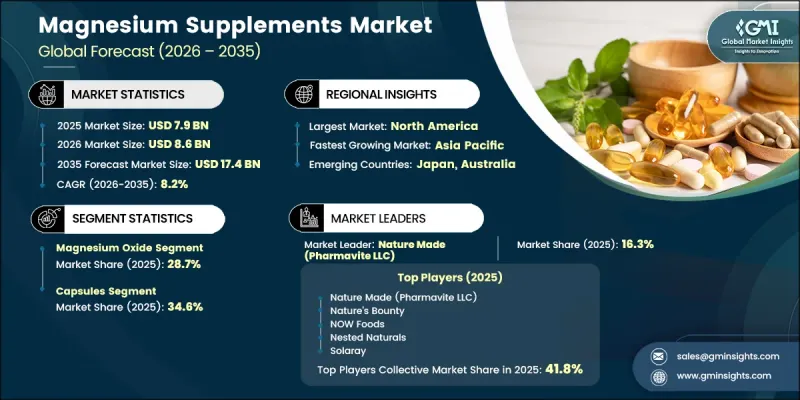
시장 확대는 노동 연령층 및 고령 소비자층의 마그네슘 결핍률 증가, 예방 의료에 대한 인식 제고, 그리고 수면의 질, 휴식, 전반적인 건강 유지에 있어 마그네슘 보충제의 역할 확대가 복합적으로 작용하여 추진되고 있습니다. 소비자 수요가 기존의 저비용 마그네슘 제제에서 특히 킬레이트화 제품이나 아미노산 결합형 제품과 같이 생체 이용률이 높은 프리미엄 대체품으로 이동함에 따라, 업계 전반에 걸쳐 뚜렷한 변화가 일어나고 있습니다. 이러한 변화는 시장이 일반적인 영양 보충제에서 보다 구체적인 대상층을 겨냥한 건강 및 웰니스 솔루션으로 진화하고 있음을 반영합니다. 신경 기능, 스트레스 반응 조절 및 회복 과정에 마그네슘이 관여한다는 과학적 근거가 점점 더 많이 밝혀지면서, 소비자들의 관심이 더욱 높아지고 있습니다. 그 결과, 수면 지원, 휴식, 인지 기능 건강을 내세운 제품들이 주목을 받고 있으며, 이는 해당 카테고리 내에서 소비자의 참여 심화, 브랜드 충성도 강화, 그리고 소비액 증가에 기여하고 있습니다.
| 시장 범위 | |
|---|---|
| 시작 연도 | 2025년 |
| 예측 기간 | 2026-2035년 |
| 시작 연도 시장 규모 | 79억 달러 |
| 예측 금액 | 174억 달러 |
| CAGR | 8.2% |
마그네슘 글리신산은 2025년에 20.1%의 시장 점유율을 차지하고, 2035년까지 연평균 성장률(CAGR) 11.1%로 성장할 것으로 전망되어 가장 빠르게 성장하는 제품 카테고리가 될 것으로 보입니다. 이러한 강력한 성장은 주로 의료 및 웰니스 전문가들의 추천이 늘어난 데다, 흡수율이 높은 마그네슘 형태에 대한 소비자들의 선호도가 높아진 데 기인합니다. 이 제품은 수면 개선, 근육 회복, 스트레스 관리에 도움이 되는 것으로 널리 알려져 있으며, 특정 웰니스 효과를 추구하는 소비자들에게 선호되는 선택지가 되고 있습니다. 의료 종사자들의 지속적인 추천이 장기적인 수요를 뒷받침하여, 이 부문 시장 입지를 강화할 것으로 예측됩니다.
분말 부문은 2025년에 14.9%의 시장 점유율을 차지하고, 2035년까지 연평균 성장률(CAGR) 9.3%로 성장할 것으로 전망됩니다. 이러한 성장은 야간 웰니스 루틴, 운동 후 회복 프로그램, 기능성 영양 분야에서의 활용을 통해 분말 형태의 마그네슘 제품이 점점 더 널리 채택되고 있는 데서 비롯된 것입니다. 소비자들은 일상생활에 자연스럽게 녹아들 수 있고, 편리하며 자신의 취향에 맞게 맞춤 설정할 수 있는 형태에 점점 더 매력을 느끼고 있습니다. 기능적인 장점 외에도, 각 제조업체들은 제품의 차별화를 꾀하고 더 폭넓은 고객층을 유치하기 위해 프리미엄 브랜딩, 혁신적인 제형, 그리고 소비자 경험 개선에 주력하고 있습니다. 이러한 요인들이 여러 유통 채널에서 분말 마그네슘 보충제 시장 확대를 지속적으로 뒷받침하고 있습니다.
2025년, 북미 마그네슘 보충제 시장은 33.5%의 점유율을 차지했습니다. 미국은 영양 보충제에 대한 꾸준한 소비자 지출, 소매점에서의 폭넓은 접근성, 그리고 확립된 헬스케어 및 웰니스 생태계에 힘입어 지역 수요의 상당 부분을 차지하고 있습니다. 특정 대상에 맞춘 영양 보충에 대한 인식이 높아지고, 의료 전문가들의 적극적인 권장까지 더해지면서 해당 지역 전체 시장 수요는 계속해서 증가하고 있습니다. 예방적 건강 관리에 대한 소비자들의 긍정적인 태도 역시 예측 기간 동안 지속적인 성장을 뒷받침할 것으로 전망됩니다.
자주 묻는 질문
목차
제1장 조사 방법과 범위
제2장 주요 요약
제3장 업계 인사이트
제4장 경쟁 구도
제5장 시장 추산 및 예측 : 제품 유형별, 2022-2035년
제6장 시장 추산 및 예측 : 제품 형태별, 2022-2035년
제7장 시장 추산 및 예측 : 용도별, 2022-2035년
제8장 시장 추산 및 예측 : 유통 채널별, 2022-2035년
제9장 시장 추산 및 예측 : 최종 사용자별, 2022-2035년
제10장 시장 추산 및 예측 : 지역별, 2022-2035년
제11장 기업 개요
JHS 26.07.01The Global Magnesium Supplements Market was valued at USD 7.9 billion in 2025 and is estimated to grow at a CAGR of 8.2% to reach USD 17.4 billion by 2035.
Market expansion is driven by the combination of increasing magnesium deficiency rates among working-age and elderly consumers, rising awareness of preventive healthcare practices, and the growing role of magnesium supplementation in supporting sleep quality, relaxation, and overall wellness. A notable transformation is occurring across the industry as consumer demand shifts away from traditional, lower-cost magnesium formulations toward premium, highly bioavailable alternatives, particularly chelated and amino acid-bound products. This transition reflects the market's evolution from general nutritional supplementation to more targeted health and wellness solutions. Growing scientific awareness regarding magnesium's involvement in neurological function, stress response regulation, and recovery processes has further strengthened consumer interest. As a result, products positioned around sleep support, relaxation, and cognitive wellness are gaining traction, contributing to higher consumer engagement, stronger brand loyalty, and increased spending within the category.
| Market Scope | |
|---|---|
| Start Year | 2025 |
| Forecast Year | 2026-2035 |
| Start Value | $7.9 Billion |
| Forecast Value | $17.4 Billion |
| CAGR | 8.2% |
Magnesium glycinate accounted for 20.1% share in 2025 and is projected to grow at a 11.1% CAGR through 2035, making it the fastest-growing product category. Its strong growth is largely attributed to increasing recommendations from healthcare and wellness professionals, along with growing consumer preference for highly absorbable magnesium forms. The product is widely recognized for its association with sleep support, muscle recovery, and stress management, positioning it as a preferred option among consumers seeking targeted wellness benefits. Continued endorsement from healthcare practitioners is expected to support long-term demand and strengthen the segment's market position.
The powder segment captured 14.9% share in 2025 and is expected to grow at a CAGR of 9.3% through 2035. Growth is being fueled by increasing incorporation of powdered magnesium products into nighttime wellness routines, post-exercise recovery regimens, and functional nutrition applications. Consumers are increasingly attracted to convenient, customizable formats that can be integrated into daily lifestyles. In addition to functional benefits, manufacturers are focusing on premium branding, innovative formulations, and enhanced consumer experiences to differentiate products and attract a broader customer base. These factors continue to support the expansion of powdered magnesium supplements across multiple distribution channels.
North America Magnesium Supplements Market held a 33.5% share in 2025. The United States accounts for the majority of regional demand, supported by strong consumer spending on dietary supplements, widespread retail availability, and a well-established healthcare and wellness ecosystem. Growing awareness of targeted nutritional supplementation, combined with active recommendations from healthcare professionals, continues to strengthen market demand across the region. Favorable consumer attitudes toward preventive health management are also expected to support sustained growth over the forecast period.
Major companies operating in the global magnesium supplements market include Ancient Nutrition, BioEmblem, Doctor's Best, HealthAid, Holland & Barrett, Jamieson Wellness, Jigsaw Health, Life Extension, Metagenics, Moon Juice, Nature Made (Pharmavite LLC), Nature's Bounty, Nested Naturals, NOW Foods, Pure Encapsulations (Nestle), Solaray, and Swisse Wellness. Companies operating in the magnesium supplements market are implementing a variety of strategies to strengthen their market presence and enhance competitive positioning. Leading manufacturers are investing in product innovation, particularly in highly bioavailable magnesium formulations designed to address specific health concerns such as sleep support, stress management, muscle recovery, and cognitive wellness. Businesses are also expanding their premium product portfolios to meet growing consumer demand for targeted nutritional solutions. Strategic partnerships with healthcare professionals, wellness practitioners, and retail distributors are helping brands improve market penetration and consumer trust. Additionally, companies are increasing investments in research and development to support formulation advancements and product differentiation.
Table of Contents
Chapter 1 Methodology & Scope
- 1.1 Research approach
- 1.2 Quality Commitments
- 1.2.1 GMI AI policy & data integrity commitment
- 1.2.1.1 Source consistency protocol
- 1.2.1 GMI AI policy & data integrity commitment
- 1.3 Research Trail & Confidence Scoring
- 1.3.1 Research Trail Components
- 1.3.2 Scoring Components
- 1.4 Data Collection
- 1.4.1 Partial list of primary sources
- 1.5 Data mining sources
- 1.5.1 Paid sources
- 1.5.1.1 Sources, by region
- 1.5.1 Paid sources
- 1.6 Base estimates and calculations
- 1.6.1 Base year calculation for any one approach
- 1.7 Forecast model
- 1.7.1 Quantified market impact analysis
- 1.7.1.1 Mathematical impact of growth parameters on forecast
- 1.7.1 Quantified market impact analysis
- 1.8 Research transparency addendum
- 1.8.1 Source attribution framework
- 1.8.2 Quality assurance metrics
- 1.8.3 Our commitment to trust
Chapter 2 Executive Summary
- 2.1 Industry 360° synopsis
- 2.2 Key market trends
- 2.2.1 Regional
- 2.2.2 Product type
- 2.2.3 Product form
- 2.2.4 Application
- 2.2.5 Distribution channel
- 2.2.6 End-user
- 2.3 TAM Analysis, 2026-2035
- 2.4 CXO perspectives: Strategic imperatives
Chapter 3 Industry Insights
- 3.1 Industry ecosystem analysis
- 3.1.1 Supplier landscape
- 3.1.2 Profit margin
- 3.1.3 Value addition at each stage
- 3.1.4 Factor affecting the value chain
- 3.1.5 Disruptions
- 3.2 Industry impact forces
- 3.2.1 Growth drivers
- 3.2.2 Industry pitfalls and challenges
- 3.2.3 Market opportunities
- 3.3 Growth potential analysis
- 3.4 Regulatory landscape
- 3.4.1 North America
- 3.4.2 Europe
- 3.4.3 Asia Pacific
- 3.4.4 Latin America
- 3.4.5 Middle East & Africa
- 3.5 Porter's analysis
- 3.6 PESTEL analysis
- 3.7 Price trends
- 3.7.1 By region
- 3.7.2 By product type
- 3.8 Future market trends
- 3.9 Technology and Innovation landscape
- 3.9.1 Current technological trends
- 3.9.2 Emerging technologies
- 3.10 Patent Landscape
- 3.11 Trade statistics (HS code)
- 3.11.1 Major importing countries
- 3.11.2 Major exporting countries
- 3.12 Sustainability and environmental aspects
- 3.12.1 Sustainable practices
- 3.12.2 Waste reduction strategies
- 3.12.3 Energy efficiency in production
- 3.12.4 Eco-friendly initiatives
- 3.13 Carbon footprint consideration
Chapter 4 Competitive Landscape, 2025
- 4.1 Introduction
- 4.2 Company market share analysis
- 4.2.1 By region
- 4.2.1.1 North America
- 4.2.1.2 Europe
- 4.2.1.3 Asia Pacific
- 4.2.1.4 LATAM
- 4.2.1.5 MEA
- 4.2.1 By region
- 4.3 Company matrix analysis
- 4.4 Competitive analysis of major market players
- 4.5 Competitive positioning matrix
- 4.6 Key developments
- 4.6.1 Mergers & acquisitions
- 4.6.2 Partnerships & collaborations
- 4.6.3 New Product Launches
- 4.6.4 Expansion Plans
Chapter 5 Market Estimates and Forecast, By Product Type, 2022-2035 (USD Billion) (Kilo Tons)
- 5.1 Key trends
- 5.2 Magnesium citrate
- 5.3 Magnesium glycinate
- 5.4 Magnesium oxide
- 5.5 Magnesium chloride
- 5.6 Magnesium sulfate
- 5.7 Others
Chapter 6 Market Estimates and Forecast, By Product Form, 2022-2035 (USD Billion) (Kilo Tons)
- 6.1 Key trends
- 6.2 Capsules
- 6.3 Tablets
- 6.4 Powder
- 6.5 Liquid
- 6.6 Gummies
- 6.7 Others
Chapter 7 Market Estimates and Forecast, By Application, 2022-2035 (USD Billion) (Kilo Tons)
- 7.1 Key trends
- 7.2 Dietary supplements
- 7.3 Pharmaceuticals
- 7.4 Food & beverage fortification
- 7.5 Functional foods
- 7.6 Fortified beverages
- 7.7 Nutritional bars & snacks
- 7.8 Others
Chapter 8 Market Estimates and Forecast, By Distribution Channel, 2022-2035 (USD Billion) (Kilo Tons)
- 8.1 Key trends
- 8.2 Pharmacies
- 8.2.1 Hospital pharmacies
- 8.2.2 Retail pharmacies
- 8.3 Health & specialty stores
- 8.4 Online retail
- 8.4.1 E-commerce platforms
- 8.4.2 Direct-to-consumer brand websites
- 8.5 Supermarkets & hypermarkets
- 8.5.1 Grocery store chains
- 8.5.2 Mass merchandisers
- 8.6 Others
Chapter 9 Market Estimates and Forecast, By End-User, 2022-2035 (USD Billion) (Kilo Tons)
- 9.1 Key trends
- 9.2 Pediatrics (0-17 years)
- 9.3 Adults (18-64 years)
- 9.4 Geriatrics (65+ years)
Chapter 10 Market Estimates and Forecast, By Region, 2022-2035 (USD Billion) (Kilo Tons)
- 10.1 Key trends
- 10.2 North America
- 10.2.1 U.S.
- 10.2.2 Canada
- 10.3 Europe
- 10.3.1 Germany
- 10.3.2 UK
- 10.3.3 France
- 10.3.4 Spain
- 10.3.5 Italy
- 10.3.6 Rest of Europe
- 10.4 Asia Pacific
- 10.4.1 China
- 10.4.2 India
- 10.4.3 Japan
- 10.4.4 Australia
- 10.4.5 South Korea
- 10.4.6 Rest of Asia Pacific
- 10.5 Latin America
- 10.5.1 Brazil
- 10.5.2 Mexico
- 10.5.3 Argentina
- 10.5.4 Rest of Latin America
- 10.6 Middle East and Africa
- 10.6.1 Saudi Arabia
- 10.6.2 South Africa
- 10.6.3 UAE
- 10.6.4 Rest of Middle East and Africa
Chapter 11 Company Profiles
- 11.1 Ancient Nutrition
- 11.2 BioEmblem
- 11.3 Doctor's Best
- 11.4 HealthAid
- 11.5 Holland & Barrett
- 11.6 Jamieson Wellness
- 11.7 Jigsaw Health
- 11.8 Life Extension
- 11.9 Metagenics
- 11.10 Moon Juice
- 11.11 Nature Made (Pharmavite LLC)
- 11.12 Nature's Bounty
- 11.13 Nested Naturals
- 11.14 NOW Foods
- 11.15 Pure Encapsulations (Nestle)
- 11.16 Solaray
- 11.17 Swisse Wellness