

|
시장보고서
상품코드
2071297
화물용 전기자전거 시장 : 기회, 성장요인, 업계 동향 분석 및 예측(2026-2035년)Cargo E-Bike Market Opportunity, Growth Drivers, Industry Trend Analysis, and Forecast 2026 - 2035 |
||||||

세계의 화물용 전기자전거 시장은 2025년에 24억 3,000만 달러 규모가 되어, CAGR 6.5%로 성장하여 2035년까지 45억 2,000만 달러에 이를 것으로 추정되고 있습니다.
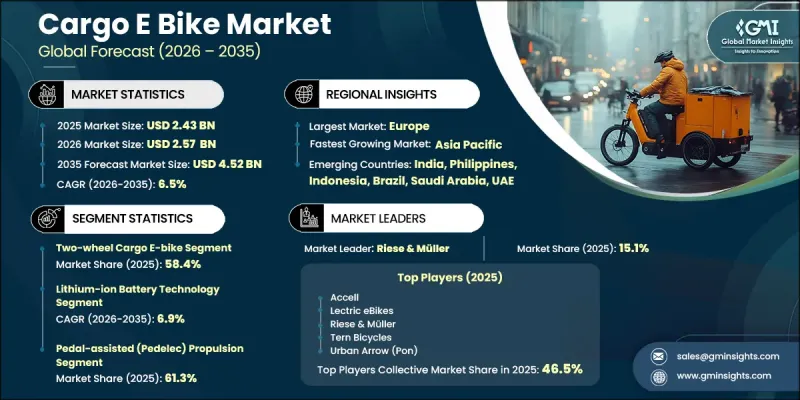
시장의 성장은 전자상거래로 인한 출하량 증가, 도시 지역의 환경 규제 강화, 그리고 차량의 효율성과 가격 경쟁력을 높여주는 배터리 기술의 지속적인 발전이 맞물려 촉진되고 있습니다. 화물용 전기자전거는 틈새 운송 수단에서 출발해, 전 세계 주요 지역의 상업용 배송 차량, 공공 서비스 업무, 도시 물류 네트워크에서 없어서는 안 될 자산으로 점점 더 진화하고 있습니다. 인구 밀집 도시에서 배기가스 감축 및 교통 체증 완화에 대한 수요가 높아짐에 따라, 단거리 화물 운송용 전기 화물 모빌리티 솔루션의 도입이 가속화되고 있습니다. 또한, 온라인 소매 활동의 지속적인 확대로 인해 배송 밀도가 높아지면서, 소형 전기 화물 차량에 유리한 운영 환경이 조성되고 있습니다. 기업들이 비용 대비 효과가 높고 환경을 고려한 운송 수단을 모색하는 가운데, 화물용 전기자전거는 라스트 마일 물류 분야에서 점점 더 매력적인 선택지로 떠오르고 있습니다. 배터리 성능, 차량 내구성, 적재 능력 및 운영 효율성의 지속적인 향상으로 인해 화물용 전기자전거 시장의 장기적인 성장 전망은 더욱 견고해지고 있으며, 동시에 상업 부문과 기관 부문에 걸친 잠재 고객층도 확대되고 있습니다.
| 시장 범위 | |
|---|---|
| 시작 연도 | 2025년 |
| 예측 기간 | 2026-2035년 |
| 시작 연도 시장 규모 | 24억 3,000만 달러 |
| 예측 금액 | 45억 2,000만 달러 |
| CAGR | 6.5% |
2025년, 이륜차 부문은 58.4%의 시장 점유율을 차지했습니다. 해당 시장에서 차지하는 선도적 지위는 혼잡한 도시 환경 내에서 효율적으로 주행할 수 있는 기동성이 뛰어나고 경량인 운송 솔루션에 대한 강력한 수요에 힘입은 것입니다. 이륜 화물용 전기자전거는 기동성, 인프라와의 호환성, 운영상의 유연성 등의 장점을 갖추고 있어, 상업용 배송 서비스나 도시 교통 용도로 특히 적합합니다. 고밀도 지역을 효율적으로 주행할 수 있는 그 능력 덕분에, 다양한 최종 용도 분야에서 계속해서 보급이 확대되고 있습니다.
리튬 이온 배터리 부문은 2025년에 64.8%의 점유율을 차지했으며, 시장 규모는 15억 7,000만 달러에 달했습니다. 리튬이온 기술이 시장에서 확고한 입지를 다지고 있는 것은 뛰어난 에너지 효율, 긴 수명, 경량성, 그리고 향상된 충전 성능 덕분입니다. 배터리 생산 비용의 지속적인 절감과 에너지 저장 능력의 향상은 상용 및 프리미엄 제품 부문 모두에서 리튬 이온 배터리를 탑재한 화물용 전기자전거의 보급을 더욱 촉진하고 있습니다.
2025년, 유럽의 화물용 전기자전거 시장은 12억 3,000만 달러에 달했으며, 시장 점유율의 51%를 차지했습니다. 지속 가능한 교통 수단에 대한 강력한 규제적 지원, 도시 이동성 인프라에 대한 투자 확대, 그리고 저배출형 운송 솔루션의 보급이 해당 지역 전체 시장 성장을 지속적으로 뒷받침하고 있습니다. 이 시장의 성장은 긍정적인 정책 조치, 상용차의 전기화를 위한 노력 확대, 그리고 효율적인 도시 화물 운송 솔루션에 대한 수요 증가에 힘입어 이루어지고 있습니다.
자주 묻는 질문
목차
제1장 조사 방법과 범위
제2장 주요 요약
제3장 업계 인사이트
제4장 경쟁 구도
제5장 시장 추산 및 예측 : 차량 유형별, 2022-2035년
제6장 시장 추산 및 예측 : 배터리 기술별, 2022-2035년
제7장 시장 추산 및 예측 : 추진력별, 2022-2035년
제8장 시장 추산 및 예측 : 최종 용도별, 2022-2035년
제9장 시장 추산 및 예측 : 범위별, 2022-2035년
제10장 시장 추산 및 예측 : 지역별, 2022-2035년
제11장 기업 개요
JHS 26.07.01The Global Cargo E-Bike Market was valued at USD 2.43 billion in 2025 and is estimated to grow at a CAGR of 6.5% to reach USD 4.52 billion by 2035.
Market growth is fueled by the combined impact of rising e-commerce shipment volumes, stricter urban environmental regulations, and continuous advancements in battery technology that are improving vehicle efficiency and affordability. Cargo E-bikes are increasingly evolving from niche transportation solutions into essential assets within commercial delivery fleets, public service operations, and urban logistics networks across major global regions. The growing need to reduce emissions and congestion in densely populated cities is accelerating the adoption of electric cargo mobility solutions for short-distance freight transportation. In addition, the sustained expansion of online retail activity is generating higher delivery density, creating favorable operating conditions for compact electric cargo vehicles. As businesses seek cost-effective and environmentally responsible transportation alternatives, cargo E-bikes are becoming an increasingly attractive option for last-mile logistics applications. Ongoing improvements in battery performance, vehicle durability, payload capabilities, and operational efficiency continue to strengthen the long-term growth outlook for the cargo E-bike market while expanding its addressable customer base across commercial and institutional sectors.
| Market Scope | |
|---|---|
| Start Year | 2025 |
| Forecast Year | 2026-2035 |
| Start Value | $2.43 Billion |
| Forecast Value | $4.52 Billion |
| CAGR | 6.5% |
The two-wheel segment held a 58.4% share in 2025. Its market leadership is supported by strong demand for agile and lightweight transportation solutions capable of operating efficiently within crowded urban environments. Two-wheel cargo E-bikes offer advantages in maneuverability, infrastructure compatibility, and operational flexibility, making them particularly well-suited for commercial delivery services and urban transportation applications. Their ability to navigate high-density areas efficiently continues to drive widespread adoption across various end-use sectors.
The lithium-ion batteries segment held a 64.8% share in 2025, with a valuation of USD 1.57 billion. The strong market position of lithium-ion technology is attributed to its superior energy efficiency, extended operating life, lightweight characteristics, and improved charging performance. Continued reductions in battery production costs and advancements in energy storage capabilities are further supporting the widespread adoption of lithium-ion-powered cargo E-bikes across both commercial and premium product categories.
Europe Cargo E-Bike Market reached USD 1.23 billion in 2025, accounting for 51% share. Strong regulatory support for sustainable transportation, increasing investment in urban mobility infrastructure, and widespread adoption of low-emission transportation solutions continue to support market expansion across the region. Market development is being supported by favorable policy initiatives, increasing commercial fleet electrification efforts, and growing demand for efficient urban freight transportation solutions.
Major companies operating in the global cargo E-bike market include Giant Manufacturing, Trek Bicycle, Urban Arrow, Accell, Pon.Bike, Lectric eBikes, Jinhua JOBO Technology, Riese & Muller, Tern Bicycles, Carqon, Triobike, Kleuster, Benno Bikes, Amsterdam Bicycle Company, and Xtracycle. Companies in the cargo E-bike market are focusing on product innovation, battery technology advancements, and strategic partnerships to strengthen their competitive position. Manufacturers are investing heavily in lightweight frame designs, extended-range battery systems, improved payload capacities, and connected mobility technologies to enhance operational efficiency and user experience. Many market participants are expanding their product portfolios to address the growing needs of logistics operators, retailers, and commercial fleet owners. Strategic collaborations with delivery service providers, fleet management companies, and urban mobility stakeholders are helping companies accelerate market penetration and increase product visibility. Businesses are also strengthening distribution networks and after-sales service capabilities to improve customer retention.
Table of Contents
Chapter 1 Methodology & Scope
- 1.1 Research approach
- 1.2 Quality Commitments
- 1.2.1 GMI AI policy & data integrity commitment
- 1.2.1.1 Source consistency protocol
- 1.2.1 GMI AI policy & data integrity commitment
- 1.3 Research Trail & Confidence Scoring
- 1.3.1 Research Trail Components
- 1.3.2 Scoring Components
- 1.4 Data Collection
- 1.4.1 Partial list of primary sources
- 1.5 Data mining sources
- 1.5.1 Paid sources
- 1.5.1.1 Sources, by region
- 1.5.1 Paid sources
- 1.6 Base estimates and calculations
- 1.6.1 Base year calculation
- 1.7 Forecast model
- 1.7.1 Quantified market impact analysis
- 1.7.1.1 Mathematical impact of growth parameters on forecast
- 1.7.1 Quantified market impact analysis
- 1.8 Research transparency addendum
- 1.8.1 Source attribution framework
- 1.8.2 Quality assurance metrics
- 1.8.3 Our commitment to trust
Chapter 2 Executive Summary
- 2.1 Industry 360° synopsis
- 2.2 Key market trends
- 2.2.1 Vehicle Type
- 2.2.2 Battery Technology
- 2.2.3 Propulsion
- 2.2.4 End Use
- 2.2.5 Range
- 2.3 TAM Analysis, 2026-2035
- 2.4 CXO perspectives: Strategic imperatives
Chapter 3 Industry Insights
- 3.1 Industry ecosystem analysis
- 3.1.1 Supplier landscape
- 3.1.1.1 Raw material suppliers
- 3.1.1.2 Component suppliers
- 3.1.1.3 Manufacturers
- 3.1.1.4 Service providers
- 3.1.1.5 Distribution channel
- 3.1.1.6 End Use
- 3.1.2 Cost structure
- 3.1.3 Profit margin
- 3.1.4 Value addition at each stage
- 3.1.5 Vertical integration trends
- 3.1.6 Disruptors
- 3.1.1 Supplier landscape
- 3.2 Industry impact forces
- 3.2.1 Growth drivers
- 3.2.1.1 Rising Demand for Sustainable Last-Mile Delivery Solutions
- 3.2.1.2 Growth of E-Commerce and Urban Parcel Delivery Services
- 3.2.1.3 Government Incentives and Subsidies for Electric Mobility
- 3.2.1.4 Increasing Urban Traffic Congestion and Low-Emission Zones
- 3.2.1.5 Lower Operating and Maintenance Costs Compared to Delivery Vans
- 3.2.2 Industry pitfalls & challenges
- 3.2.2.1 High Upfront Purchase Cost of Cargo E-Bikes
- 3.2.2.2 Limited Charging Infrastructure in Some Regions
- 3.2.3 Market opportunities
- 3.2.3.1 Expansion of Urban Micro-Logistics Networks
- 3.2.3.2 Growing Adoption by Retailers and E-Commerce Companies
- 3.2.3.3 Increasing Use in Municipal and Public Service Applications
- 3.2.3.4 Development of Advanced Battery and Fast-Charging Technologies
- 3.2.3.5 Rising Demand in Emerging Markets and Smart City Projects
- 3.2.1 Growth drivers
- 3.3 Growth potential analysis
- 3.4 Pricing Analysis (Driven by Primary Research)
- 3.4.1 Historical Price Trend Analysis
- 3.4.2 Pricing Strategy by Player Type (Premium / Value / Cost-plus)
- 3.5 Regulatory landscape
- 3.5.1 North America
- 3.5.1.1 U.S.: Consumer Product Safety Commission (CPSC) Bicycle Regulations
- 3.5.1.2 U.S.: UL 2849 Electric Bicycle Safety Standard
- 3.5.1.3 Canada: Motor Vehicle Safety Act (MVSA) - Power-Assisted Bicycle Regulations
- 3.5.1.4 Canada: Provincial E-Bike Regulations
- 3.5.2 Europe
- 3.5.2.1 EN 15194 Electrically Power Assisted Cycles (EPAC) Standard
- 3.5.2.2 EU Machinery Regulation
- 3.5.2.3 EU Battery Regulation
- 3.5.2.4 CE Marking Compliance Framework
- 3.5.3 Asia-Pacific
- 3.5.3.1 China GB 17761 Electric Bicycle Safety Standard
- 3.5.3.2 Japan Road Traffic Act & Electric Bicycle Regulations
- 3.5.3.3 Australia Australian Design Rules (ADR) for Electric Bicycles
- 3.5.3.4 South Korea Personal Mobility Device & E-Bike Regulations
- 3.5.4 Latin America
- 3.5.4.1 Brazil National Traffic Council (CONTRAN) E-Bike Regulations
- 3.5.4.2 Mexico NOM Electric Bicycle Safety Standard
- 3.5.5 Middle East & Africa
- 3.5.5.1 GCC Micromobility & Electric Bicycle Regulations
- 3.5.5.2 South Africa National Road Traffic Act (NRTA)
- 3.5.5.3 UAE E-Bike & Sustainable Mobility Regulations
- 3.5.1 North America
- 3.6 Technology and Innovation landscape
- 3.6.1 Current technologies
- 3.6.2 Emerging technologies
- 3.7 Porter's analysis
- 3.8 PESTEL analysis
- 3.9 Patent analysis (Driven by Primary Research)
- 3.10 Trade Data Analysis (Based on Paid Database)
- 3.10.1 Import/Export Volume & Value Trends
- 3.10.2 Key Trade Corridors & Tariff Impact
- 3.11 Capacity & Production Landscape (Driven by Primary Research)
- 3.11.1 Production Capacity by Region & Key Producer
- 3.11.2 Capacity Utilization Rates & Expansion Pipelines
- 3.12 Impact of AI & generative AI on the market
- 3.12.1 AI-Driven Disruption of Existing Business Models
- 3.12.2 Automated design optimization
- 3.12.3 Supply chain AI for demand forecasting
- 3.12.4 GenAI use cases & adoption roadmap by segment
- 3.12.5 Risks, Limitations & Regulatory Considerations
- 3.13 Sustainability and environmental aspects
- 3.13.1 Sustainable practices
- 3.13.2 Waste reduction strategies
- 3.13.3 Energy efficiency in production
- 3.13.4 Eco-friendly Initiatives
- 3.13.5 Carbon footprint considerations
- 3.14 Forecast assumptions & scenario analysis (Driven by Primary Research)
- 3.14.1 Base Casekey macro & industry variables driving CAGR
- 3.14.2 Optimistic Scenarios Favorable Macro and Industry Tailwinds
- 3.14.3 Pessimistic ScenarioMacroeconomic slowdown or industry headwinds
Chapter 4 Competitive Landscape, 2025
- 4.1 Introduction
- 4.2 Company market share analysis
- 4.2.1 North America
- 4.2.2 Europe
- 4.2.3 Asia-Pacific
- 4.2.4 Latin America
- 4.2.5 Middle East & Africa
- 4.3 Competitive positioning matrix
- 4.4 Key developments
- 4.4.1 Mergers & acquisitions
- 4.4.2 Partnerships & collaborations
- 4.4.3 New product launches
- 4.4.4 Expansion plans and funding
- 4.5 Company tier benchmarking
- 4.5.1 Tier classification criteria & qualifying thresholds
- 4.5.2 Tier positioning matrix by revenue, geography & innovation
Chapter 5 Market Estimates & Forecast, By Vehicle Type, 2022-2035, ($Mn, Units)
- 5.1 Key trends
- 5.2 Two-Wheeler
- 5.3 Three-Wheeler
- 5.4 Four-Wheeler
Chapter 6 Market Estimates & Forecast, By Battery Technology, 2022-2035, ($Mn, Units)
- 6.1 Key trends
- 6.2 Lithium-Ion (Li-Ion)
- 6.3 Lead-Acid
- 6.4 Nickel-Metal Hydride (NiMH)
- 6.5 Others
Chapter 7 Market Estimates & Forecast, By Propulsion, 2022-2035, ($Mn, Units)
- 7.1 Key trends
- 7.2 Pedal-Assisted (Pedelec)
- 7.3 Throttle-Assisted
Chapter 8 Market Estimates & Forecast, By End Use, 2022-2035, ($Mn, Units)
- 8.1 Key trends
- 8.2 Courier and Parcel Services
- 8.3 Service Delivery
- 8.4 Large Retail & E-Commerce Fulfilment
- 8.5 Waste & Municipal Services
- 8.6 Personal Use
- 8.7 Others
Chapter 9 Market Estimates & Forecast, By Range, 2022-2035, ($Mn, Units)
- 9.1 Key trends
- 9.2 Less than 50 km
- 9.3 50-100 km
- 9.4 Above 100 Km
Chapter 10 Market Estimates & Forecast, By Region, 2022-2035, ($Mn, Units)
- 10.1 North America
- 10.1.1 US
- 10.1.2 Canada
- 10.2 Europe
- 10.2.1 UK
- 10.2.2 Germany
- 10.2.3 France
- 10.2.4 Italy
- 10.2.5 Spain
- 10.2.6 Belgium
- 10.2.7 Netherlands
- 10.2.8 Sweden
- 10.2.9 Russia
- 10.3 Asia Pacific
- 10.3.1 China
- 10.3.2 India
- 10.3.3 Japan
- 10.3.4 Australia
- 10.3.5 Singapore
- 10.3.6 South Korea
- 10.3.7 Vietnam
- 10.3.8 Indonesia
- 10.3.9 Thailand
- 10.4 Latin America
- 10.4.1 Brazil
- 10.4.2 Mexico
- 10.4.3 Argentina
- 10.5 MEA
- 10.5.1 South Africa
- 10.5.2 Saudi Arabia
- 10.5.3 UAE
- 10.5.4 Turkey
Chapter 11 Company Profiles
- 11.1 Global Players
- 11.1.1 Accell
- 11.1.2 Carqon
- 11.1.3 Giant Manufacturing
- 11.1.4 Jinhua JOBO Technology
- 11.1.5 Lectric eBikes
- 11.1.6 Pon (Pon.Bike)
- 11.1.7 Riese & Muller
- 11.1.8 Tern Bicycles
- 11.1.9 Trek Bicycle
- 11.1.10 Urban Arrow
- 11.2 Regional Players
- 11.2.1 Aventon Bikes
- 11.2.2 Butchers & Bicycles
- 11.2.3 Christiania Bikes
- 11.2.4 Douze Cycles
- 11.2.5 Hero Lectro (Hero Cycles)
- 11.2.6 Larry vs Harry (Bullitt)
- 11.2.7 Nihola
- 11.2.8 Radkutsche
- 11.2.9 WorkCycles
- 11.2.10 Yuba Bicycles
- 11.3 Emerging Players
- 11.3.1 Amsterdam Bicycle Company
- 11.3.2 Benno Bikes
- 11.3.3 Kleuster
- 11.3.4 Triobike A/S
- 11.3.5 Xtracycle


