|
시장보고서
상품코드
2071303
음료 포장기계 시장 : 비즈니스 기회, 성장요인, 업계 동향 분석 및 예측(2026-2035년)Beverage Packaging Machine Market Opportunity, Growth Drivers, Industry Trend Analysis, and Forecast 2026 - 2035 |
||||||

세계의 음료 포장기계 시장은 2025년에 184억 달러 규모가 되어, 2035년까지 연평균 복합 성장률(CAGR) 5.4%로 성장하여 312억 달러에 이를 것으로 추정되고 있습니다.
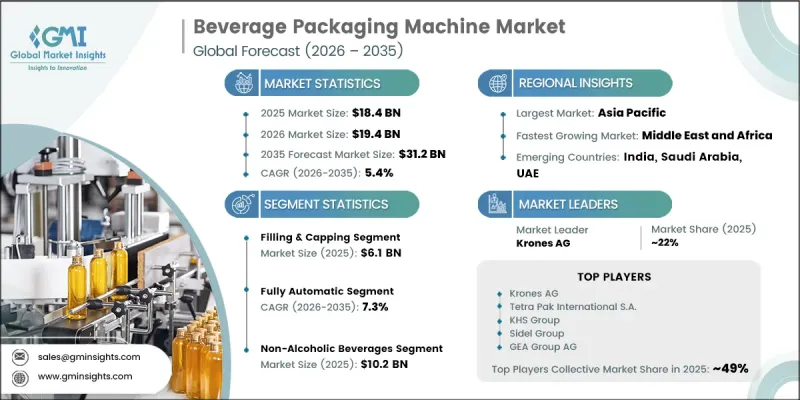
이 시장의 성장은 전 세계 포장 음료 소비 증가와 자동화 및 고효율 생산 시스템으로의 전환이 진행되고 있는 것이 원동력이 되고 있습니다. 각 음료 제조업체들은 생산 효율을 높이고, 인건비 및 유지보수 비용을 절감하며, 대규모 생산 환경에서도 일관된 제품 품질을 확보하기 위해 첨단 포장 장비를 꾸준히 도입하고 있습니다. 생수, 탄산음료, 주스, 유제품 음료 및 즉시 음용형(RTD) 제품 등 비알코올 음료의 생산 확대는 전 세계 포장 장비 수요를 더욱 가속화하고 있습니다. 또한, 이 업계에서는 충진, 라벨링, 이송, 팔레타이징에 사용되는 고속 시스템의 도입이 활발해지고 있으며, 이는 생산 라인의 효율 향상에 기여하고 있습니다. 지속가능성에 대한 관심이 높아짐에 따라, 각 제조업체들은 에너지 효율이 뛰어나고 폐기물을 줄여주는 포장 기술에 대한 투자를 확대되고 있습니다. 이와 더불어 자동화, 로봇 공학, 디지털 제어 시스템의 통합을 통해 음료 생산 시설의 현대화가 진행되면서 정밀도와 처리 능력이 향상되고 있습니다. 전반적으로, 전 세계 음료 제조 업계에서 확장성이 뛰어나고 효율적이며 기술 주도적인 포장 솔루션에 대한 수요가 증가함에 따라 시장은 급속히 진화하고 있습니다.
| 시장 범위 | |
|---|---|
| 시작 연도 | 2025년 |
| 예측 기간 | 2026-2035년 |
| 시작 연도 시장 규모 | 184억 달러 |
| 예측 금액 | 312억 달러 |
| CAGR | 5.4% |
충진·캡핑 분야는 2025년에 61억 달러 시장 규모를 기록하고, 2035년까지 연평균 성장률(CAGR) 4.9%로 성장할 것으로 전망됩니다. 이 분야는 음료 생산 라인 전체에서 정확한 충전 작업, 위생적인 취급 및 일관된 포장 성능을 확보하는 데 있어 매우 중요한 역할을 수행하고 있으므로, 그 선도적인 위치를 유지하고 있습니다. 또한, 작업 속도와 제품 품질이 필수적인 대규모 제조 환경에서 널리 활용되고 있습니다. 자동화된 대용량 충전 시스템에 대한 강력한 수요가 전 세계 음료 가공 시설에서 해당 시스템의 보급을 지속적으로 촉진하고 있습니다.
완전 자동화 부문은 2025년에 63.2%의 시장 점유율을 차지하고, 2026년부터 2035년까지 연평균 성장률(CAGR) 7.3%로 성장할 것으로 전망됩니다. 이 부문이 주도적인 위치를 차지하고 있는 것은 산업의 자동화 전환이 진행되고 있으며, 수작업 개입을 최소화하는 고속 포장 시스템에 대한 수요가 증가하고 있기 때문입니다. 각 제조업체는 안정적인 생산량, 유연성 향상, 생산 효율 향상을 실현할 수 있다는 점에서 전자동 솔루션을 선호하여 도입하고 있습니다. 로봇 기술, IoT 기반 감시 시스템, 예측 유지보수 기술의 통합이 수요를 더욱 부추기고 있습니다. 또한, 대규모 음료 생산 시설의 확충도 이 부문의 성장에 크게 기여하고 있습니다.
중국의 음료 포장기계 시장은 2025년에 29억 달러 규모에 달하고, 2035년까지 연평균 성장률(CAGR) 5.6%로 성장할 것으로 전망됩니다. 이 나라가 시장을 주도하고 있는 배경에는 광범위한 음료 생산 능력, 포장 음료 소비 증가, 그리고 전체 가공 시설에 걸친 산업 자동화의 급속한 발전이 있습니다. 여러 음료 부문에 걸친 활발한 생산 활동이 첨단 포장기계에 대한 수요를 지속적으로 견인하고 있습니다. 각 제조업체는 업무 효율을 높이고, 국내 소비와 수출 지향적 생산 요건을 모두 충족하기 위해 고성능 충전, 라벨링, 이송 시스템에 대한 투자를 적극적으로 추진하고 있습니다.
자주 묻는 질문
목차
제1장 조사 방법과 범위
제2장 주요 요약
제3장 업계 인사이트
제4장 경쟁 구도
제5장 시장 추산 및 예측 : 제품 유형별, 2022-2035년
제6장 시장 추산 및 예측 : 자동화 레벨별, 2022-2035년
제7장 시장 추산 및 예측 : 음료 유형별, 2022-2035년
제8장 시장 추산 및 예측 : 포장 형태별, 2022-2035년
제9장 시장 추산 및 예측 : 포장 재료별, 2022-2035년
제10장 시장 추산 및 예측 : 유통 채널별, 2022-2035년
제11장 시장 추산 및 예측 : 지역별, 2022-2035년
제12장 기업 개요
JHS 26.07.01The Global Beverage Packaging Machine Market was valued at USD 18.4 billion in 2025 and is estimated to grow at a CAGR of 5.4% to reach USD 31.2 billion by 2035.
Growth in this market is driven by rising global consumption of packaged beverages and the increasing shift toward automated and high-efficiency production systems. Beverage manufacturers are steadily adopting advanced packaging machinery to enhance operational productivity, reduce labor and maintenance costs, and ensure consistent product quality across large-scale production environments. Expansion in the production of non-alcoholic beverages such as bottled water, carbonated soft drinks, juices, dairy-based drinks, and ready-to-drink formats is further accelerating demand for packaging equipment worldwide. The industry is also witnessing strong adoption of high-speed systems used for filling, labeling, conveying, and palletizing, which are improving production line efficiency. Sustainability concerns are encouraging manufacturers to invest in energy-efficient and waste-reducing packaging technologies. In parallel, the integration of automation, robotics, and digital control systems is modernizing beverage production facilities and improving accuracy and throughput. Overall, the market is evolving rapidly due to increasing demand for scalable, efficient, and technology-driven packaging solutions across global beverage manufacturing operations.
| Market Scope | |
|---|---|
| Start Year | 2025 |
| Forecast Year | 2026-2035 |
| Start Value | $18.4 Billion |
| Forecast Value | $31.2 Billion |
| CAGR | 5.4% |
The filling and capping segment generated USD 6.1 billion in 2025 and is projected to grow at a CAGR of 4.9% through 2035. This segment maintains its leadership due to its critical role in ensuring precise filling operations, hygienic handling, and consistent packaging performance across beverage production lines. It is widely utilized in large-scale manufacturing environments where operational speed and product integrity are essential. Strong demand for automated high-capacity filling systems continues to reinforce its widespread adoption across global beverage processing facilities.
The fully automatic segment accounted for 63.2% share in 2025 and is anticipated to grow at a CAGR of 7.3% during 2026-2035. This segment leads due to the growing shift toward industrial automation and the need for high-speed packaging systems that minimize manual intervention. Manufacturers prefer fully automated solutions for their ability to deliver consistent output, improved flexibility, and enhanced production efficiency. The integration of robotics, IoT-based monitoring systems, and predictive maintenance technologies is further strengthening demand. Expansion of large-scale beverage production facilities is also contributing significantly to segment growth.
China Beverage Packaging Machine Market captured USD 2.9 billion in 2025, and is expected to grow at a CAGR of 5.6% through 2035. The country's dominance is supported by extensive beverage manufacturing capacity, increasing consumption of packaged drinks, and rapid industrial automation across processing facilities. Strong production activity across multiple beverage categories continues to drive demand for advanced packaging machinery. Manufacturers are actively investing in high-performance filling, labeling, and conveying systems to improve operational efficiency and support both domestic consumption and export-oriented production requirements.
Major companies operating in the Global Beverage Packaging Machine Market include Krones AG, Tetra Pak International S.A., Sidel Group, KHS Group, GEA Group AG, Coesia S.p.A., Barry-Wehmiller Companies, Syntegon Technology GmbH, Serac Group, IMA Group (Industria Macchine Automatiche), ProMach, CFT Group S.p.A., SMI S.p.A. (SMIGROUP), Newamstar Packaging Machinery Co., Ltd., Douglas Machine Inc., EconoCorp Inc., Cama Group S.r.l., Accutek Packaging Equipment Companies, IC Filling Systems Ltd., Combi Packaging Systems LLC, and Massman Automation Designs LLC. Companies in the beverage packaging machine market are strengthening their market position through a combination of technology advancement, operational efficiency improvements, and global expansion strategies. A primary focus is placed on developing highly automated and intelligent packaging systems that integrate robotics, IoT-enabled monitoring, and predictive maintenance capabilities. Manufacturers are also investing in energy-efficient and sustainable machinery designs to align with evolving environmental standards and reduce production waste. Strategic partnerships with beverage producers are helping companies expand their customer base and improve service responsiveness. Continuous product innovation aimed at enhancing speed, precision, and flexibility in packaging operations remains a key priority.
Table of Contents
Chapter 1 Methodology & Scope
- 1.1 Market scope and definition
- 1.2 Research design
- 1.2.1 Research approach
- 1.2.2 Data collection methods
- 1.3 Data mining sources
- 1.3.1 Global
- 1.3.2 Regional/Country
- 1.4 Base estimates and calculations
- 1.4.1 Base year calculation
- 1.4.2 Key trends for market estimation
- 1.5 Primary research and validation
- 1.5.1 Primary sources
- 1.6 Forecast model
- 1.7 Research assumptions and limitations
Chapter 2 Executive Summary
- 2.1 Industry 360° synopsis
- 2.2 Key market trends
- 2.2.1 Regional
- 2.2.2 Product type
- 2.2.3 Automation level
- 2.2.4 Beverage type
- 2.2.5 Packaging format
- 2.2.6 Packaging material
- 2.2.7 Distribution channel
Chapter 3 Industry Insights
- 3.1 Industry ecosystem analysis
- 3.1.1 Supplier landscape
- 3.1.2 Profit margin
- 3.1.3 Value addition at each stage
- 3.1.4 Factor affecting the value chain
- 3.2 Industry impact forces
- 3.2.1 Growth drivers
- 3.2.1.1 Rising consumption of packaged beverages globally
- 3.2.1.2 Growing automation across beverage manufacturing facilities
- 3.2.1.3 Increasing focus on sustainable packaging and efficient production processes
- 3.2.2 Pitfalls & Challenges
- 3.2.2.1 High capital investment associated with advanced packaging machinery
- 3.2.2.2 Fluctuating raw material and packaging material costs
- 3.2.3 Opportunities
- 3.2.3.1 Rising demand for smart packaging automation and robotics integration
- 3.2.3.2 Expansion of beverage manufacturing in emerging economies
- 3.2.1 Growth drivers
- 3.3 Growth potential analysis
- 3.4 Future market trends
- 3.5 Technology and innovation landscape
- 3.5.1 Current technological trends
- 3.5.2 Emerging technologies
- 3.6 Regulatory landscape
- 3.6.1 Standards and compliance requirements
- 3.6.2 Regional regulatory frameworks
- 3.6.3 Certification standards
- 3.7 Porter's analysis
- 3.8 PESTEL analysis
- 3.9 Pricing analysis (driven by primary research)
- 3.9.1 Historical price trend analysis by machine type (2019-2024) (driven by primary research)
- 3.9.2 Pricing strategy by player type (premium / value / cost-plus) (driven by primary research)
- 3.9.3 Price sensitivity by end-user segment (large manufacturers vs. craft producers) (driven by primary research)
- 3.10 Trade data analysis (driven by paid database)
- 3.10.1 Import/export volume & value trends by machine type (HS code 8422) (driven by paid database)
- 3.10.2 Key trade corridors & tariff impact (China-EU, US-LATAM, intra-Asia) (driven by paid database)
- 3.10.3 Trade policy shifts & anti-dumping measures affecting OEM exports (driven by paid database)
- 3.11 Impact of AI & generative AI on the market
- 3.11.1 AI-driven disruption of existing business models (predictive maintenance, line optimization)
- 3.11.2 GenAI use cases & adoption roadmap by machine segment
- 3.11.3 Digital twins & AI-powered changeover optimization
- 3.11.4 Risks, limitations & regulatory considerations for AI in food-grade machinery
- 3.12 Capacity & production landscape (driven by primary research)
- 3.12.1 Installed capacity by region & key producer (driven by primary research)
- 3.12.2 Capacity utilization rates & expansion pipelines (driven by primary research)
Chapter 4 Competitive Landscape, 2025
- 4.1 Introduction
- 4.2 Company market share analysis
- 4.2.1 By Region
- 4.2.1.1 North America
- 4.2.1.2 Europe
- 4.2.1.3 Asia Pacific
- 4.2.1.4 Latin America
- 4.2.1.5 Middle East & Africa
- 4.2.1 By Region
- 4.3 Company matrix analysis
- 4.4 Competitive analysis of major market players
- 4.5 Competitive positioning matrix
- 4.6 Key developments
- 4.6.1 Mergers & acquisitions
- 4.6.2 Partnerships & collaborations
- 4.6.3 New product launches
- 4.6.4 Expansion plans
Chapter 5 Market Estimates & Forecast, By Product Type, 2022 - 2035, (USD Billion) (Thousand Units)
- 5.1 Key trends
- 5.2 Filling and capping machine
- 5.3 Labeling and coding machine
- 5.4 Palletizing and depalletizing machine
- 5.5 Conveying and handling machine
- 5.6 Cleaning and sterilizing machine
- 5.7 Wrapping and bundling machine
- 5.8 Others
Chapter 6 Market Estimates & Forecast, By Automation Level, 2022 - 2035, (USD Billion) (Thousand Units)
- 6.1 Key trends
- 6.2 Manual
- 6.3 Semi-automatic
- 6.4 Fully automatic
Chapter 7 Market Estimates & Forecast, By Beverage Type, 2022 - 2035, (USD Billion) (Thousand Units)
- 7.1 Key trends
- 7.2 Alcoholic beverages
- 7.3 Non-alcoholic beverages
- 7.4 Dairy beverages
Chapter 8 Market Estimates & Forecast, By Packaging Format, 2022 - 2035, (USD Billion) (Thousand Units)
- 8.1 Key trends
- 8.2 Bottles
- 8.3 Cans
- 8.4 Cartons
- 8.5 Pouches & flexible formats
- 8.6 Others
Chapter 9 Market Estimates & Forecast, By Packaging Material, 2022 - 2035, (USD Billion) (Thousand Units)
- 9.1 Key trends
- 9.2 Glass
- 9.3 Metal
- 9.4 Paperboard
- 9.5 Plastic
- 9.6 Others
Chapter 10 Market Estimates & Forecast, By Distribution Channel, 2022 - 2035, (USD Billion) (Thousand Units)
- 10.1 Key trends
- 10.2 Direct sales
- 10.3 Indirect sales
Chapter 11 Market Estimates & Forecast, By Region, 2022 - 2035, (USD Billion) (Thousand Units)
- 11.1 Key trends
- 11.2 North America
- 11.2.1 U.S.
- 11.2.2 Canada
- 11.3 Europe
- 11.3.1 Germany
- 11.3.2 UK
- 11.3.3 France
- 11.3.4 Italy
- 11.3.5 Spain
- 11.4 Asia Pacific
- 11.4.1 China
- 11.4.2 India
- 11.4.3 Japan
- 11.4.4 South Korea
- 11.4.5 Australia
- 11.5 Latin America
- 11.5.1 Brazil
- 11.5.2 Mexico
- 11.5.3 Argentina
- 11.6 MEA
- 11.6.1 Saudi Arabia
- 11.6.2 UAE
- 11.6.3 South Africa
Chapter 12 Company Profiles
- 12.1 Top Global Players
- 12.1.1 Krones AG
- 12.1.2 Tetra Pak International S.A.
- 12.1.3 Sidel Group
- 12.1.4 GEA Group AG
- 12.1.5 KHS Group
- 12.1.6 Coesia S.p.A.
- 12.1.7 Barry-Wehmiller Companies
- 12.2 Regional Champions
- 12.2.1 ProMach
- 12.2.2 IMA Group (Industria Macchine Automatiche)
- 12.2.3 Serac Group
- 12.2.4 Syntegon Technology GmbH
- 12.2.5 SMI S.p.A. (SMIGROUP)
- 12.2.6 Newamstar Packaging Machinery Co., Ltd.
- 12.2.7 CFT Group S.p.A.
- 12.3 Emerging & Specialized Players
- 12.3.1 Douglas Machine Inc.
- 12.3.2 EconoCorp Inc.
- 12.3.3 Cama Group S.r.l.
- 12.3.4 Accutek Packaging Equipment Companies
- 12.3.5 IC Filling Systems Ltd.
- 12.3.6 Combi Packaging Systems LLC
- 12.3.7 Massman Automation Designs LLC