

|
시장보고서
상품코드
2071306
주차장 관리 시장 : 시장 기회, 성장 촉진요인, 산업 동향 분석, 예측(2026-2035년)Parking Management Market Opportunity, Growth Drivers, Industry Trend Analysis, and Forecast 2026 - 2035 |
||||||

세계의 주차장 관리 시장은 2025년에 44억 달러 규모에 달하고, 2035년까지 CAGR 16.4%로 성장하여 194억 달러에 달할 것으로 추정됩니다.
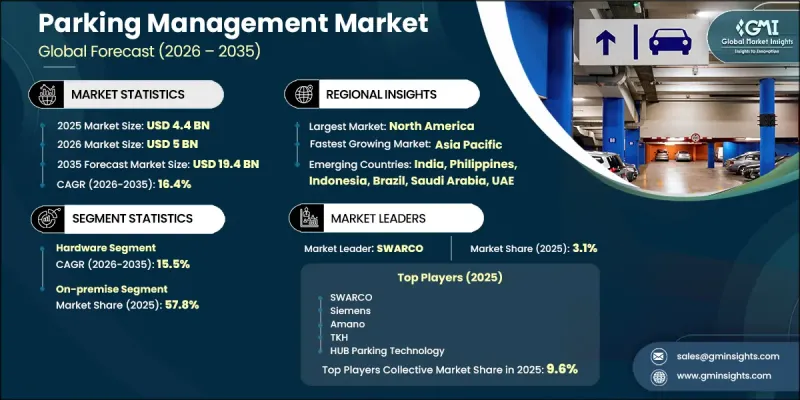
시장 성장을 견인하고 있는 요인은 자동차 보유 대수의 증가와 도시 지역의 제한된 주차 공간 공급량 사이의 격차가 확대되고 있다는 점입니다. 도시들이 교통 체증의 심화와 토지 제약에 직면함에 따라, 이해관계자들은 새로운 물리적 인프라에 투자하기보다는 기존 자산을 최대한 활용하기 위해 지능형 주차 기술을 점점 더 많이 도입하고 있습니다. 주차장 점유 현황 모니터링, 자동화된 출입 통제, 디지털 결제 시스템, 클라우드 연동, 데이터 기반 분석을 통합한 첨단 주차장 관리 솔루션을 통해 사업자들은 업무 효율 향상, 수익 증대, 그리고 사용자 경험 개선을 실현하고 있습니다. 지자체들이 지속가능한 도시 계획을 지원하기 위해 디지털 교통 인프라를 우선시하는 가운데, 스마트 도시 모빌리티 체계로의 전환이 시장 발전을 더욱 가속화하고 있습니다. 교통 최적화, 차량 공회전 시간 단축, 주차 유도 개선, 그리고 규제 준수 강화가 점점 더 중요시됨에 따라, 주차장 관리는 단순한 독립적인 운영 기능에서 더 광범위한 도시 모빌리티 생태계의 핵심 구성요소로 변모하고 있습니다. 그 결과, 선진국 시장과 신흥 시장 모두에서 스마트 주차 기술에 대한 수요가 지속적으로 증가하고 있습니다.
| 시장 범위 | |
|---|---|
| 시작 연도 | 2025년 |
| 예측 기간 | 2026-2035년 |
| 초기 시장 규모 | 44억 달러 |
| 시장 규모 예측 | 194억 달러 |
| CAGR | 16.4% |
하드웨어 분야는 2025년에 23억 8,470만 달러에 달했으며, 시장 점유율의 54%를 차지했습니다. 하드웨어 솔루션은 주차 인프라의 현대화 과정에서 여전히 핵심적인 역할을 수행하며, 차량 출입 관리, 주차 현황 감지, 결제 처리, 감시 및 교통 흐름 최적화를 뒷받침하고 있습니다. 수요는 새로운 주차 시설의 개발과 기존 주차 시스템의 현대화 모두에 의해 계속해서 견인되고 있습니다. 운영 사업자들이 자동화와 운영 효율 향상을 도모하는 가운데, 첨단 하드웨어 기술에 대한 투자는 시장 전체의 성장에 있어 여전히 주요 요인으로 작용하고 있습니다.
클라우드 기반 부문은 2035년까지 연평균 성장률(CAGR) 20.9%를 기록할 것으로 예상됩니다. 기업들은 확장성, 중앙 집중식 관리 기능, 그리고 다양한 운영 기능을 단일 생태계에 통합할 수 있는 능력을 이유로 클라우드 지원 플랫폼으로의 전환을 가속화하고 있습니다. 클라우드 인프라를 통해 운영 사업자는 통합된 디지털 플랫폼을 통해 주차 현황 정보, 거래 기록, 단속 활동, 분석 및 사용자 참여 도구를 관리할 수 있게 됩니다. 중앙 집중식 관리에 대한 관심이 높아지고 지능형 감시 기술의 도입이 확대됨에 따라, 전 세계적으로 클라우드 기반 주차 솔루션에 대한 수요는 계속해서 증가하고 있습니다.
독일의 주차장 관리 시장은 2025년에 3억 7,220만 달러의 시장 규모를 기록했으며, 2035년까지 연평균 성장률(CAGR) 15.3%로 성장할 것으로 전망됩니다. 이러한 성장은 스마트 인프라 구상, 도시 모빌리티 현대화 프로그램, 그리고 디지털 교통 시스템에 대한 투자 확대에 힘입어 이루어지고 있습니다. 데이터 보호 및 개인정보 보호와 관련된 규제 요건은 계속해서 조달 결정에 영향을 미치고 있으며, 안전하고 규정을 준수하는 주차장 관리 기술의 도입을 촉진하고 있습니다. 이 나라의 지능형 모빌리티 솔루션에 대한 노력과 진행 중인 디지털 전환 노력이 맞물려, 향후 몇 년간 시장의 지속적인 성장을 뒷받침할 것으로 예상됩니다.
자주 묻는 질문
목차
제1장 분석 방법과 범위
제2장 주요 요약
제3장 업계 인사이트
제4장 경쟁 구도
제5장 시장 추정 및 예측 : 구성요소별(2022-2035년)
제6장 시장 추정 및 예측 : 전개 방식별(2022-2035년)
제7장 시장 추정 및 예측 : 주차장별(2022-2035년)
제8장 시장 추정 및 예측 : 솔루션별(2022-2035년)
제9장 시장 추정 및 예측 : 최종사용자별(2022-2035년)
제10장 시장 추정 및 예측 : 지역별(2022-2035년)
제11장 기업 개요
KSM 26.07.03The Global Parking Management Market was valued at USD 4.4 billion in 2025 and is estimated to grow at a CAGR of 16.4% to reach USD 19.4 billion by 2035.
Market growth is driven by the widening gap between rising vehicle ownership and the limited availability of urban parking space. As cities face mounting congestion and land constraints, stakeholders are increasingly adopting intelligent parking technologies to maximize utilization of existing assets rather than investing in new physical infrastructure. Advanced parking management solutions incorporating occupancy monitoring, automated access control, digital payment systems, cloud connectivity, and data-driven analytics are enabling operators to improve operational efficiency, increase revenue generation, and enhance user experiences. The transition toward smart urban mobility frameworks is further accelerating market development as municipalities prioritize digital transportation infrastructure to support sustainable city planning. Growing emphasis on traffic optimization, reduced vehicle idle times, improved parking guidance, and enhanced regulatory compliance is transforming parking management from a standalone operational function into a critical component of broader urban mobility ecosystems. As a result, demand for intelligent parking technologies continues to increase across both developed and emerging markets.
| Market Scope | |
|---|---|
| Start Year | 2025 |
| Forecast Year | 2026-2035 |
| Start Value | $4.4 Billion |
| Forecast Value | $19.4 Billion |
| CAGR | 16.4% |
The hardware segment reached USD 2,384.7 million in 2025 accounting for 54% share. Hardware solutions remain fundamental to parking infrastructure modernization, supporting vehicle access management, occupancy detection, payment processing, monitoring, and traffic flow optimization. Demand continues to be fueled by both new parking facility developments and the modernization of legacy parking systems. As operators seek to improve automation and operational efficiency, investments in advanced hardware technologies remain a major contributor to overall market growth.
The cloud-based segment is expected to register a CAGR of 20.9% through 2035. Organizations are increasingly transitioning toward cloud-enabled platforms due to their scalability, centralized management capabilities, and ability to integrate multiple operational functions into a single ecosystem. Cloud infrastructure allows operators to manage occupancy information, transaction records, enforcement activities, analytics, and user engagement tools through unified digital platforms. The growing preference for centralized management, combined with rising adoption of intelligent monitoring technologies, continues to strengthen demand for cloud-based parking solutions worldwide.
Germany Parking Management Market generated USD 372.2 million in 2025 growing at a CAGR of 15.3% through 2035. Growth is being supported by increasing investments in smart infrastructure initiatives, urban mobility modernization programs, and digital transportation systems. Regulatory requirements surrounding data protection and privacy continue to influence procurement decisions, encouraging the adoption of secure and compliant parking management technologies. The country's commitment to intelligent mobility solutions, combined with ongoing digital transformation efforts, is expected to support sustained market expansion over the coming years.
Major companies operating in the global parking management market include SpotHero, Flowbird, TIBA Parking Systems, SKIDATA, Amano, Verra Mobility, Cleverciti Systems, HUB Parking Technology, Hectronic, Arrive, Swarco, Genetec, Designa Verkehrsleittechnik, ParkHelp Technologies, Nedap, IPS, Flash, Frogparking, CAME Parkare, and T2 Systems. Companies operating in the parking management market are focusing on technology innovation, strategic partnerships, and platform integration to strengthen their market position. Businesses are investing heavily in cloud-based solutions, artificial intelligence, predictive analytics, and real-time occupancy monitoring to improve operational efficiency and customer experience. Many vendors are expanding software capabilities to support centralized management, dynamic pricing, automated enforcement, and seamless payment processing. Strategic collaborations with municipalities, transportation authorities, and smart city developers are helping companies secure long-term projects and expand their customer base. Organizations are also prioritizing data security, regulatory compliance, and interoperability to meet evolving market requirements.
Table of Contents
Chapter 1 Methodology & Scope
- 1.1 Research approach
- 1.2 Quality Commitments
- 1.2.1 GMI AI policy & data integrity commitment
- 1.2.1.1 Source consistency protocol
- 1.2.1 GMI AI policy & data integrity commitment
- 1.3 Research Trail & Confidence Scoring
- 1.3.1 Research Trail Components
- 1.3.2 Scoring Components
- 1.4 Data Collection
- 1.4.1 Partial list of primary sources
- 1.5 Data mining sources
- 1.5.1 Paid sources
- 1.5.1.1 Sources, by region
- 1.5.1 Paid sources
- 1.6 Base estimates and calculations
- 1.6.1 Base year calculation
- 1.7 Forecast
- 1.7.1 Quantified market impact analysis
- 1.7.1.1 Mathematical impact of growth parameters on forecast
- 1.7.1 Quantified market impact analysis
- 1.8 Research transparency addendum
- 1.8.1 Source attribution framework
- 1.8.2 Quality assurance metrics
- 1.8.3 Our commitment to trust
Chapter 2 Executive Summary
- 2.1 Industry 360° synopsis
- 2.2 Key market trends
- 2.2.1 Regional
- 2.2.2 Component
- 2.2.3 Deployment Mode
- 2.2.4 Parking Site
- 2.2.5 Solution
- 2.2.6 End User
- 2.3 TAM Analysis, 2026-2035
- 2.4 CXO perspectives: Strategic imperatives
Chapter 3 Industry Insights
- 3.1 Industry ecosystem analysis
- 3.1.1 Supplier landscape
- 3.1.1.1 Raw material suppliers
- 3.1.1.2 Component suppliers
- 3.1.1.3 Manufacturers
- 3.1.1.4 Service providers
- 3.1.1.5 Distribution channel
- 3.1.1.6 End Use
- 3.1.2 Cost structure
- 3.1.3 Profit margin
- 3.1.4 Value addition at each stage
- 3.1.5 Vertical integration trends
- 3.1.6 Disruptors
- 3.1.1 Supplier landscape
- 3.2 Industry impact forces
- 3.2.1 Growth drivers
- 3.2.1.1 Rapid Urbanization and Vehicle Ownership Growth
- 3.2.1.2 Smart City Initiatives and Digital Infrastructure Investments
- 3.2.1.3 Growing Adoption of Mobile and Contactless Payments
- 3.2.1.4 Demand for Real-Time Parking Availability Solutions
- 3.2.2 Industry pitfalls & challenges
- 3.2.2.1 High Initial Infrastructure and Deployment Costs
- 3.2.2.2 Data Security and Privacy Concerns
- 3.2.3 Market opportunities
- 3.2.3.1 Cloud-Based Parking Platform Migration
- 3.2.3.2 AI-Assisted Occupancy Forecasting
- 3.2.3.3 Mobile Reservation and Contactless Payment Expansion
- 3.2.3.4 Smart Mobility Integration and Data Sharing
- 3.2.1 Growth drivers
- 3.3 Growth potential analysis
- 3.4 Pricing Analysis (Driven by Primary Research)
- 3.4.1 Historical Price Trend Analysis
- 3.4.2 Pricing Strategy by Player Type (Premium / Value / Cost-plus)
- 3.5 Regulatory landscape
- 3.5.1 North America
- 3.5.1.1 United States Department of Transportation (USDOT) - Intelligent Transportation Systems (ITS) Programs
- 3.5.1.2 Federal Highway Administration (FHWA) - Smart Parking and Urban Mobility Initiatives
- 3.5.1.3 National Highway Traffic Safety Administration (NHTSA) - Connected Vehicle and Transportation Infrastructure Guidelines
- 3.5.1.4 Transport Canada - Smart Transportation and Urban Mobility Regulations
- 3.5.2 Europe
- 3.5.2.1 European Commission - Urban Mobility Framework and Smart City Initiatives
- 3.5.2.2 Intelligent Transport Systems (ITS) Directive (EU)
- 3.5.2.3 General Data Protection Regulation (GDPR) for Parking Data Management
- 3.5.2.4 European Committee for Standardization (CEN) Smart Parking Standards
- 3.5.3 Asia-Pacific
- 3.5.3.1 China Ministry of Transport - Smart Transportation and Intelligent Parking Policies
- 3.5.3.2 Japan Ministry of Land, Infrastructure, Transport and Tourism (MLIT)
- 3.5.3.3 India Ministry of Housing and Urban Affairs (MoHUA) - Smart Cities Mission
- 3.5.3.4 Australia National Smart Cities and Transport Infrastructure Framework
- 3.5.4 Latin America
- 3.5.4.1 Brazil National Traffic Secretariat (SENATRAN) - Urban Mobility and Parking Regulations
- 3.5.4.2 Mexico Ministry of Infrastructure, Communications and Transport (SICT) - Smart Mobility Programs
- 3.5.5 Middle East & Africa
- 3.5.5.1 GCC Smart City and Intelligent Transportation Infrastructure Initiatives
- 3.5.5.2 South Africa National Land Transport Act (NLTA)
- 3.5.5.3 UAE Smart Dubai and Intelligent Mobility Regulations
- 3.5.1 North America
- 3.6 Technology and Innovation landscape
- 3.6.1 Current technologies
- 3.6.2 Emerging technologies
- 3.7 Porter's analysis
- 3.8 PESTEL analysis
- 3.9 Patent analysis (Driven by Primary Research)
- 3.10 Impact of AI & generative AI on the market
- 3.10.1 AI-Driven Disruption of Existing Business Models
- 3.10.2 Automated design optimization
- 3.10.3 Supply chain AI for demand forecasting
- 3.10.4 GenAI use cases & adoption roadmap by segment
- 3.10.5 Risks, Limitations & Regulatory Considerations
- 3.11 Sustainability and environmental aspects
- 3.11.1 Sustainable practices
- 3.11.2 Waste reduction strategies
- 3.11.3 Energy efficiency in production
- 3.11.4 Eco-friendly Initiatives
- 3.11.5 Carbon footprint considerations
- 3.12 Forecast assumptions & scenario analysis (Driven by Primary Research)
- 3.12.1 Base Case - key macro & industry variables driving CAGR
- 3.12.2 Optimistic Scenarios - Favorable Macro and Industry Tailwinds
- 3.12.3 Pessimistic Scenario - Macroeconomic slowdown or industry headwinds
Chapter 4 Competitive Landscape, 2025
- 4.1 Introduction
- 4.2 Company market share analysis
- 4.2.1 North America
- 4.2.2 Europe
- 4.2.3 Asia-Pacific
- 4.2.4 Latin America
- 4.2.5 Middle East & Africa
- 4.3 Competitive positioning matrix
- 4.4 Key developments
- 4.4.1 Mergers & acquisitions
- 4.4.2 Partnerships & collaborations
- 4.4.3 New product launches
- 4.4.4 Expansion plans and funding
- 4.5 Company tier benchmarking
- 4.5.1 Tier classification criteria & qualifying thresholds
- 4.5.2 Tier positioning matrix by revenue, geography & innovation
Chapter 5 Market Estimates & Forecast, By Component, 2022 - 2035 ($Mn)
- 5.1 Key trends
- 5.2 Hardware
- 5.2.1 Sensors & Detectors
- 5.2.2 Barriers & Gates
- 5.2.3 Payment Kiosks & Terminals
- 5.2.4 LPR Cameras
- 5.2.5 Guidance Displays & Signage
- 5.3 Software
- 5.3.1 Access & Revenue Control Software
- 5.3.2 Parking Guidance Software
- 5.3.3 Reservation Management Software
- 5.3.4 Enforcement Management Software
- 5.3.5 Security & Surveillance Software
- 5.3.6 Valet Management Software
- 5.4 Services
- 5.4.1 Consulting Services
- 5.4.2 System Integration & Deployment Services
- 5.4.3 Support & Maintenance Services
Chapter 6 Market Estimates & Forecast, By Deployment Mode, 2022 - 2035 ($Mn)
- 6.1 Key trends
- 6.2 On-Premise
- 6.3 Cloud-Based
Chapter 7 Market Estimates & Forecast, By Parking Site, 2022 - 2035 ($Mn)
- 7.1 Key trends
- 7.2 Off-Street Parking
- 7.3 On-Street Parking
Chapter 8 Market Estimates & Forecast, By Solution, 2022 - 2035 ($Mn)
- 8.1 Key trends
- 8.2 Parking Access and Revenue Control Systems
- 8.3 Parking Guidance Systems
- 8.4 Parking Reservation and Payment Solutions
- 8.5 Parking Analytics and Monitoring Solutions
- 8.6 Others
Chapter 9 Market Estimates & Forecast, By End User, 2022 - 2035 ($Mn)
- 9.1 Key trends
- 9.2 Government & Municipalities
- 9.3 Commercial Establishments
- 9.4 Residential
Chapter 10 Market Estimates & Forecast, By Region, 2022 - 2035 ($Mn)
- 10.1 North America
- 10.1.1 US
- 10.1.2 Canada
- 10.2 Europe
- 10.2.1 UK
- 10.2.2 Germany
- 10.2.3 France
- 10.2.4 Italy
- 10.2.5 Spain
- 10.2.6 Belgium
- 10.2.7 Netherlands
- 10.2.8 Sweden
- 10.2.9 Russia
- 10.3 Asia Pacific
- 10.3.1 China
- 10.3.2 India
- 10.3.3 Japan
- 10.3.4 Australia
- 10.3.5 Singapore
- 10.3.6 South Korea
- 10.3.7 Vietnam
- 10.3.8 Indonesia
- 10.3.9 Thailand
- 10.4 Latin America
- 10.4.1 Brazil
- 10.4.2 Mexico
- 10.4.3 Argentina
- 10.5 MEA
- 10.5.1 South Africa
- 10.5.2 Saudi Arabia
- 10.5.3 UAE
Chapter 11 Company Profiles
- 11.1 Global Players
- 11.1.1 SKIDATA
- 11.1.2 Amano
- 11.1.3 Arrive
- 11.1.4 Genetec
- 11.1.5 Swarco
- 11.1.6 Nedap
- 11.1.7 Verra Mobility
- 11.1.8 Designa Verkehrsleittechnik
- 11.1.9 HUB Parking Technology
- 11.1.10 ParkHelp Technologies
- 11.2 Regional Players
- 11.2.1 T2 Systems
- 11.2.2 IPS
- 11.2.3 SpotHero
- 11.2.4 Flash
- 11.2.5 TIBA Parking Systems
- 11.2.6 Hectronic
- 11.2.7 CAME Parkare
- 11.2.8 Cleverciti Systems
- 11.2.9 Flowbird
- 11.2.10 Frogparking


