
|
시장보고서
상품코드
2071309
휴머노이드 로봇 시장 : 비즈니스 기회, 성장요인, 업계 동향 분석 및 예측(2026-2035년)Humanoid Robot Market Opportunity, Growth Drivers, Industry Trend Analysis, and Forecast 2026 - 2035 |
||||||

세계의 휴머노이드 로봇 시장은 2025년에 79억 달러 규모가 되어, 2035년까지 연평균 복합 성장률(CAGR) 37.6%로 성장하여 1,927억 달러에 이를 것으로 추정되고 있습니다.
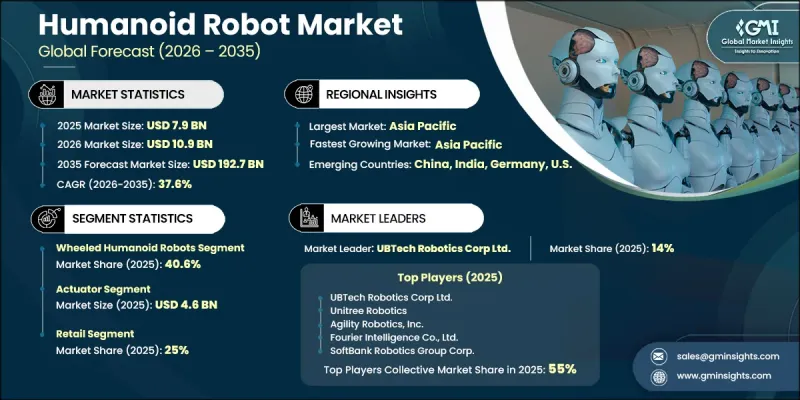
Global Market Insights Inc.가 발표한 최신 보고서에 따르면, 해당 시장은 예측 기간 동안 연평균 성장률(CAGR) 37.6%를 나타낼 것으로 전망됩니다. 산업 및 서비스 부문의 만성적인 인력 부족, 의료 및 노인 돌봄 서비스 분야에서 로봇 지원에 대한 수요 증가, 그리고 첨단 자동화 기술에 초점을 맞춘 공공 및 민간 기관 양측의 투자 확대가 시장의 급속한 성장을 뒷받침하고 있습니다. 기업들이 업무 효율과 사용자 참여도 향상을 도모할 수 있는 솔루션을 모색하는 가운데, 고객 응대 현장에서 휴머노이드 로봇의 도입이 확대되면서 업계 성장에 더욱 기여하고 있습니다. 인공지능, 머신러닝, 자율적 의사결정 능력의 지속적인 발전 덕분에 휴머노이드 로봇은 인간과의 더욱 자연스러운 대화를 실현하는 동시에, 점점 더 복잡한 작업을 수행할 수 있게 되었습니다. 로봇 개발을 지원하는 정부의 이니셔티브에 더해, 유리한 자금 조달 프로그램과 기술 혁신이 맞물리면서 전 세계적으로 상용화 노력이 가속화되고 있습니다. 또한, ‘Robots-as-a-Service(RaaS)’라는 비즈니스 모델의 등장으로 조직은 막대한 초기 투자 없이도 첨단 로봇 시스템을 활용할 수 있게 되었으며, 이로 인해 다양한 산업 분야와 용도에서의 보급이 촉진되고 있습니다.
| 시장 범위 | |
|---|---|
| 시작 연도 | 2025년 |
| 예측 기간 | 2026-2035년 |
| 시작 연도 시장 규모 | 79억 달러 |
| 예측 금액 | 1,927억 달러 |
| CAGR | 37.6% |
2025년, 바퀴식 휴머노이드 로봇 부문은 시장 점유율의 40.6%를 차지했습니다. 해당 부문이 시장을 선도하고 있는 주된 요인은 비용 효율성, 작동 안정성, 그리고 실내 환경에 대한 높은 적응성에 있습니다. 기계적으로 더 복잡한 대체 제품과 비교했을 때, 바퀴 달린 휴머노이드 로봇은 도입이 용이하고 유지보수 요구 사항이 적으며, 상업, 산업, 서비스업 등 각 분야에서 신뢰할 수 있는 성능을 발휘합니다. 이러한 실용적인 설계 덕분에 여러 최종 이용 산업 분야에서 도입이 확대되고 지속적인 수요가 뒷받침되고 있습니다.
소매 부문은 2025년에 25%의 점유율을 차지했습니다. 이 부문의 성장은 고객과의 소통, 업무 지원, 재고 관리 및 매장 내 경험 향상을 목적으로 한 휴머노이드 로봇의 활용 확대에 힘입어 이루어지고 있습니다. 소매 환경은 도입 및 통합 프로세스를 간소화하는 체계적인 운영 조건을 갖추고 있습니다. 기업들이 고객 만족도 향상, 효율성 증대 및 디지털 전환 노력을 지속적으로 우선시함에 따라, 소매 업무 분야에서 휴머노이드 로봇에 대한 수요는 예측 기간 동안 견조한 추세를 보일 것으로 전망됩니다.
2025년, 북미의 휴머노이드 로봇 시장은 22.8%의 점유율을 차지했습니다. 지역별 성장은 노동력 부족 문제 해결과 생산성 향상을 목표로 하는 제조업, 물류업 및 기술 집약형 산업 분야에서 고도화된 자동화 솔루션에 대한 수요가 증가함에 따라 뒷받침되고 있습니다. 확립된 로봇 기술 분야의 혁신 기업, 인공지능(AI) 개발 기업, 그리고 차세대 자동화 기술에 적극적으로 투자하고 있는 조직들의 존재가 시장 발전을 더욱 뒷받침하고 있습니다. 연구 기관, 기술 기업 및 민간 기업 간의 협력은 혁신을 더욱 가속화하고, 통제된 운영 환경에서의 보다 광범위한 도입을 뒷받침하고 있습니다.
자주 묻는 질문
목차
제1장 조사 방법과 범위
제2장 주요 요약
제3장 업계 인사이트
제4장 경쟁 구도
제5장 시장 추산 및 예측 : 제품별, 2022-2035년
제6장 시장 추산 및 예측 : 컴포넌트별, 2022-2035년
제7장 시장 추산 및 예측 : 용도별, 2022-2035년
제8장 시장 추산 및 예측 : 지역별, 2022-2035년
제9장 기업 개요
JHS 26.07.01The Global Humanoid Robot Market was valued at USD 7.9 billion in 2025 and is estimated to grow at a CAGR of 37.6% to reach USD 192.7 billion by 2035.
The market is anticipated to register a CAGR of 37.6% throughout the forecast period, according to the latest report published by Global Market Insights Inc. Rapid market expansion is being fueled by persistent labor shortages across industrial and service sectors, rising demand for robotic assistance in healthcare and elderly support services, and increasing investments from both public and private organizations focused on advanced automation technologies. Growing adoption of humanoid robots in customer-facing environments is further contributing to industry growth as businesses seek solutions that improve operational efficiency and user engagement. Continuous progress in artificial intelligence, machine learning, and autonomous decision-making capabilities is enabling humanoid robots to perform increasingly complex tasks while delivering more natural human interaction. Government initiatives supporting robotics development, along with favorable funding programs and technological innovation, are accelerating commercialization efforts worldwide. In addition, the emergence of Robots-as-a-Service (RaaS) business models is creating new opportunities for organizations to access advanced robotic systems without substantial upfront capital expenditures, supporting broader adoption across a wide range of industries and applications.
| Market Scope | |
|---|---|
| Start Year | 2025 |
| Forecast Year | 2026-2035 |
| Start Value | $7.9 Billion |
| Forecast Value | $192.7 Billion |
| CAGR | 37.6% |
The wheeled humanoid robots segment accounted for 40.6% share in 2025. Their market leadership is largely attributed to cost efficiency, operational stability, and strong suitability for indoor environments. Compared with more mechanically complex alternatives, wheeled humanoid robots offer simplified deployment, reduced maintenance requirements, and reliable performance across commercial, industrial, and service-oriented settings. Their practical design continues to support increasing adoption and sustained demand across multiple end-use industries.
The retail segment held a 25% share in 2025. Growth within this segment is driven by the increasing utilization of humanoid robots for customer interaction, operational support, inventory assistance, and enhanced in-store experiences. Retail environments provide structured operating conditions that simplify implementation and integration processes. As businesses continue to prioritize customer satisfaction, efficiency improvements, and digital transformation initiatives, demand for humanoid robots within retail operations is expected to remain strong throughout the forecast period.
North America Humanoid Robot Market held 22.8% share in 2025. Regional growth is supported by rising demand for advanced automation solutions across manufacturing, logistics, and technology-intensive industries seeking to address workforce challenges and improve productivity. The presence of established robotics innovators, artificial intelligence developers, and organizations actively investing in next-generation automation technologies continues to strengthen market development. Collaboration between research institutions, technology companies, and commercial enterprises is further accelerating innovation and supporting broader deployment across controlled operational environments.
Key companies operating in the global humanoid robot market include Unitree Robotics, Apptronik, Inc., Sanctuary AI Technologies Inc., Figure AI, Inc., Honda Motor Co., Ltd., SoftBank Robotics Group Corp., Neura Robotics GmbH, Agility Robotics, Inc., Mentee Robotics Ltd., UBTech Robotics Corp Ltd., Engineered Arts Limited, PAL Robotics, Clone Robotics, Tesla, Inc., Fourier Intelligence Co., Ltd., Rainbow Robotics Co., Ltd., Boston Dynamics, 1X Technologies AS, and other prominent industry participants. Companies operating in the humanoid robot market are pursuing a combination of technological innovation, strategic collaborations, and commercialization initiatives to strengthen their market position and expand their customer base. Significant investments are being directed toward artificial intelligence, machine learning, computer vision, and autonomous navigation capabilities to improve robot performance and functionality. Industry participants are also forming partnerships with technology providers, research organizations, and enterprise customers to accelerate product development and deployment. Expanding Robots-as-a-Service offerings is enabling companies to attract a wider range of customers by reducing adoption costs and financial barriers.
Table of Contents
Chapter 1 Methodology and Scope
- 1.1 Market scope and definition
- 1.2 Research design
- 1.2.1 Research approach
- 1.2.2 Data collection methods
- 1.3 Data mining sources
- 1.3.1 Global
- 1.3.2 Regional/Country
- 1.4 Base estimates and calculations
- 1.4.1 Base year calculation
- 1.4.2 Key trends for market estimation
- 1.5 Primary research and validation
- 1.5.1 Primary sources
- 1.6 Forecast model
- 1.7 Research assumptions and limitations
Chapter 2 Executive Summary
- 2.1 Industry 360° synopsis, 2022 - 2035
- 2.2 Key market trends
- 2.2.1 Product trends
- 2.2.2 Components trends
- 2.2.3 Application trends
- 2.2.4 Regional trends
- 2.3 TAM Analysis, 2026-2035
- 2.4 CXO perspectives: Strategic imperatives
Chapter 3 Industry Insights
- 3.1 Industry ecosystem analysis
- 3.1.1 Supplier Landscape
- 3.1.2 Profit Margin
- 3.1.3 Cost structure
- 3.1.4 Value addition at each stage
- 3.1.5 Factor affecting the value chain
- 3.1.6 Disruptions
- 3.2 Industry impact forces
- 3.2.1 Growth drivers
- 3.2.1.1 Rising Labor Shortages Across Industries
- 3.2.1.2 Growing demand for humanoid robots in healthcare and elderly care
- 3.2.1.3 Growing Investment and Funding from Tech Companies and Governments
- 3.2.1.4 Expansion of humanoid robots in retail, hospitality and customer service sectors
- 3.2.1.5 Advancements in AI enabling human-like interaction and autonomy
- 3.2.2 Industry pitfalls and challenges
- 3.2.2.1 High manufacturing and system integration costs
- 3.2.2.2 Limited component supply and manufacturing scalability
- 3.2.3 Market opportunities
- 3.2.3.1 Deployment of humanoid robots in hazardous and extreme environments
- 3.2.3.2 Expansion of humanoid robots in education, training, and simulation use cases
- 3.2.1 Growth drivers
- 3.3 Growth potential analysis
- 3.4 Regulatory landscape
- 3.4.1 North America
- 3.4.2 Europe
- 3.4.3 Asia Pacific
- 3.4.4 Latin America
- 3.4.5 Middle East & Africa
- 3.5 Porter's analysis
- 3.6 PESTEL analysis
- 3.7 Technology and Innovation landscape
- 3.7.1 Current technological trends
- 3.7.2 Emerging technologies
- 3.8 Price trends
- 3.8.1 By region
- 3.8.2 By product
- 3.9 Pricing Strategies
- 3.10 Emerging Business Models
- 3.11 Compliance Requirements
- 3.12 Patent and IP analysis
Chapter 4 Competitive Landscape, 2025
- 4.1 Introduction
- 4.2 Company market share analysis
- 4.2.1 By region
- 4.2.1.1 North America
- 4.2.1.2 Europe
- 4.2.1.3 Asia Pacific
- 4.2.1.4 Latin America
- 4.2.1.5 Middle East & Africa
- 4.2.2 Market concentration analysis
- 4.2.1 By region
- 4.3 Competitive benchmarking of key players
- 4.3.1 Financial performance comparison
- 4.3.1.1 Revenue
- 4.3.1.2 Profit margin
- 4.3.1.3 R&D
- 4.3.2 Product portfolio comparison
- 4.3.2.1 Product range breadth
- 4.3.2.2 Technology
- 4.3.2.3 Innovation
- 4.3.3 Geographic presence comparison
- 4.3.3.1 Global footprint analysis
- 4.3.3.2 Service network coverage
- 4.3.3.3 Market penetration by region
- 4.3.4 Competitive positioning matrix
- 4.3.4.1 Leaders
- 4.3.4.2 Challengers
- 4.3.4.3 Followers
- 4.3.4.4 Niche players
- 4.3.5 Strategic outlook matrix
- 4.3.1 Financial performance comparison
- 4.4 Key developments
- 4.4.1 Mergers and acquisitions
- 4.4.2 Partnerships and collaborations
- 4.4.3 Technological advancements
- 4.4.4 Expansion and investment strategies
- 4.4.5 Digital transformation initiatives
- 4.5 Emerging/ startup competitors landscape
Chapter 5 Market Estimates and Forecast, By Product, 2022 - 2035 (USD Million & Units)
- 5.1 Key trends
- 5.2 Bipedal humanoid robots
- 5.3 Upper-body humanoid robots
- 5.4 Wheeled humanoid robots
Chapter 6 Market Estimates and Forecast, By Components, 2022 - 2035 (USD Million & Units)
- 6.1 Key trends
- 6.2 Actuator
- 6.2.1 Rotary
- 6.2.2 Linear
- 6.2.3 Others
- 6.3 Sensors
- 6.3.1 Motion & position sensor
- 6.3.2 Force & tactile sensor
- 6.3.3 Vision sensor
- 6.3.4 Others
Chapter 7 Market Estimates and Forecast, By Application, 2022 - 2035 (USD Million & Units)
- 7.1 Key trends
- 7.2 Military & defense
- 7.3 Construction
- 7.4 Healthcare
- 7.5 Underwater systems
- 7.6 Hospitality
- 7.7 Education & scientific research
- 7.8 Residential
- 7.9 Retail
- 7.10 Others
Chapter 8 Market Estimates and Forecast, By Region, 2022 - 2035 (USD Million & Units)
- 8.1 Key trends
- 8.2 North America
- 8.2.1 U.S.
- 8.2.2 Canada
- 8.3 Europe
- 8.3.1 Germany
- 8.3.2 UK
- 8.3.3 France
- 8.3.4 Spain
- 8.3.5 Italy
- 8.3.6 Russia
- 8.4 Asia Pacific
- 8.4.1 China
- 8.4.2 India
- 8.4.3 Japan
- 8.4.4 Australia
- 8.4.5 South Korea
- 8.5 Latin America
- 8.5.1 Brazil
- 8.5.2 Mexico
- 8.5.3 Argentina
- 8.6 Middle East and Africa
- 8.6.1 South Africa
- 8.6.2 Saudi Arabia
- 8.6.3 UAE
Chapter 9 Company Profiles
- 9.1 Global Key Players
- 9.1.1 UBTech Robotics Corp Ltd.
- 9.1.2 Unitree Robotics
- 9.1.3 Agility Robotics, Inc.
- 9.1.4 Fourier Intelligence Co., Ltd.
- 9.1.5 SoftBank Robotics Group Corp.
- 9.2 Regional key players
- 9.2.1 North America
- 9.2.1.1 Apptronik, Inc.
- 9.2.1.2 Boston Dynamics (Hyundai Motor Group)
- 9.2.1.3 Figure AI, Inc.
- 9.2.1.4 Tesla, Inc. (Optimus Program)
- 9.2.1.5 Sanctuary AI Technologies Inc.
- 9.2.2 Asia Pacific
- 9.2.2.1 Honda Motor Co., Ltd.
- 9.2.2.2 Rainbow Robotics Co., Ltd.
- 9.2.3 Europe
- 9.2.3.1 Engineered Arts Limited
- 9.2.3.2 PAL Robotics
- 9.2.3.3 Neura Robotics GmbH
- 9.2.3.4 1X Technologies AS
- 9.2.4 Middle East & Africa
- 9.2.4.1 Mentee Robotics Ltd.
- 9.2.1 North America
- 9.3 Niche Players/Disruptors
- 9.3.1 Clone Robotics