|
시장보고서
상품코드
2071342
테이블 및 주방 린넨 시장 : 기회, 성장요인, 업계 동향 분석 및 예측(2026-2035년)Table and Kitchen Linen Market Opportunity, Growth Drivers, Industry Trend Analysis, and Forecast 2026 - 2035 |
||||||

세계의 테이블 및 주방 린넨 시장은 2025년에 262억 달러 규모가 되어, CAGR 5.7%로 성장하여 2035년까지 458억 달러에 이를 것으로 추정되고 있습니다.
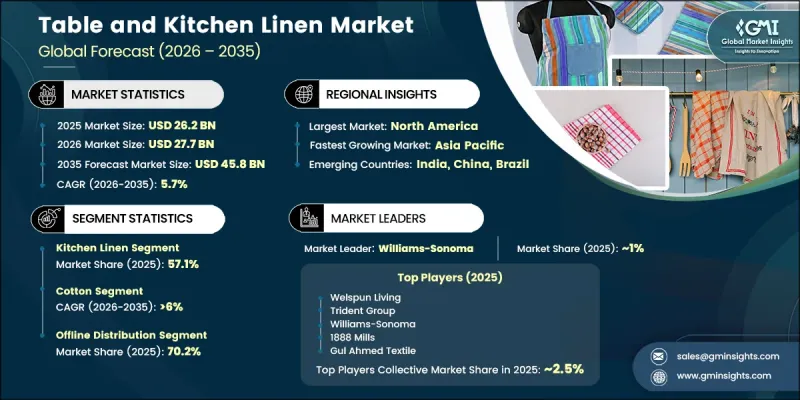
시장 확대는 유럽과 미국의 성숙한 경제권에서 소비가 꾸준히 증가하는 데 더해, 아시아태평양이나 중동과 같이 급속히 발전하고 있는 지역 수요 증가에 힘입어 이루어지고 있습니다. 가처분 소득 수준의 상승, 전 세계 호스피탈리티 산업의 지속적인 성장, 그리고 프리미엄급이자 라이프스타일을 중시하는 홈 텍스타일 제품으로의 소비자의 선호도가 뚜렷하게 변화함에 따라 장기적인 수요 기반이 강화되고 있습니다. 체계화된 소매 형태와 전자상거래 플랫폼의 보급이 확대됨에 따라 제품의 접근성이 더욱 향상되고 있으며, 각 브랜드는 통합된 온라인 채널을 통해 가성비를 중시하는 고객층과 프리미엄을 추구하는 고객층 모두에게 서비스를 제공할 수 있게 되었습니다. 이와 동시에 호텔 및 외식업체의 조달 관행은 점차 체계화되고 있으며, 기관 구매자들 사이에서는 비정기적인 구매 행태 대신 장기 공급 계약이 점점 더 보편화되고 있습니다. 호텔 및 레스토랑 및 외식 산업은 여전히 업무용 테이블 및 주방 린넨 제품에 대한 수요를 견인하는 핵심 요인으로 자리 잡고 있습니다. 아시아태평양, 중동, 북미 전역에서 호텔 객실 수 확대, 레스토랑 개발 및 외식 산업 인프라 전반에 대한 지속적인 투자로 인해 테이블 린넨, 주방 수건, 냅킨, 앞치마 등 필수 린넨 제품에 대한 안정적인 수요가 유지되고 있습니다.
| 시장 범위 | |
|---|---|
| 시작 연도 | 2025년 |
| 예측 기간 | 2026-2035년 |
| 시작 연도 시장 규모 | 262억 달러 |
| 예측 금액 | 458억 달러 |
| CAGR | 5.7% |
주방 린넨 부문은 57.1%의 시장 점유율을 차지하고 있으며, 2035년까지 연평균 성장률(CAGR) 5.3%로 성장할 것으로 전망됩니다. 이 부문의 경쟁력은 식기용 타월, 주방 타월, 오븐 장갑, 앞치마, 보호용 주방 용품 등 폭넓은 제품 포트폴리오에 기반을 두고 있으며, 일반 가정 및 업무용 시설의 최종 사용자 모두에게 제공되고 있습니다. 이 카테고리 수요는 주로 기능적인 교체 주기에 의해 주도되고 있으며, 주택 주방 및 상업용 외식 산업 분야에서 안정적인 보충 수요가 확보되고 있습니다. 장식용 테이블 린넨과 달리, 주방 린넨은 사용 빈도가 높고 교체 주기도 짧기 때문에 전 세계 시장에서 안정적이고 지속적인 수요가 유지되고 있습니다.
면 부문은 2035년까지 연평균 성장률(CAGR) 6%로 성장할 것으로 전망됩니다. 이러한 우위는 높은 흡수성, 통기성, 내구성, 관리의 용이성 등 천연 소재만이 지닌 특성에 대한 소비자들의 강한 선호에서 비롯됩니다. 또한, 면은 가정용 세탁과 산업용 세탁 공정 모두에 폭넓게 대응할 수 있으므로, 주거용 및 상업용 용도에 적합합니다. 최근 몇 년간 전 세계 면 섬유 생산량은 연간 약 2,500만-2,600만 메트르톤 수준으로 안정적으로 유지되고 있으며, 이를 통해 섬유 제조업체에 대한 원자재의 안정적인 공급이 뒷받침되어 밸류체인 전반에 걸친 공급 안정에 기여하고 있습니다.
북미의 테이블 및 주방 린넨 시장은 2025년에 26.9%의 점유율을 차지하고, 2035년까지 연평균 성장률(CAGR) 6%로 성장할 것으로 전망됩니다. 시장 확대는 고급 홈 텍스타일에 대한 소비자의 관심이 높아지고 있는 점과 회복세를 보이고 있는 상업·호스피탈리티 부문에 의해 주도되고 있습니다. 호텔 건설 활동이 활발해지고 외식 산업 인프라가 확충됨에 따라, 테이블 및 주방 린넨 제품에 대한 기관 수요가 견조한 추세를 보이고 있으며, 이는 상업용 최종 사용자 전반에 걸쳐 일관된 조달 주기를 뒷받침하고 있습니다.
자주 묻는 질문
목차
제1장 조사 방법과 범위
제2장 주요 요약
제3장 업계 인사이트
제4장 경쟁 구도
제5장 시장 추산 및 예측 : 제품 유형별, 2022-2035년
제6장 시장 추산 및 예측 : 소재별, 2022-2035년
제7장 시장 추산 및 예측 : 가격별, 2022-2035년
제8장 시장 추산 및 예측 : 최종 용도별, 2022-2035년
제9장 시장 추산 및 예측 : 유통 채널별, 2022-2035년
제10장 시장 추산 및 예측 : 지역별, 2022-2035년
제11장 기업 개요
JHS 26.07.01The Global Table and Kitchen Linen Market was valued at USD 26.2 billion in 2025 and is estimated to grow at a CAGR of 5.7% to reach USD 45.8 billion by 2035.
Market expansion is supported by steady consumption growth across established Western economies as well as rapidly developing regions such as Asia Pacific and the Middle East. Rising disposable income levels, continuous expansion of the global hospitality sector, and a clear shift in consumer preference toward premium and lifestyle-focused home textiles are strengthening long-term demand fundamentals. Increased penetration of organized retail formats and e-commerce platforms is further improving product accessibility, enabling brands to serve both value-oriented and premium customer segments through integrated online channels. In parallel, procurement practices within hotels and food service operators are becoming more structured, with long-term supply agreements increasingly replacing irregular purchasing behavior across institutional buyers. The hospitality and food service industry continues to represent the core demand driver for commercial-grade table and kitchen linen products. Ongoing investments in hotel capacity expansion, restaurant development, and broader food service infrastructure across Asia Pacific, the Middle East, and North America are sustaining stable demand for essential linen products, including table coverings, kitchen towels, napkins, and aprons.
| Market Scope | |
|---|---|
| Start Year | 2025 |
| Forecast Year | 2026-2035 |
| Start Value | $26.2 Billion |
| Forecast Value | $45.8 Billion |
| CAGR | 5.7% |
The kitchen linen segment held a 57.1% share and is projected to grow at a CAGR of 5.3% through 2035. The segment's dominance is supported by its wide product portfolio, which includes dish towels, kitchen towels, oven mitts, aprons, and protective kitchen accessories, serving both household and institutional end users. Demand in this category is largely driven by functional replacement cycles, ensuring consistent replenishment across residential kitchens and commercial food service operations. Unlike decorative table linen, kitchen linen benefits from frequent usage and higher replacement frequency, which sustains stable and recurring demand across global markets.
The cotton segment is projected to grow at a CAGR of 6% through 2035. Its dominance is attributed to strong consumer preference for its natural properties, including high absorbency, breathability, durability, and ease of maintenance. Cotton is also widely compatible with both household washing and industrial laundering processes, making it suitable for residential and commercial applications. Stable global cotton fiber production levels, maintained at approximately 25-26 million metric tonnes annually in recent years, have supported consistent raw material availability for textile manufacturers, contributing to supply stability across the value chain.
North America Table and Kitchen Linen Market accounted for 26.9% share in 2025 and is expected to grow at a CAGR of 6% through 2035. Market expansion is driven by rising consumer interest in premium home textiles and a recovering commercial hospitality sector. Increasing hotel construction activity and expanding food service infrastructure are generating strong institutional demand for table and kitchen linen products, supporting consistent procurement cycles across commercial end users.
Major companies operating in the global table and kitchen linen market include Welspun Living, Trident Group, Garnier-Thiebaut, Libeco, Ralph Lauren Home, and 1888 Mills. Companies in the table and kitchen linen market are adopting diversified growth strategies to strengthen their market presence and enhance long-term competitiveness. Product innovation is a key focus area, with manufacturers introducing premium, durable, and design-oriented linen products tailored to evolving consumer lifestyles. Sustainability initiatives are gaining importance, with increased adoption of eco-friendly fibers, responsible sourcing practices, and low-impact dyeing processes. Expansion of e-commerce and direct-to-consumer channels is enabling brands to improve market reach while building stronger customer relationships and improving margin structures. Strategic partnerships with hospitality and food service operators support long-term supply contracts and ensuring consistent demand visibility.
Table of Contents
Chapter 1 Methodology and Scope
- 1.1 Market scope and definition
- 1.2 Research design
- 1.2.1 Research approach
- 1.2.2 Data collection methods
- 1.3 Data mining sources
- 1.3.1 Global
- 1.3.2 Regional/Country
- 1.4 Base estimates and calculations
- 1.4.1 Base year calculation
- 1.4.2 Key trends for market estimation
- 1.5 Primary research and validation
- 1.5.1 Primary sources
- 1.6 Forecast model
- 1.7 Research assumptions and limitations
Chapter 2 Executive Summary
- 2.1 Industry 360° synopsis
- 2.2 Key market trends
- 2.2.1 Regional
- 2.2.2 Product type
- 2.2.3 Material
- 2.2.4 Price
- 2.2.5 End user
- 2.2.6 Distribution channel
Chapter 3 Industry Insights
- 3.1 Industry ecosystem analysis
- 3.1.1 Raw material suppliers
- 3.1.2 Manufacturers & textile mills
- 3.1.3 Distributors, wholesalers & importers
- 3.1.4 Retail channels
- 3.1.5 End users
- 3.1.6 Profit margin
- 3.1.7 Value addition at each stage
- 3.1.8 Factor affecting the value chain
- 3.2 Industry impact forces
- 3.2.1 Growth drivers
- 3.2.1.1 Rising global hospitality & food service industry expansion driving commercial linen procurement
- 3.2.1.2 Growing consumer spending on home decor & kitchen aesthetics fueling residential demand
- 3.2.1.3 Social media influence on dining & kitchen styling
- 3.2.2 Pitfalls & challenges
- 3.2.2.1 Volatility in raw material prices increasing production costs
- 3.2.2.2 Increasing competition from low-cost synthetic substitutes & disposable tableware alternatives
- 3.2.3 Opportunities
- 3.2.3.1 Premiumization & customization trend creating high-margin growth segments
- 3.2.3.2 Growing demand for sustainable, organic & OEKO-TEX certified linen products
- 3.2.1 Growth drivers
- 3.3 Growth potential analysis
- 3.4 Technology and innovation landscape
- 3.4.1 Advanced fabric technologies
- 3.4.2 Digital textile printing & custom design innovation
- 3.4.3 Smart textiles & functional fabric developments
- 3.5 Regulatory & licensing framework
- 3.5.1 Global textile safety & chemical regulations
- 3.5.2 Sustainability & eco-label compliance requirements
- 3.6 Pricing analysis (driven by primary research)
- 3.6.1 Historical price trend analysis by product category
- 3.6.2 Pricing strategy by player type (premium / value / cost-plus)
- 3.7 Supply chain analysis
- 3.7.1 Global sourcing hubs
- 3.7.2 Supply chain disruption risks & mitigation strategies
- 3.7.3 Nearshoring & reshoring trends in textile procurement
- 3.8 Trade data analysis (driven by paid database) (HS code- 6302)
- 3.8.1 Import/export volume & value trends by product category
- 3.8.2 Key trade corridors & tariff impact
- 3.9 Impact of AI & generative AI on the market
- 3.9.1 AI-driven disruption of existing business models
- 3.9.2 GenAI use cases & adoption roadmap by segment
- 3.9.3 Risks, limitations & regulatory considerations
- 3.10 Distribution infrastructure & channel penetration landscape (driven by primary research)
- 3.10.1 Channel coverage by region & format (modern vs. traditional trade)
- 3.10.2 Last-mile infrastructure gaps & emerging channel shifts
Chapter 4 Competitive Landscape, 2025
- 4.1 Introduction
- 4.2 Company market share analysis
- 4.2.1 By region
- 4.2.1.1 North America
- 4.2.1.2 Europe
- 4.2.1.3 Asia Pacific
- 4.2.1.4 Latin America
- 4.2.1.5 Middle East and Africa
- 4.2.1 By region
- 4.3 Company matrix analysis
- 4.4 Competitive analysis of major market players
- 4.5 Competitive positioning matrix
- 4.6 Key developments
- 4.6.1 Mergers & acquisitions
- 4.6.2 Partnerships & collaborations
- 4.6.3 New product launches
- 4.6.4 Expansion plans
Chapter 5 Market Estimates and Forecast, By Product Type, 2022 - 2035 (USD Billion) (Million Units)
- 5.1 Key trends
- 5.2 Table linen
- 5.2.1 Tablecloths
- 5.2.2 Table runners
- 5.2.3 Placemats & table mat
- 5.2.4 Napkins
- 5.2.5 Others (table skirting, table overlays, etc.)
- 5.3 Kitchen linen
- 5.3.1 Kitchen towels & dish towels
- 5.3.2 Aprons
- 5.3.3 Pot holders & oven mitts/gloves
- 5.3.4 Others (dishcloths, sink mats, etc.)
Chapter 6 Market Estimates and Forecast, By Material, 2022 - 2035 (USD Billion) (Million Units)
- 6.1 Key trends
- 6.2 Cotton
- 6.2.1 Conventional cotton
- 6.2.2 Organic & sustainably sourced cotton
- 6.3 Linen
- 6.4 Artificial fibers (polyester, microfiber & blends)
- 6.4.1 Polyester
- 6.4.2 Microfiber
- 6.4.3 Blended fabrics (cotton-polyester, etc.)
- 6.5 Others (silk, wool, bamboo, terrycloth)
Chapter 7 Market Estimates and Forecast, By Price Range, 2022 - 2035 (USD Billion) (Million Units)
- 7.1 Key trends
- 7.2 Low
- 7.3 Medium
- 7.4 High
Chapter 8 Market Estimates and Forecast, By End Use, 2022 - 2035 (USD Billion) (Million Units)
- 8.1 Key trends
- 8.2 Residential
- 8.3 Commercial
- 8.3.1 Hospitality
- 8.3.2 Food service
- 8.3.3 Institutional
Chapter 9 Market Estimates and Forecast, By Distribution Channel, 2022 - 2035 (USD Billion) (Million Units)
- 9.1 Key trends
- 9.2 Online
- 9.2.1 Company website
- 9.2.2 E-commerce website
- 9.3 Offline
- 9.3.1 Hypermarkets & supermarkets
- 9.3.2 Departmental & specialty home stores
- 9.3.3 Wholesale & institutional supply channels
- 9.3.4 Others (home decor boutiques, pop-up stores)
Chapter 10 Market Estimates and Forecast, By Region, 2022 - 2035 (USD Billion) (Million Units)
- 10.1 Key trends
- 10.2 North America
- 10.2.1 U.S.
- 10.2.2 Canada
- 10.3 Europe
- 10.3.1 Germany
- 10.3.2 UK
- 10.3.3 France
- 10.3.4 Italy
- 10.3.5 Spain
- 10.4 Asia Pacific
- 10.4.1 China
- 10.4.2 Japan
- 10.4.3 India
- 10.4.4 Australia
- 10.4.5 South Korea
- 10.5 Latin America
- 10.5.1 Brazil
- 10.5.2 Mexico
- 10.5.3 Argentina
- 10.6 Middle East and Africa
- 10.6.1 South Africa
- 10.6.2 Saudi Arabia
- 10.6.3 UAE
Chapter 11 Company Profiles
- 11.1 Global players
- 11.1.1 Welspun Living
- 11.1.2 Trident Group
- 11.1.3 Garnier-Thiebaut
- 11.1.4 Libeco
- 11.1.5 Ralph Lauren Home
- 11.1.6 1888 Mills
- 11.2 Regional players
- 11.2.1 Alok Industries
- 11.2.2 Gul Ahmed Textile Mills
- 11.2.3 Milliken & Company (Table Linens)
- 11.2.4 Williams-Sonoma
- 11.2.5 Zorluteks Tekstil
- 11.2.6 Beauville (MIE)
- 11.2.7 Tessitura Carlo Lamperti
- 11.2.8 SFERRA Fine Linens
- 11.2.9 American Dawn (ADI)
- 11.2.10 AB Siulas (Linen Fashion)
- 11.2.11 LinenMe
- 11.3 Emerging players
- 11.3.1 Coyuchi
- 11.3.2 Cultiver
- 11.3.3 Rough Linen
- 11.3.4 NJU Linen