

|
시장보고서
상품코드
2071355
전신 홍반성 루푸스(SLE) 치료 시장 성장 기회, 성장요인, 업계 동향 분석 및 예측(2026-2035년)Systemic Lupus Erythematosus Treatment Market Opportunity, Growth Drivers, Industry Trend Analysis, and Forecast 2026 - 2035 |
||||||

세계의 전신 홍반성 루푸스 치료 시장은 2025년에 30억 달러로 평가되었고 CAGR 7.8%로 성장하여 2035년까지 63억 달러에 이를 것으로 추정되고 있습니다.
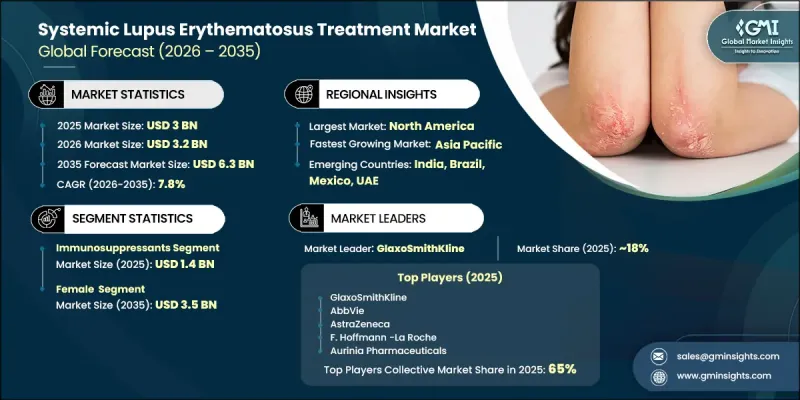
이러한 성장은 질병의 조기 발견에 대한 인식 제고, 진단 정확도의 향상, 그리고 첨단 치료법의 보급에 힘입어 이루어지고 있습니다. 특히 가임기 여성에서 전신 홍반성 루푸스의 발병률 증가가 효과적인 질환 관리 요법에 대한 장기적인 수요를 뒷받침하고 있습니다. 의료비 증가, 만성 질환 및 희귀질환 치료를 지원하는 노력, 그리고 면역학 분야의 지속적인 혁신이 시장 확대를 더욱 뒷받침하고 있습니다. 정밀 의학 및 바이오마커에 기반한 접근법의 활용 확대는 더욱 개인화되고 치료 성과에 초점을 맞춘 치료 전략을 가능하게 함으로써, 치료의 패러다임을 변화시키고 있습니다. 전문 의료 서비스 제공업체에 대한 접근성 확대와 환자 모니터링 시스템의 개선 또한 환자 집단 전체의 질환 관리 향상과 재발률 감소를 뒷받침하고 있습니다.
| 시장 범위 | |
|---|---|
| 시작 연도 | 2025년 |
| 예측 기간 | 2026-2035년 |
| 시작 연도 시장 규모 | 30억 달러 |
| 예측 금액 | 63억 달러 |
| CAGR | 7.8% |
전신 홍반성 루푸스(SLE)의 치료란, 피부, 관절, 신장, 심혈관계, 신경계 등 여러 장기계에 영향을 미치는 만성 자가면역질환을 관리하기 위해 사용되는 일련의 치료 접근법을 의미합니다. 주요 치료 목표는 염증을 완화하고, 면역계의 활동을 조절하며, 장기 손상을 예방하고, 장기적인 삶의 질(QOL)을 향상시키는 것입니다. 치료 옵션으로는 코르티코스테로이드, 비스테로이드성 항염증제(NSAIDs), 항말라리아제, 면역억제제, 생물학적 제제, 그리고 특정 면역 경로를 표적으로 하는 새로운 표적 치료법 등이 포함됩니다. 맞춤형 의료 접근법이 점점 더 널리 보급됨에 따라 치료의 정확도가 높아지고, 환자의 예후가 개선되고 있습니다.
2025년, 면역억제제 부문 시장 규모는 14억 달러에 달했습니다. 이러한 압도적인 점유율은 면역계의 과잉 반응을 억제하고 질환의 진행을 막는 데 있어 이러한 치료법이 수행하는 필수적인 역할에 기인합니다. 널리 사용되는 약제는 특히 신장 합병증이나 다기관 병변을 동반한 사례에서 중등도에서 중증의 질환 상태를 관리하는 데 기여하고 있습니다.
2025년, 병원 약국 부문은 52.6%의 점유율을 차지하며, 복잡한 루푸스 치료 요법을 제공하는 데 있어 핵심적인 역할을 하고 있음을 반영하고 있습니다. 이러한 시설들은 특히 질환이 재발하거나 치료를 시작하는 단계에서 치밀한 임상적 감독이 필요한 첨단 치료법을 적시에 이용할 수 있도록 보장하고 있습니다. 다직종 연계 케어팀과의 협력을 통해 최적의 치료법 선택, 안전성 모니터링 및 이상반응 관리가 지원되며, 환자 케어 과정에서 그 중요성이 더욱 커지고 있습니다.
북미 전신 홍반성 루푸스 치료 시장은 2025년에 38.4%의 점유율을 기록했습니다. 이는 고도로 발달한 의료 인프라와 혁신적인 치료법의 적극적인 도입에 힘입은 결과입니다. 이 지역은 조기 진단이 활발히 이루어지고, 질병에 대한 인지도가 높으며, 전문 의료 서비스를 폭넓게 이용할 수 있다는 장점이 있습니다. 제약 회사와 생명공학 기업의 적극적인 진출과 활발한 임상 연구 환경이 어우러져, 새로운 치료 옵션의 혁신과 상용화를 지속적으로 추진하고 있습니다.
자주 묻는 질문
목차
제1장 조사 방법과 범위
제2장 주요 요약
제3장 업계 인사이트
제4장 경쟁 구도
제5장 시장 추산 및 예측 : 약제 클래스별, 2022-2035년
제6장 시장 추산 및 예측 : 성별, 2022-2035년
제7장 시장 추산 및 예측 : 투여 경로별, 2022-2035년
제8장 시장 추산 및 예측 : 유통 채널별, 2022-2035년
제9장 시장 추산 및 예측 : 지역별, 2022-2035년
제10장 기업 개요
JHS 26.07.01The Global Systemic Lupus Erythematosus Treatment Market was valued at USD 3 billion in 2025 and is estimated to grow at a CAGR of 7.8% to reach USD 6.3 billion by 2035.
Growth is driven by increasing awareness of early disease detection, improved diagnostic accuracy, and broader availability of advanced treatment options. The higher incidence of systemic lupus erythematosus, particularly among women in reproductive age groups, is sustaining long-term demand for effective disease management therapies. Expanding healthcare expenditure, supportive initiatives for chronic and rare disease treatment, and continuous innovation in immunology are further reinforcing market expansion. The increasing use of precision medicine and biomarker-based approaches is reshaping treatment paradigms by enabling more individualized and outcome-focused care strategies. Growing access to specialist healthcare providers and improved patient monitoring systems is also supporting better disease control and reduced flare frequency across patient populations.
| Market Scope | |
|---|---|
| Start Year | 2025 |
| Forecast Year | 2026-2035 |
| Start Value | $3 Billion |
| Forecast Value | $6.3 Billion |
| CAGR | 7.8% |
Systemic lupus erythematosus treatment refers to a range of therapeutic approaches used to manage a chronic autoimmune condition that affects multiple organ systems, including the skin, joints, kidneys, cardiovascular system, and nervous system. The primary treatment goal is to reduce inflammation, control immune system activity, prevent organ damage, and improve long-term quality of life. Therapeutic options include corticosteroids, nonsteroidal anti-inflammatory drugs, antimalarial agents, immunosuppressants, biologics, and newer targeted therapies designed to address specific immune pathways. Increasing adoption of personalized medicine approaches is enhancing treatment precision and improving patient outcomes.
The immunosuppressants segment generated USD 1.4 billion in 2025. This dominance is attributed to the essential role these therapies play in controlling immune overactivity and preventing disease progression. Widely used agents support the management of moderate to severe disease conditions, particularly in cases involving kidney complications and multi-organ involvement.
The hospital pharmacies segment accounted for a 52.6% share in 2025, reflecting their central role in the delivery of complex lupus treatment regimens. These facilities ensure timely access to advanced therapies that require close clinical supervision, particularly during disease flare-ups or treatment initiation phases. Their integration with multidisciplinary care teams supports optimized treatment selection, safety monitoring, and adverse event management, reinforcing their importance in patient care pathways.
North America Systemic Lupus Erythematosus Treatment Market held a 38.4% share in 2025, supported by a highly advanced healthcare infrastructure and strong adoption of innovative therapies. The region benefits from early diagnosis practices, high disease awareness, and broad access to specialized care services. Strong participation from pharmaceutical and biotechnology companies, combined with an active clinical research environment, continues to drive innovation and commercialization of new treatment options.
Major players operating in the global systemic lupus erythematosus treatment industry include AstraZeneca, AbbVie, F. Hoffmann-La Roche, GlaxoSmithKline, Teva Pharmaceutical, Sandoz, Sun Pharmaceutical, Cipla, Lupin, Aurinia Pharmaceuticals, and ImmuPharma. Companies in the systemic lupus erythematosus treatment market are strengthening their market position by investing in biologics and next-generation immunotherapies that target specific immune pathways involved in disease progression. They are expanding clinical trial programs to accelerate approval timelines for novel therapies and improve treatment efficacy. Strategic collaborations between pharmaceutical companies and research institutions are supporting faster drug development and broader clinical validation. Firms are also focusing on biomarker-driven precision medicine approaches to improve patient stratification and treatment outcomes. Expansion into emerging markets with rising autoimmune disease prevalence is further supporting growth.
Table of Contents
Chapter 1 Methodology and Scope
- 1.1 Market scope and definition
- 1.2 Research approach
- 1.3 Quality commitments
- 1.3.1 GMI AI policy and data integrity commitment
- 1.3.1.1 Source consistency protocol
- 1.3.1 GMI AI policy and data integrity commitment
- 1.4 Research trail and confidence scoring
- 1.4.1 Research trail components
- 1.4.2 Scoring components
- 1.5 Data collection
- 1.5.1 Partial list of primary sources
- 1.6 Data mining sources
- 1.6.1 Paid sources
- 1.6.1.1 Sources, by region
- 1.6.1 Paid sources
- 1.7 Base estimates and calculations
- 1.7.1 Revenue share analysis
- 1.7.2 Base year calculation
- 1.8 Forecast model
- 1.9 Research transparency addendum
- 1.9.1 Source attribution framework
- 1.9.2 Quality assurance metrics
- 1.9.3 Our commitment to trust
Chapter 2 Executive Summary
- 2.1 Industry 3600 synopsis
- 2.2 Key market trends
- 2.2.1 Regional trends
- 2.2.2 Drug class trends
- 2.2.3 Gender trends
- 2.2.4 Route of administration trends
- 2.2.5 Distribution channel trends
- 2.3 CXO perspectives: Strategic imperatives
Chapter 3 Industry Insights
- 3.1 Industry ecosystem analysis
- 3.2 Industry impact forces
- 3.2.1 Growth drivers
- 3.2.1.1 Increasing prevalence of SLE
- 3.2.1.2 Advancements in treatment options
- 3.2.1.3 Increased government funding and support for research on autoimmune diseases
- 3.2.2 Industry pitfalls & challenges
- 3.2.2.1 High cost of treatment
- 3.2.2.2 Limited awareness and diagnosis
- 3.2.3 Market opportunities
- 3.2.3.1 Development of organ-specific lupus therapies
- 3.2.3.2 Expansion of personalized and precision medicine approaches
- 3.2.3.3 Rising demand for steroid-sparing targeted therapies
- 3.2.1 Growth drivers
- 3.3 Growth potential analysis
- 3.4 Regulatory landscape (Driven by Primary Research)
- 3.4.1 North America
- 3.4.2 Europe
- 3.4.3 Asia Pacific
- 3.4.4 Latin America
- 3.4.5 Middle East and Africa
- 3.5 Pipeline analysis (Driven by Primary Research)
- 3.6 Future market trends (Driven by Primary Research)
- 3.7 Technology and innovation trends
- 3.7.1 Current technology
- 3.7.2 Emerging technology
- 3.8 Impact of AI and Generative AI on the market (Driven by Primary Research)
- 3.9 Porter's analysis
- 3.10 PESTEL analysis
Chapter 4 Competitive Landscape, 2025
- 4.1 Introduction
- 4.2 Company market share analysis
- 4.2.1 North America
- 4.2.2 Europe
- 4.2.3 Asia Pacific
- 4.3 Company matrix analysis
- 4.4 Competitive analysis of major market players
- 4.5 Competitive positioning matrix
- 4.6 Key developments
- 4.6.1 Merger and acquisition
- 4.6.2 Partnership and collaboration
- 4.6.3 New product launches
- 4.6.4 Expansion plans
Chapter 5 Market Estimates and Forecast, By Drug Class, 2022 - 2035 ($ Mn)
- 5.1 Key trends
- 5.2 Immunosuppressants
- 5.3 Corticosteroids
- 5.4 Biologics
- 5.5 Antimalarials
- 5.6 NSAIDs
Chapter 6 Market Estimates and Forecast, By Gender, 2022 - 2035 ($ Mn)
- 6.1 Key trends
- 6.2 Female
- 6.3 Male
Chapter 7 Market Estimates and Forecast, By Route of Administration, 2022 - 2035 ($ Mn)
- 7.1 Key trends
- 7.2 Oral
- 7.3 Intravenous
- 7.4 Subcutaneous
Chapter 8 Market Estimates and Forecast, By Distribution Channel, 2022 - 2035 ($ Mn)
- 8.1 Key trends
- 8.2 Hospital pharmacies
- 8.3 Retail pharmacies
- 8.4 Other distribution channels
Chapter 9 Market Estimates and Forecast, By Region, 2022 - 2035 ($ Mn)
- 9.1 Key trends
- 9.2 North America
- 9.2.1 U.S.
- 9.2.2 Canada
- 9.3 Europe
- 9.3.1 Germany
- 9.3.2 UK
- 9.3.3 France
- 9.3.4 Spain
- 9.3.5 Italy
- 9.3.6 Poland
- 9.3.7 Netherlands
- 9.4 Asia Pacific
- 9.4.1 China
- 9.4.2 Japan
- 9.4.3 India
- 9.4.4 Australia
- 9.4.5 South Korea
- 9.5 Latin America
- 9.5.1 Brazil
- 9.5.2 Mexico
- 9.5.3 Argentina
- 9.6 Middle East and Africa
- 9.6.1 South Africa
- 9.6.2 Saudi Arabia
- 9.6.3 UAE
Chapter 10 Company Profiles
- 10.1 AbbVie
- 10.2 AstraZeneca
- 10.3 Aurinia Pharmaceuticals
- 10.4 Cipla
- 10.5 F. Hoffmann-La Roche
- 10.6 GlaxoSmithKline
- 10.7 ImmuPharma
- 10.8 Lupin
- 10.9 Sandoz
- 10.10 Sun Pharmaceutical
- 10.11 Teva Pharmaceutical


