
|
시장보고서
상품코드
2071359
광견병 백신 시장 기회, 성장 촉진요인, 산업 동향 분석, 예측(2026-2035년)Rabies Vaccine Market Opportunity, Growth Drivers, Industry Trend Analysis, and Forecast 2026 - 2035 |
||||||

세계의 광견병 백신 시장은 2025년에 12억 달러로 평가되었으며, CAGR 4.5%로 성장하여 2035년까지 19억 달러에 달할 것으로 추정됩니다.
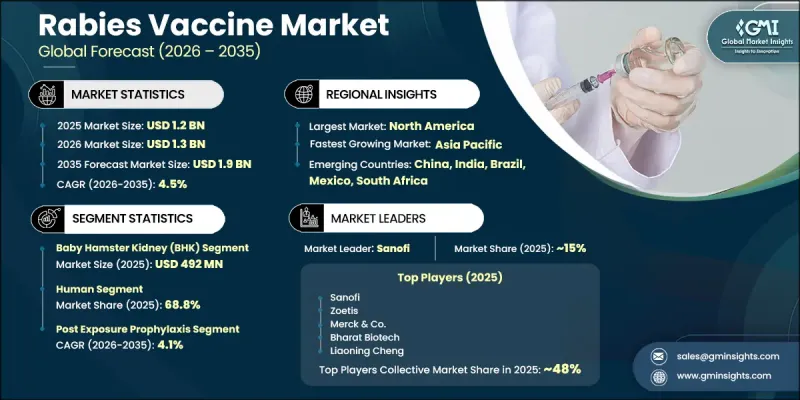
시장 확대에는 광견병 예방에 대한 인식 제고, 동물에 의한 물림 사고의 증가, 그리고 노출 후 예방(PEP)에 대한 의존도 증가가 큰 영향을 미치고 있습니다. 또한, 개발도상국에서 정부가 주도하는 예방접종 이니셔티브 역시 백신 보급을 가속화하는 데 중요한 역할을 하고 있습니다. 동시에, 광견병으로 인한 사망을 근절하고 저·중소득 국가에서의 백신 접근성을 높이는 것을 목표로 하는 전 세계적인 노력이 수요를 더욱 부추기고 있습니다.
| 시장 범위 | |
|---|---|
| 시작 연도 | 2025년 |
| 예측 기간 | 2026-2035년 |
| 시작 시점 시장 규모 | 12억 달러 |
| 예측액 | 19억 달러 |
| CAGR | 4.5% |
광견병은 특히 감염 위험이 여전히 비교적 높은 아시아와 아프리카에서 심각한 공중보건 문제로 남아 있습니다. 광견병 백신은 광견병 바이러스에 대한 면역력을 활성화하기 위해 개발된 생물학적 제제입니다. 광견병은 임상 증상이 나타나면 거의 확실하게 사망에 이르는 질병입니다. 이러한 백신은 실험실 전문가, 수의사, 여행자 등 고위험군에 대한 노출 전 예방(PrEP)으로, 또한 동물에게 물리거나 할퀴인 후의 노출 후 예방으로 투여됩니다. 정부 주도의 백신 접종 프로그램 확대, 동물 광견병 대책에 대한 투자 증가, 그리고 유행 지역에서의 의료비 증가로 인해 시장은 꾸준한 성장세를 보이고 있습니다. 인도, 중국 및 일부 아프리카 국가에서는 개를 대상으로 한 대규모 백신 접종 캠페인과 인간용 백신에 대한 접근성 개선을 통해 예방 프로그램을 적극적으로 확대하고 있습니다.
2025년, 베이비 햄스터 신장(BHK) 부문은 4억 9,200만 달러의 시장 규모를 기록했습니다. 이 부문은 통제된 환경에서 효율적인 대규모 바이러스 배양을 가능하게 하기 때문에 광견병 백신 제조에 널리 이용되고 있습니다. BHK 세포 플랫폼은 높은 바이러스 수율, 빠른 증식 특성, 그리고 생물공정 중 효율적인 바이러스 증식을 촉진하는 능력을 갖추고 있어, 불활성화 광견병 백신 제조에 널리 활용되고 있습니다. 기존의 신경 조직 유래 방법을 대체하여 세포 배양 기반의 백신 제조로 전환이 진행되고 있는 점이, 광견병 백신 제조에 있어 BHK 기반 기술의 채택을 더욱 촉진하고 있습니다.
2025년에는 인간용 부문이 68.8%의 점유율을 차지했습니다. 전 세계적으로 인간의 광견병 노출 사례가 많고, 동물에 물린 후 노출 후 예방의 필요성이 높아지고 있는 만큼, 이 부문은 여전히 주요 카테고리로 자리 잡고 있습니다. 이 부문의 성장은 즉각적인 치료의 필요성에 대한 일반 대중의 인식 제고, 정부가 지원하는 예방접종 프로그램의 확대, 그리고 첨단 세포 배양 기반 백신의 접근성 향상 등에 힘입어 이루어지고 있습니다. 또한, 의료비 증가, 유행 지역에서의 백신 접종 기회 확대, 그리고 인간 광견병으로 인한 사망을 근절하기 위한 지속적인 공중보건 이니셔티브 역시 이 부문의 성장을 더욱 촉진하고 있습니다.
2025년, 북미의 광견병 백신 시장은 39.3%의 점유율을 차지했습니다. 이 지역의 경쟁력은 첨단 의료 인프라, 광견병 예방에 대한 높은 인식, 그리고 특히 미국 내 노출 후 예방 서비스에 대한 폭넓은 접근성을 바탕으로 하고 있습니다.
전 세계 광견병 백신 업계에서 사업을 전개하는 주요 기업으로는 사노피, 머크 앤 컴퍼니, 조에티스, 베링거 인겔하임, 바바리안 노르딕, 엘란코 애니멀 헬스, 빌백, AIM 백신, 바라트 바이오테크, 바이오제네시스 바고, 카디라 파마슈티컬스, 청두 생물제품연구소, 랴오닝 청다 주식회사, 인디언 이뮤놀로지칼스, 자이다스 라이프사이언스 등이 있습니다. 광견병 백신 시장의 각 기업은 첨단 세포 배양 기술과 바이오 제조 역량의 지속적인 향상을 통해 생산 확장성 강화에 주력하고 있습니다. 공중보건 기관 및 정부와의 전략적 제휴는 유행 지역에서의 백신 접종률 확대에 기여하고 있습니다. 또한, 각 제약사는 백신의 안전성, 유효성 및 보관 안정성을 향상시키기 위한 연구에도 투자하고 있습니다. 특히 농촌 지역이나 의료 서비스가 미비한 지역의 유통망이 확대됨에 따라, 백신을 구하기가 더 쉬워지고 있습니다. 또한, 각 기업은 감염원에서의 전파를 억제하기 위해 인식 제고 캠페인과 수의사가 진행하는 백신 접종 프로그램에 대한 투자를 확대하고 있습니다. 제품 포트폴리오의 다각화, 신흥 시장 규제 당국의 승인 획득, 그리고 시설 업그레이드를 통한 생산능력 확대는 장기적인 시장 입지와 경쟁 우위를 더욱 공고히 하고 있습니다.
자주 묻는 질문
목차
제1장 조사 방법과 범위
제2장 주요 요약
제3장 업계 인사이트
제4장 경쟁 구도
제5장 시장 추정 및 예측 : 제품 유형별, 2022-2035년
제6장 시장 추정 및 예측 : 유형별, 2022-2035년
제7장 시장 추정 및 예측 : 용도별, 2022-2035년
제8장 시장 추정 및 예측 : 유통 채널별, 2022-2035년
제9장 시장 추정 및 예측 : 지역별, 2022-2035년
제10장 기업 개요
KSM 26.07.03The Global Rabies Vaccine Market was valued at USD 1.2 billion in 2025 and is estimated to grow at a CAGR of 4.5% to reach USD 1.9 billion by 2035.
Market expansion is strongly influenced by increasing awareness regarding rabies prevention, a rising incidence of animal bite cases, and the growing reliance on post-exposure prophylaxis (PEP). Government-led immunization initiatives across developing regions are also playing a critical role in accelerating vaccine adoption. At the same time, global efforts aimed at eliminating rabies-related mortality and improving vaccine accessibility in low- and middle-income countries are further strengthening demand.
| Market Scope | |
|---|---|
| Start Year | 2025 |
| Forecast Year | 2026-2035 |
| Start Value | $1.2 Billion |
| Forecast Value | $1.9 Billion |
| CAGR | 4.5% |
Rabies continues to represent a serious public health challenge, especially across Asia and Africa, where exposure risks remain comparatively high. Rabies vaccines are biological preparations developed to activate immunity against the rabies virus, a disease that is almost always fatal once clinical symptoms develop. These vaccines are administered as pre-exposure prophylaxis (PrEP) for high-risk groups such as laboratory professionals, veterinarians, and travelers, as well as post-exposure prophylaxis following animal bites or scratches. The market has shown steady growth due to expanding government-backed vaccination programs, increasing investment in animal rabies control, and rising healthcare expenditure in endemic regions. Countries such as India and China, along with several African nations, are actively scaling up prevention programs through mass dog vaccination drives and improved human vaccine access.
The Baby Hamster Kidney (BHK) segment generated USD 492 million in 2025. This segment is widely utilized in rabies vaccine production because it supports efficient large-scale viral cultivation in controlled environments. BHK cell platforms are extensively used in manufacturing inactivated rabies vaccines due to their strong viral yield, rapid growth characteristics, and ability to facilitate efficient virus propagation during bioprocessing. The increasing shift toward cell culture-based vaccine production, replacing older nerve tissue-derived methods, has further reinforced the adoption of BHK-based technologies in rabies vaccine manufacturing.
The human segment accounted for 68.8% share in 2025. It remains the dominant category due to the high global incidence of human rabies exposure and the increasing need for post-exposure prophylaxis following animal bites. Growth in this segment is supported by rising public awareness of immediate treatment requirements, expanding immunization programs backed by governments, and improved availability of advanced cell culture-based vaccines. Additionally, increasing healthcare expenditure, broader vaccine accessibility in endemic regions, and sustained public health initiatives aimed at eliminating human rabies deaths are further supporting segment expansion.
North America Rabies Vaccine Market held a 39.3% share in 2025. The region's dominance is supported by advanced healthcare infrastructure, strong awareness of rabies prevention, and broad access to post-exposure prophylaxis services, particularly in the United States.
A few of the prominent players operating in the global rabies vaccine industry include Sanofi, Merck & Co., Zoetis, Boehringer Ingelheim, Bavarian Nordic, Elanco Animal Health, Virbac, AIM Vaccine, Bharat Biotech, Biogenesis Bago, Cadila Pharmaceuticals, Chengdu Institute of Biological Products, Liaoning Cheng Da Co., Ltd., Indian Immunologicals Ltd., and Zydus Lifesciences. Companies in the rabies vaccine market are focusing on strengthening production scalability through advanced cell culture technologies and continuous upgrades in biomanufacturing capabilities. Strategic collaborations with public health organizations and governments are helping expand vaccination coverage in endemic regions. Manufacturers are also investing in research to improve vaccine safety, efficacy, and storage stability. Expansion of distribution networks, particularly in rural and underserved areas, is improving accessibility. In addition, firms are increasing investments in awareness campaigns and veterinary vaccination programs to reduce transmission at the source. Portfolio diversification, regulatory approvals in emerging markets, and capacity expansion through facility upgrades are further supporting long-term market positioning and competitive advantage.
Table of Contents
Chapter 1 Methodology and Scope
- 1.1 Market scope and definition
- 1.2 Research approach
- 1.3 Quality commitments
- 1.3.1 GMI AI policy and data integrity commitment
- 1.3.1.1 Source consistency protocol
- 1.3.1 GMI AI policy and data integrity commitment
- 1.4 Research trail and confidence scoring
- 1.4.1 Research trail components
- 1.4.2 Scoring components
- 1.5 Data collection
- 1.5.1 Partial list of primary sources
- 1.6 Data mining sources
- 1.6.1 Paid sources
- 1.6.1.1 Sources, by region
- 1.6.1 Paid sources
- 1.7 Base estimates and calculations
- 1.7.1 Revenue share analysis
- 1.7.2 Base year calculation
- 1.8 Forecast model
- 1.9 Research transparency addendum
- 1.9.1 Source attribution framework
- 1.9.2 Quality assurance metrics
- 1.9.3 Our commitment to trust
Chapter 2 Executive Summary
- 2.1 Industry 360° synopsis
- 2.2 Key market trends
- 2.2.1 Regional trends
- 2.2.2 Product type trends
- 2.2.3 Type trends
- 2.2.4 Application trends
- 2.2.5 Distribution channel trends
- 2.3 CXO perspectives: Strategic imperatives
Chapter 3 Industry Insights
- 3.1 Industry ecosystem analysis
- 3.2 Industry impact forces
- 3.2.1 Growth drivers
- 3.2.1.1 Increasing incidence of animal bite cases
- 3.2.1.2 Government-led rabies elimination programs
- 3.2.1.3 Growing awareness regarding preventive vaccination
- 3.2.1.4 Expansion of healthcare access in emerging economies
- 3.2.2 Industry pitfalls & challenges
- 3.2.2.1 Limited access in low-income regions
- 3.2.2.2 High cost of post-exposure treatment
- 3.2.2.3 Underreporting of rabies cases
- 3.2.3 Market opportunities
- 3.2.3.1 Expansion of "Zero by 30" global initiative
- 3.2.1 Growth drivers
- 3.3 Growth potential analysis
- 3.4 Regulatory landscape (Driven by primary research)
- 3.4.1 North America
- 3.4.2 Europe
- 3.4.3 Asia Pacific
- 3.4.4 Latin America
- 3.4.5 MEA
- 3.5 Technology landscape
- 3.5.1 Current technological trends
- 3.5.2 Emerging technologies (Driven by Primary Research)
- 3.6 Porter's analysis
- 3.7 PESTEL analysis
- 3.8 Pricing analysis (Driven by Primary Research)
- 3.8.1 Historical price trend analysis
- 3.8.2 Pricing strategy, by product type
- 3.9 Pipeline analysis and clinical trial landscape
- 3.10 Future market trends (Driven by primary research)
- 3.11 Investment & funding analysis
- 3.12 Impact of AI and Generative AI on the market
Chapter 4 Competitive Landscape, 2025
- 4.1 Introduction
- 4.2 Company matrix analysis
- 4.3 Company market share analysis (Driven by primary research)
- 4.3.1 Global
- 4.3.2 North America
- 4.3.3 Europe
- 4.3.4 Asia Pacific
- 4.4 Competitive positioning matrix
- 4.5 Competitive analysis of major market players
- 4.6 Key developments
- 4.6.1 Mergers & acquisitions
- 4.6.2 Partnerships & collaborations
- 4.6.3 New product launches
- 4.6.4 Expansion plans
Chapter 5 Market Estimates and Forecast, By Product Type, 2022 - 2035 ($ Mn)
- 5.1 Key trends
- 5.2 Baby Hamster Kidney (BHK)
- 5.3 Purified chick embryo cell rabies vaccine
- 5.4 Vero cell rabies vaccine
- 5.5 Other product types
Chapter 6 Market Estimates and Forecast, By Type, 2022 - 2035 ($ Mn)
- 6.1 Key trends
- 6.2 Human
- 6.3 Veterinary
Chapter 7 Market Estimates and Forecast, By Application, 2022 - 2035 ($ Mn)
- 7.1 Key trends
- 7.2 Pre exposure prophylaxis
- 7.3 Post exposure prophylaxis
Chapter 8 Market Estimates and Forecast, By Distribution Channel, 2022 - 2035 ($ Mn)
- 8.1 Key trends
- 8.2 Hospital pharmacies
- 8.3 Retail pharmacies
- 8.4 Online pharmacies
Chapter 9 Market Estimates and Forecast, By Region, 2022 - 2035 ($ Mn)
- 9.1 Key trends
- 9.2 North America
- 9.2.1 U.S.
- 9.2.2 Canada
- 9.3 Europe
- 9.3.1 Germany
- 9.3.2 UK
- 9.3.3 France
- 9.3.4 Spain
- 9.3.5 Italy
- 9.3.6 Netherlands
- 9.4 Asia Pacific
- 9.4.1 China
- 9.4.2 Japan
- 9.4.3 India
- 9.4.4 Australia
- 9.4.5 South Korea
- 9.5 Latin America
- 9.5.1 Brazil
- 9.5.2 Mexico
- 9.5.3 Argentina
- 9.6 Middle East and Africa
- 9.6.1 South Africa
- 9.6.2 Saudi Arabia
- 9.6.3 UAE
Chapter 10 Company Profiles
- 10.1 AIM Vaccine
- 10.2 Bharat Biotech
- 10.3 Boehringer Ingelheim
- 10.4 Bavarian Nordic
- 10.5 BiogenesisBago
- 10.6 Chengdu Institute of Biological Products
- 10.7 Cadila Pharmaceuticals
- 10.8 Elanco Animal Health
- 10.9 Indian Immunologicals Ltd.
- 10.10 Liaoning Cheng Da Co., Ltd.
- 10.11 Merck & Co.
- 10.12 Sanofi
- 10.13 Virbac
- 10.14 Zoetis
- 10.15 Zydus Lifesciences