

|
시장보고서
상품코드
2083080
자동차용 이더넷 트랜시버 및 컨트롤러 IC 시장 기회, 성장요인, 업계 동향 분석 및 예측(2026-2035년)Automotive Ethernet Transceivers and Controller IC Market Opportunity, Growth Drivers, Industry Trend Analysis, and Forecast 2026 - 2035 |
||||||

세계의 자동차용 이더넷 트랜시버 및 컨트롤러 IC 시장은 2025년에 14억 달러로 평가되었고, CAGR 15.1%로 성장하여 2035년까지 55억 달러에 달할 것으로 예측됩니다.
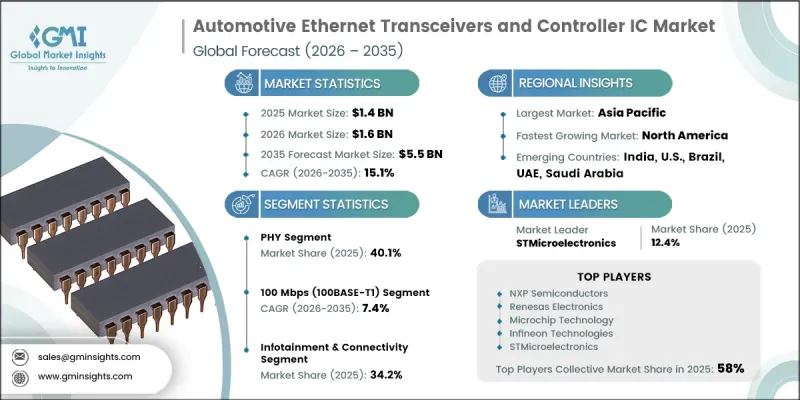
자동차 업계가 지능적이고 연결성이 뛰어나며 소프트웨어 중심의 차량 아키텍처로 점점 더 전환됨에 따라, 이 시장은 눈부신 성장세를 보이고 있습니다. 자동차용 이더넷 기술은 현대 차량의 핵심 통신 백본으로 자리 잡고 있으며, 다양한 전자 시스템 간에 고속·저지연·고신뢰성의 데이터 전송에 대한 수요 증가를 뒷받침하고 있습니다. 차량 아키텍처가 분산형 전자 네트워크에서 집중형 컴퓨팅 플랫폼으로 계속 진화함에 따라, 대폭 증가한 데이터 양을 처리할 수 있는 첨단 이더넷 트랜시버 및 컨트롤러 IC에 대한 수요는 계속해서 증가하고 있습니다. ADAS(첨단 운전자 지원 시스템), 커넥티드카 기술, 실시간 데이터 처리 기능, 그리고 첨단 차량용 컴퓨팅 플랫폼의 통합이 진행되고 있는 것이 이 기술의 도입을 더욱 가속화하고 있습니다. 또한, 사이버 보안, 기능 안전 및 데이터 신뢰성에 대한 중요성이 커짐에 따라, 자동차 제조업체와 기술 제공업체들은 차량 생태계 전반에 걸쳐 안전하고 결정론적인 정보 교환을 보장하는 견고한 통신 솔루션의 도입을 추진하고 있습니다. 또한, 차세대 모빌리티 기술, 지능형 차량 플랫폼 및 첨단 센서 기반 시스템을 뒷받침하는 데 있어 자동차용 이더넷의 중요성이 점점 더 커짐에 따라, 기존 차량 네트워크를 넘어선 용도의 확대도 시장에 긍정적인 영향을 미치고 있습니다. 반도체 설계 분야의 지속적인 혁신과 차량 디지털화에 대한 투자 확대가 맞물리면서, 향후 몇 년 동안 자동차용 이더넷 트랜시버 및 컨트롤러 IC 제조업체에 큰 성장 기회가 찾아올 것으로 예측됩니다.
| 시장 범위 | |
|---|---|
| 개시연도 | 2025년 |
| 예측 기간 | 2026-2035년 |
| 초기 시장 규모 | 14억 달러 |
| 예측액 | 55억 달러 |
| CAGR | 15.1% |
PHY 부문은 40.1%의 점유율을 차지하고 있으며, 2026년부터 2035년까지 연평균 성장률(CAGR) 14.5%로 성장할 것으로 전망됩니다. PHY 구성 요소는 차량 내 네트워크 전체에서 고속 물리 계층 통신을 가능하게 하며, 지연을 최소화한 효율적인 데이터 전송을 지원하는 데 있어 매우 중요한 역할을 하고 있습니다. 이러한 보급을 뒷받침하고 있는 것은 점점 더 복잡해지는 차량용 전자 아키텍처에서 대역폭 확대, 신호整合성 향상, 에너지 효율 향상, 그리고 신뢰성 높은 통신 성능에 대한 수요가 높아지고 있기 때문입니다. 자동차 시스템이 점점 더 데이터 집약적으로 변함에 따라, 업계 전반에 걸쳐 첨단 PHY 솔루션에 대한 수요는 계속해서 증가하고 있습니다.
2025년, 인포테인먼트 및 커넥티비티 분야는 34.2%의 점유율을 차지했습니다. 이 분야의 성장은 커넥티드 서비스, 첨단 멀티미디어 플랫폼, 디지털 콕핏 기술, 그리고 원활한 차량 내 통신 기능의 통합이 진전되고 있는 데 힘입고 있습니다. 자동차용 이더넷은 현대의 인포테인먼트 생태계를 뒷받침하는 데 필요한 대량의 데이터를 신속하게 전송할 수 있게 하여, 사용자 경험을 향상시키고 연결 성능을 개선합니다. 디지털 기술로 강화된 차량 내 환경에 대한 소비자의 기대감이 높아지면서 고속 네트워크 인프라에 대한 투자를 지속적으로 견인하고 있으며, 이는 해당 부문의 성장을 더욱 뒷받침하고 있습니다.
중국의 자동차용 이더넷 트랜시버 및 컨트롤러 IC 시장은 2025년에 65.2%의 점유율을 차지하며 5억 450만 달러 시장 규모를 기록했습니다. 이 나라의 선도적인 위상은 광범위한 자동차 생산 능력, 전기차 보급 가속화, 그리고 소프트웨어 정의 차량 플랫폼의 도입 확대에 힘입어 유지되고 있습니다. 지능형 모빌리티 솔루션, 첨단 차량용 전자기기 및 중앙 집중형 컴퓨팅 아키텍처에 대한 투자가 확대됨에 따라, 고성능 차량용 네트워크 기술에 대한 수요가 크게 증가하고 있습니다. 자동차 생산의 지속적인 현대화와 커넥티드카 기능의 급속한 통합에 힘입어, 중국은 자동차용 이더넷 기술의 주요 성장 시장으로서의 입지를 계속해서 공고히 하고 있습니다.
자주 묻는 질문
목차
제1장 조사 방법
제2장 주요 요약
제3장 업계 인사이트
제4장 경쟁 구도
제5장 시장 추산 및 예측 : 컴포넌트별, 2022년-2035년
제6장 시장 추산 및 예측 : 이더넷 속도별, 2022년-2035년
제7장 시장 추산 및 예측 : 용도별, 2022년-2035년
제8장 시장 추산 및 예측 : 차량별, 2022년-2035년
제9장 시장 추산 및 예측 : 지역별, 2022년-2035년
제10장 기업 개요
LSH 26.07.13The Global Automotive Ethernet Transceivers and Controller IC Market was valued at USD 1.4 billion in 2025 and is estimated to grow at a CAGR of 15.1% to reach USD 5.5 billion by 2035.
The market is experiencing significant momentum as the automotive industry increasingly shifts toward intelligent, connected, and software-driven vehicle architecture. Automotive Ethernet technology has become a critical communication backbone within modern vehicles, supporting the growing demand for high-speed, low-latency, and dependable data transmission across various electronic systems. As vehicle architecture continues to evolve from distributed electronic networks toward centralized computing platforms, the need for advanced Ethernet transceivers and controller ICs capable of handling substantially higher data volumes continues to rise. The growing integration of advanced driver assistance systems connected vehicle technologies, real-time data processing capabilities, and sophisticated onboard computing platforms is further accelerating adoption. In addition, increasing emphasis on cybersecurity, functional safety, and data reliability is encouraging automakers and technology providers to deploy robust communication solutions that ensure secure and deterministic information exchange throughout the vehicle ecosystem. The market is also benefiting from expanding applications beyond conventional vehicle networking, as automotive Ethernet becomes increasingly important for supporting next-generation mobility technologies, intelligent vehicle platforms, and advanced sensor-based systems. Continuous innovation in semiconductor design, coupled with rising investments in vehicle digitalization, is expected to create substantial growth opportunities for automotive Ethernet transceivers and controller IC manufacturers over the coming years.
| Market Scope | |
|---|---|
| Start Year | 2025 |
| Forecast Year | 2026-2035 |
| Start Value | $1.4 Billion |
| Forecast Value | $5.5 Billion |
| CAGR | 15.1% |
The PHY segment accounted for 40.1% share and is anticipated to grow at a CAGR of 14.5% from 2026 to 2035. PHY components play a vital role in enabling high-speed physical-layer communication across vehicle networks, supporting efficient data transmission with minimal latency. Their widespread adoption is driven by the growing need for enhanced bandwidth capabilities, improved signal integrity, greater energy efficiency, and reliable communication performance within increasingly complex vehicle electronic architectures. As automotive systems become more data-intensive, demand for advanced PHY solutions continues to strengthen across the industry.
The infotainment and connectivity segment held a share of 34.2% in 2025. The segment's growth is supported by the increasing integration of connected services, advanced multimedia platforms, digital cockpit technologies, and seamless in-vehicle communication capabilities. Automotive Ethernet enables the rapid transfer of large volumes of data required to support modern infotainment ecosystems, delivering enhanced user experiences and improved connectivity performance. Growing consumer expectations for digitally enhanced vehicle environments continue to drive investments in high-speed networking infrastructure, further supporting segment expansion.
China Automotive Ethernet Transceivers and Controller IC Market held a 65.2% share, generating USD 504.5 million in 2025. The country's leadership position is supported by its extensive automotive manufacturing capabilities, accelerating adoption of electric vehicles, and growing deployment of software-defined vehicle platforms. Increasing investments in intelligent mobility solutions, advanced vehicle electronics, and centralized computing architectures are creating strong demand for high-performance in-vehicle networking technologies. The ongoing modernization of automotive production and the rapid integration of connected vehicle features continue to reinforce China's position as a key growth market for automotive Ethernet technologies.
Major companies operating in the Global Automotive Ethernet Transceivers and Controller IC Market include Infineon Technologies, NXP Semiconductors, Marvell Technology, Broadcom, STMicroelectronics, Texas Instruments, and Microchip Technology. Companies operating in the automotive Ethernet transceivers and controller IC market are prioritizing technological innovation, strategic collaborations, and product portfolio expansion to strengthen their competitive position. Leading manufacturers are investing heavily in advanced semiconductor technologies that support higher bandwidth, lower latency, enhanced cybersecurity, and improved functional safety. Businesses are also developing scalable solutions designed to support evolving software-defined vehicle architectures and centralized computing platforms. Strategic partnerships with automakers, Tier-1 suppliers, and mobility technology providers are helping companies accelerate product adoption and strengthen ecosystem integration. Additionally, market participants are focusing on research and development initiatives to improve energy efficiency, reliability, and communication performance.
Table of Contents
Chapter 1 Methodology
- 1.1 Research approach
- 1.2 Quality Commitments
- 1.2.1 GMI AI policy & data integrity commitment
- 1.2.1.1 Source consistency protocol
- 1.2.1 GMI AI policy & data integrity commitment
- 1.3 Research Trail & Confidence Scoring
- 1.3.1 Research Trail Components
- 1.3.2 Scoring Components
- 1.4 Data Collection
- 1.4.1 Partial list of primary sources
- 1.5 Data mining sources
- 1.5.1 Paid sources
- 1.5.1.1 Sources, by region
- 1.5.1 Paid sources
- 1.6 Base estimates and calculations
- 1.6.1 Base year calculation
- 1.7 Forecast
- 1.7.1 Quantified market impact analysis
- 1.7.1.1 Mathematical impact of growth parameters on forecast
- 1.7.1 Quantified market impact analysis
- 1.8 Research transparency addendum
- 1.8.1 Source attribution framework
- 1.8.2 Quality assurance metrics
- 1.8.3 Our commitment to trust
Chapter 2 Executive Summary
- 2.1 Industry 360° synopsis, 2022 - 2035
- 2.2 Key market trends
- 2.2.1 Regional
- 2.2.2 Component
- 2.2.3 Ethernet Speed
- 2.2.4 Application
- 2.2.5 Vehicle
- 2.3 TAM Analysis, 2026-2035
- 2.4 CXO perspectives: Strategic imperatives
Chapter 3 Industry Insights
- 3.1 Industry ecosystem analysis
- 3.1.1 Supplier landscape
- 3.1.2 Profit margin analysis
- 3.1.3 Cost structure
- 3.1.4 Value addition at each stage
- 3.1.5 Factor affecting the value chain
- 3.1.6 Disruptions
- 3.2 Industry impact forces
- 3.2.1 Growth drivers
- 3.2.1.1 Increasing adoption of connected and software-defined vehicles (SDVs)
- 3.2.1.2 Rising deployment of ADAS and autonomous driving systems
- 3.2.1.3 Growing electrification of vehicles
- 3.2.1.4 Expansion of zonal and centralized vehicle architectures
- 3.2.2 Industry pitfalls and challenges
- 3.2.2.1 High design and integration complexity
- 3.2.2.2 Stringent automotive reliability and safety requirements
- 3.2.3 Market opportunities
- 3.2.3.1 Emergence of Multi-Gig Automotive Ethernet
- 3.2.3.2 Growth in autonomous and connected vehicle ecosystems
- 3.2.3.3 Increasing adoption of over-the-air (OTA) software updates
- 3.2.3.4 Integration of Ethernet with domain and zonal controllers
- 3.2.1 Growth drivers
- 3.3 Growth potential analysis
- 3.4 Pricing Analysis (Driven by Primary Research)
- 3.4.1 Historical Price Trend Analysis
- 3.4.2 Pricing Strategy by Player Type
- 3.5 Cost breakdown analysis
- 3.6 Regulatory landscape
- 3.6.1 North America
- 3.6.1.1 National Highway Traffic Safety Administration (NHTSA), United States
- 3.6.1.2 U.S. Department of Transportation (USDOT)
- 3.6.1.3 SAE International
- 3.6.1.4 Standards Council of Canada (SCC)
- 3.6.2 Europe
- 3.6.2.1 European Commission (EC)
- 3.6.2.2 United Nations Economic Commission for Europe (UNECE)
- 3.6.2.3 European Telecommunications Standards Institute (ETSI)
- 3.6.2.4 European Committee for Standardization (CEN)
- 3.6.3 Asia Pacific
- 3.6.3.1 Ministry of Industry and Information Technology (MIIT), China
- 3.6.3.2 Standardization Administration of China (SAC)
- 3.6.3.3 Ministry of Road Transport and Highways (MoRTH), India
- 3.6.3.4 Ministry of Land, Infrastructure, Transport and Tourism (MLIT), Japan
- 3.6.4 Latin America
- 3.6.4.1 National Institute of Metrology, Quality and Technology (INMETRO), Brazil
- 3.6.4.2 National Agency for Industrial Safety and Environmental Protection (ASEA), Mexico
- 3.6.4.3 Argentine Institute for Standardization and Certification (IRAM), Argentina
- 3.6.5 Middle East and Africa
- 3.6.5.1 Saudi Standards, Metrology and Quality Organization (SASO), Saudi Arabia
- 3.6.5.2 Emirates Authority for Standardization and Metrology (ESMA) / UAE Ministry of Industry and Advanced Technology (MoIAT)
- 3.6.5.3 Qatar General Organization for Standards and Metrology (QS)
- 3.6.1 North America
- 3.7 Porter's analysis
- 3.8 PESTEL analysis
- 3.9 Technology and Innovation Landscape
- 3.9.1 Current technological trends
- 3.9.2 Emerging technologies
- 3.10 Patent Landscape (Driven by Primary Research)
- 3.11 Cost breakdown analysis
- 3.12 Trade data analysis (Driven by Paid Research)
- 3.12.1 Import/export volume & value trends
- 3.12.2 Key trade corridors & tariff impact
- 3.13 Capacity & production landscape (Driven by Primary Research)
- 3.13.1 Installed capacity by region & key producer
- 3.13.2 Capacity utilization rates & expansion pipelines
- 3.14 Impact of AI & Generative AI on the Market (Driven by Primary Research)
- 3.14.1 AI-Driven Disruption of Existing Business Models
- 3.14.2 GenAI Use Cases & Adoption Roadmap by Segment
- 3.14.3 Risks, Limitations & Regulatory Considerations
- 3.15 Sustainability and environmental aspects
- 3.15.1 Sustainable practices
- 3.15.2 Waste reduction strategies
- 3.15.3 Energy efficiency in production
- 3.15.4 Eco-friendly initiatives
- 3.15.5 Carbon footprint considerations
- 3.16 Forecast assumptions & scenario analysis (Driven by Primary Research)
- 3.16.1 Base Case- Key Macro & Industry Variables Driving CAGR
- 3.16.2 Optimistic Scenarios- Favorable macro and industry tailwinds
- 3.16.3 Pessimistic Scenario - Macroeconomic slowdown or industry headwinds
Chapter 4 Competitive Landscape, 2025
- 4.1 Introduction
- 4.2 Company market share analysis
- 4.2.1 North America
- 4.2.2 Europe
- 4.2.3 Asia Pacific
- 4.2.4 LATAM
- 4.2.5 MEA
- 4.3 Competitive analysis of major market players
- 4.4 Competitive positioning matrix
- 4.5 Key developments
- 4.5.1 Mergers & acquisitions
- 4.5.2 Partnerships & collaborations
- 4.5.3 New Product Launches
- 4.5.4 Expansion Plans and funding
- 4.6 Company tier benchmarking
- 4.6.1 Tier classification criteria & qualifying thresholds
- 4.6.2 Tier positioning matrix by revenue, geography & innovation
Chapter 5 Market Estimates & Forecast, By Component, 2022 - 2035 ($Mn, Units)
- 5.1 Key trends
- 5.2 Controller
- 5.2.1 Standalone Single-Port MAC Controller ICs
- 5.2.2 Multi-Port MAC Controller ICs
- 5.3 PHY Transceivers
- 5.3.1 100BASE-T1 PHY Transceivers
- 5.3.2 1000BASE-T1 PHY Transceivers
- 5.3.3 Multi-Gigabit PHY Transceivers
- 5.4 Switch
- 5.4.1 2-Port Automotive Ethernet Bridge ICs
- 5.4.2 Multi-Port Automotive Ethernet Switch ICs (4-Port, 8-Port)
- 5.5 Integrated MAC+PHY ICs
- 5.5.1 Single-Port Integrated MAC+PHY
- 5.5.2 Multi-Port Integrated MAC+PHY
Chapter 6 Market Estimates & Forecast, By Ethernet Speed, 2022 - 2035 ($Mn, Units)
- 6.1 Key trends
- 6.2 10 Mbps (10BASE-T1S)
- 6.3 100 Mbps (100BASE-T1)
- 6.4 1 Gbps (1000BASE-T1)
- 6.5 2.5G / 5G / 10G Automotive Ethernet
Chapter 7 Market Estimates & Forecast, By Application, 2022 - 2035 ($Mn, Units)
- 7.1 Key trends
- 7.2 ADAS & Autonomous Driving
- 7.3 Infotainment & Connectivity
- 7.4 Body & Chassis Electronics
- 7.5 Gateway & Powertrain
- 7.6 Other
Chapter 8 Market Estimates & Forecast, By Vehicle, 2022 - 2035 ($Mn, Units)
- 8.1 Key trends
- 8.2 Passenger Vehicles
- 8.2.1 Sedan
- 8.2.2 SUV
- 8.2.3 Hatchback
- 8.3 Commercial Vehicles
- 8.3.1 LCV
- 8.3.2 MCV
- 8.3.3 HCV
Chapter 9 Market Estimates & Forecast, By Region, 2022 - 2035 ($Mn, Units)
- 9.1 Key trends
- 9.2 North America
- 9.2.1 US
- 9.2.2 Canada
- 9.3 Europe
- 9.3.1 Germany
- 9.3.2 UK
- 9.3.3 France
- 9.3.4 Italy
- 9.3.5 Spain
- 9.3.6 Russia
- 9.3.7 Netherlands
- 9.3.8 Nordic
- 9.4 Asia Pacific
- 9.4.1 China
- 9.4.2 India
- 9.4.3 Japan
- 9.4.4 Australia
- 9.4.5 South Korea
- 9.4.6 Singapore
- 9.4.7 Thailand
- 9.4.8 Indonesia
- 9.4.9 Malaysia
- 9.5 Latin America
- 9.5.1 Brazil
- 9.5.2 Mexico
- 9.5.3 Argentina
- 9.6 MEA
- 9.6.1 South Africa
- 9.6.2 Saudi Arabia
- 9.6.3 UAE
Chapter 10 Company Profiles
- 10.1 Global Players
- 10.1.1 NXP Semiconductors
- 10.1.2 Infineon Technologies
- 10.1.3 Texas Instruments
- 10.1.4 Broadcom
- 10.1.5 Microchip Technology
- 10.1.6 Realtek Semiconductor
- 10.1.7 Motorcomm Electronic
- 10.1.8 JLSemi
- 10.1.9 onsemi
- 10.1.10 Toshiba Electronic Devices & Storage
- 10.2 Regional Players
- 10.2.1 Analog Devices
- 10.2.2 Siemens
- 10.2.3 Tasson Technology
- 10.2.4 Renesas Electronics
- 10.2.5 STMicroelectronics
- 10.2.6 KungGao Microelectronics
- 10.2.7 ROHM Semiconductor


