

|
시장보고서
상품코드
2083286
리치 스태커 시장 기회, 성장 촉진요인, 업계 동향 분석 및 예측(2026-2035년)Reach Stacker Market Opportunity, Growth Drivers, Industry Trend Analysis, and Forecast 2026 - 2035 |
||||||

세계의 리치 스태커 시장은 2025년에 21억 달러로 평가되었으며, CAGR 5.5%로 성장하여 2035년까지 36억 달러에 달할 것으로 추정됩니다.
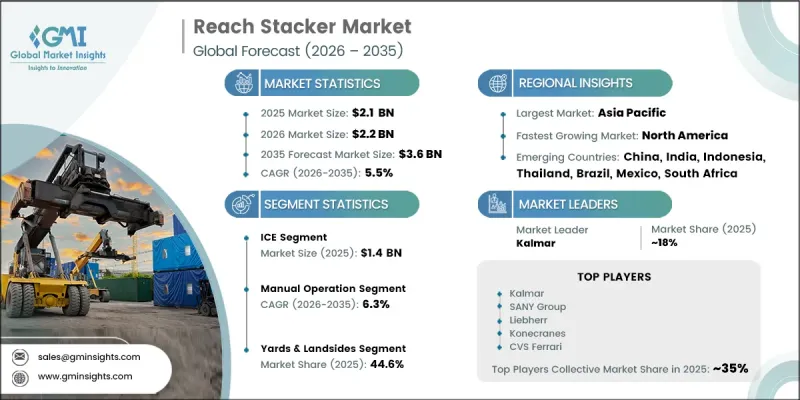
세계 무역량이 지속적으로 증가함에 따라 리치 스태커 시장은 꾸준히 확대되고 있으며, 항만, 화물 터미널, 물류 허브 전반에 걸쳐 효율적인 자재 취급 장비에 대한 지속적인 수요가 발생하고 있습니다. 지속적인 경제 통합과 국경을 넘는 화물 이동 증가에 힘입어 국제 무역 활동이 활발해지면서, 첨단 자재 취급 솔루션에 대한 투자가 촉진되고 있습니다. 또한, 복합운송 시스템의 도입 확대에 따라 철도, 도로, 해상 네트워크 간에 컨테이너를 원활하게 이동시킬 수 있는 장비에 대한 수요가 더욱 높아지고 있습니다. 리치 스태커는 적재 및 하역 시간을 단축하는 동시에 보관 야드의 운영을 최적화함으로써, 컨테이너 취급 효율 향상에 중요한 역할을 하고 있습니다. 항만 확장, 물류 인프라의 현대화, 그리고 화물 처리 능력에 대한 지속적인 투자 역시 시장 성장에 기여하고 있습니다. 컨테이너 화물 운송량의 증가에 더해, 전 세계 E-Commerce 및 공급망 네트워크의 급속한 확대로 인해 물류 업체들은 최신 컨테이너 하역 장비를 통해 업무 생산성을 높이려 하고 있습니다. 이러한 장기적인 추세는 선진국과 신흥국을 막론하고 리치 스태커 업계에 계속해서 호기를 창출하고 있습니다.
| 시장 범위 | |
|---|---|
| 시작 연도 | 2025년 |
| 예측 기간 | 2026-2035년 |
| 개시 금액 | 21억 달러 |
| 예측 금액 | 36억 달러 |
| CAGR | 5.5% |
2025년에는 내연기관(ICE) 부문이 시장 점유율의 66.9%를 차지하며 14억 달러의 매출을 올렸습니다. ICE 구동 리치 스태커는 혹독한 컨테이너 취급 작업에서 그 성능이 입증됨에 따라 계속해서 시장을 독점하고 있습니다. 뛰어난 적재 능력, 운영의 신뢰성, 그리고 확립된 서비스 체계를 바탕으로, 까다로운 물류 환경에서 최적의 선택지가 되고 있습니다. 또한, 연료를 쉽게 구할 수 있기 때문에 장시간 가동 중에도 중단 없이 작업을 계속할 수 있어, 이러한 기계들은 집중적인 컨테이너 취급 작업에 매우 적합합니다.
수동 조작 부문은 2025년에 63.3%의 점유율을 차지했으며, 2035년까지 연평균 성장률(CAGR) 6.3%로 성장할 것으로 전망됩니다. 이 부문은 컨테이너의 정밀한 배치 및 취급 작업에서 작업자에게 뛰어난 조작성을 제공할 수 있기 때문에 선도적인 위치를 유지하고 있습니다. 수동식 리치 스태커는 자동화된 대체 기종에 비해 초기 투자 비용을 낮게 유지하면서도, 다양한 컨테이너 크기와 적재 요건에 대응할 수 있는 높은 운영 유연성을 제공합니다. 이러한 뛰어난 적응성 덕분에, 다양한 물류 및 화물 취급 시설에서 계속해서 선호되는 솔루션으로 자리 잡고 있습니다.
중국의 리치 스태커 시장은 38.8%의 점유율을 차지하고 있으며, 2025년에는 3억 달러의 시장 규모를 기록하고, 2026년부터 2035년까지 연평균 성장률(CAGR) 5.7%로 성장할 것으로 전망됩니다. 이 지역의 시장 성장은 항만 인프라 확충, 컨테이너 화물량 증가, 그리고 첨단 자재 취급 장비의 도입 확대에 힘입어 이루어지고 있습니다. 물류의 현대화, 새로운 화물 터미널, 그리고 운송 인프라에 대한 지속적인 투자가 해당 지역 전체의 리치 스태커 수요를 견인하고 있습니다. 정부 주도의 인프라 개발 계획과 화물 처리 능력의 지속적인 향상 또한 장기적인 시장 확대를 뒷받침하고 있습니다.
자주 묻는 질문
목차
제1장 조사 방법과 범위
제2장 주요 요약
제3장 업계 인사이트
제4장 경쟁 구도
제5장 시장 추정 및 예측 : 추진력별, 2022-2035년
제6장 시장 추정 및 예측 : 조작별, 2022-2035년
제7장 시장 추정 및 예측 : 용량별, 2022-2035년
제8장 시장 추정 및 예측 : 용도별, 2022-2035년
제9장 시장 추정 및 예측 : 판매 채널별, 2022-2035년
제10장 시장 추정 및 예측 : 지역별, 2022-2035년
제11장 기업 개요
KSM 26.07.16The Global Reach Stacker Market was valued at USD 2.1 billion in 2025 and is estimated to grow at a CAGR of 5.5% to reach USD 3.6 billion by 2035.
The reach stacker market is expanding steadily as global trade volumes continue to increase, creating sustained demand for efficient cargo handling equipment across ports, freight terminals, and logistics hubs. Rising international trade activities, supported by ongoing economic integration and greater movement of goods across borders, are encouraging investments in advanced material handling solutions. The growing adoption of intermodal transportation systems has further strengthened the need for equipment capable of moving containers seamlessly between rail, road, and maritime networks. Reach stackers play a vital role in improving container handling efficiency by reducing loading and unloading times while optimizing storage yard operations. Continued investments in port expansion, logistics infrastructure modernization, and cargo handling capacity are also contributing to market growth. Increasing containerized freight movements, combined with the rapid expansion of global e-commerce and supply chain networks, are encouraging logistics operators to enhance operational productivity through modern container handling equipment. These long-term developments continue to create favorable opportunities for the reach stacker industry across both developed and emerging economies.
| Market Scope | |
|---|---|
| Start Year | 2025 |
| Forecast Year | 2026-2035 |
| Start Value | $2.1 Billion |
| Forecast Value | $3.6 Billion |
| CAGR | 5.5% |
The internal combustion engine (ICE) segment accounted for 66.9% share in 2025, generating USD 1.4 billion. ICE-powered reach stackers continue to dominate the market because of their proven performance in heavy-duty container handling applications. Their high lifting capacity, operational reliability, and well-established service infrastructure make them the preferred choice for demanding logistics environments. In addition, widespread fuel availability enables uninterrupted operation during extended working hours, making these machines highly suitable for intensive container handling activities.
The manual operation segment held 63.3% share in 2025 and is projected to grow at a CAGR of 6.3% through 2035. This segment maintains its leadership due to the superior control it provides operators during precise container placement and handling tasks. Manual reach stackers also offer greater operational flexibility across different container sizes and stacking requirements while maintaining lower upfront investment costs than automated alternatives. Their adaptability continues to make them the preferred solution across a broad range of logistics and cargo handling facilities.
China Reach Stacker Market accounted for 38.8% share, generating USD 300 million in 2025 and is forecast to grow at a CAGR of 5.7% between 2026 and 2035. Regional market growth is supported by expanding port infrastructure, increasing containerized cargo volumes, and greater adoption of advanced material handling equipment. Continuous investments in logistics modernization, new cargo terminals, and transportation infrastructure are strengthening demand for reach stackers across the region. Government-backed infrastructure development initiatives and ongoing improvements in freight handling capabilities are further supporting long-term market expansion.
Major companies operating in the global reach stacker market include Kalmar, Konecranes, Liebherr, SANY Group, XCMG, Zoomlion Heavy Industry, HD Hyundai Construction Equipment, Hyster-Yale Group, Hangcha Group, Anhui Heli, ACE (Action Construction Equipment), Combilift, CVS Ferrari, Bulmor Industries, Hoist Liftruck, Liftking Industries, Rainbow Heavy Industries, Svetruck, Taylor Machine Works, Dalian Forklift (DALIFT), and ZPMC (Shanghai Zhenhua Heavy Industries). Companies operating in the reach stacker market are strengthening their market position by investing in product innovation, fuel-efficient powertrains, and advanced automation technologies. Manufacturers are expanding their portfolios with higher-capacity equipment, intelligent fleet management systems, and enhanced operator safety features to meet evolving customer requirements. Many companies are also focusing on telematics integration, predictive maintenance capabilities, and digital monitoring solutions to improve equipment uptime and operational efficiency. Strategic collaborations with logistics providers, port operators, and equipment distributors are helping expand regional presence and customer reach.
Table of Contents
Chapter 1 Methodology and Scope
- 1.1 Market scope and definition
- 1.2 Research design
- 1.2.1 Research approach
- 1.2.2 Data collection methods
- 1.3 Data mining sources
- 1.3.1 Global
- 1.3.2 Regional/Country
- 1.4 Base estimates and calculations
- 1.4.1 Base year calculation
- 1.4.2 Key trends for market estimation
- 1.5 Primary research and validation
- 1.5.1 Primary sources
- 1.6 Forecast model
- 1.7 Research assumptions and limitations
Chapter 2 Executive Summary
- 2.1 Industry 360° synopsis
- 2.2 Key market trends
- 2.2.1 Regional
- 2.2.2 Propulsion
- 2.2.3 Operation
- 2.2.4 Capacity
- 2.2.5 Application
- 2.2.6 Sales Channel
Chapter 3 Industry Insights
- 3.1 Industry ecosystem analysis
- 3.1.1 Supplier landscape
- 3.1.2 Profit margin
- 3.1.3 Value addition at each stage
- 3.1.4 Factor affecting the value chain
- 3.2 Industry impact forces
- 3.2.1 Growth drivers
- 3.2.2 Industry pitfalls & challenges
- 3.2.3 Opportunities
- 3.3 Growth potential analysis
- 3.3.1 Price volatility and market unpredictability
- 3.3.2 Quality assurance and equipment reliability concerns
- 3.4 Future market trends
- 3.5 Technology and innovation landscape
- 3.5.1 Current technological trends
- 3.5.2 Emerging technologies
- 3.6 Pricing Analysis (Driven by Primary Research)
- 3.6.1 Historical Price Trend Analysis (Driven by Primary Research)
- 3.6.2 Pricing Strategy by Player Type (Premium/Value/Cost-plus) (Driven by Primary Research)
- 3.6.3 Average Selling Price by Product Type & Capacity
- 3.7 Regulatory landscape
- 3.7.1 Standards and compliance requirements
- 3.7.2 Regional regulatory frameworks
- 3.7.3 Certification standards
- 3.8 Porter's analysis
- 3.9 PESTEL analysis
- 3.10 Trade Data Analysis (Driven by Primary Research)
- 3.10.1 Import/Export Volume & Value Trends (HS Code 8428) (Driven by Primary Research)
- 3.10.2 Key Trade Corridors & Tariff Impact (China, EU, North America) (Driven by Primary Research)
- 3.11 Impact of AI & Generative AI on the Reach Stacker Market
- 3.11.1 AI-Driven Disruption of Existing Business Models (Predictive Maintenance, Fleet Optimization)
- 3.11.2 GenAI Use Cases & Adoption Roadmap by Segment (Autonomous Operations, Remote Diagnostics)
- 3.11.3 Risks, Limitations & Regulatory Considerations
- 3.12 Capacity & Production Landscape (Driven by Primary Research)
- 3.12.1 Installed Manufacturing Capacity by Region & Key Producer (Driven by Primary Research)
- 3.12.2 Capacity Utilization Rates & Expansion Pipelines (Driven by Primary Research)
Chapter 4 Competitive Landscape, 2025
- 4.1 Introduction
- 4.2 Company market share analysis
- 4.2.1 By region
- 4.2.1.1 North America
- 4.2.1.2 Europe
- 4.2.1.3 Asia Pacific
- 4.2.1.4 Latin America
- 4.2.1.5 Middle East and Africa
- 4.2.1 By region
- 4.3 Company matrix analysis
- 4.4 Competitive analysis of major market players
- 4.5 Competitive positioning matrix
- 4.6 Key developments
- 4.6.1 Mergers & acquisitions
- 4.6.2 Partnerships & collaborations
- 4.6.3 New product launches
- 4.6.4 Expansion plans
Chapter 5 Market Estimates & Forecast, By Propulsion, 2022 - 2035, (USD Billion) (Thousand Units)
- 5.1 Key trends
- 5.2 ICE
- 5.3 Electric
- 5.4 Hybrid
Chapter 6 Market Estimates & Forecast, By Operation, 2022 - 2035, (USD Billion) (Thousand Units)
- 6.1 Key trends
- 6.2 Manual
- 6.3 Semi-automated
- 6.4 Automated
Chapter 7 Market Estimates & Forecast, By Capacity, 2022 - 2035, (USD Billion) (Thousand Units)
- 7.1 Key trends
- 7.2 Below 30 tons
- 7.3 30 to 45 tons
- 7.4 Above 45 tons
Chapter 8 Market Estimates & Forecast, By Application, 2022 - 2035, (USD Billion) (Thousand Units)
- 8.1 Key trends
- 8.2 Seaports & terminals
- 8.3 Yards & landsides
- 8.4 Industrial
Chapter 9 Market Estimates & Forecast, By Sales channel, 2022 - 2035, (USD Billion) (Thousand Units)
- 9.1 Key trends
- 9.2 Direct Sales
- 9.3 Indirect Sales
Chapter 10 Market Estimates and Forecast, By Region, 2022 - 2035 (USD Billion) (Thousand Units)
- 10.1 Key trends
- 10.2 North America
- 10.2.1 U.S.
- 10.2.2 Canada
- 10.3 Europe
- 10.3.1 Germany
- 10.3.2 UK
- 10.3.3 France
- 10.3.4 Italy
- 10.3.5 Spain
- 10.4 Asia Pacific
- 10.4.1 China
- 10.4.2 Japan
- 10.4.3 India
- 10.4.4 Australia
- 10.4.5 South Korea
- 10.5 Latin America
- 10.5.1 Brazil
- 10.5.2 Mexico
- 10.5.3 Argentina
- 10.6 Middle East and Africa
- 10.6.1 South Africa
- 10.6.2 Saudi Arabia
- 10.6.3 UAE
Chapter 11 Company Profiles
- 11.1 Top Global Player
- 11.1.1 Kalmar
- 11.1.2 SANY Group
- 11.1.3 Liebherr
- 11.1.4 Konecranes
- 11.1.5 CVS Ferrari
- 11.1.6 Hyster-Yale Group
- 11.1.7 XCMG
- 11.2 Regional Player
- 11.2.1 Taylor Machine Works
- 11.2.2 Hoist Liftruck
- 11.2.3 Svetruck
- 11.2.4 Liftking Industries
- 11.2.5 ZPMC (Shanghai Zhenhua Heavy Industries)
- 11.2.6 Anhui Heli
- 11.2.7 Hangcha Group
- 11.2.8 Dalian Forklift (DALIFT)
- 11.3 Emerging Players
- 11.3.1 Zoomlion Heavy Industry
- 11.3.2 HD Hyundai Construction Equipment
- 11.3.3 ACE (Action Construction Equipment)
- 11.3.4 Bulmor Industries
- 11.3.5 Rainbow Heavy Industries
- 11.3.6 Combilift


