

|
시장보고서
상품코드
2083287
항공우주 및 방위용 화학제품 유통 시장 기회, 성장 촉진요인, 업계 동향 분석 및 예측(2026-2035년)Aerospace and Defense Chemical Distribution Market Opportunity, Growth Drivers, Industry Trend Analysis, and Forecast 2026 - 2035 |
||||||

세계의 항공우주 및 방위용 화학제품 유통 시장은 2025년에 55억 달러로 평가되었으며, CAGR 4.2%로 성장하여 2035년까지 83억 달러에 달할 것으로 추정됩니다.
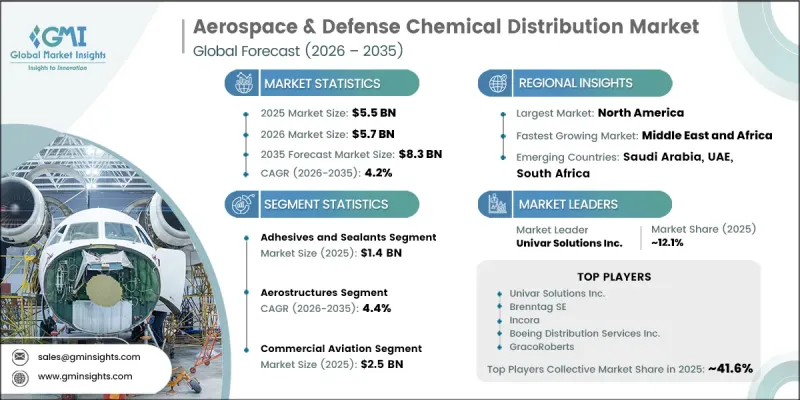
이러한 성장은 항공우주 등급의 엄격한 품질 요건과 항공기 제조 및 방위 업무를 규정하는 고도로 규제된 규정 준수 기준의 영향을 받고 있습니다. 유통업체는 인증된 항공 규격을 충족해야 하는 접착제, 실란트, 코팅제, 윤활제, 세정제 등 미션 크리티컬한 특수 화학 약품의 중단 없는 공급을 유지하는 데 있어 매우 중요한 역할을 하고 있습니다. 전 세계 항공 교통량의 증가, 항공기 교체 프로그램, 국방 예산 확대에 따라 연료 효율, 내구성, 내식성을 향상시키는 고성능 화학 솔루션에 대한 수요가 급증하고 있습니다. 추적성, 안전 규정 준수 및 인증된 공급망에 대한 수요가 증가함에 따라, 확립된 유통 네트워크의 중요성이 더욱 부각되고 있습니다. 동시에, 항공우주 OEM 및 MRO 공급업체들은 복잡한 세계 공급망 전반에 걸쳐 조달 프로세스의 효율화, 재고 관리의 최적화, 그리고 적시 납품을 보장하기 위해 유통업체에 대한 의존도를 높이고 있습니다. 방위 분야에서의 용도는 함대 운용 준비 요건과 수명이 긴 장비의 유지보수 주기에 힘입어 안정적인 수요를 유지하고 있으며, 이는 시장의 장기적인 구조적 전망을 한층 더 공고히 하고 있습니다.
| 시장 범위 | |
|---|---|
| 시작 연도 | 2025년 |
| 예측 기간 | 2026-2035년 |
| 개시 금액 | 55억 달러 |
| 예측 금액 | 83억 달러 |
| CAGR | 4.2% |
접착제·실란트 분야는 2025년에 14억 달러의 시장 규모를 기록했으며, 2026년부터 2035년까지 연평균 성장률(CAGR) 4.3%로 성장할 것으로 전망됩니다. 이 분야는 항공기 조립, 구조용 접착 및 실링 용도에서 필수적인 역할을 수행하고 있어 확고한 입지를 다지고 있습니다. 코팅은 가혹한 항공우주 환경에서 내식성, 열안정성 및 부품 전체의 내구성을 높이기 위해 여전히 매우 중요합니다. 윤활유와 그리스는 민간 및 국방용 항공기 시스템 모두에서 효율적인 기계적 성능을 확보하고 마모를 줄이기 위해 계속해서 널리 사용되고 있습니다.
민간 항공 부문은 2025년에 25억 달러를 기록하며 시장 점유율의 46.1%를 차지하고 있으며, 2035년까지 연평균 성장률(CAGR) 4.5%로 성장할 것으로 예상됩니다. 이 부문의 수요는 지속적인 항공기 생산, 승객 수 증가, 그리고 전 세계 항공기 함대에 대한 지속적인 MRO(정비·수리·점검) 업무에 의해 견인되고 있습니다. 군·방위 분야 역시 현대화 프로그램 및 임무 핵심 플랫폼에 적용되는 엄격한 운용·안전 기준을 충족하는 첨단 화학 솔루션에 대한 수요에 힘입어, 안정적인 수익원으로 자리매김하고 있습니다.
2025년 북미 항공우주 및 방위 산업용 화학제품 유통 시장의 규모는 21억 달러였습니다. 이 지역은 고도로 발달한 항공우주 제조 생태계와 막대한 국방 지출의 혜택을 누리고 있습니다. 미국은 대규모 항공기 생산, 첨단 방위 프로그램, 그리고 광범위한 MRO 활동을 바탕으로 주요 성장 동력으로서의 역할을 수행하고 있습니다. OEM 기업의 강력한 입지와 성숙한 물류 네트워크는 인증된 화학제품 유통 서비스에 대한 안정적인 수요를 더욱 뒷받침하고 있습니다. 또한, 업무 효율과 규정 준수를 향상시키기 위해 디지털 재고 관리 및 공급망 관리 시스템의 도입도 확대하고 있습니다.
자주 묻는 질문
목차
제1장 조사 방법과 범위
제2장 주요 요약
제3장 업계 인사이트
제4장 경쟁 구도
제5장 시장 추정 및 예측 : 화학제품 유형별, 2022-2035년
제6장 시장 추정 및 예측 : 용도별, 2022-2035년
제7장 시장 추정 및 예측 : 최종사용자별, 2022-2035년
제8장 시장 추정 및 예측 : 지역별, 2022-2035년
제9장 기업 개요
KSM 26.07.16The Global Aerospace & Defense Chemical Distribution Market was valued at USD 5.5 billion in 2025 and is estimated to grow at a CAGR of 4.2% to reach USD 8.3 billion by 2035.
Growth is influenced by strict aerospace-grade quality requirements and highly regulated compliance standards governing aircraft manufacturing and defense operations. Distributors play a vital role in maintaining uninterrupted access to mission-critical specialty chemicals, including adhesives, sealants, coatings, lubricants, and cleaning agents that must meet certified aviation specifications. Increasing global air traffic, fleet modernization programs, and rising defense budgets are accelerating demand for high-performance chemical solutions that enhance fuel efficiency, durability, and corrosion resistance. The need for traceability, safety compliance, and certified supply chains is reinforcing the importance of established distribution networks. At the same time, aerospace OEMs and MRO providers are increasingly relying on distributors to streamline procurement, optimize inventory management, and ensure timely delivery across complex global supply chains. Defense applications continue to provide stable demand, supported by fleet readiness requirements and long-life equipment maintenance cycles, further strengthening the long-term structural outlook of the market.
| Market Scope | |
|---|---|
| Start Year | 2025 |
| Forecast Year | 2026-2035 |
| Start Value | $5.5 Billion |
| Forecast Value | $8.3 Billion |
| CAGR | 4.2% |
The adhesives and sealants segment was valued at USD 1.4 billion in 2025 and is projected to grow at a CAGR of 4.3% from 2026 to 2035. This segment holds a strong position due to its essential role in aircraft assembly, structural bonding, and sealing applications. Coatings remain critical for enhancing corrosion resistance, thermal stability, and overall component durability in demanding aerospace environments. Lubricants and greases continue to be widely used to ensure efficient mechanical performance and reduce wear across both commercial and defense aircraft systems.
The commercial aviation segment accounted for USD 2.5 billion in 2025, representing 46.1% share, and is expected to grow at a CAGR of 4.5% through 2035. Demand in this segment is driven by ongoing aircraft production, rising passenger traffic, and continuous MRO operations across global fleets. Military and defense applications also remain a stable contributor, supported by modernization programs and the need for advanced chemical solutions that meet stringent operational and safety standards across mission-critical platforms.
North America Aerospace & Defense Chemical Distribution Market was valued at USD 2.1 billion in 2025. The region benefits from a highly developed aerospace manufacturing ecosystem and significant defense expenditure. The United States serves as the primary growth engine, supported by large-scale aircraft production, advanced defense programs, and extensive MRO activity. Strong OEM presence and a mature logistics network further reinforce consistent demand for certified chemical distribution services, alongside increasing adoption of digital inventory and supply chain management systems to improve operational efficiency and compliance.
Key players operating in the global aerospace & defense chemical distribution industry include Brenntag SE, Univar Solutions Inc., Incora, Boeing Distribution Services Inc., GracoRoberts, Ellsworth Adhesives, AVIOCOM B.V., Jaco Aerospace, Spectrum Aerospace GmbH, Aviation Chemical Solutions Inc., Chemical Strategies Inc., Process Point LLC, AirChem Consumables, and others. Companies in the aerospace & defense chemical distribution market are strengthening their market position by expanding certified product portfolios and ensuring compliance with strict aerospace regulatory standards. Many distributors are investing in advanced logistics infrastructure and digital supply chain systems to improve traceability, reduce lead times, and enhance inventory visibility. Strategic partnerships with OEMs, MRO providers, and defense contractors are being used to secure long-term supply agreements and improve customer integration. Firms are also focusing on geographic expansion into high-growth aviation hubs to capture rising demand from fleet expansion and defense modernization programs.
Table of Contents
Chapter 1 Methodology & Scope
- 1.1 Market scope and definition
- 1.2 Research design
- 1.2.1 Research approach
- 1.2.2 Data collection methods
- 1.3 Data mining sources
- 1.3.1 Global
- 1.3.2 Regional/Country
- 1.4 Base estimates and calculations
- 1.4.1 Base year calculation
- 1.4.2 Key trends for market estimation
- 1.5 Primary research and validation
- 1.5.1 Primary sources
- 1.6 Forecast model
- 1.7 Research assumptions and limitations
Chapter 2 Executive Summary
- 2.1 Industry 360° synopsis
- 2.2 Key market trends
- 2.2.1 Regional
- 2.2.2 Chemical Type
- 2.2.3 Application
- 2.2.4 End User
- 2.3 TAM Analysis, 2026-2035
- 2.4 CXO perspectives: Strategic imperatives
Chapter 3 Industry Insights
- 3.1 Industry ecosystem analysis
- 3.1.1 Supplier landscape
- 3.1.2 Profit margin
- 3.1.3 Value addition at each stage
- 3.1.4 Factor affecting the value chain
- 3.1.5 Disruptions
- 3.2 Industry impact forces
- 3.2.1 Growth drivers
- 3.2.2 Industry pitfalls and challenges
- 3.2.3 Market opportunities
- 3.3 Growth potential analysis
- 3.4 Regulatory landscape
- 3.4.1 North America
- 3.4.2 Europe
- 3.4.3 Asia Pacific
- 3.4.4 Latin America
- 3.4.5 Middle East & Africa
- 3.5 Porter's analysis
- 3.6 PESTEL analysis
- 3.7 Price trends
- 3.7.1 By region
- 3.7.2 By type
- 3.8 Future market trends
- 3.9 Technology and Innovation landscape
- 3.9.1 Current technological trends
- 3.9.2 Emerging technologies
- 3.10 Patent Landscape
- 3.11 Trade statistics (HS code)
- 3.11.1 Major importing countries
- 3.11.2 Major exporting countries
- 3.12 Sustainability and environmental aspects
- 3.12.1 Sustainable practices
- 3.12.2 Waste reduction strategies
- 3.12.3 Energy efficiency in production
- 3.12.4 Eco-friendly initiatives
- 3.13 Carbon footprint consideration
Chapter 4 Competitive Landscape, 2025
- 4.1 Introduction
- 4.2 Company market share analysis
- 4.2.1 By region
- 4.2.1.1 North America
- 4.2.1.2 Europe
- 4.2.1.3 Asia Pacific
- 4.2.1.4 LATAM
- 4.2.1.5 MEA
- 4.2.1 By region
- 4.3 Company matrix analysis
- 4.4 Competitive analysis of major market players
- 4.5 Competitive positioning matrix
- 4.6 Key developments
- 4.6.1 Mergers & acquisitions
- 4.6.2 Partnerships & collaborations
- 4.6.3 New Product Launches
- 4.6.4 Expansion Plans
Chapter 5 Market Estimates and Forecast, By Chemical Type, 2022-2035 (USD Billion) (Kilo Tons)
- 5.1 Key trends
- 5.2 Adhesives and sealants
- 5.2.1 Epoxy-based adhesives
- 5.2.2 Polyurethane adhesives
- 5.2.3 Silicone sealants
- 5.2.4 Others
- 5.3 Surface treatments and coatings
- 5.3.1 Primers
- 5.3.2 Anti-corrosion coatings
- 5.3.3 Thermal barrier coatings
- 5.3.4 Others
- 5.4 Composites and resins
- 5.4.1 Epoxy resins
- 5.4.2 Phenolic resins
- 5.4.3 Polyimide resins
- 5.4.4 Others
- 5.5 Lubricants and greases
- 5.5.1 Synthetic lubricants
- 5.5.2 Specialty greases
- 5.5.3 Others
- 5.6 Cleaning agents and solvents
- 5.6.1 Aliphatic hydrocarbons
- 5.6.2 Alcohols and ketones
- 5.6.3 Chlorinated solvents
- 5.6.4 Others
- 5.7 Specialty chemicals
- 5.7.1 Propellants and fuels
- 5.7.2 Fire retardants
- 5.7.3 Anti-icing agents
- 5.7.4 Others
Chapter 6 Market Estimates and Forecast, By Application, 2022-2035 (USD Billion) (Kilo Tons)
- 6.1 Key trends
- 6.2 Aerostructures
- 6.2.1 Fuselage
- 6.2.2 Wings
- 6.2.3 Empennage
- 6.2.4 Others
- 6.3 Propulsion systems
- 6.3.1 Engines
- 6.3.2 Fuel systems
- 6.3.3 Others
- 6.4 Interior components
- 6.4.1 Cabin interiors
- 6.4.2 Seating
- 6.4.3 Others
- 6.5 Avionics and electronics
- 6.5.1 Communication systems
- 6.5.2 Navigation systems
- 6.5.3 Others
- 6.6 Landing gear and undercarriage
- 6.7 Weapons systems and munitions
- 6.8 Others
Chapter 7 Market Estimates and Forecast, By End User, 2022-2035 (USD Billion) (Kilo Tons)
- 7.1 Key trends
- 7.2 Commercial aviation
- 7.2.1 Commercial airlines
- 7.2.2 Business and general aviation
- 7.3 Military and defense
- 7.3.1 Military aircraft
- 7.3.2 Naval vessels
- 7.3.3 Land-based defense systems
- 7.3.4 Missile and weapons systems
- 7.4 Space and satellite
- 7.4.1 Launch vehicles
- 7.4.2 Satellites and space systems
- 7.5 Others
Chapter 8 Market Estimates and Forecast, By Region, 2022-2035 (USD Billion) (Kilo Tons)
- 8.1 Key trends
- 8.2 North America
- 8.2.1 U.S.
- 8.2.2 Canada
- 8.3 Europe
- 8.3.1 Germany
- 8.3.2 UK
- 8.3.3 France
- 8.3.4 Spain
- 8.3.5 Italy
- 8.3.6 Rest of Europe
- 8.4 Asia Pacific
- 8.4.1 China
- 8.4.2 India
- 8.4.3 Japan
- 8.4.4 Australia
- 8.4.5 South Korea
- 8.4.6 Rest of Asia Pacific
- 8.5 Latin America
- 8.5.1 Brazil
- 8.5.2 Mexico
- 8.5.3 Argentina
- 8.5.4 Rest of Latin America
- 8.6 Middle East and Africa
- 8.6.1 Saudi Arabia
- 8.6.2 South Africa
- 8.6.3 UAE
- 8.6.4 Rest of Middle East and Africa
Chapter 9 Company Profiles
- 9.1 Univar Solutions Inc.
- 9.2 Brenntag SE
- 9.3 Incora
- 9.4 Boeing Distribution Services Inc.
- 9.5 GracoRoberts
- 9.6 AVIOCOM B.V.
- 9.7 Jaco Aerospace
- 9.8 Spectrum Aerospace GmbH
- 9.9 Aviation Chemical Solutions Inc.
- 9.10 Chemical Strategies Inc.
- 9.11 Ellsworth Adhesives
- 9.12 Process Point LLC
- 9.13 AirChem Consumables


