|
시장보고서
상품코드
2083294
균질기 시장 기회, 성장 촉진요인, 업계 동향 분석 및 예측(2026-2035년)Homogenizer Market Opportunity, Growth Drivers, Industry Trend Analysis, and Forecast 2026 - 2035 |
||||||

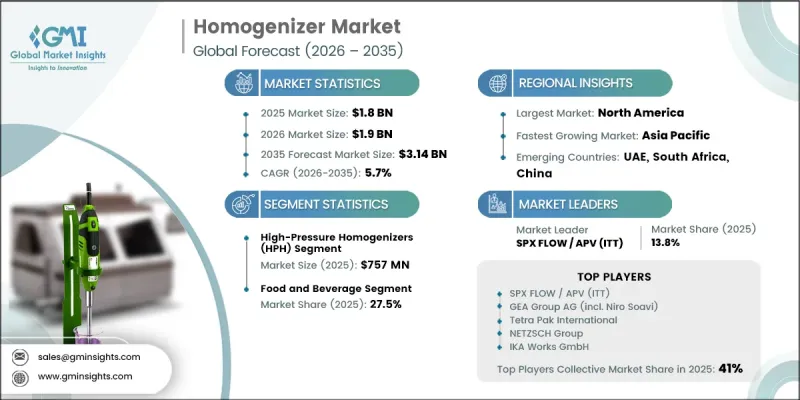
세계의 균질기 시장은 2025년에 18억 달러 규모를 기록하며 CAGR 5.7%로 성장하여 31억 4,000만 달러에 달할 것으로 추정됩니다.
시장의 성장은 북미 및 유럽의 바이오의약품 생산능력에 대한 지속적인 투자와 더불어, 아시아태평양의 식품 가공 인프라가 지속적으로 현대화됨에 따라 뒷받침되고 있습니다. 또한, 유제품, 음료, 소스, 조리 식품, 기능성 영양 제품의 소비가 전 세계적으로 꾸준히 증가하고 있어 수요를 뒷받침하고 있으며, 이에 따라 유화, 식감 개선, 미생물학적 안정성 및 유통기한 연장에 활용되는 균질화 기술에 대한 수요가 지속적으로 높아지고 있습니다. mRNA 기반 치료제, 단일클론 항체, 세포·유전자 치료, 지질 나노입자 약물전달 시스템을 포함한 바이오의약품 제조의 급속한 확대로 인해, 고압 균질화는 의약품 제조 워크플로우에서 핵심적이고 검증된 단위 공정으로서의 위상을 확립했습니다. cGMP 요건에 기반한 의약품 제조 품질 기준을 규정하는 규제 체계에서는 입자 크기의 일관성과 제제의 균일성이 엄격하게 요구되고 있으며, 이는 대규모 생산 환경에서 첨단 균질화 시스템의 도입을 더욱 촉진하고 있습니다.
| 시장 범위 | |
|---|---|
| 시작 연도 | 2025년 |
| 예측 기간 | 2026-2035년 |
| 개시 금액 | 18억 달러 |
| 예측 금액 | 31억 4,000만 달러 |
| CAGR | 5.7% |
식품·음료 부문은 27.5%의 시장 점유율을 차지했으며, 2025년에는 4억 9,600만 달러의 매출을 올렸습니다. 이러한 우위는 전 세계의 유제품 가공, 액상 우유 생산, 요거트 제조, 과즙 가공 및 음료 생산 시스템에서 균질기가 널리 사용되고 있다는 사실에 기인합니다. 대규모 유제품 가공량은 높은 처리량을 요구하는 생산 요건과 공급망 전반에 걸친 제품의 균일성 및 안정성에 대한 수요에 힘입어, 설비의 안정적인 가동을 지속적으로 뒷받침하고 있습니다.
고압 균질화기 부문은 42%의 시장 점유율을 차지했으며, 2025년에는 7억 5,700만 달러 규모의 시장을 기록했습니다. 이러한 시스템은 공정 유체를 극도로 높은 압력 하에서 좁은 밸브 틈새로 강제로 통과시킴으로써 작동하며, 강력한 전단력, 캐비테이션, 난류를 발생시켜 입자 크기를 서브마이크론 수준까지 축소시킵니다. 정밀한 유화 및 균일한 분산을 실현하는 능력 덕분에, 일관성과 제품의 안정성이 극히 중요한 의약품, 유제품 및 고사양 음료의 가공 분야에서 널리 채택되고 있습니다.
북미의 균질기 시장은 33.36%의 점유율을 차지하고 있으며, 제약 제조 및 대규모 식품·음료 가공 산업에서의 확고한 입지에 힘입어, 첨단 균질화 장비에 대한 지속적인 수요가 계속해서 시장을 견인함에 따라, 2035년까지 연평균 성장률(CAGR) 5%로 9억 8,000만 달러에 달할 것으로 전망됩니다.
자주 묻는 질문
목차
제1장 조사 방법과 범위
제2장 주요 요약
제3장 업계 인사이트
제4장 경쟁 구도
제5장 시장 추정 및 예측 : 제품 유형별, 2022-2035년
제6장 시장 추정 및 예측 : 규모별, 2022-2035년
제7장 시장 추정 및 예측 : 출력 정격별, 2022-2035년
제8장 시장 추정 및 예측 : 최종사용자별, 2022-2035년
제9장 시장 추정 및 예측 : 유통 채널별, 2022-2035년
제10장 시장 추정 및 예측 : 지역별, 2022-2035년
제11장 기업 개요
KSM 26.07.16The Global Homogenizer Market generated USD 1.8 billion in 2025 and is estimated to grow at a CAGR of 5.7% to reach USD 3.14 billion.
Market growth is supported by sustained investment in biopharmaceutical manufacturing capacity across North America and Europe alongside continued modernization of food processing infrastructure in Asia Pacific. Demand is further reinforced by the steady global rise in consumption of dairy products, beverages, sauces, prepared meals, and functional nutrition products, which continues to strengthen the need for homogenization technologies used in emulsification, texture improvement, microbial stability, and shelf-life enhancement. The rapid expansion of biologics manufacturing, including mRNA-based therapeutics, monoclonal antibodies, cell and gene therapies, and lipid nanoparticle drug delivery systems, has positioned high-pressure homogenization as a core and validated unit operation in pharmaceutical production workflows. Regulatory frameworks governing pharmaceutical manufacturing quality standards under cGMP requirements enforce strict particle size consistency and formulation uniformity, which further reinforces adoption of advanced homogenization systems in large-scale production environments.
| Market Scope | |
|---|---|
| Start Year | 2025 |
| Forecast Year | 2026-2035 |
| Start Value | $1.8 Billion |
| Forecast Value | $3.14 Billion |
| CAGR | 5.7% |
The food and beverage segment held a 27.5% share, generating USD 496 million in 2025. This dominance is supported by extensive use of homogenizers across dairy processing, fluid milk production, yogurt manufacturing, juice processing, and beverage production systems globally. Large-scale dairy processing volumes continue to support consistent equipment utilization, driven by high-throughput production requirements and the need for product consistency and stability across supply chains.
The high-pressure homogenizers segment held a 42% share, generating USD 757 million in 2025. These systems function by forcing process fluids through narrow valve gaps under extremely high pressure, generating intense shear forces, cavitation, and turbulence that reduce particle size to submicron levels. Their ability to deliver precise emulsification and uniform dispersion makes them widely adopted across pharmaceutical, dairy, and high-specification beverage processing applications, where consistency and product stability are critical.
North America Homogenizer Market held a 33.36% share and is projected to reach USD 980 million by 2035 at a CAGR of 5%, supported by its strong position in both pharmaceutical manufacturing and large-scale food and beverage processing industries, which continue to drive sustained demand for advanced homogenization equipment.
Major companies operating in the global homogenizer market include GEA Group AG, SPX FLOW / APV (ITT), NETZSCH Group, and Tetra Pak International. Companies operating in the homogenizer market are prioritizing technological innovation, capacity expansion, and application diversification to strengthen their competitive position. Significant investment in research and development is enabling manufacturers to enhance efficiency, improve energy consumption, and achieve higher precision in particle size reduction. Strategic collaborations with pharmaceutical and food processing companies are helping equipment providers align product development with evolving end-user requirements. Market players are also expanding their service networks and aftermarket support capabilities to improve equipment lifecycle value and customer retention.
Table of Contents
Chapter 1 Methodology & Scope
- 1.1 Research approach
- 1.2 Quality Commitments
- 1.2.1 GMI AI policy & data integrity commitment
- 1.2.1.1 Source consistency protocol
- 1.2.1 GMI AI policy & data integrity commitment
- 1.3 Research Trail & Confidence Scoring
- 1.3.1 Research Trail Components
- 1.3.2 Scoring Components
- 1.4 Data Collection
- 1.4.1 Partial list of primary sources
- 1.5 Data mining sources
- 1.5.1 Paid sources
- 1.5.1.1 Sources, by region
- 1.5.1 Paid sources
- 1.6 Base estimates and calculations
- 1.6.1 Base year calculation for any one approach
- 1.7 Forecast model
- 1.7.1 Quantified market impact analysis
- 1.7.1.1 Mathematical impact of growth parameters on forecast
- 1.7.1 Quantified market impact analysis
- 1.8 Research transparency addendum
- 1.8.1 Source attribution framework
- 1.8.2 Quality assurance metrics
- 1.8.2.1 Our commitment to trust
Chapter 2 Executive Summary
- 2.1 Industry 360° synopsis, 2022 - 2035
- 2.2 Key market trends
- 2.2.1 Region
- 2.2.2 Product Type
- 2.2.3 Scale/Capacity
- 2.2.4 Power Rating
- 2.2.5 Application/End-user
- 2.2.6 Distribution channel
Chapter 3 Industry Insights
- 3.1 Industry ecosystem analysis
- 3.2 Supply chain analysis
- 3.2.1 Raw Material Sourcing (Stainless Steel, Valves, Seals)
- 3.2.2 Component Manufacturing & Assembly
- 3.2.3 Distribution & After-Sales Service Networks
- 3.3 Industry impact forces
- 3.3.1 Market drivers
- 3.3.1.1 Rising Demand for Processed & Packaged Food Products Globally
- 3.3.1.2 Growing Pharmaceutical & Biotechnology Industry (Lipid Nanoparticles, Vaccine Manufacturing)
- 3.3.1.3 Expansion of Cosmetics & Personal Care Manufacturing
- 3.3.1.4 Increasing Adoption of High-Pressure Processing in Beverage Industry
- 3.3.2 Market restraints
- 3.3.2.1 High Capital Investment & Maintenance Costs Deterring SMEs
- 3.3.2.2 Availability of Alternative Mixing & Blending Technologies
- 3.3.2.3 High Energy Consumption of Industrial-Scale Equipment
- 3.3.3 Market opportunities
- 3.3.3.1 Growing mRNA & Biopharmaceutical Manufacturing Driving Demand for Precision Homogenizers
- 3.3.3.2 Expansion in Emerging Markets (Asia Pacific, Latin America, MEA)
- 3.3.3.3 Integration of IoT & Smart Automation in Homogenizer Systems
- 3.3.3.4 Rising Demand for Compact & Affordable Homogenizers Among SMEs
- 3.3.1 Market drivers
- 3.4 Growth potential analysis
- 3.5 Technology & innovation landscape
- 3.5.1 High-Pressure Homogenization Technology Advances
- 3.5.2 Ultrasonic Homogenization Technology Advances
- 3.5.3 Emerging Microfluidization & Bead Mill Innovations
- 3.6 Regulatory framework
- 3.6.1 Food Safety Regulations (FDA, EFSA, FSSAI)
- 3.6.2 GMP & Pharmaceutical Compliance Standards
- 3.6.3 Industrial Equipment Safety & CE Marking Requirements
- 3.7 Major market trends and disruptions
- 3.8 Future market trends
- 3.9 Pricing analysis (driven by primary research)
- 3.9.1 Historical Price Trend Analysis (Driven by Primary Research)
- 3.9.2 Pricing Strategy by Player Type (Premium / Value / Cost-plus) (Driven by Primary Research)
- 3.10 Trade data analysis (driven by primary research)
- 3.10.1 Import/Export Volume & Value Trends (Driven by Primary Research)
- 3.10.2 Key Trade Corridors & Tariff Impact (Driven by Primary Research)
- 3.11 Impact of AI & generative AI on the market
- 3.11.1 AI-Driven Disruption of Existing Business Models (Predictive Maintenance, Smart Process Optimization)
- 3.11.2 GenAI Use Cases & Adoption Roadmap by Segment (Food, Pharma, Chemical)
- 3.11.3 Risks, Limitations & Regulatory Considerations
- 3.12 Investment & funding analysis
- 3.12.1 Capital Investment Trends in Homogenizer Manufacturing
- 3.12.2 R&D Expenditure by Leading Players
- 3.13 Porter's analysis
- 3.14 PESTEL analysis
Chapter 4 Competitive Landscape, 2025
- 4.1 Introduction
- 4.2 Company market share analysis
- 4.2.1 By Region
- 4.2.1.1 North America
- 4.2.1.2 Europe
- 4.2.1.3 Asia Pacific
- 4.2.1.4 Latin America
- 4.2.1.5 Middle East and Africa
- 4.2.1 By Region
- 4.3 Company matrix analysis
- 4.4 Competitive analysis of major market players
- 4.5 Competitive positioning matrix
- 4.6 Key developments
- 4.6.1 Mergers & acquisitions
- 4.6.2 Partnerships & collaborations
- 4.6.3 New product launches
- 4.6.4 Expansion plans
Chapter 5 Market Estimates and Forecast, By Product Type, 2022 - 2035 (USD Billion) (Thousand Units)
- 5.1 Key trends
- 5.2 High-Pressure Homogenizers
- 5.2.1 Single-Valve Assembly
- 5.2.2 Two-Valve Assembly
- 5.2.3 Multiple-Valve Assembly
- 5.3 Ultrasonic Homogenizers
- 5.3.1 Probe/Tip Ultrasonic Homogenizers
- 5.3.2 Cup/Bath Ultrasonic Homogenizers
- 5.4 Mechanical Homogenizers (Rotor-Stator)
- 5.4.1 Batch Rotor-Stator Homogenizers
- 5.4.2 Inline/Continuous Rotor-Stator Homogenizers
- 5.5 Bead Mill Homogenizers
- 5.5.1 Horizontal Bead Mills
- 5.5.2 Vertical Bead Mills
- 5.6 Others (Microfluidizers, Blade-Type)
Chapter 6 Market Estimates and Forecast, By Scale, 2022 - 2035 (USD Billion) (Thousand Units)
- 6.1 Key trends
- 6.2 Laboratory-Scale Homogenizers
- 6.2.1 Handheld & Bench-Top Units
- 6.2.2 Micro-Volume & Sample-Prep Units
- 6.3 Pilot-Scale Homogenizers
- 6.3.1 Scale-Up & Process Validation Systems
- 6.3.2 Semi-Continuous Pilot Systems
- 6.4 Industrial/Full-Scale Homogenizers
- 6.4.1 Continuous High-Capacity Systems
- 6.4.2 Automated & IoT-Integrated Industrial Systems
Chapter 7 Market Estimates and Forecast, By Power Rating, 2022 - 2035 (USD Billion) (Thousand Units)
- 7.1 Key Trends
- 7.2 Low Power (Up to 7.5 kW)
- 7.2.1 Laboratory & Benchtop Applications
- 7.2.2 Small-Batch Food & Cosmetic Processing
- 7.3 Medium Power (7.5 kW to 30 kW)
- 7.3.1 Pilot-Scale & Mid-Volume Industrial Processing
- 7.3.2 Pharmaceutical & Biotech Mid-Range Applications
- 7.4 High Power (Above 30 kW)
- 7.4.1 Full-Scale Dairy & Beverage Production Lines
- 7.4.2 Heavy-Duty Chemical & Petrochemical Processing
Chapter 8 Market Estimates and Forecast, By End User, 2022 - 2035 (USD Billion) (Thousand Units)
- 8.1 Key trends
- 8.2 Food & Beverage
- 8.2.1 Dairy Processing (Milk, Cream, Cheese)
- 8.2.2 Beverages (Juices, Energy Drinks, Plant-Based Drinks)
- 8.2.3 Sauces, Dressings & Emulsified Food Products
- 8.2.4 Infant Nutrition & Specialty Foods
- 8.3 Pharmaceutical & Biotechnology
- 8.3.1 Drug Formulation & Emulsion Manufacturing
- 8.3.2 Lipid Nanoparticle (LNP) & Vaccine Production
- 8.3.3 Cell Disruption & Protein Extraction
- 8.3.4 Injectable & Sterile Product Manufacturing
- 8.4 Cosmetics & Personal Care
- 8.4.1 Creams, Lotions & Ointments
- 8.4.2 Hair Care Products
- 8.4.3 Color Cosmetics & Pigment Dispersions
- 8.5 Chemical Processing
- 8.5.1 Pigment & Dye Dispersion
- 8.5.2 Adhesive & Polymer Blending
- 8.5.3 Petrochemical & Specialty Chemical Emulsification
- 8.5.4 Paint & Varnish Manufacturing
- 8.6 Others (Research Institutes, Environmental Testing)
Chapter 9 Market Estimates and Forecast, By Distribution Channel, 2022 - 2035 (USD Billion) (Thousand Units)
- 9.1 Key Trends
- 9.2 Direct Sales
- 9.2.1 OEM/Manufacturer-Direct to Large End-Users
- 9.2.2 Direct Key Account Management (Food, Pharma, Chemical Majors)
- 9.3 Indirect Sales
- 9.3.1 Distributors & Dealers
- 9.3.2 System Integrators & Engineering Contractors
- 9.3.3 Online/E-Commerce Platforms (Lab-Scale & SME Segment)
Chapter 10 Market Estimates & Forecast, By Region, 2022 - 2035, (USD Billion) (Thousand Units)
- 10.1 Key trends
- 10.2 North America
- 10.2.1 U.S.
- 10.2.2 Canada
- 10.3 Europe
- 10.3.1 Germany
- 10.3.2 U.K.
- 10.3.3 France
- 10.3.4 Italy
- 10.3.5 Spain
- 10.4 Asia Pacific
- 10.4.1 China
- 10.4.2 India
- 10.4.3 Japan
- 10.4.4 South Korea
- 10.4.5 Australia
- 10.5 Latin America
- 10.5.1 Brazil
- 10.5.2 Mexico
- 10.5.3 Argentina
- 10.6 MEA
- 10.6.1 UAE
- 10.6.2 Saudi Arabia
- 10.6.3 South Africa
Chapter 11 Company Profiles
- 11.1 GEA Group AG
- 11.2 SPX FLOW / APV
- 11.3 Krones AG
- 11.4 Tetra Pak International S.A.
- 11.5 FBF Italia S.r.l.
- 11.6 IKA Works GmbH & Co. KG
- 11.7 NETZSCH Group
- 11.8 Silverson Machines Ltd.
- 11.9 Avestin Inc.
- 11.10 Hielscher Ultrasonics GmbH
- 11.11 Shanghai Samro Homogenizer Co., Ltd.
- 11.12 SPX FLOW / Microfluidics (IDEX MPT)
- 11.13 BEE International (a Pion Company)
- 11.14 Bertoli S.r.l. (Interpump Group)
- 11.15 BOS Homogenisers B.V.
- 11.16 Charles Ross & Son Company
- 11.17 Sonic Corporation
- 11.18 Kinematica AG
- 11.19 EKATO Holding GmbH
- 11.20 Ystral GmbH
- 11.21 PHD Technology International LLC
- 11.22 Stansted Fluid Power Ltd.
- 11.23 SIMES S.A.