|
시장보고서
상품코드
2083323
뚜껑 및 마개 시장 기회, 성장 촉진요인, 업계 동향 분석 및 예측(2026-2035년)Caps and Closures Market Opportunity, Growth Drivers, Industry Trend Analysis, and Forecast 2026 - 2035 |
||||||

세계의 뚜껑 및 마개 시장은 2025년에 818억 달러 규모에 달하고, 2035년까지 CAGR 4.8%로 성장하여 1,327억 달러에 달할 것으로 추정됩니다.
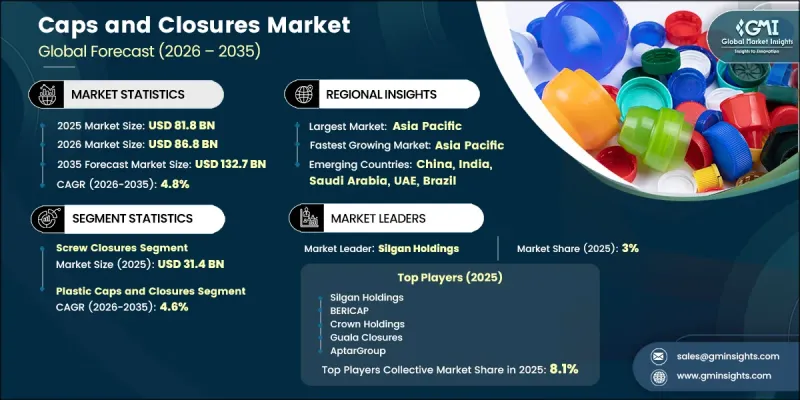
이 업계는 기본적인 범용 씰 제품에서 특정 최종 용도의 요구 사항에 맞춰 설계된 고도로 공학화된 뚜껑 및 마개 시스템으로 명확한 구조적 전환을 이루고 있습니다. 이러한 진화로 인해, 가격에 민감한 시장에서 표준화된 캡 및 밀봉 방식은 이익률 압박에 직면하는 반면, 디스펜싱 캡, 어린이 안전 잠금 장치가 적용된 의약품 포장, 스마트 캡 및 기능성 캡과 같은 첨단 솔루션은 더 높은 부가가치를 창출하는 등 양극화된 성장 양상이 형성되고 있습니다. 이러한 성장은 도시 지역의 인구 증가, 가처분 소득의 향상, 그리고 기능성 음료나 프리미엄 패키지 음료와 같은 제품 카테고리의 다양화에 힘입어 확대되고 있는 전 세계 음료 소비에 의해 더욱 가속화되고 있습니다. 제약 분야에서도 위조 방지 기능, 안전 기준 준수, 그리고 정밀한 투여가 가능한 캡 시스템에 대한 구조적인 수요가 증가하고 있습니다. 동시에, 지속가능성에 대한 요구와 규제적 압력으로 인해 경량 소재, 재활용 가능성, 그리고 플라스틱 사용량 감축을 위한 혁신이 촉진되고 있으며, 이는 업계 전반의 장기적인 제품 개발 전략을 형성하고 있습니다.
| 시장 범위 | |
|---|---|
| 시작 연도 | 2025년 |
| 예측 기간 | 2026-2035년 |
| 개시 금액 | 818억 달러 |
| 예측 금액 | 1,327억 달러 |
| CAGR | 4.8% |
스크류 뚜껑 및 마개 부문은 2025년에 314억 달러에 달했으며, 시장 점유율의 38%를 차지했습니다. 이 부문은 병에 담긴 음료, 포장된 액체, 식품 등 폭넓은 분야에서 활용되고 있기 때문에 시장 전체 평균을 상회하는 연평균 성장률(CAGR) 5.2%로 성장할 것으로 예상됩니다. 신흥국의 대중 소비재 부문에서 수요가 확대됨에 따라, 특히 비용 효율성과 신뢰성이 여전히 중요한 구매 요인으로 작용하는 시장에서 해당 부문의 우위를 더욱 공고히 하고 있습니다.
플라스틱 뚜껑 및 마개 부문은 2025년에 651억 달러에 해당하는 79%의 시장 점유율을 차지했으며, 2035년까지 연평균 성장률(CAGR) 4.6%로 성장할 것으로 전망됩니다. 폴리프로필렌은 내구성, 내화학성, 가공 용이성, 그리고 대규모 사출 성형 공정에의 적합성 덕분에 여전히 주요 소재로 사용되고 있습니다. 이 부문에서 현재 진행 중인 주요 변화로는 테더가 부착된 캡에 대한 규제 요건에 대한 업계 전반의 대응과 재생 폴리머 함유율의 증가를 들 수 있으며, 이러한 변화들이 소재의 지속적인 혁신과 마개 구조의 재설계를 촉진하고 있습니다.
북미의 뚜껑 및 마개 시장은 2025년에 161억 달러 규모에 달하며, 시장 점유율의 20%를 차지하고 있으며, 2035년까지 연평균 성장률(CAGR) 4.5%로 성장할 것으로 예상됩니다. 미국은 포장 음료, 생수, 프리미엄 기능성 음료 분야의 견조한 소비에 더해, 안전 기준을 준수하는 마개에 대한 의약품 포장 분야의 안정적인 수요에 힘입어 계속해서 지역 수요의 주요 견인차 역할을 하고 있습니다. 이 지역의 공급 체계는 Silgan Holdings나 Closure Systems International(CSI)과 같은 유서 깊은 제조업체들에 의해 뒷받침되고 있습니다. 이 기업들은 미국 전역의 여러 제조 거점에 광범위한 생산 네트워크를 구축하고 있으며, 식품, 음료, 헬스케어 분야의 고객들에게 서비스를 제공하고 있습니다.
자주 묻는 질문
목차
제1장 조사 방법과 범위
제2장 주요 요약
제3장 업계 인사이트
제4장 경쟁 구도
제5장 시장 추정 및 예측 : 제품 유형별, 2022-2035년
제6장 시장 추정 및 예측 : 소재 유형별, 2022-2035년
제7장 시장 추정 및 예측 : 마개 사이즈별, 2022-2035년
제8장 시장 추정 및 예측 : 최종 이용 산업별, 2022-2035년
제9장 시장 추정 및 예측 : 유통 채널별, 2022-2035년
제10장 시장 추정 및 예측 : 지역별, 2022-2035년
제11장 기업 개요
KSM 26.07.16The Global Caps and Closures Market was valued at USD 81.8 billion in 2025 and is estimated to grow at a CAGR of 4.8% to reach USD 132.7 billion by 2035.
The industry is undergoing a clear structural transition from basic commodity sealing products toward highly engineered closure systems designed for specific end-use requirements. This evolution is creating a dual-track growth pattern, where standardized closure formats in price-sensitive markets face margin pressure, while advanced solutions such as dispensing closures, child-resistant pharmaceutical formats, and smart or functional caps are generating higher value realization. Growth is further reinforced by expanding global beverage consumption, driven by urban population growth, higher disposable incomes, and increasing diversification in product categories such as functional drinks and premium packaged beverages. The pharmaceutical sector is also strengthening structural demand for tamper-evident, safety-compliant, and precision dosing closure systems. At the same time, sustainability requirements and regulatory pressure are encouraging innovation in lightweight materials, recyclability, and reduced plastic usage, shaping long-term product development strategies across the industry.
| Market Scope | |
|---|---|
| Start Year | 2025 |
| Forecast Year | 2026-2035 |
| Start Value | $81.8 Billion |
| Forecast Value | $132.7 Billion |
| CAGR | 4.8% |
The screw closures segment reached USD 31.4 billion in 2025, accounting for 38% share. This segment is expected to grow at a CAGR of 5.2%, outperforming the overall market average due to its widespread application across bottled beverages, packaged liquids, and food products. Demand expansion across high-volume consumer categories in emerging economies continues to reinforce its dominant position, particularly where cost efficiency and reliability remain key purchasing factors.
The plastic-based caps and closures segment held 79% share, equivalent to USD 65.1 billion in 2025, and is projected to grow at a CAGR of 4.6% through 2035. Polypropylene continues to serve as the primary material due to its durability, chemical resistance, ease of processing, and suitability for large-scale injection molding operations. A major ongoing shift within this segment is the industry-wide adaptation to regulatory requirements for tethered caps and increased incorporation of recycled polymer content, driving continuous material innovation and redesign of closure structures.
North America Caps and Closures Market was valued at USD 16.1 billion in 2025, accounting for 20% share, and is expected to grow at a CAGR of 4.5% through 2035. The United States remains the primary contributor to regional demand, supported by strong consumption across packaged beverages, bottled water, and premium functional drinks, along with consistent pharmaceutical packaging requirements for safety-compliant closures. The regional supply landscape is supported by established manufacturers such as Silgan Holdings and Closure Systems International (CSI), which operate extensive production networks across multiple U.S. manufacturing locations serving food, beverage, and healthcare customers.
Key players operating in the global caps and closures industry include Amcor, AptarGroup, BERICAP, Closure Systems International (CSI), Crown Holdings, Guala Closures, Silgan Holdings, HERTI JSC, MRP Solutions, Nippon Closures, Pact Group, Pelliconi, Tecnocap, UNITED CAPS, Alcopack, Blackhawk Molding, Caprite Australia, JSD Pharma, PHOENIX Packaging, SRS Packaging, and UAB Elmoris. Companies in the caps and closures market are strengthening their position by investing in advanced closure technologies that improve functionality, safety, and user convenience. Manufacturers are increasingly focusing on developing dispensing systems, tamper-evident designs, and child-resistant solutions tailored for pharmaceutical and premium beverage applications. Sustainability has become a central strategy, with firms integrating recycled plastics, lightweight designs, and circular packaging models to meet regulatory and consumer expectations. Strategic expansion of production capacity in high-growth regions is also helping companies improve supply chain efficiency and reduce lead times.
Table of Contents
Chapter 1 Methodology and scope
- 1.1 Research approach
- 1.2 Quality Commitments
- 1.2.1 GMI AI policy & data integrity commitment
- 1.2.1.1 Source consistency protocol
- 1.2.1 GMI AI policy & data integrity commitment
- 1.3 Research Trail & Confidence Scoring
- 1.3.1 Research Trail Components
- 1.3.2 Scoring Components
- 1.4 Data Collection
- 1.4.1 Partial list of primary sources
- 1.5 Data mining sources
- 1.5.1 Paid sources
- 1.5.1.1 Sources, by region
- 1.5.1 Paid sources
- 1.6 Base estimates and calculations
- 1.6.1 Base year calculation for any one approach
- 1.7 Forecast model
- 1.7.1 Quantified market impact analysis
- 1.7.1.1 Mathematical impact of growth parameters on forecast
- 1.7.1 Quantified market impact analysis
- 1.8 Research transparency addendum
- 1.8.1 Source attribution framework
- 1.8.2 Quality assurance metrics
- 1.8.3 Our commitment to trust
Chapter 2 Executive summary
- 2.1 Industry 360° synopsis
- 2.2 Key market trends
- 2.2.1 Regional
- 2.2.2 Product type
- 2.2.3 Material type
- 2.2.4 Closure size
- 2.2.5 End use industry
- 2.2.6 Distribution channel
Chapter 3 Industry insights
- 3.1 Industry ecosystem analysis
- 3.1.1 Supplier landscape
- 3.1.2 Profit margin
- 3.1.3 Value addition at each stage
- 3.1.4 Factor affecting the value chain
- 3.1.5 Disruptions
- 3.2 Industry impact forces
- 3.2.1 Growth drivers
- 3.2.2 Industry pitfalls & challenges
- 3.2.3 Opportunities
- 3.3 Growth potential analysis
- 3.4 Price trends
- 3.4.1 Historical price trend analysis
- 3.4.2 Pricing strategy by player type
- 3.5 Regulatory framework
- 3.5.1 North America: US FDA packaging regulations & Canada Health packaging standards
- 3.5.2 Europe: EU packaging & packaging waste directive (PPWD), tethered cap mandates (SUP directive)
- 3.5.3 China: GB standards & NMPA packaging regulations
- 3.5.4 India: BIS standards & FSSAI packaging compliance
- 3.5.5 Japan: JIS standards & Ministry of Health closure regulations
- 3.5.6 ASEAN countries: harmonized packaging & food safety directives
- 3.5.7 Australia & New Zealand: FSANZ & TGA closure compliance
- 3.5.8 Latin America: ANVISA (Brazil) & ANMAT (Argentina) packaging regulations
- 3.5.9 Middle East & Africa: GCC standardization organization & regional food authority mandates
- 3.6 Porter's five forces analysis
- 3.7 PESTEL analysis
- 3.8 Trade Data Analysis (Based on Paid Database) (HS Code: 3923)
- 3.8.1 Import/export volume & value trends
- 3.8.2 Key trade corridors & tariff impact
- 3.9 Impact of AI & generative AI on the market
- 3.9.1 AI-driven disruption of traditional business models
- 3.9.2 GenAI use cases & adoption roadmap by customer segment
- 3.9.3 Risks, limitations & regulatory considerations
- 3.10 Future market trends
- 3.11 Technology and innovation landscape
- 3.11.1 Current technological trends
- 3.11.2 Emerging technologies
- 3.12 Consumer behavior analysis
- 3.12.1 Purchasing patterns
- 3.12.2 Preference analysis
- 3.12.3 Regional variations in consumer behavior
- 3.12.4 Impact of e-commerce on buying decisions
Chapter 4 Competitive landscape, 2025
- 4.1 Introduction
- 4.2 Company market share analysis
- 4.2.1 North America
- 4.2.2 Europe
- 4.2.3 Asia Pacific
- 4.2.4 Latin America
- 4.2.5 MEA
- 4.3 Company matrix analysis
- 4.4 Competitive analysis of major market players
- 4.5 Competitive positioning matrix
- 4.6 Key developments
- 4.6.1 Mergers & acquisitions
- 4.6.2 Partnerships & collaborations
- 4.6.3 New product launches
- 4.6.4 Expansion plans
Chapter 5 Market Estimates & Forecast, By Product Type, 2022 - 2035 ($Billion, Million Units)
- 5.1 Key trends
- 5.2 Screw closures
- 5.2.1 Continuous thread (CT) caps
- 5.2.2 Lug & twist caps
- 5.2.3 Roll-on pilfer proof (ROPP) caps
- 5.2.4 Linerless & conical caps
- 5.3 Dispensing closures
- 5.3.1 Flip-top & snap-top caps
- 5.3.2 Push-pull caps
- 5.3.3 Disc-top caps
- 5.3.4 Pump & spray dispensers
- 5.3.5 Drop counter & dropper caps
- 5.4 Tamper-evident closures
- 5.4.1 Break-band closures
- 5.4.2 Shrink sleeve closures
- 5.4.3 Tear-off strip closures
- 5.5 Child-resistant closures (CRC)
- 5.5.1 Push-and-turn CRC
- 5.5.2 Squeeze-and-turn CRC
- 5.5.3 Senior-friendly CRC
- 5.6 Crown closures
- 5.6.1 Standard crown caps
- 5.6.2 Twist-off crown caps
- 5.6.3 Aerosol closures
- 5.6.4 Actuator caps
- 5.6.5 Overcaps
- 5.7 Others (snap-on & press-on caps, venting caps etc.)
Chapter 6 Market Estimates & Forecast, By Material Type, 2022 - 2035 ($Billion, Million Units)
- 6.1 Key trends
- 6.2 Plastic caps & closures
- 6.2.1 Polypropylene (PP)
- 6.2.2 Polyethylene (PE)
- 6.2.3 High-density polyethylene (HDPE)
- 6.2.4 Low-density polyethylene (LDPE)
- 6.2.5 Polyethylene terephthalate (PET)
- 6.2.6 Others (bio-based & sustainable plastics etc.)
- 6.3 Metal caps & closures
- 6.3.1 Aluminum
- 6.3.2 Steel & tin plate
Chapter 7 Market Estimates & Forecast, By Closure Size, 2022 - 2035 ($Billion, Million Units)
- 7.1 Key trends
- 7.2 Small (up to 20 mm)
- 7.3 Medium (21 mm - 40 mm)
- 7.4 Large (41 mm - 60 mm)
- 7.5 Extra-large (above 60 mm)
Chapter 8 Market Estimates & Forecast, By End Use Industry, 2022 - 2035 ($Billion, Million Units)
- 8.1 Key trends
- 8.2 Food and beverages
- 8.3 Pharmaceuticals & healthcare
- 8.4 Cosmetics & personal care
- 8.5 Household chemicals
- 8.6 Others (agricultural chemicals and industrial chemicals etc.)
Chapter 9 Market Estimates & Forecast, By Distribution Channel, 2022 - 2035 ($Billion, Million Units)
- 9.1 Key trends
- 9.2 Direct sales
- 9.3 Indirect sales
Chapter 10 Market Estimates & Forecast, By Region, 2022 - 2035 ($Billion, Million Units)
- 10.1 Key trends
- 10.2 North America
- 10.2.1 U.S.
- 10.2.2 Canada
- 10.3 Europe
- 10.3.1 Germany
- 10.3.2 UK
- 10.3.3 France
- 10.3.4 Spain
- 10.3.5 Italy
- 10.3.6 Netherlands
- 10.4 Asia Pacific
- 10.4.1 China
- 10.4.2 Japan
- 10.4.3 India
- 10.4.4 Australia
- 10.4.5 South Korea
- 10.5 Latin America
- 10.5.1 Brazil
- 10.5.2 Mexico
- 10.5.3 Argentina
- 10.6 MEA
- 10.6.1 South Africa
- 10.6.2 Saudi Arabia
- 10.6.3 UAE
Chapter 11 Company Profiles
- 11.1 Global Key Players
- 11.1.1 Amcor
- 11.1.2 AptarGroup
- 11.1.3 BERICAP
- 11.1.4 Closure Systems International (CSI)
- 11.1.5 Crown Holdings
- 11.1.6 Guala Closures
- 11.1.7 Silgan Holdings
- 11.2 Regional Players
- 11.2.1 HERTI JSC
- 11.2.2 MRP Solutions
- 11.2.3 Nippon Closures
- 11.2.4 Pact Group
- 11.2.5 Pelliconi
- 11.2.6 Tecnocap
- 11.2.7 UNITED CAPS
- 11.3 Emerging/Niche Specialists
- 11.3.1 Alcopack
- 11.3.2 Blackhawk Molding
- 11.3.3 Caprite Australia
- 11.3.4 JSD Pharma
- 11.3.5 PHOENIX Packaging
- 11.3.6 SRS Packaging
- 11.3.7 UAB Elmoris