
|
시장보고서
상품코드
2083327
비디오 인터콤 기기 시장 기회, 성장 촉진요인, 업계 동향 분석 및 예측(2026-2035년)Video Intercom Devices Market Opportunity, Growth Drivers, Industry Trend Analysis, and Forecast 2026 - 2035 |
||||||

세계의 비디오 인터콤 기기 시장은 2025년에 284억 달러로 평가되었으며, 2035년까지 CAGR 16.6%로 성장하여 1,257억 달러에 달할 것으로 추정됩니다.
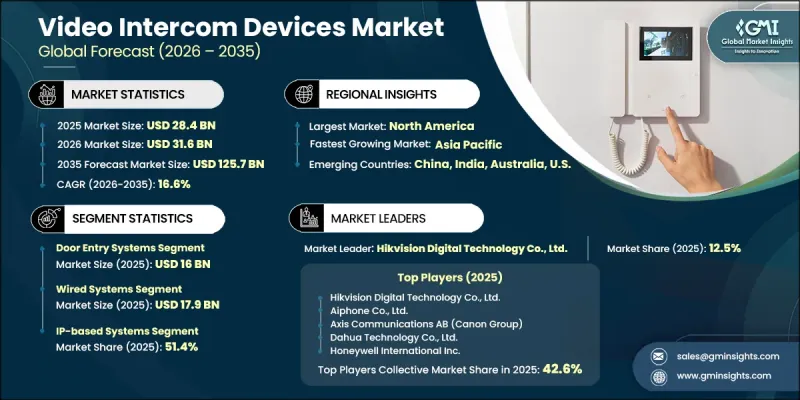
비디오 인터콤 기기 시장은 주거 및 상업 환경에서의 스마트홈 생태계와 커넥티드 보안 솔루션의 보급에 힘입어 급속히 성장하고 있습니다. 인터폰 시스템과 스마트폰, 스마트 잠금장치, 홈 오토메이션 플랫폼 간의 연동이 확대됨에 따라 방문객에 대한 실시간 모니터링 및 원격 접근 제어가 가능해져, 최종사용자의 편의성과 보안성이 크게 향상되고 있습니다. 이와 동시에, 스마트 시티 및 지능형 빌딩에 대한 노력은 운영 효율성과 거주자의 안전성 향상을 목표로 하는 정부 주도의 인프라 현대화 프로그램의 지원을 받아 전 세계적으로 확산 속도를 높이고 있습니다. 첨단 빌딩 관리 생태계에서는 방문객 관리, 출입 통제, 엘리베이터 이용 등 내부 이동 기능을 효율화하기 위해 비디오 인터폰 시스템이 점점 더 많이 도입되고 있습니다. 클라우드 기반 보안 플랫폼의 도입 확대, 광대역 연결의 보급, 그리고 건물 인프라 분야의 디지털 전환 진전이 시장 수요를 더욱 부추기고 있습니다. 그 결과, 비디오 인터폰 시스템은 단일 기기에서 지능형 빌딩 네트워크의 완전히 통합된 구성요소로 진화하여, 주거, 공공 시설, 상업 부문에 걸친 장기적인 시장 확대를 뒷받침하고 있습니다.
| 시장 범위 | |
|---|---|
| 시작 연도 | 2025년 |
| 예측 기간 | 2026-2035년 |
| 개시 금액 | 284억 달러 |
| 예측 금액 | 1,257억 달러 |
| CAGR | 16.6% |
도어 엔트리 시스템 시장은 2025년에 160억 달러에 달했습니다. 이 시장은 주택, 상업 시설, 공공·공익 시설에서 스마트 출입 통제 솔루션의 도입이 확대됨에 따라 계속해서 견조한 성장을 이루고 있습니다. 도어 엔트리 시스템은 방문자의 실시간 식별, 원격 출입 관리, 그리고 스마트 잠금 장치 및 빌딩 자동화 플랫폼과의 원활한 연동을 가능하게 합니다. 아파트, 게이트가 설치된 주거 단지, 사무실, 공공 시설 등에서 광범위하게 도입되고 있는 것은 현대 보안 인프라에서 그 중요성을 여실히 보여주고 있으며, 시장의 지속적인 성장을 뒷받침하고 있습니다.
유선 시스템 부문은 2025년에 179억 달러를 차지했습니다. 이러한 선도적 지위는 높은 신뢰성, 안정적인 통신 성능, 강화된 사이버 보안, 그리고 대규모 도입에 대한 적합성에 의해 뒷받침되고 있습니다. 유선 시스템은 병원, 교육 기관, 정부 시설, 상업 시설 등 끊김 없는 연결성과 안정적인 영상 전송이 요구되는 환경에서 널리 선호되고 있습니다. 통합 빌딩 시스템과의 호환성 및 저지연 고품질 통신을 구현하는 능력이, 이 회사의 확고한 시장 입지를 더욱 공고히 하고 있습니다.
2025년, 북미의 비디오 인터콤 기기 시장은 34.3%의 점유율을 차지했습니다. 이 지역의 시장 성장은 스마트홈 기술의 적극적인 도입, 지능형 빌딩 시스템의 도입 확대, 그리고 첨단 출입 통제 및 보안 솔루션에 대한 수요 증가에 힘입어 이루어지고 있습니다. 디지털 인프라 확충, 고속 인터넷의 보급, 클라우드 기반 보안 플랫폼의 이용 확대가 그 도입을 더욱 가속화하고 있습니다. 또한, 스마트 빌딩의 업그레이드와 인프라의 디지털화를 추진하는 정부 주도의 노력도 주택, 상업 시설, 의료 시설, 공공 시설에서의 도입 확대에 기여하고 있습니다.
자주 묻는 질문
목차
제1장 조사 방법과 범위
제2장 주요 요약
제3장 업계 인사이트
제4장 경쟁 구도
제5장 시장 추정 및 예측 : 디바이스 유형별, 2022-2035년
제6장 시장 추정 및 예측 : 기술별, 2022-2035년
제7장 시장 추정 및 예측 : 연결성별, 2022-2035년
제8장 시장 추정 및 예측 : 용도별, 2022-2035년
제9장 시장 추정 및 예측 : 지역별, 2022-2035년
제10장 기업 개요
KSM 26.07.20The Global Video Intercom Devices Market was valued at USD 28.4 billion in 2025 and is estimated to grow at a CAGR of 16.6% to reach USD 125.7 billion by 2035.
The video intercom devices market is experiencing rapid expansion driven by the widespread adoption of smart home ecosystems and connected security solutions across residential and commercial environments. Increasing integration of intercom systems with smartphones, smart locks, and home automation platforms is enabling real-time visitor monitoring and remote access control, significantly improving convenience and security for end users. In parallel, smart city and intelligent building initiatives are accelerating global adoption, supported by government-led infrastructure modernization programs aimed at improving operational efficiency and occupant safety. Advanced building management ecosystems are increasingly incorporating video intercom systems to streamline visitor management, access control, and internal mobility functions such as elevator access. Growing deployment of cloud-based security platforms, expanding broadband connectivity, and rising digital transformation in building infrastructure are further strengthening market demand. As a result, video intercom systems are evolving from standalone devices into fully integrated components of intelligent building networks, supporting long-term market expansion across residential, institutional, and commercial sectors.
| Market Scope | |
|---|---|
| Start Year | 2025 |
| Forecast Year | 2026-2035 |
| Start Value | $28.4 Billion |
| Forecast Value | $125.7 Billion |
| CAGR | 16.6% |
The door entry systems segment reached USD 16 billion in 2025. This segment continues to grow strongly due to the rising adoption of smart access control solutions across residential, commercial, and institutional buildings. Door entry systems enable real-time visitor identification, remote access management, and seamless integration with smart locks and building automation platforms. Their widespread deployment across apartments, gated communities, offices, and public facilities highlights their importance in modern security infrastructure, supporting continued segment expansion.
The wired systems segment accounted for USD 17.9 billion in 2025. Its leadership is supported by high reliability, stable communication performance, enhanced cybersecurity, and suitability for large-scale installations. Wired systems are widely preferred in environments that require uninterrupted connectivity and consistent video transmission, including hospitals, educational institutions, government facilities, and commercial complexes. Their compatibility with integrated building systems and ability to deliver low-latency, high-quality communication continue to reinforce their strong market position.
North America Video Intercom Devices Market held 34.3% share in 2025. Market growth in the region is supported by strong adoption of smart home technologies, rising deployment of intelligent building systems, and increasing demand for advanced access control and security solutions. Expanding digital infrastructure, widespread availability of high-speed internet, and growing use of cloud-based security platforms are further accelerating adoption. Government-led initiatives promoting smart building upgrades and infrastructure digitization are also contributing to increased deployment across residential, commercial, healthcare, and institutional facilities.
Major companies operating in the global video intercom devices market include Hikvision Digital Technology Co., Ltd., Dahua Technology Co., Ltd., Axis Communications AB (Canon Group), Panasonic Corporation, Honeywell International Inc., Legrand SA (BTicino), Aiphone Co., Ltd., Fermax Electronica SAU, 2N Telekomunikace, Urmet S.p.A., Comelit Group S.p.A., BAS-IP, Verkada Inc., ButterflyMX, Swiftlane, TCS AG, Aipix, and Akuvox. Companies operating in the video intercom devices market are strengthening their market position by focusing on AI-enabled security features, cloud-based access control platforms, and seamless integration with smart home and building automation systems. Manufacturers are investing heavily in research and development to enhance video quality, cybersecurity, and real-time communication capabilities. Strategic partnerships with real estate developers and facility management companies are enabling wider deployment across large-scale residential and commercial projects. Firms are also expanding their product portfolios to include mobile app integration, IoT connectivity, and advanced facial recognition technologies.
Table of Contents
Chapter 1 Methodology and Scope
- 1.1 Market scope and definition
- 1.2 Research design
- 1.2.1 Research approach
- 1.2.2 Data collection methods
- 1.3 Data mining sources
- 1.3.1 Global
- 1.3.2 Regional/Country
- 1.4 Base estimates and calculations
- 1.4.1 Base year calculation
- 1.4.2 Key trends for market estimation
- 1.5 Primary research and validation
- 1.5.1 Primary sources
- 1.6 Forecast model
- 1.7 Research assumptions and limitations
Chapter 2 Executive Summary
- 2.1 Industry 360° synopsis, 2022 - 2035
- 2.2 Key market trends
- 2.2.1 Device type trends
- 2.2.2 Technology trends
- 2.2.3 Connectivity trends
- 2.2.4 Application trends
- 2.2.5 Regional trends
- 2.3 TAM Analysis, 2026-2035
- 2.4 CXO perspectives: Strategic imperatives
Chapter 3 Industry Insights
- 3.1 Industry ecosystem analysis
- 3.1.1 Supplier Landscape
- 3.1.2 Profit Margin
- 3.1.3 Cost structure
- 3.1.4 Value addition at each stage
- 3.1.5 Factor affecting the value chain
- 3.1.6 Disruptions
- 3.2 Industry impact forces
- 3.2.1 Growth drivers
- 3.2.1.1 Rising adoption of smart homes and connected security systems
- 3.2.1.2 Expansion of smart buildings and intelligent infrastructure projects
- 3.2.1.3 Growing focus on building security and access control
- 3.2.1.4 Increasing integration with access control, elevators, and building management systems
- 3.2.1.5 Advancements in AI, cloud connectivity, and IoT-enabled communication technologies
- 3.2.2 Industry pitfalls and challenges
- 3.2.2.1 Complex integration with existing building management systems
- 3.2.2.2 Network dependency and connectivity limitations
- 3.2.3 Market opportunities
- 3.2.3.1 Expansion of smart city and digital infrastructure projects
- 3.2.3.2 Growing adoption of cloud-based and mobile-enabled intercom solutions
- 3.2.1 Growth drivers
- 3.3 Growth potential analysis
- 3.4 Regulatory landscape
- 3.4.1 North America
- 3.4.2 Europe
- 3.4.3 Asia Pacific
- 3.4.4 Latin America
- 3.4.5 Middle East & Africa
- 3.5 Porter's analysis
- 3.6 PESTEL analysis
- 3.7 Technology and Innovation landscape
- 3.7.1 Current technological trends
- 3.7.2 Emerging technologies
- 3.8 Price trends
- 3.8.1 By region
- 3.8.2 By product
- 3.9 Pricing Strategies
- 3.10 Emerging Business Models
- 3.11 Compliance Requirements
- 3.12 Patent and IP analysis
Chapter 4 Competitive Landscape, 2025
- 4.1 Introduction
- 4.2 Company market share analysis
- 4.2.1 By region
- 4.2.1.1 North America
- 4.2.1.2 Europe
- 4.2.1.3 Asia Pacific
- 4.2.1.4 Latin America
- 4.2.1.5 Middle East & Africa
- 4.2.2 Market concentration analysis
- 4.2.1 By region
- 4.3 Competitive benchmarking of key players
- 4.3.1 Financial performance comparison
- 4.3.1.1 Revenue
- 4.3.1.2 Profit margin
- 4.3.1.3 R&D
- 4.3.2 Product portfolio comparison
- 4.3.2.1 Product range breadth
- 4.3.2.2 Technology
- 4.3.2.3 Innovation
- 4.3.3 Geographic presence comparison
- 4.3.3.1 Global footprint analysis
- 4.3.3.2 Service network coverage
- 4.3.3.3 Market penetration by region
- 4.3.4 Competitive positioning matrix
- 4.3.4.1 Leaders
- 4.3.4.2 Challengers
- 4.3.4.3 Followers
- 4.3.4.4 Niche players
- 4.3.5 Strategic outlook matrix
- 4.3.1 Financial performance comparison
- 4.4 Key developments
- 4.4.1 Mergers and acquisitions
- 4.4.2 Partnerships and collaborations
- 4.4.3 Technological advancements
- 4.4.4 Expansion and investment strategies
- 4.4.5 Digital transformation initiatives
- 4.5 Emerging/ startup competitors landscape
Chapter 5 Market Estimates and Forecast, By Device Type, 2022 - 2035 (USD Million)
- 5.1 Key trends
- 5.2 Door entry systems
- 5.3 Handheld devices
- 5.4 Video baby monitors
Chapter 6 Market Estimates and Forecast, By Technology, 2022 - 2035 (USD Million)
- 6.1 Key trends
- 6.2 IP-based systems
- 6.2.1 Ethernet/poe systems
- 6.2.2 WIFI-based systems
- 6.2.3 Cloud-native ip systems
- 6.3 Analog systems
- 6.3.1 Coaxial cable systems
- 6.3.2 Traditional analog video transmission
Chapter 7 Market Estimates and Forecast, By Connectivity, 2022 - 2035 (USD Million)
- 7.1 Key trends
- 7.2 Wired systems
- 7.3 Wireless systems
Chapter 8 Market Estimates and Forecast, By Application, 2022 - 2035 (USD Million)
- 8.1 Key trends
- 8.2 Residential buildings
- 8.2.1 Apartment buildings
- 8.2.2 Condominiums
- 8.2.3 Gated communities
- 8.2.4 Others
- 8.3 Commercial buildings
- 8.3.1 Office buildings
- 8.3.2 Retail facilities
- 8.3.3 Hospitality
- 8.3.4 Others
- 8.4 Institutional buildings
- 8.4.1 Healthcare facilities
- 8.4.2 Educational institutions
- 8.4.3 Government buildings
- 8.4.4 Others
Chapter 9 Market Estimates and Forecast, By Region, 2022 - 2035 (USD Million)
- 9.1 Key trends
- 9.2 North America
- 9.2.1 U.S.
- 9.2.2 Canada
- 9.3 Europe
- 9.3.1 Germany
- 9.3.2 UK
- 9.3.3 France
- 9.3.4 Spain
- 9.3.5 Italy
- 9.4 Asia Pacific
- 9.4.1 China
- 9.4.2 India
- 9.4.3 Japan
- 9.4.4 South Korea
- 9.4.5 Australia
- 9.5 Latin America
- 9.5.1 Brazil
- 9.5.2 Mexico
- 9.6 Middle East and Africa
- 9.6.1 South Africa
- 9.6.2 Saudi Arabia
- 9.6.3 UAE
Chapter 10 Company Profiles
- 10.1 Global Key Players
- 10.1.1 Aiphone Co., Ltd.
- 10.1.2 Axis Communications AB (Canon Group)
- 10.1.3 Dahua Technology Co., Ltd.
- 10.1.4 Hikvision Digital Technology Co., Ltd.
- 10.1.5 Honeywell International Inc.
- 10.1.6 Legrand SA (Bticino)
- 10.1.7 Panasonic Corporation
- 10.2 Regional key players
- 10.2.1 North America
- 10.2.1.1 Swiftlane
- 10.2.1.2 Verkada Inc.
- 10.2.2 Asia Pacific
- 10.2.2.1 Aipix
- 10.2.2.2 BAS-IP
- 10.2.2.3 Akuvox
- 10.2.3 Europe
- 10.2.3.1 2N Telekomunikace
- 10.2.3.2 Comelit Group S.p.A.
- 10.2.3.3 Fermax Electronica SAU
- 10.2.3.4 TCS AG
- 10.2.3.5 Urmet S.p.A.
- 10.2.1 North America
- 10.3 Niche Players/Disruptors
- 10.3.1 ButterflyMX