

|
시장보고서
상품코드
2083343
BPA Free 및 BPS Free 캔 코팅 시장 성장 기회, 성장요인, 업계 동향 분석 및 예측(2026-2035년)BPA-Free and BPS-Free Can Coatings Market Opportunity, Growth Drivers, Industry Trend Analysis, and Forecast 2026 - 2035 |
||||||

세계의 BPA Free 및 BPS Free 캔 코팅 시장은 2025년에 6억 4,300만 달러 규모로 평가되었고, CAGR 7.4%로 성장하여 2035년까지 13억 2,000만 달러에 달할 것으로 추정되고 있습니다.
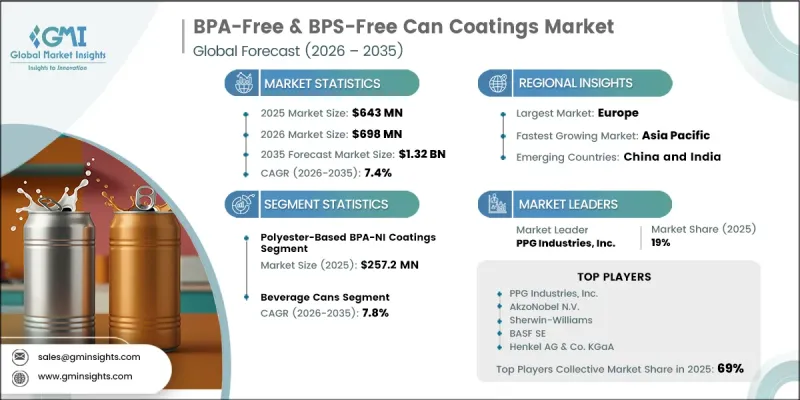
금속 포장 업계가 비스페놀 계열 물질의 사용을 배제하는 대체 코팅 기술로 점점 더 전환함에 따라, 이 시장은 큰 변화를 겪고 있습니다. 성장의 원동력은 식품 접촉 재료에 대한 규제 요건의 강화, 안전 기준의 발전, 그리고 브랜드 소유자들 사이에서 인증된 비스페놀 프리 포장 솔루션에 대한 선호도가 높아지고 있다는 점입니다. 포장 밸류체인 전반에 걸쳐 활동하는 제조업체들은 변화하는 규정 준수 요건과 더 안전한 포장재를 원하는 소비자 수요에 대응하기 위해 제품 재조성을 위한 노력을 가속화하고 있습니다. BPA 및 BPS가 함유되지 않은 캔용 코팅 시장은 코팅 화학 분야의 지속적인 발전으로 인해 혜택을 보고 있으며, 이를 통해 성능이 향상되는 동시에 점점 더 엄격해지는 규제 요건도 충족되고 있습니다. 입증된 코팅 기술은 그 신뢰성과 제조상의 적합성 덕분에 여전히 강력한 입지를 유지하고 있는 반면, 신흥 배합 기술은 환경 친화성, 지속가능성 향상 및 도포 성능 개선을 바탕으로 그 기세를 더해가고 있습니다. 비스페놀 계열 소재를 둘러싼 규제상의 불확실성은 전 세계 공급망 전반에 걸쳐 대체 코팅 솔루션에 대한 적극적인 투자를 더욱 촉진하고 있습니다. 식품 및 음료 포장 제조업체들이 규정 준수, 지속가능성, 제품 안전성을 지속적으로 최우선으로 삼고 있는 가운데, BPA 및 BPS가 함유되지 않은 캔용 코팅제에 대한 수요는 예측 기간 동안 견조한 추세를 보일 것으로 전망됩니다.
| 시장 범위 | |
|---|---|
| 개시 연도 | 2025년 |
| 예측 기간 | 2026-2035년 |
| 개시 연도 시장 규모 | 6억 4,300만 달러 |
| 예측액 | 13억 2,000만 달러 |
| CAGR | 7.4% |
폴리에스터계 BPA-NI 코팅 시장은 2025년에 2억 5,720만 달러에 달했습니다. 해당 부문은 2035년까지 연평균 성장률(CAGR) 8.2%로 성장할 것으로 전망됩니다. 이러한 지속적인 선도적 지위는 규제 준수, 확립된 생산 인프라, 그리고 금속 포장 분야 전반에 걸친 입증된 성능 특성이 결합되어 실현된 것으로 보입니다. 이 기술은 규제 시장에서 기존의 코팅 시스템을 대체하는 솔루션으로 널리 받아들여지고 있으며, 제조업체들은 업무 효율성을 저해하지 않으면서도 끊임없이 변화하는 규정 준수 요건을 충족할 수 있게 되었습니다. 이 기술의 지속적인 도입으로 인해, 예측 기간 동안 해당 부문의 지배적 지위가 더욱 공고해질 것으로 예측됩니다.
2025년, 음료 캔 부문은 시장 점유율의 55.1%를 차지했으며, 그 규모는 3억 5,430만 달러에 달했습니다. 이러한 성장은 금속 음료 용기에 대한 수요 증가와 비스페놀 프리 코팅 기술로의 지속적인 전환에 힘입은 것입니다. 음료 포장 분야에서의 채택률은 업계가 규제 준수, 제품 안전성 및 소비자 신뢰를 중시하고 있기 때문에 특히 견조한 추세를 보이고 있습니다. 제조업체들이 지속 가능하고 규정을 준수하는 포장 솔루션을 지속적으로 우선시함에 따라, 음료 캔 용도의 첨단 코팅 시스템에 대한 수요는 계속해서 견조할 것으로 예측됩니다.
2025년, 북미의 BPA 및 BPS 무함유 캔용 코팅 시장은 28.9%의 점유율을 차지하며 1억 8,580만 달러 시장 규모를 기록했습니다. 해당 지역 시장은 예측 기간 동안 연평균 성장률(CAGR) 7%로 확대될 것으로 전망됩니다. 이러한 성장은 확립된 금속 포장 산업, 강력한 규제 감독, 그리고 대체 코팅 기술의 도입 확대에 힘입어 이루어지고 있습니다. 미국은 탄탄한 캔 제조 인프라와 식품 접촉 재료의 안전성에 대한 관심이 높아지고 있는 점으로 인해, 여전히 이 지역 최대 시장을 차지하고 있습니다. 포장 혁신과 규정 준수를 중시하는 제품 개발에 대한 지속적인 투자가 향후 몇 년간 북미 전역에서 꾸준한 성장을 뒷받침할 것으로 예측됩니다.
자주 묻는 질문
목차
제1장 조사 방법과 범위
제2장 주요 요약
제3장 업계 인사이트
제4장 경쟁 구도
제5장 시장 추산 및 예측 : 수지 유형별, 2022년부터 2035년
제6장 시장 추산 및 예측 : 용도별, 2022년부터 2035년
제7장 시장 추산 및 예측 : 코팅층별, 2022년부터 2035년
제8장 시장 추산 및 예측 : 제제 기술별, 2022년부터 2035년
제9장 시장 추산 및 예측 : 최종 용도별, 2022년부터 2035년
제10장 시장 추산 및 예측 : 지역별, 2022년부터 2035년
제11장 기업 개요
LSH 26.07.14The Global BPA-Free & BPS-Free Can Coatings Market was valued at USD 643 million in 2025 and is estimated to grow at a CAGR of 7.4% to reach USD 1.32 billion by 2035.
The market is undergoing a significant transformation as the metal packaging industry increasingly shifts toward alternative coating technologies that eliminate the use of bisphenol-based substances. Growth is being driven by tightening regulatory requirements governing food-contact materials, evolving safety standards, and a growing preference among brand owners for verified bisphenol-free packaging solutions. Manufacturers throughout the packaging value chain are accelerating product reformulation efforts to align with changing compliance expectations and consumer demand for safer packaging materials. The BPA-Free & BPS-Free Can Coatings market is also benefiting from ongoing advancements in coating chemistry, which are improving performance while meeting increasingly stringent regulatory requirements. Established coating technologies continue to maintain a strong presence due to their proven reliability and manufacturing compatibility, while emerging formulations are gaining momentum because of their environmental profile, improved sustainability characteristics, and enhanced application performance. Regulatory uncertainty surrounding bisphenol-based materials is further encouraging proactive investment in alternative coating solutions across global supply chains. As food and beverage packaging producers continue to prioritize compliance, sustainability, and product safety, demand for BPA-Free & BPS-Free can coatings is expected to remain strong throughout the forecast period.
| Market Scope | |
|---|---|
| Start Year | 2025 |
| Forecast Year | 2026-2035 |
| Start Value | $643 Million |
| Forecast Value | $1.32 Billion |
| CAGR | 7.4% |
The polyester-based BPA-NI coatings segment reached USD 257.2 million in 2025. The segment is anticipated to grow at a CAGR of 8.2% through 2035. Its continued leadership is attributed to a combination of regulatory compliance, established production infrastructure, and proven performance characteristics across metal packaging applications. The technology has become a widely accepted replacement for traditional coating systems in regulated markets, enabling manufacturers to meet evolving compliance requirements without compromising operational efficiency. Continued adoption is expected to reinforce the segment's dominant position throughout the forecast period.
The beverage cans segment accounted for 55.1% share in 2025, equivalent to USD 354.3 million. Growth is supported by increasing demand for metal beverage packaging and the continued transition toward bisphenol-free coating technologies. Adoption rates within beverage packaging remain particularly strong due to the industry's focus on regulatory compliance, product safety, and consumer confidence. As manufacturers continue to prioritize sustainable and compliant packaging solutions, demand for advanced coating systems in beverage can applications is expected to remain robust.
North America BPA-Free & BPS-Free Can Coatings Market accounted for 28.9% share in 2025, generating USD 185.8 million. The regional market is projected to expand at a CAGR of 7% during the forecast period. Growth is being supported by a well-established metal packaging industry, strong regulatory oversight, and increasing adoption of alternative coating technologies. The United States continues to represent the largest market within the region due to its substantial can manufacturing infrastructure and growing emphasis on food-contact material safety. Continued investments in packaging innovation and compliance-driven product development are expected to support steady growth across North America over the coming years.
Major companies operating in the Global BPA-Free & BPS-Free Can Coatings market include PPG Industries, Inc., AkzoNobel N.V., Sherwin-Williams, BASF SE, and Henkel AG & Co. KGaA. Companies operating in the BPA-Free & BPS-Free Can Coatings market are focusing on product innovation, regulatory compliance, and sustainability initiatives to strengthen their competitive position. Significant investments in research and development are being directed toward the creation of high-performance coating technologies that meet evolving food-contact regulations while delivering superior durability and protection. Manufacturers are also expanding their portfolios with advanced resin systems and environmentally responsible formulations to address growing customer demand for safer packaging solutions. Strategic partnerships with packaging producers, food and beverage brands, and supply chain stakeholders are helping companies accelerate product adoption and strengthen market reach.
Table of Contents
Chapter 1 Methodology & Scope
- 1.1 Research approach
- 1.2 Quality Commitments
- 1.2.1 GMI AI policy & data integrity commitment
- 1.2.1.1 Source consistency protocol
- 1.2.1 GMI AI policy & data integrity commitment
- 1.3 Research Trail & Confidence Scoring
- 1.3.1 Research Trail Components
- 1.3.2 Scoring Components
- 1.4 Data Collection
- 1.4.1 Partial list of primary sources
- 1.5 Data mining sources
- 1.5.1 Paid sources
- 1.5.1.1 Sources, by region
- 1.5.1 Paid sources
- 1.6 Base estimates and calculations
- 1.6.1 Base year calculation for any one approach
- 1.7 Forecast model
- 1.7.1 Quantified market impact analysis
- 1.7.1.1 Mathematical impact of growth parameters on forecast
- 1.7.1 Quantified market impact analysis
- 1.8 Research transparency addendum
- 1.8.1 Source attribution framework
- 1.8.2 Quality assurance metrics
- 1.8.3 Our commitment to trust
Chapter 2 Executive Summary
- 2.1 Industry 360° synopsis
- 2.2 Key market trends
- 2.2.1 Regional
- 2.2.2 By Resin Chemistry
- 2.2.3 By Application
- 2.2.4 By Coating Layer
- 2.2.5 By Formulation Technology
- 2.2.6 By End-Use
- 2.3 TAM Analysis, 2026 2035
- 2.4 CXO perspectives: Strategic imperatives
Chapter 3 Industry Insights
- 3.1 Industry ecosystem analysis
- 3.1.1 Supplier landscape
- 3.1.2 Profit margin
- 3.1.3 Value addition at each stage
- 3.1.4 Factor affecting the value chain
- 3.1.5 Disruptions
- 3.2 Industry impact forces
- 3.2.1 Growth drivers
- 3.2.2 Industry pitfalls and challenges
- 3.2.3 Market opportunities
- 3.3 Growth potential analysis
- 3.4 Regulatory landscape
- 3.4.1 North America
- 3.4.2 Europe
- 3.4.3 Asia Pacific
- 3.4.4 Latin America
- 3.4.5 Middle East & Africa
- 3.5 Porter's analysis
- 3.6 PESTEL analysis
- 3.7 Price trends
- 3.7.1 By region
- 3.7.2 By technology
- 3.8 Future market trends
- 3.9 Technology and Innovation landscape
- 3.9.1 Current technological trends
- 3.9.2 Emerging technologies
- 3.10 Patent Landscape
- 3.11 Trade statistics (HS code)
- 3.11.1 Major importing countries
- 3.11.2 Major exporting countries
- 3.12 Sustainability and environmental aspects
- 3.12.1 Sustainable practices
- 3.12.2 Waste reduction strategies
- 3.12.3 Energy efficiency in production
- 3.12.4 Eco-friendly initiatives
Chapter 4 Competitive Landscape, 2025
- 4.1 Introduction
- 4.2 Company market share analysis
- 4.2.1 By region
- 4.2.1.1 North America
- 4.2.1.2 Europe
- 4.2.1.3 Asia Pacific
- 4.2.1.4 LATAM
- 4.2.1.5 MEA
- 4.2.1 By region
- 4.3 Company matrix analysis
- 4.4 Competitive analysis of major market players
- 4.5 Competitive positioning matrix
- 4.6 Key developments
- 4.6.1 Mergers & acquisitions
- 4.6.2 Partnerships & collaborations
- 4.6.3 New Product Launches
- 4.6.4 Expansion Plans
Chapter 5 Market Estimates and Forecast, By Resin Chemistry, 2022 to 2035 (USD Million) (Tons)
- 5.1 Key trends
- 5.2 Acrylic-Based Coatings
- 5.2.1 Waterborne Acrylic
- 5.2.2 Solvent-Borne Acrylic
- 5.3 Polyester-Based Coatings (BPA-NI)
- 5.3.1 Thermoplastic Polyester
- 5.3.2 Thermosetting Polyester
- 5.4 Polyolefin-Based Coatings
- 5.4.1 Homopolymer Polyolefin
- 5.4.2 Copolymer Polyolefin
- 5.5 Non-BPA Epoxy Coatings
- 5.5.1 Plant-Based / Bio-Derived Epoxy
- 5.5.2 BADGE-Free Synthetic Epoxy (BPA-NI Epoxy)
- 5.6 Organosol Coatings (BPS-Free Reformulations)
- 5.7 Bio-Based & Emerging Coatings
- 5.7.1 UV/EB-Curable Bio-Based Coatings
- 5.7.2 Other Novel Polymer Systems
Chapter 6 Market Estimates and Forecast, By Application, 2022 to 2035 (USD Million) (Tons)
- 6.1 Key trends
- 6.2 Beverage Cans
- 6.2.1 Carbonated Beverages (CSDs, Beer, Hard Seltzer, Energy Drinks)
- 6.2.2 Non-Carbonated Beverages (Juice, Still Water, RTD Tea & Coffee)
- 6.3 Food Cans
- 6.3.1 Ready Meals & Processed Foods
- 6.3.2 Soups & Broths
- 6.3.3 Vegetables & Fruits
- 6.3.4 Dairy & Infant Nutrition
- 6.4 Aerosol Cans
- 6.4.1 Cosmetic & Personal Care Aerosol (Fragrances, Haircare, Skincare)
- 6.4.2 Industrial & Household Aerosol
- 6.4.3 Pharmaceutical Aerosol (Inhalers & Topical Dispensers)
- 6.5 Caps & Closures
- 6.5.1 Beverage Can Ends (Easy-Open Ends, Standard Ends)
- 6.5.2 Food Can Lids & Twist-Off Closures
- 6.6 Industrial Cans
- 6.6.1 Chemical & Lubricant Cans
- 6.6.2 Paint & Adhesive Cans
Chapter 7 Market Estimates and Forecast, By Coating Layer, 2022 to 2035 (USD Million) (Tons)
- 7.1 Key trends
- 7.2 Interior Coating (Can Liner - Primary Food-Contact Surface)
- 7.3 Exterior Coating (Decoration, Branding & Environmental Protection)
- 7.4 End / Closure Coating (Can End & Lid - Food-Contact Surface)
- 7.5 Side-Seam Spray Coating (3-Piece Can Welded Seam Coverage)
Chapter 8 Market Estimates and Forecast, By Formulation Technology, 2022 to 2035 (USD Million) (Tons)
- 8.1 Key trends
- 8.2 Waterborne
- 8.3 Solvent-Borne
- 8.4 Powder Coating
- 8.5 UV/EB-Curable
Chapter 9 Market Estimates and Forecast, By End-Use, 2022 to 2035 (USD Million) (Tons)
- 9.1 Key trends
- 9.2 Food & Beverage
- 9.3 Personal Care & Cosmetics
- 9.4 Pharmaceutical
- 9.5 Industrial
Chapter 10 Market Estimates and Forecast, By Region, 2022 to 2035 (USD Million) (Tons)
- 10.1 Key trends
- 10.2 North America
- 10.2.1 U.S.
- 10.2.2 Canada
- 10.3 Europe
- 10.3.1 Germany
- 10.3.2 UK
- 10.3.3 France
- 10.3.4 Spain
- 10.3.5 Italy
- 10.3.6 Rest of Europe
- 10.4 Asia Pacific
- 10.4.1 China
- 10.4.2 India
- 10.4.3 Japan
- 10.4.4 Australia
- 10.4.5 South Korea
- 10.4.6 Rest of Asia Pacific
- 10.5 Latin America
- 10.5.1 Brazil
- 10.5.2 Mexico
- 10.5.3 Argentina
- 10.5.4 Rest of Latin America
- 10.6 Middle East and Africa
- 10.6.1 Saudi Arabia
- 10.6.2 South Africa
- 10.6.3 UAE
- 10.6.4 Rest of Middle East and Africa
Chapter 11 Company Profiles
- 11.1 PPG Industries, Inc.
- 11.2 AkzoNobel N.V.
- 11.3 Sherwin-Williams
- 11.4 BASF SE
- 11.5 Henkel AG & Co. KGaA
- 11.6 Axalta Coating Systems
- 11.7 Kansai Paint Co., Ltd.
- 11.8 artience Co., Ltd.
- 11.9 VPL Coatings GmbH & Co. KG
- 11.10 TIGER Coatings GmbH & Co. KG


