

|
시장보고서
상품코드
2083348
지휘 통제 시스템 시장 기회, 성장 촉진요인, 업계 동향 분석 및 예측(2026-2035년)Command and Control Systems Market Opportunity, Growth Drivers, Industry Trend Analysis, and Forecast 2026 - 2035 |
||||||

세계의 지휘 통제 시스템 시장은 2025년에 367억 달러 규모에 달하고, CAGR 6.9%로 성장하여 2035년에는 710억 달러에 달할 것으로 추정됩니다.
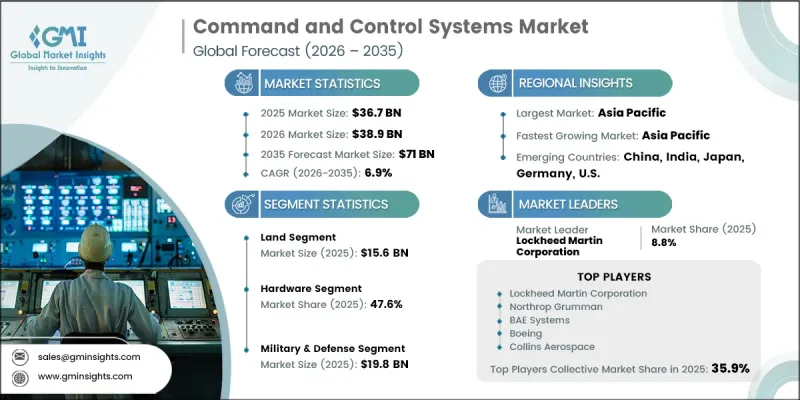
시장 확대는 전 세계적으로 국방 현대화 프로그램에 대한 투자가 증가하고, 주요 경제권에서 네트워크 중심 전술 능력 개발이 가속화됨에 따라 주도되고 있습니다. 전 세계 각국 정부는 전장 상황 인식 향상, 의사결정의 신속화, 그리고 육·공·해·우주·사이버 각 영역에 걸친 작전 통제의 연계 강화를 최우선 과제로 삼고 있습니다. 최신 지휘통제 플랫폼은 여러 정보 출처에서 수집된 방대한 양의 데이터를 통합·처리하도록 설계되어, 상황 인식을 향상시키고 시간적 제약이 엄격한 작전에서 신속한 대응을 가능하게 합니다.
| 시장 범위 | |
|---|---|
| 시작 연도 | 2025년 |
| 예측 기간 | 2026-2035년 |
| 개시 금액 | 367억 달러 |
| 예측 금액 | 710억 달러 |
| CAGR | 6.9% |
지휘 통제 시스템 시장의 주요 구조적 촉진요인은 인공지능, 클라우드 컴퓨팅, 빅데이터 분석, 사이버 보안 프레임워크와 같은 첨단 기술의 급속한 융합입니다. 방위·치안 기관에서는 복잡한 운용 데이터를 처리하고, 위협을 실시간으로 파악하며, 임무의 성패를 좌우하는 의사결정을 지원할 수 있는 지능형 시스템에 대한 수요가 높아지고 있습니다. AI를 활용한 지휘 시스템은 예측 분석 및 위협 탐지 능력을 강화하는 한편, 클라우드 기반 아키텍처는 분산형 방어 환경 전반에 걸쳐 데이터의 접근성, 확장성 및 운영상의 유연성을 향상시킵니다.
2025년에는 지휘 센터, 통신 인프라, 네트워크 시스템, 운영자 콘솔, 디스플레이 기술, 센서, 서버, 전술 통신 장비에 대한 대규모 투자의 뒷받침을 받아 하드웨어 부문이 시장 점유율의 47.6%를 차지했습니다. 방위·치안 기관들이 실시간 감시, 정보 처리 및 임무 수행에 필수적인 작전 조정 능력을 지속적으로 강화하고 있기 때문에 견고한 하드웨어 플랫폼에 대한 수요는 여전히 높은 수준을 유지하고 있습니다.
군·방위 부문은 2025년에 198억 달러의 매출을 기록하며, 전 세계 지휘 통제 시스템 시장에서 가장 큰 수익 기여를 했습니다. 이 부문의 성장은 국방 예산의 증가와 여러 국가에서 진행 중인 대규모 군사 현대화 계획의 영향을 크게 받고 있습니다. 지정학적 불안정성이 고조됨에 따라, 전장의 실시간 가시화, 안전한 통신, 정보 공유, 그리고 다영역 작전에 걸친 협력적인 의사결정을 가능하게 하는 첨단 시스템에 대한 수요가 더욱 증가하고 있습니다.
북미의 지휘 통제 시스템 시장은 지속적인 국방 지출과 군 및 국토안보 기관의 지속적인 현대화 프로그램에 힘입어 2025년에는 31.1%의 시장 점유율을 기록했습니다. 이 지역은 주요 방위 기술 공급업체들이 강력하게 진출해 있다는 장점을 살려, 첨단 지휘·통제·통신·컴퓨터·정보·감시·정찰(C4ISR) 시스템에 대한 막대한 투자를 계속하고 있습니다. 인공지능, 사이버 보안 프레임워크, 우주 기반 방어 능력, 그리고 전 영역에 걸친 통합 지휘 구조의 도입 확대가 해당 지역의 시장 성장을 더욱 뒷받침하고 있습니다.
자주 묻는 질문
목차
제1장 조사 방법과 범위
제2장 주요 요약
제3장 업계 인사이트
제4장 경쟁 구도
제5장 시장 추정 및 예측 : 플랫폼 유형별, 2022-2035년
제6장 시장 추정 및 예측 : 솔루션별, 2022-2035년
제7장 시장 추정 및 예측 : 설치 유형별, 2022-2035년
제8장 시장 추정 및 예측 : 용도별, 2022-2035년
제9장 시장 추정 및 예측 : 지역별, 2022-2035년
제10장 기업 개요
KSM 26.07.20The Global Command and Control Systems Market was valued at USD 36.7 billion in 2025 and is estimated to grow at a CAGR of 6.9% to reach USD 71 billion in 2035.
Market expansion is driven by rising global investments in defense modernization programs and the accelerated development of network-centric warfare capabilities across major economies. Governments worldwide are prioritizing enhanced battlefield awareness, faster decision-making, and synchronized operational control across land, air, naval, space, and cyber domains. Modern command and control platforms are designed to integrate and process large volumes of data from multiple sources, improving situational awareness and enabling rapid response in time-critical operations.
| Market Scope | |
|---|---|
| Start Year | 2025 |
| Forecast Year | 2026-2035 |
| Start Value | $36.7 Billion |
| Forecast Value | $71 Billion |
| CAGR | 6.9% |
A key structural driver of the command and control systems market is the rapid convergence of advanced technologies such as artificial intelligence, cloud computing, big data analytics, and cybersecurity frameworks. Defense and security agencies increasingly require intelligent systems capable of processing complex operational data, identifying threats in real time, and supporting mission-critical decision-making. AI-enabled command systems enhance predictive analytics and threat detection capabilities, while cloud-based architectures improve data accessibility, scalability, and operational flexibility across distributed defense environments.
The hardware segment accounted for 47.6% share in 2025, supported by extensive investments in command centers, communication infrastructure, networking systems, operator consoles, display technologies, sensors, servers, and tactical communication equipment. Demand for robust hardware platforms remains high as defense and security agencies continue to strengthen real-time surveillance, intelligence processing, and mission-critical operational coordination capabilities.
The military and defense segment generated USD 19.8 billion in 2025, representing the largest revenue contribution within the global command and control systems market. Growth in this segment is strongly influenced by rising defense budgets and large-scale military modernization initiatives across multiple countries. Increasing geopolitical instability has further intensified the demand for advanced systems that enable real-time battlefield visibility, secure communication, intelligence sharing, and coordinated decision-making across multi-domain operations.
North America Command and Control Systems Market held 31.1% share in 2025, supported by sustained defense spending and ongoing modernization programs across military and homeland security agencies. The region benefits from a strong presence of leading defense technology providers and continues to invest heavily in advanced command, control, communications, computers, intelligence, surveillance, and reconnaissance systems. Expanding adoption of artificial intelligence, cybersecurity frameworks, space-based defense capabilities, and joint all-domain command structures is further reinforcing regional market growth.
Major companies operating in the global command and control systems market include Airbus, Lockheed Martin Corporation, Thales Group, BAE Systems, Northrop Grumman, Boeing, Elbit Systems Ltd., Rheinmetall AG, Collins Aerospace, CACI International Inc, Saab AB, INDRA SISTEMAS, S.A., LARSEN & TOUBRO, Panasonic Corporation, Barco NV, Activu, Hiperwall, Inc., and Leonardo S.p.A. Companies operating in the command and control systems market are focusing on strengthening their competitive position through investments in AI-enabled decision support systems, cloud-based command platforms, and integrated multi-domain operational architectures. Key players are prioritizing interoperability across defense networks to ensure seamless data exchange between land, air, sea, space, and cyber domains. Strategic partnerships with defense agencies and government bodies are enabling large-scale deployment of advanced systems. Firms are also expanding R&D in predictive analytics, cybersecurity, and real-time data fusion technologies to enhance situational awareness. Additionally, companies are adopting modular system designs, upgrading legacy infrastructure, and investing in secure communication technologies.
Table of Contents
Chapter 1 Methodology and Scope
- 1.1 Market scope and definition
- 1.2 Research design
- 1.2.1 Research approach
- 1.2.2 Data collection methods
- 1.3 Data mining sources
- 1.3.1 Global
- 1.3.2 Regional/Country
- 1.4 Base estimates and calculations
- 1.4.1 Base year calculation
- 1.4.2 Key trends for market estimation
- 1.5 Primary research and validation
- 1.5.1 Primary sources
- 1.6 Forecast model
- 1.7 Research assumptions and limitations
Chapter 2 Executive Summary
- 2.1 Industry 360° synopsis, 2022 - 2035
- 2.2 Key market trends
- 2.2.1 Platform trends
- 2.2.2 Solution trends
- 2.2.3 Installation type trends
- 2.2.4 Applications trends
- 2.2.5 Regional trends
- 2.3 TAM Analysis, 2026-2035
- 2.4 CXO perspectives: Strategic imperatives
Chapter 3 Industry Insights
- 3.1 Industry ecosystem analysis
- 3.1.1 Supplier Landscape
- 3.1.2 Profit Margin
- 3.1.3 Cost structure
- 3.1.4 Value addition at each stage
- 3.1.5 Factor affecting the value chain
- 3.1.6 Disruptions
- 3.2 Industry impact forces
- 3.2.1 Growth drivers
- 3.2.1.1 Increasing Defense Modernization Programs Worldwide
- 3.2.1.2 Growing Adoption of Network-Centric and Multi-Domain Warfare
- 3.2.1.3 Integration of Artificial Intelligence and Advanced Analytics
- 3.2.1.4 Rising Demand for Real-Time Situational Awareness
- 3.2.1.5 Increasing Focus on Cybersecurity and Secure Communications
- 3.2.2 Industry pitfalls and challenges
- 3.2.2.1 High System Integration and Deployment Costs
- 3.2.2.2 Rising Cybersecurity Threats and Data Vulnerabilities
- 3.2.3 Market opportunities
- 3.2.3.1 Expansion of Joint All-Domain Command and Control (JADC2) and Multi-Domain Operations
- 3.2.3.2 Increasing Adoption of AI-Enabled and Cloud-Based Command Platforms
- 3.2.1 Growth drivers
- 3.3 Growth potential analysis
- 3.4 Regulatory landscape
- 3.4.1 North America
- 3.4.2 Europe
- 3.4.3 Asia Pacific
- 3.4.4 Latin America
- 3.4.5 Middle East & Africa
- 3.5 Porter's analysis
- 3.6 PESTEL analysis
- 3.7 Technology and Innovation landscape
- 3.7.1 Current technological trends
- 3.7.2 Emerging technologies
- 3.8 Price trends (Based on paid Database)
- 3.8.1 Historical Price Analysis (2022-2025)
- 3.8.2 Price Trend Drivers
- 3.8.3 Regional Price Variations
- 3.8.4 Price Forecast (2026-2035)
- 3.9 Trade Data Analysis (Driven by Primary Research)
- 3.9.1 Import/Export Volume & Value Trends
- 3.9.2 Key Trade Corridors & Tariff Impact
- 3.10 Impact of AI & Generative AI on the Market
- 3.10.1 AI-Driven Disruption of Existing Business Models
- 3.10.2 GenAI Use Cases & Adoption Roadmap by Segment
- 3.10.3 Risks, Limitations & Regulatory Considerations
- 3.11 Capacity & Production Landscape (Driven by Primary Research)
- 3.11.1 Installed Capacity by Region & Key Producer
- 3.11.2 Capacity Utilization Rates & Expansion Pipelines
Chapter 4 Competitive Landscape, 2025
- 4.1 Introduction
- 4.2 Company market share analysis
- 4.2.1 By region
- 4.2.1.1 North America
- 4.2.1.2 Europe
- 4.2.1.3 Asia Pacific
- 4.2.1.4 Latin America
- 4.2.1.5 Middle East & Africa
- 4.2.2 Market concentration analysis
- 4.2.1 By region
- 4.3 Competitive analysis of major market players
- 4.4 Competitive positioning matrix
- 4.5 Key developments
- 4.5.1 Mergers & acquisitions
- 4.5.2 Partnerships & collaborations
- 4.5.3 New product launches
- 4.5.4 Expansion plans and funding
- 4.6 Company tier benchmarking
- 4.6.1 Tier classification criteria & qualifying thresholds
- 4.6.2 Tier positioning matrix by revenue, geography & innovation
Chapter 5 Market Estimates and Forecast, By Platform Type, 2022 - 2035 (USD Million)
- 5.1 Key trends
- 5.2 Land
- 5.3 Maritime
- 5.4 Space
- 5.5 Airborne
Chapter 6 Market Estimates and Forecast, By Solution, 2022 - 2035 (USD Million)
- 6.1 Hardware
- 6.1.1 Computers/Consoles
- 6.1.2 Displays & Panels
- 6.1.3 Networking Equipment
- 6.1.4 Communication Devices
- 6.1.5 Others
- 6.2 Software
- 6.3 Services
- 6.3.1 System Integration
- 6.3.2 Support & Maintenance
- 6.3.3 Training & Simulation
- 6.3.4 Consulting Services
Chapter 7 Market Estimates and Forecast, By Installation type, 2022 - 2035 (USD Million)
- 7.1 Fixed Command Centers
- 7.2 Deployable Tactical Command Centers
- 7.3 Vehicle-Mounted Systems
- 7.4 Mobile Command Units (MCUs)
Chapter 8 Market Estimates and Forecast, By Application, 2022 - 2035 (USD Million)
- 8.1 Military & Defence
- 8.1.1 Battlefield Management & ISR Integration
- 8.1.2 Naval Command & Maritime Surveillance
- 8.1.3 Tactical Command & Control
- 8.1.4 Cyber & Electronic Warfare Management
- 8.1.5 Others
- 8.2 Homeland Security & Emergency Management
- 8.2.1 Border Security & Coastal Surveillance
- 8.2.2 Fire & Rescue Coordination
- 8.2.3 Disaster Relief Operations
- 8.2.4 Public Safety and Law Enforcement
- 8.2.5 Others
- 8.3 Civil & Commercial
- 8.3.1 Airport Operations
- 8.3.2 Transportation & Logistics Monitoring
- 8.3.3 Industrial Safety Management
- 8.3.4 Energy Grid Control Centers
- 8.3.5 Others
Chapter 9 Market Estimates and Forecast, By Region, 2022 - 2035 (USD Million)
- 9.1 Key trends
- 9.2 North America
- 9.2.1 U.S.
- 9.2.2 Canada
- 9.3 Europe
- 9.3.1 Germany
- 9.3.2 UK
- 9.3.3 France
- 9.3.4 Spain
- 9.3.5 Italy
- 9.3.6 Rest of Europe
- 9.4 Asia Pacific
- 9.4.1 China
- 9.4.2 India
- 9.4.3 Japan
- 9.4.4 Australia
- 9.4.5 South Korea
- 9.4.6 Rest of Asia Pacific
- 9.5 Latin America
- 9.5.1 Brazil
- 9.5.2 Mexico
- 9.5.3 Argentina
- 9.5.4 Rest of Latin America
- 9.6 Middle East and Africa
- 9.6.1 South Africa
- 9.6.2 Saudi Arabia
- 9.6.3 UAE
- 9.6.4 Rest of MEA
Chapter 10 Company Profiles
- 10.1 Global Key Players
- 10.1.1 Lockheed Martin Corporation
- 10.1.2 Northrop Grumman
- 10.1.3 Boeing
- 10.1.4 Airbus
- 10.1.5 BAE Systems
- 10.1.6 Thales Group Texas Instruments Incorporated
- 10.2 Regional players
- 10.2.1 Larsen & Toubro
- 10.2.2 INDRA Sistemas
- 10.2.3 Elbit Systems Ltd
- 10.2.4 Rheinmetall AG
- 10.2.5 Saab AB
- 10.3 Niche players
- 10.3.1 Activu
- 10.3.2 Barco NV
- 10.3.3 Hiperwall, Inc.
- 10.3.4 Panasonic Corporation
- 10.3.5 CACI International Inc.
- 10.3.6 Collins Aerospace
- 10.3.7 Leonardo S.p.A.


